A reliable UPS can keep your computer running through brief outages, protect sensitive electronics from surges, and give you time to save work safely. The right model depends on your computer’s power draw, connected equipment, and how much runtime you need.
We compare 10 popular APC and CyberPower options across capacity, power management, connectivity, and useful features for home offices, gaming PCs, networking equipment, and everyday desktops.
Best 10 Ups Battery Backups for Computers Picks for 2026
High-Capacity Pick

- 1500VA/900W output for demanding computer setups
- AVR, LCD monitoring, and Active PFC compatibility
- 10 outlets with a replaceable battery
Best For: Gaming PCs, workstations, and larger home-office setups
Feature-Rich Home Office Pick

- 1500VA/900W capacity with 12 outlets
- Color LCD and AVR provide useful power monitoring
- USB-A and USB-C charging ports included
Best For: Home offices, workstations, and entertainment equipment
Compact Essentials Pick

- 390W capacity for lower-power equipment
- Eight outlets for computers and peripherals
- Up to 22 minutes at a 100W load
Best For: Routers, NAS devices, external drives, and basic PCs
Pure Sine Wave Pick

- 1500VA/1000W pure sine wave output
- Designed for Active PFC power supplies
- 12 outlets, AVR, LCD, and USB charging
Best For: Gaming PCs, workstations, and network equipment
Best Overall

- 600W capacity with AVR
- Eight outlets, four battery-backed
- LCD monitoring and replaceable battery
Best For: Home offices and larger computer setups
Best for Outlet Capacity

- 500W capacity with 12 outlets
- Six battery-backed outlets
- Compact design with three-year warranty
Best For: Multi-device desks and entertainment setups
Best Compact Option
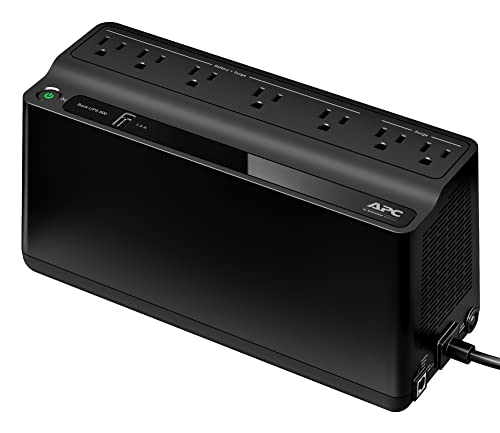
- 330W capacity in a compact design
- Five battery-backed outlets
- USB charging and replaceable battery
Best For: Small desks, routers, and basic computers
Best Eco-Friendly Pick

- 850VA/510W capacity with 12 outlets
- LCD monitoring and ECO peripheral control
- Three-year warranty including the battery
Best For: Computer setups with multiple peripherals and energy-saving priorities
Best Compact Backup

- 425VA/255W capacity for low-power devices
- Six outlets with four battery-backed
- Wall-mountable design and up to 15 minutes at 100W
Best For: Routers, modems, VoIP phones, and compact workspaces
Best Slim Home-Office Option

- 700VA/370W standby UPS in a slim profile
- Eight outlets and two USB charging ports
- Three-year warranty and $100,000 equipment guarantee
Best For: Compact computer, gaming, router, and entertainment setups
High-Capacity Pick – APC BX1500M
For shoppers comparing ups battery backups for computers, the APC BX1500M is a high-capacity tower with 1500VA/900W output, automatic voltage regulation, and 10 protected outlets. Its LCD panel makes it easier to monitor load, battery status, runtime, and input voltage.
Best For: Gaming PCs, home-office workstations, and larger computer setups that need Active PFC compatibility and multiple protected connections.
Pros:
- 1500VA/900W capacity supports higher-power computer setups.
- AVR corrects low voltage and surges without using battery power.
- Ten outlets include five battery-backup and five surge-only connections.
- Replaceable battery, LCD monitoring, and Energy Star certification add long-term practicality.
Cons:
- Replacement battery is sold separately.
- Its tower form factor may require more vertical space than compact units.
The BX1500M is a strong choice when capacity, monitoring, and voltage regulation matter more than a compact footprint. Its replaceable battery can also help extend the useful life of the UPS.
Feature-Rich Home Office Pick – CyberPower CP1500AVRLCD3
The CyberPower CP1500AVRLCD3 combines 1500VA/900W capacity with 12 outlets, AVR, and a multifunction color LCD. For ups battery backups for computers, it adds convenient USB-A and USB-C charging while providing battery protection for workstations and networking equipment.
Best For: Home offices and entertainment setups that need many outlets, easy status monitoring, and convenient device charging.
Pros:
- Twelve outlets include six battery-backup and six surge-only outlets.
- Color LCD provides detailed battery and power information.
- AVR corrects minor power fluctuations without switching to battery.
- USB-A and USB-C ports charge phones and tablets.
Cons:
- Uses simulated sine wave output rather than pure sine wave output.
- The mini-tower weighs 23.8 pounds.
With its generous outlet count and clear color display, this model is especially practical for a busy workstation. The three-year warranty includes the battery, adding reassurance for longer-term ownership.
Compact Essentials Pick – APC BE650G1
The APC BE650G1 is a smaller UPS option for shoppers seeking ups battery backups for computers, routers, modems, and external drives. It provides 390W capacity, eight outlets, and up to 22 minutes of runtime at a 100W load.
Best For: Basic computer setups, Wi-Fi equipment, NAS devices, and other lower-power home-office essentials.
Pros:
- Eight outlets include four battery-backup and four surge-only connections.
- Up to 22 minutes of runtime is specified at a 100W load.
- User-replaceable battery supports easier maintenance.
- Includes a three-year warranty and $75,000 equipment protection.
Cons:
- 390W capacity is less suitable for high-power gaming PCs or workstations.
- It does not list AVR among the supplied features.
This APC is best viewed as an everyday protection solution for modest loads rather than a high-capacity computer UPS. Its outlet layout and replaceable battery make it convenient for keeping essential connected devices running during short interruptions.
Pure Sine Wave Pick – CyberPower CP1500PFCLCD
The CyberPower CP1500PFCLCD is designed for shoppers who need ups battery backups for computers with Active PFC power supplies. Its 1500VA/1000W pure sine wave output, AVR, 12 outlets, and color LCD make it a well-equipped option for computer and network equipment.
Best For: Gaming PCs, workstations, network devices, and other equipment that benefits from pure sine wave battery output.
Pros:
- Pure sine wave output supports Active PFC and conventional power supplies.
- 1500VA/1000W capacity provides more output headroom than 900W models.
- Twelve outlets split evenly between battery backup and surge protection.
- Color LCD, AVR, USB charging, and a tilting screen improve usability.
Cons:
- The unit weighs 24.9 pounds.
- Only six of the 12 outlets provide battery backup.
This model stands out when power-supply compatibility is a priority. Its pure sine wave output and higher 1000W rating make it a particularly suitable match for demanding computer systems, while the display and outlet layout simplify everyday monitoring.
Best Overall – APC 1000VA/600W Pro UPS
If you need ups battery backups for computers that can support a fuller home-office setup, the APC BX1000M offers 1000VA/600W capacity, automatic voltage regulation, and eight protected outlets. Its LCD helps you monitor load, battery status, runtime, and power conditions.
Best For: Home offices, gaming PCs, NAS systems, routers, and other setups that benefit from AVR and higher capacity.
Pros:
- Provides 600W of output and four battery-backed outlets.
- AVR corrects brownouts and surges without using battery power.
- Includes an LCD, replaceable battery, and coaxial and Ethernet surge protection.
- Offers over 42 minutes of runtime at a 100W load.
Cons:
- Only four of the eight outlets provide battery backup.
- Replacement battery is sold separately.
The BX1000M is the most capable option here for a computer-centered workstation with several peripherals. Its tower design and 15.9-pound weight make it less compact than a basic desktop UPS, but the added monitoring and voltage regulation improve its usefulness for demanding setups.
Best for Outlet Capacity – CyberPower ST900U Standby UPS
The CyberPower ST900U is a practical choice among ups battery backups for computers when outlet count and a slim profile matter. It supplies 900VA/500W, has 12 total outlets, and uses a five-foot cord with a space-saving right-angle plug.
Best For: Compact home-office or entertainment setups with multiple devices, including computers, consoles, and broadband routers.
Pros:
- Provides 500W of capacity and six battery-backed outlets.
- Includes 12 outlets, with four spaced for larger plugs.
- Compact design uses an energy-efficient GreenPower UPS system.
- Includes a three-year warranty covering the battery and a $125,000 equipment guarantee.
Cons:
- Uses simulated sine wave output.
- Its listed runtime is 15 minutes, so it is intended for short interruptions.
Choose the ST900U when you want many connection points without a bulky tower. It is well suited to everyday computer and entertainment equipment, while the six battery-backed outlets leave the remaining outlets available for surge-only peripherals.
Best Compact Option – APC BE600M1 UPS
For a smaller desk or networking station, the APC BE600M1 is one of the more straightforward ups battery backups for computers. Its 600VA/330W output, compact footprint, USB charging port, and seven outlets cover a computer, router, and essential accessories.
Best For: Basic computers, Wi-Fi routers, NAS devices, and compact workstations that need short-term backup and safe shutdown time.
Pros:
- Five outlets provide battery backup and surge protection, with two additional surge-only outlets.
- Built-in 1.5A USB port can charge a phone during an outage.
- Provides 23 minutes of runtime at a 100W load.
- Internal battery is replaceable, helping extend the unit’s service life.
Cons:
- 330W capacity is lower than the other two models.
- Replacement battery is sold separately.
The BE600M1 makes sense when space and essential-device coverage matter more than high wattage. It is a compact, desk-friendly solution for keeping a modest computer and network connection running long enough to remain connected or shut down safely.
Best Eco-Friendly Pick – CyberPower EC850LCD
For shoppers comparing ups battery backups for computers, the CyberPower EC850LCD stands out with 850VA/510W capacity, a multifunction LCD, and energy-saving ECO outlets. Its 12-outlet layout suits a computer setup with several peripherals.
Best For: Computer users who want detailed power information, many outlets, and automatic peripheral power management.
Pros:
- Offers six battery-backup and surge-protected outlets plus six surge-only outlets.
- LCD panel displays battery and power conditions.
- ECO mode can shut off connected peripherals when a computer is off or asleep.
- Includes a three-year warranty covering the battery and a $100,000 connected-equipment guarantee.
Cons:
- Listed runtime is only two minutes.
- Its 7.7-pound, 12.2-inch-wide body may take more desk space than a mini UPS.
The EC850LCD is a feature-rich choice for a home-office computer station. The LCD and ECO mode add convenience, while the 12 outlets provide flexibility for monitors, networking gear, and accessories.
Best Compact Backup – APC BE425M
The APC BE425M is a compact option for ups battery backups for computers and small electronics. With 425VA/255W capacity, six outlets, and a wall-mountable design, it is suited to low-power equipment and space-constrained work areas.
Best For: Wi-Fi routers, modems, VoIP phones, and small home-office electronics that need basic outage protection.
Pros:
- Provides four battery-backup/surge-protected outlets and two surge-only outlets.
- Can deliver up to 15 minutes of runtime at a 100W load.
- Compact design can sit under a desk or mount on a wall.
- Includes a three-year limited warranty and $75,000 equipment protection.
Cons:
- Its 255W rating is intended for low-power equipment rather than larger computer systems.
- It has only six total outlets.
The BE425M makes sense when size and simplicity matter more than high capacity. It can keep essential networking or small-office equipment running briefly during an interruption, helping maintain connectivity or allow a safe shutdown.
Best Slim Home-Office Option – CyberPower SL700U
The CyberPower SL700U is a slim standby UPS for computer users who need 700VA/370W of backup capacity without a bulky enclosure. It combines eight outlets, two USB charging ports, and simulated sine wave output for home-office and entertainment equipment.
Best For: Slim computer, gaming, router, and home-entertainment setups that also need convenient USB charging.
Pros:
- Provides five battery-backup/surge-protected outlets and three surge-only outlets.
- Two widely spaced outlets accommodate larger plugs.
- Two USB ports share 2.4 amps for charging mobile devices.
- Includes a three-year warranty, $100,000 connected-equipment guarantee, and UL certification.
Cons:
- Listed runtime is two minutes.
- Simulated sine wave output may be less suitable for equipment requiring pure sine wave power.
- Its 370W maximum is lower than the CyberPower EC850LCD’s 510W rating.
The SL700U is a practical middle ground for a compact computer or entertainment setup. Its slim profile, extra outlets, and USB ports make it versatile, while the 370W limit should be matched carefully against the connected load.
How We Picked These Ups Battery Backups for Computers
We selected models that cover a range of computer setups, budgets, and power requirements. Our comparison considers VA and watt capacity, battery-backed outlet count, surge protection, automatic voltage regulation, waveform type, display and monitoring features, connectivity, size, and practical use cases. Because advertised runtime varies with load, we focus on how each capacity tier fits common computer and accessory setups rather than promising one universal runtime.
Quick Comparison
Compact units such as the APC BE425M and CyberPower SL700U are suited to basic desktops, monitors, routers, and small accessories. Midrange options, including the APC BE650G1, APC BE600M1, CyberPower ST900U, and CyberPower EC850LCD, offer more flexibility for home-office equipment and networking gear. Higher-capacity models such as the APC BX1000M, APC BX1500M, CyberPower CP1500AVRLCD3, and CyberPower CP1500PFCLCD are better choices for demanding desktops, multiple monitors, storage devices, and longer shutdown windows.
Key Buying Factors for Ups Battery Backups for Computers
Capacity and Runtime
Check both the VA and watt ratings. Your equipment’s combined watt draw must remain below the UPS watt limit, with headroom for startup loads and future additions. A larger capacity generally provides more runtime, but actual performance depends on the connected load.
Power Regulation and Waveform
Automatic voltage regulation can correct minor brownouts without switching to battery, helping preserve battery life. A pure sinewave model, such as the CyberPower CP1500PFCLCD, is especially worth considering for high-performance PCs, active power-factor-correction power supplies, and other equipment that may be sensitive to simulated waveforms.
Outlets, Surge Protection, and Connectivity
Count how many devices need battery support, not just surge protection. Look for convenient outlet spacing, USB charging, and data-line protection when connecting routers or network equipment. USB connectivity and monitoring software can help trigger an orderly computer shutdown during a prolonged outage.
Size, Noise, and Replacement Batteries
Confirm that the UPS fits beneath or beside your desk and consider fan noise if it will sit in a quiet workspace. Also check replacement-battery availability, warranty coverage, and whether the battery is user-replaceable, since these factors affect long-term ownership cost.
Who Should Buy Which Ups Battery Backups for Computers?
For Basic Desktops and Small Electronics
Choose a compact standby unit when you need affordable protection for a modest computer, monitor, router, or modem. These models are practical where space and budget matter more than extended runtime.
For Home Offices and Networking Gear
A midrange UPS is a balanced choice for a desktop, monitor, router, NAS, and peripherals. Prioritize enough battery-backed outlets, USB connectivity, and a display if you want clearer status information.
For Gaming PCs and Demanding Workstations
Higher-capacity models provide more watt headroom for powerful computers and multiple displays. If your PC uses an active-PFC power supply or you want the broadest compatibility, prioritize a pure sinewave design and adequate runtime at your normal load.