Choosing the right vacuum manifold for laboratory work can speed up sample prep, improve consistency, and reduce handling errors.
Below, we focus on the most useful options for SPE, Schlenk applications, and liquid filtration so you can match the manifold to your workflow.
Best 10 Vacuum Manifold for Laboratory Picks for 2026
Dual-Bank Schlenk Line Pick

- Dual main pipes with 4 ports and 5 stopcocks
- Borosilicate glass handles thermal and chemical stress
- Fits vacuum tubes with an 8 mm inner diameter
Best For: Schlenk line setups needing a dual-bank glass manifold
Extraction Efficiency Pick
12-Position SPE Vacuum Manifold

- 12-position layout supports faster SPE workflows
- Separate design helps reduce cross-contamination
- Vacuum tank withstands up to -80 kPa
Best For: SPE sample preparation with separate collection and higher throughput
Hand-Blown Glass Bank Pick
Double Row Vacuum Gas Distributor

- High borosilicate glass double manifold
- 25 mm main tubes with 60 mm port spacing
- Includes a 4-port solid glass stopcock
Best For: Schlenk-line users wanting a hand-blown double glass manifold
Fast Filtration Helper

- Pumps gas out of filter bottles for faster filtration
- Includes 3 suction tube sizes for different nozzles
- Anti-vibration rubber bases help reduce noise
Best For: Fast liquid filtration and distillation support
Schlenk Line Pick
Laboy Double-Bank Glass Vacuum/Gas Manifold

- Double-bank vacuum and inert gas layout
- Four solid glass stopcocks, 4 mm bore
- 10 mm hose connections on borosilicate 3.3 glass
Best For: Schlenk line users needing an all-glass manifold with separate vacuum and gas banks
SPE Workflow Upgrade
12-Position SPE Vacuum Manifold with Flow Control
- Processes 12 samples in parallel
- Individual flow valves and isolated channels
- Vacuum tank supports up to -80 kPa
Best For: Sample-prep labs that want batch SPE processing with per-port flow control
Simple Glass Option
Single-Row 4-Port Vacuum Gas Manifold

- Four-port single-row glass manifold
- Glass stopcocks for lab chemistry routing
- Borosilicate glass with 10 mm hose adapter
Best For: Users who need a basic four-port all-glass manifold
High-Throughput SPE Choice
12-Position Vacuum Manifold for Lab
- 12-position SPE design for faster workflows
- Quartz sand vacuum tank rated to -80 kPa
- Flow control valves and guide pin for handling
Best For: Labs needing a multi-position SPE manifold for sample pretreatment
Compact Glass Setup
Single Row Vacuum Gas Distributor Manifold
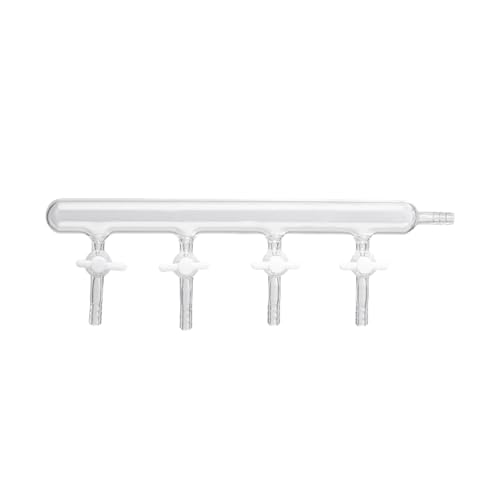
- Borosilicate glass construction
- Four PTFE stopcocks for port control
- Compact and lightweight lab glassware
Best For: Chemistry labs needing a simple 4-port glass distributor
Dual-Row Utility Pick
Double Manifold Vacuum Gas Distributor

- Double-row layout with 4 ports
- Solid PTFE cock for controlled flow
- Hand-blown glass build with listed dimensions
Best For: Labs needing a compact double-row glass distributor
Dual-Bank Schlenk Line Pick – Glass Double Vacuum Manifold
This vacuum manifold for laboratory use is built as a double-bank glass distributor with 4 ports and 5 glass stopcocks, making it a practical fit for Schlenk line setups that need controlled access to vacuum or gas lines. The borosilicate construction and spaced main pipes are geared toward everyday lab handling and repeat use.
Best For: Schlenk line work and labs needing a dual-bank glass vacuum gas manifold with multiple ports.
Pros:
- Double main pipes with 40 mm spacing for easier operation and access
- 4 small nozzles plus 5 spring-held polyglass plug valve ports
- Borosilicate glass build is reusable and rated to withstand thermal and chemical stress
- Compatible with vacuum tubes that have an 8 mm inner diameter
Cons:
- Glass construction requires careful handling in the lab
- Best suited to setups that match the stated tubing and port dimensions
Overall, this is a purpose-built manifold for users who want a traditional glass Schlenk-line component with multiple controlled connections. Its value comes from the port layout, compatibility, and borosilicate durability rather than extra features.
Extraction Efficiency Pick – 12-Position SPE Vacuum Manifold
This vacuum manifold for laboratory sample prep is designed for solid phase extraction with 12 positions, separate collection, and a vacuum tank rated for up to -80 kPa. If you need a compact manifold that focuses on throughput and sample handling, this kit is built around that workflow.
Best For: Solid phase extraction workflows that benefit from 12 positions and separate sample handling.
Pros:
- 12 test tube holes support higher extraction progress and efficiency
- Separate design helps avoid cross-contamination and simplifies collection of analytes
- Quartz sand vacuum tank is rated for high negative pressure up to -80 kPa
- Compact footprint helps it fit easily in the lab
Cons:
- Purpose-built for SPE rather than general vacuum gas distribution
- Heavier than some compact lab tools at 8.7 lbs
For labs focused on extraction work, this manifold emphasizes capacity, separation, and safe vacuum handling. It is a specialized choice, but those traits make it well matched to routine SPE sample preparation.
Hand-Blown Glass Bank Pick – Double Row Vacuum Gas Distributor
This vacuum manifold for laboratory Schlenk-line use is a high borosilicate glass double manifold with 25 mm main tubes and 4 solid glass stopcock ports. Its hand-blown construction and wider port spacing make it a straightforward option for labs looking for a simple double-row gas distributor.
Best For: Glass Schlenk-line setups that want a hand-blown double manifold with solid glass stopcocks.
Pros:
- Double manifold design supports two rows of connections
- 25 mm outer diameter main tubes provide a substantial glass body
- 60 mm port spacing helps keep connections accessible
- Hand-blown build with 4-port solid glass stopcock
Cons:
- Only the listed items are included, so accessories may need to be sourced separately
- Glass component requires careful bench handling
This is a focused, traditional manifold for users who want a manually made glass distributor rather than a multi-feature system. The straightforward port layout and borosilicate build are its main strengths.
Fast Filtration Helper – Lab Vacuum Filtration Pump
Unlike a manifold-style vacuum setup, this laboratory vacuum product is a pump for filtration and distillation work, designed to speed liquid filtering by removing gas from the filter bottle. If your priority is fast, simple filtration rather than a glass vacuum manifold for laboratory gas distribution, this is the more targeted tool.
Best For: Quick lab liquid filtration and distillation support using a vacuum filter pump.
Pros:
- Designed to pump gas out of the filter bottle for faster filtration
- Simple setup with transparent and silicone tube connections
- Includes 3 suction tube diameters for different filter bottle nozzles
- Plastic housing with anti-vibration rubber bases for quieter operation
Cons:
- Not a vacuum manifold for gas distribution or Schlenk-line use
- Plastic housing is less specialized than borosilicate glass manifold designs
This pump is a practical choice when your lab workflow centers on filtration speed and compatibility with common filter bottles. It is best viewed as a companion vacuum tool, not a replacement for a manifold.
Schlenk Line Pick – Laboy Double-Bank Glass Vacuum/Gas Manifold
If you’re comparing a vacuum manifold for laboratory Schlenk setups, this Laboy glass distributor is built for vacuum and inert gas handling in air- and moisture-sensitive chemistry. It uses a double-bank layout with four solid glass stopcocks, so you can route vacuum and gas flow across a compatible line while keeping the setup all-glass.
Best For: Trained lab users building or replacing a Schlenk line manifold with vacuum and inert gas control.
Pros:
- Double-bank design for vacuum on one side and inert gas on the other
- Four solid glass stopcocks with 4 mm bores for flow selection
- 10 mm serrated hose connections for compatible tubing
- Borosilicate 3.3 glass construction for routine laboratory use
Cons:
- Designed for compatible Schlenk line assemblies, not general-purpose bench use
- Needs tubing fit confirmed before installation
- Size and port spacing should be checked against your setup
Overall, this is a specialized glass vacuum/gas manifold that fits well in air- and moisture-sensitive workflows where precision and chemical compatibility matter. The clear dimension specs make it easier to plan a proper setup before buying.
SPE Workflow Upgrade – 12-Position SPE Vacuum Manifold with Flow Control
For buyers looking for a vacuum manifold for laboratory sample prep, this 12-position SPE apparatus is aimed at parallel extraction workflows. It combines individual flow control valves, isolated channels, and a vacuum chamber designed to support batch processing in environmental, pharmaceutical, and biochemical testing.
Best For: Labs that need to process up to 12 samples at once with individual control and strong vacuum support.
Pros:
- 12-port design supports high-throughput parallel sample preparation
- Individual valves and isolated channels help keep samples separate
- Vacuum tank is rated for up to -80 kPa negative pressure
- Chemical-resistant PP construction for lab solvent exposure
Cons:
- Built specifically for SPE workflows, not general vacuum/gas distribution
- Compatible with 12 tubes, so capacity is fixed
- Bulkier than a simple single-purpose manifold
This is a practical choice when sample prep speed matters more than versatility. The isolated flow paths and pressure gauge support more controlled extraction runs, while the durable polymer build suits routine lab handling.
Simple Glass Option – Single-Row 4-Port Vacuum Gas Manifold
This vacuum manifold for laboratory glass setups is a simple single-row gas distributor with four ports and glass stopcocks. If you want an all-glass option for basic vacuum or gas routing, it offers a straightforward borosilicate build with standard 10 mm hose connections.
Best For: Labs that want a compact four-port glass manifold for basic chemistry routing.
Pros:
- Single-row layout with four ports for straightforward routing
- Glass stopcock design for lab chemistry use
- Borosilicate glass construction
- 10 mm hose connection adapter noted in the product details
Cons:
- Supplied notes are limited, so setup details are less complete
- No dimension or bore information provided in the notes
- Appears best suited to basic manifold use rather than advanced configurations
As a simple glass manifold, this model makes sense when you need a compact four-port distributor without extra complexity. The tradeoff is that the available product notes are sparse, so buyers should verify fit and compatibility before ordering.
High-Throughput SPE Choice – 12-Position Vacuum Manifold for Lab
If you need a vacuum manifold for laboratory sample cleanup and solid phase extraction, this 12-position device is built for higher-throughput workflows. Its separate collection design, flow control valves, and vacuum top are aimed at making sample pretreatment more controlled while helping direct liquid neatly into test tubes.
Best For: Labs that want a 12-position SPE manifold for environmental, agricultural, biological, or pharmaceutical sample pretreatment.
Pros:
- 12 test tube holes can increase extraction progress and improve experiment efficiency.
- Quartz sand vacuum tank is rated for high negative pressure up to -80 kPa.
- Flow control valves and a vacuum top add control during collection.
- Separate design and guide pin help with analyte collection and sample handling.
Cons:
- Designed specifically for SPE-style sample pretreatment rather than general-purpose vacuum use.
- Bulkier multi-position format may be more than needed for small jobs.
Overall, this is a practical choice when you want a durable SPE setup with more sample positions and a design focused on efficient, controlled extraction. The material mix and negative-pressure rating add confidence for routine lab use.
Compact Glass Setup – Single Row Vacuum Gas Distributor Manifold
This vacuum manifold for laboratory gas distribution is a compact single-row glass manifold with four PTFE stopcocks. If you want a straightforward glass setup for controlled port distribution, this borosilicate model keeps the design simple and lightweight.
Best For: Chemistry labs looking for a 4-port single-row glass vacuum gas distributor with PTFE stopcocks.
Pros:
- Made from borosilicate glass for a lab glassware build.
- Four PTFE stopcocks provide port control.
- Hose connection adapter is included in the design.
- Compact package size and 7.1 oz weight suggest an easy-to-handle unit.
Cons:
- Only four ports, so it may be limited for higher-throughput setups.
- Single-row format may not suit users who need a larger manifold layout.
In practice, this is a simple, compact option for labs that need a basic vacuum gas distributor rather than a large multi-place manifold. The PTFE stopcocks and borosilicate construction make it a practical glassware choice for controlled connections.
Dual-Row Utility Pick – Double Manifold Vacuum Gas Distributor
If you need a vacuum manifold for laboratory gas distribution with more spacing and a dual-row layout, this hand-blown glass manifold is worth a look. It uses a solid PTFE cock and has 4 ports, making it a practical option for controlled lab connections where the dimensions matter.
Best For: Labs that want a hand-blown double-row vacuum gas distributor with a 4-port PTFE stopcock.
Pros:
- Double-row manifold format may suit setups that need a different port layout.
- 4-port solid PTFE stopcock supports controlled distribution.
- Hand-blown construction gives it a traditional glassware build.
- Listed tube dimensions and 70 mm port spacing provide clear sizing information.
Cons:
- Only four ports, so capacity is still limited.
- Glass manifold design may be better for specific chemistry workflows than general lab use.
This model is mainly about layout and control: the double-row design, PTFE cock, and stated dimensions help users match it to an existing setup. It is a good fit when you need a compact but clearly specified distributor rather than a high-capacity manifold.
How We Picked the Best Vacuum Manifold for Laboratory
We prioritized compatibility, port count, stopcock quality, vacuum sealing, and the intended lab application. For a Vacuum Manifold for Laboratory use, the right design matters as much as the number of positions: SPE workflows need stable flow control, while Schlenk and gas-distribution setups benefit from durable glass construction and reliable hose connections.
Quick Comparison
At a high level, the 10 options split into three groups: SPE manifolds for sample preparation, double-row or single-row gas distribution manifolds for inert-atmosphere and vacuum work, and filtration-focused systems for faster liquid handling. That makes it easier to narrow choices by task instead of shopping by port count alone.
Key Buying Factors for Vacuum Manifold for Laboratory
Application Type
Start with your primary use. SPE manifolds are best for sample prep and cleanup, gas distributors fit Schlenk lines and chemistry setups, and filtration units serve routine liquid processing. Buying the wrong category is the most common mistake.
Ports, Position Count, and Throughput
More ports are useful only if you actually run multiple samples or connections at once. A 12-position SPE model boosts throughput, while 4-port manifolds are often enough for smaller setups or specialized line work.
Stopcock Material and Control
Glass stopcocks offer traditional lab compatibility, while PTFE stopcocks can provide smoother operation and lower maintenance in some environments. For a Vacuum Manifold for Laboratory use, sealing consistency and chemical resistance should take priority over appearance.
Construction and Connections
Borosilicate glass is common for chemical resistance and visibility. Check hose connection size, bore diameter, and whether the manifold integrates cleanly with your vacuum source, gas supply, or collection vessels.
Who Should Buy Which Vacuum Manifold for Laboratory?
Choose an SPE manifold if your work centers on analytical sample preparation, extraction, or pretreatment. Choose a double vacuum/gas distributor if you need a versatile manifold for Schlenk-line style work or multi-line gas handling. Choose a filtration pump kit if speed and convenience in liquid filtration matter more than multi-port control. If your lab handles mixed workflows, prioritize a model with robust construction, clear port labeling, and the simplest path to reliable vacuum performance.