Resin printing can produce exceptionally detailed miniatures, models, prototypes, and display pieces, but the right first printer makes the learning curve much easier.
These 10 resin printers for beginners cover compact entry-level machines, larger high-resolution models, and convenient features such as auto-leveling, Wi-Fi, and assisted setup.
Best 10 Resin Printers for Beginners Picks for 2026
Best Beginner Detail Pick

- 7-inch 10K mono LCD with 17 μm XY pixels
- Beginner-friendly four-point leveling
- Compact design with a 153.4 × 87 × 165 mm build volume
Best For: Beginners prioritizing detailed prints and simple setup
Best Large-Format Choice

- 10-inch 12K mono LCD for intricate details
- Large 218.88 × 122.88 × 250 mm build volume
- Supports third-party slicers through open-source GOO format
Best For: Users wanting larger models and room to expand
Best Plug-and-Play Option

- Factory pre-leveled platform simplifies first setup
- 9K LCD with 18 μm XY resolution
- USB, WiFi, and Creality Cloud file transfer
Best For: First-time users and miniature-focused desktop makers
Best Smart-Speed Pick
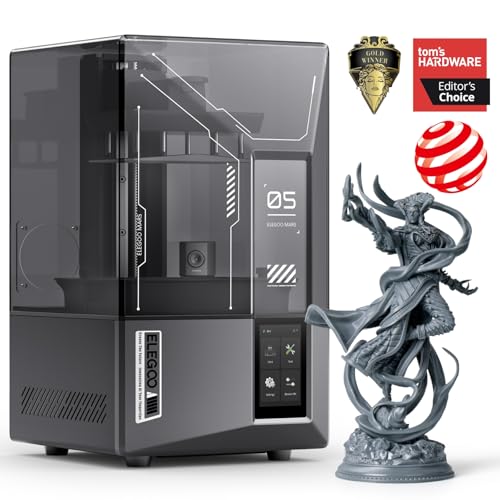
- 9K mono LCD with 18 μm XY resolution
- Print speeds up to 150 mm/h with tilt release
- AI camera and sensors help monitor print issues
Best For: Beginners seeking faster prints and extra monitoring features
Most Versatile

- Dual-color and dual-material printing
- Factory-calibrated automatic leveling
- AI checks and high-viscosity resin support
Best For: Beginners seeking creative flexibility and automated monitoring
Best Simple Setup
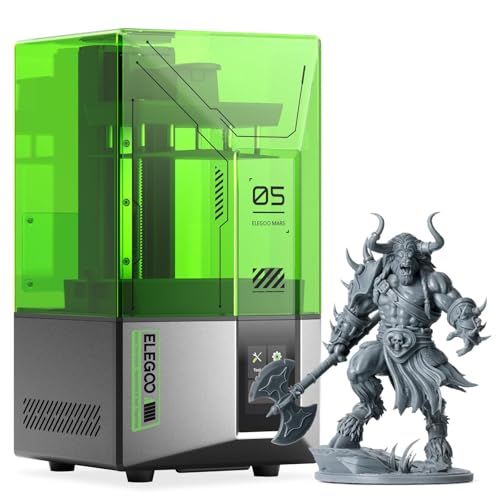
- One-click automatic leveling
- Pre-print self-check and residue detection
- 4K mono LCD for detailed models
Best For: New users who want an uncomplicated, safety-conscious setup
Best High-Detail Choice

- 16K resolution for fine surface detail
- Factory pre-leveling and smart resin handling
- Remote monitoring and built-in resin heating
Best For: Detail-focused beginners with room for a larger printer
Best Detail-Focused Pick

- 7-inch 9K LCD with 18 μm XY resolution
- Four-point leveling and adhesion-focused build plate
- Wi-Fi supports 2.4G and 5G networks
Best For: Beginners who want detailed prints and wireless file transfers
Best Large-Format Upgrade

- 16K LCD with 14 x 19 μm XY resolution
- Large 8.33 x 4.66 x 8.66-inch print volume
- Automatic heating, leveling, sensors, and AI camera
Best For: Beginners planning larger, detailed projects
Best Beginner-Friendly Setup

- One-click automatic leveling simplifies setup
- Self-check and sensors help identify problems
- 6.6-inch 4K monochrome LCD for everyday prints
Best For: First-time users who want guided setup and built-in safeguards
Best Beginner Detail Pick – ANYCUBIC Photon Mono 4
For beginners seeking resin printers for beginners, the ANYCUBIC Photon Mono 4 combines a straightforward leveling process with highly detailed 10K resolution. Its compact footprint and moderate build volume make it a practical choice for everyday models and detailed projects.
Best For: Beginners who want fine detail, simple leveling, and a reasonably sized desktop printer.
Pros:
- 7-inch 10K mono LCD delivers 17 × 17 μm XY pixel size for detailed models.
- Four-point leveling is designed to avoid repeated leveling after initial setup.
- Laser-engraved platform improves adhesion while keeping model removal manageable.
- Power-resume functionality can reduce wasted resin and printing time after an outage.
Cons:
- Anycubic app service is not supported.
- Its build volume is smaller than the ELEGOO Saturn 3.
The Photon Mono 4 is a balanced entry point for detail-focused users. It offers strong resolution and beginner-oriented setup features without taking up excessive space.
Best Large-Format Choice – ELEGOO Saturn 3 12K
Among resin printers for beginners, the ELEGOO Saturn 3 stands out for users who want a larger workspace from the start. Its 10-inch 12K screen supports detailed models, while the generous build volume accommodates larger or multiple prints.
Best For: Beginners and developing makers who need substantial build capacity and high-resolution output.
Pros:
- 10-inch 12K mono LCD provides 11520 × 5120 resolution and detailed results.
- Large 218.88 × 122.88 × 250 mm build volume supports ambitious projects.
- Tempered glass helps protect the LCD from scratches and resin damage.
- Laser-carved build plate is designed for strong print adhesion.
Cons:
- At 33 pounds, it is considerably heavier than the other listed options.
- The larger printer requires more workspace than compact beginner models.
The Saturn 3 is a strong choice when print size matters as much as detail. Its flexible slicing support and multiple printing modes also leave room to grow beyond basic projects.
Best Plug-and-Play Option – Creality HALOT-X1 Neo
The Creality HALOT-X1 Neo is one of the most approachable resin printers for beginners because its build platform arrives factory pre-leveled. With 9K resolution, guided tutorials, and several file-transfer options, it is designed to reduce friction for first-time users.
Best For: New users, miniature makers, tabletop gamers, and DIY enthusiasts seeking a ready-to-start workflow.
Pros:
- Factory pre-leveled platform supports a plug-and-play setup.
- 6.8-inch 9K LCD provides 18 μm XY resolution for miniatures and intricate models.
- Files can be transferred by USB, 2.4GHz WiFi, or Creality Cloud.
- AI-powered 2D-to-3D generation can turn images into models.
Cons:
- The 153.36 × 77.76 × 160 mm build volume is more compact than the Saturn 3.
- AI model generation may take as long as 3.5 hours for a creation.
With pre-leveling and accessible connectivity, the HALOT-X1 Neo is particularly appealing if setup simplicity is your top priority. Its compact size also suits desktop workspaces.
Best Smart-Speed Pick – ELEGOO Mars 5 Ultra
For beginners comparing resin printers for beginners, the ELEGOO Mars 5 Ultra adds speed and monitoring features that can make the printing process easier to manage. Its 9K display supports detailed output, while tilt release technology is rated for speeds up to 150 mm/h.
Best For: Beginners who value fast printing, automated checks, and convenient wireless control.
Pros:
- 7-inch 9K mono LCD offers 18 μm XY resolution for finely detailed models.
- Tilt release technology enables printing speeds of up to 150 mm/h.
- AI camera monitors prints and can alert users to issues such as warping.
- Smart sensors provide residue detection plus resin-shortage and leveling-failure alerts.
Cons:
- AI detection results can vary with the environment, model, and resin type.
- Its listed dimensions are larger than those of several compact models.
The Mars 5 Ultra is a feature-rich option for users who want speed without giving up detail. Its monitoring and alert systems may help newcomers identify problems sooner, though automated detection is not infallible.
Most Versatile – Anycubic Photon P1
For beginners looking beyond basic single-resin projects, the Anycubic Photon P1 stands out among resin printers for beginners with dual-color and dual-material printing, automatic leveling, and built-in print checks. Its factory-calibrated setup is designed to reduce manual adjustment before your first print.
Best For: Beginners who want dual-material creativity and advanced monitoring features.
Pros:
- Supports simultaneous two-color or two-material printing.
- Factory-calibrated automatic leveling reduces setup work.
- AI monitoring checks plate installation, resin levels, residue, and layer separation.
- Handles high-viscosity resins up to 8,000 cps.
Cons:
- Its 39-pound weight makes it less convenient to move.
- The advanced feature set may be more than a first-time user needs.
The Photon P1 is a strong choice if you want beginner-friendly automation without limiting your material and color options. Its sturdy motion system and easier model release are also geared toward consistent results over extended use.
Best Simple Setup – ELEGOO Mars 5
The ELEGOO Mars 5 is a straightforward option for resin printers for beginners, with one-click automatic leveling and a pre-print self-check. It also adds residue detection, resin-shortage alerts, and a 4K mono LCD for detailed output.
Best For: New users who prioritize easy setup, dependable checks, and detailed prints.
Pros:
- One-click automatic leveling helps minimize calibration work.
- Self-checking verifies components before each print.
- Residue detection and resin-shortage alerts can reduce interruptions and waste.
- 4K mono LCD and COB lighting reproduce intricate details.
Cons:
- It does not offer the dual-material or remote-monitoring features listed for some alternatives.
- Overheat protection pauses printing if LED temperature exceeds 80°C.
With its compact 14.52-pound build and simple controls, the Mars 5 is an accessible starting point for beginners who want to focus on learning resin printing rather than repeated leveling and troubleshooting.
Best High-Detail Choice – UniFormation GK3T
The UniFormation GK3T combines very high resolution with several convenience features that can appeal to beginners shopping for resin printers for beginners. Factory pre-leveling, smart resin feeding, a quick-release plate, and remote monitoring are intended to make the workflow easier from setup through post-processing.
Best For: Beginners who want maximum detail, guided workflow features, and remote print monitoring.
Pros:
- 16K resolution and 14×19μm pixels target highly detailed, smooth prints.
- Factory pre-leveling supports plug-and-play setup.
- Built-in heating maintains resin fluidity in temperatures as low as 0°C/32°F.
- App and slicer support enable remote control, progress updates, and timelapse capture.
Cons:
- At 52.8 pounds, it is the heaviest option in this roundup.
- The 20.47-inch height may require more dedicated workspace.
- The high-resolution feature set may be excessive for simple starter projects.
The GK3T makes the most sense for beginners who already value fine miniatures, figurines, or prototypes and want fewer manual workflow steps. Its compatible wash-and-cure ecosystem can also help organize the transition from printing to finishing.
Best Detail-Focused Pick – ELEGOO Mars 4 Ultra
For beginners seeking resin printers for beginners with room to grow, the ELEGOO Mars 4 Ultra combines a high-resolution display, straightforward leveling, and wireless file transfers. Its 7-inch 9K mono LCD is designed for crisp details, while the protected screen and adhesion-focused build plate support regular use.
Best For: Beginners who prioritize fine detail and convenient Wi-Fi file transfers.
Pros:
- 7-inch 9K mono LCD delivers 18 μm XY resolution for detailed models.
- Four-point leveling is designed to avoid repeated leveling after setup.
- Built-in Wi-Fi supports both 2.4G and 5G networks.
- Laser-carved build plate and low-tension ACF film are intended to improve print success.
Cons:
- Its 17 x 22 x 22-inch footprint requires dedicated workspace.
- At 18 pounds, it is less convenient to move than a smaller printer.
- Its feature set may be more than beginners need for basic projects.
The Mars 4 Ultra is a strong middle ground for new users who want an approachable setup without giving up high-resolution output or wireless convenience.
Best Large-Format Upgrade – ELEGOO Saturn 4 Ultra 16K
The ELEGOO Saturn 4 Ultra 16K is one of the more advanced resin printers for beginners who want a larger build area and automated assistance from the start. It adds automatic leveling, resin-tank heating, monitoring sensors, and an AI camera to a high-resolution 16K printing system.
Best For: Beginners who want large, detailed models and extensive automated monitoring.
Pros:
- 16K LCD provides 14 x 19 μm XY resolution for intricate models.
- 8.33 x 4.66 x 8.66-inch print volume accommodates larger projects.
- Automatic resin heating can help maintain suitable printing temperatures.
- AI camera, mechanical sensors, Wi-Fi transfer, and automatic leveling add convenience.
Cons:
- Its 35.4-pound weight and 12.8 x 12.9 x 21.5-inch dimensions demand substantial space.
- The advanced feature set may be unnecessary for simple beginner projects.
- High-resolution, large-format printing can require more resin and workspace.
Choose the Saturn 4 Ultra if you would rather start with a feature-rich platform than outgrow a compact printer quickly. Its automation is particularly useful for users who value monitoring and setup assistance.
Best Beginner-Friendly Setup – ELEGOO Mars 5
For shoppers comparing resin printers for beginners, the ELEGOO Mars 5 emphasizes guided setup and built-in safeguards. Automatic leveling, one-click self-checks, mechanical sensing, and overheat protection make it a practical choice for users who want help identifying common setup or operating problems.
Best For: First-time resin users who value automatic setup and printer-status checks.
Pros:
- One-click automatic leveling reduces manual setup work.
- One-click self-check helps verify printer operation before printing.
- Mechanical sensors can detect foreign objects, resin issues, and leveling failures.
- 6.6-inch 4K monochrome LCD supports everyday printing at 35 μm resolution.
Cons:
- The 4K screen is lower resolution than the Mars 4 Ultra and Saturn 4 Ultra models listed here.
- Its compact print system is aimed at daily projects rather than large-format output.
- The 9.06 x 9.06 x 17.07-inch body still needs dedicated vertical clearance.
The Mars 5 is the clearest choice for beginners who want fewer manual checks during setup. Its emphasis on automatic leveling, diagnostics, and protection helps make the initial learning curve more manageable.
How We Picked the Best Resin Printers for Beginners
We focused on the features that matter most to first-time resin users: setup simplicity, print consistency, screen resolution, build volume, platform leveling, software compatibility, and the availability of replacement parts and consumables. We also considered whether each printer suits a specific use case, such as miniatures, larger models, batch printing, or low-maintenance operation.
Resolution is only one part of the decision. A beginner-friendly printer should also offer predictable exposure controls, a practical build platform, clear operating steps, and a workflow that does not require constant troubleshooting.
Quick Comparison
| Priority | What to look for | Best suited to |
|---|---|---|
| Lowest learning curve | Auto-leveling, pre-leveled platform, and guided setup | First-time users |
| Fine detail | 9K, 12K, or 16K monochrome LCD resolution | Miniatures and intricate models |
| Larger projects | Generous build volume and stable Z-axis movement | Figures, props, and prototypes |
| Convenience | Wi-Fi, touchscreen controls, or assisted model preparation | Users who want a simpler workflow |
| Lower running cost | Affordable resin compatibility and readily available components | Frequent hobby printing |
Key Buying Factors for Resin Printers for Beginners
Resolution and Detail
Higher LCD resolution can improve fine surface detail, but it does not guarantee better prints by itself. Exposure settings, resin quality, model orientation, supports, and mechanical stability all influence the final result. A 9K or 12K printer is already highly detailed for most beginner projects, while 16K models are attractive for demanding miniature work.
Build Volume
Compact printers are easier to place and generally use less resin per failed test, but their smaller platforms limit the size and number of parts printed at once. Choose a larger format if you plan to print helmets, large figures, multiple miniatures, or functional prototypes.
Leveling and Setup
Auto-leveling or a pre-leveled platform can reduce one of the most common early frustrations. Even with these features, read the setup instructions carefully and verify that the build plate is secure before starting a print.
Resin Handling and Safety
Liquid resin requires gloves, eye protection, ventilation, and careful cleanup. You will also need washing and curing equipment, suitable containers, paper towels, and a safe way to dispose of contaminated materials. Budget for the complete workflow rather than the printer alone.
Software and Connectivity
Check which slicers and file formats the printer supports. Wi-Fi can simplify file transfers, while USB remains dependable and broadly compatible. A clear touchscreen and accessible exposure controls are especially useful while learning.
Who Should Buy Which Resin Printers for Beginners?
Choose a compact Mars or Photon model if you want an approachable first printer for miniatures, jewelry-scale designs, and small household projects. These machines are easier to fit into a workspace and can keep initial material use manageable.
Choose a Saturn, HALOT-X1 Neo, or GK3T-class printer if you need more build space, plan to print several objects at once, or want room to grow. Higher-resolution models are best for users who prioritize intricate detail and are willing to spend more time learning support placement and resin calibration.
For the simplest start, prioritize leveling assistance, stable mechanics, accessible replacement parts, and clear documentation over headline resolution alone. The best resin printer for your needs is the one that matches your project size, available ventilation, and willingness to manage washing and curing safely.