The best camera external recorders for studio filming can make interviews, livestreams, music sessions, and tutorial videos easier to capture and monitor. The right choice depends on more than resolution: audio inputs, frame rates, lens flexibility, power, storage, and workflow compatibility all matter.
We selected 10 options spanning dedicated recorders, compact vlogging cameras, camcorders, and body-style cameras. Use the guide below to match your studio setup, recording style, and budget with the most useful features.
Best 10 Camera External Recorders for Studio Filming Picks for 2026
Best Compact Video-Audio Combo

- 4K video with a 150° wide-angle lens
- Built-in X/Y mics rated to 120dB SPL
- USB streaming and tripod-ready design
Best For: Musicians, streamers, and performance-focused creators
Best Dedicated Audio Recorder

- 32-bit float recording up to 96kHz
- Two locking XLR/TRS inputs
- Waveform display and SDXC support up to 1TB
Best For: Filming setups that prioritize separate, high-quality audio
Best Beginner All-in-One Camcorder

- 4K/30fps video and 48MP stills
- Wireless lavalier and external microphone included
- Flip touchscreen, webcam mode, and two batteries
Best For: Beginners and casual creators building a simple filming setup
Best Budget Camcorder
kimire Full HD Recording Camcorder
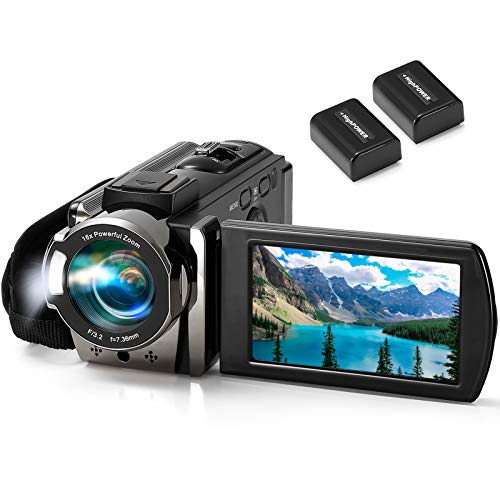
- PC CAM webcam mode for computer use
- Records while charging with two batteries
- Pause function and 270° rotating LCD
Best For: Basic studio presentations and beginner recording setups
Feature-Packed Starter Pick

- Up to 5K front-camera video and 56MP photos
- Dual-lens capture for two perspectives
- Includes mic, tripod, bag, card, and two batteries
Best For: Beginner creators and event-focused YouTube setups
Budget Webcam Choice
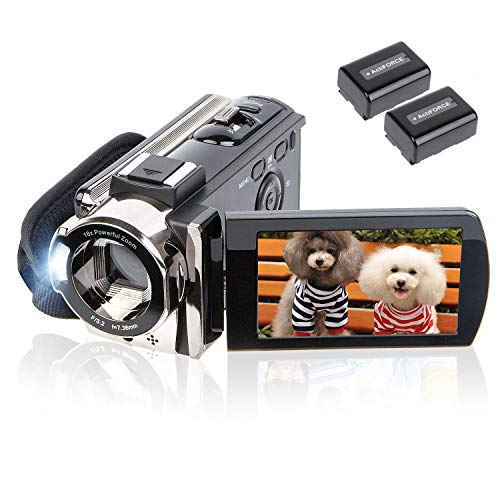
- 1080P recording at 15fps with 24MP photos
- USB webcam mode for computer use
- Records while charging for extended sessions
Best For: Basic webcam recording and budget studio setups
Best Compact Video-Audio Combo – Zoom Q2n-4K
For creators comparing camera external recorders for studio filming, the Zoom Q2n-4K is a compact option that combines 4K video with built-in X/Y microphones. Its 150-degree lens, HDR presets, and USB streaming support make it particularly practical for music, rehearsals, performances, and simple creator setups.
Best For: Musicians, streamers, and filmmakers who want an all-in-one camera with capable built-in audio.
Pros:
- Records 4K video with five field-of-view settings.
- X/Y microphones handle sound levels up to 120dB SPL.
- HDR and 12 scene presets help with varied lighting.
- Supports direct USB streaming and has a built-in tripod mount.
Cons:
- No image stabilization.
- Uses two AA batteries.
- Fixed-focus design may offer less flexibility than interchangeable-lens cameras.
The Q2n-4K is a strong fit when fast setup and synchronized video-and-audio recording matter more than advanced camera controls. It is especially appealing for performance-focused studio or live-content workflows.
Best Wearable Studio B-Camera – BOBLOV W5 Body Camera
Among camera external recorders for studio filming, the BOBLOV W5 stands out as a small, wearable camera for behind-the-scenes footage, mobile angles, and quick vlogging. It records up to 5K at 15fps or 4K at 60fps, while its external microphone support adds flexibility for spoken content.
Best For: Vloggers and creators who need a discreet, wearable camera for active or secondary angles.
Pros:
- Offers detailed 5K recording and smoother 4K/60fps capture.
- 270-degree rotating lens supports selfie and first-person views.
- External microphone support can improve voice recording.
- Includes 128GB storage and multiple clip or strap mounting options.
Cons:
- 5K recording is limited to 15fps.
- Small 1.3-inch screen may be less convenient for framing.
- Not water resistant.
The W5 is better suited to portable angles and informal production than a conventional primary studio camera. Its included storage, digital stabilization, and flexible mounting make it useful when mobility is the priority.
Best Dedicated Audio Recorder – Zoom H1 XLR
For camera external recorders for studio filming where clean production sound is the priority, the Zoom H1 XLR is a dedicated audio companion rather than a video camera. Its two XLR/TRS inputs, 32-bit/96kHz recording, and waveform display make it suitable for feeding microphones, instruments, and other sources into a filming workflow.
Best For: Filmmakers, podcasters, and musicians who need flexible external audio capture alongside a camera.
Pros:
- Records in 32-bit float and up to 96kHz.
- Two locking XLR/TRS combo inputs support microphones and instruments.
- Waveform display helps monitor levels during recording.
- Includes 3.5mm stereo input, headphone output, and SDXC support up to 1TB.
Cons:
- Records audio only, so a separate camera is required.
- Small 0.96-inch screen may limit on-device visibility.
- Requires two AA batteries.
The H1 XLR is the most purpose-built choice here for improving sound quality in a studio filming setup. Choose it when reliable external microphone connections and monitoring are more important than an integrated video solution.
Best Beginner All-in-One Camcorder – Rawiemy 4K Vlogging Camera
For beginners exploring camera external recorders for studio filming, this Rawiemy camcorder offers an accessible package with 4K/30fps video, a flip touchscreen, external microphone support, and a wireless lavalier microphone. It also works as a webcam and includes a 32GB SD card plus two batteries.
Best For: Beginners, students, and casual YouTube creators who want a ready-to-use camcorder package.
Pros:
- Captures 4K/30fps video and 48MP still images.
- Includes both an external microphone and wireless lavalier microphone.
- 270-degree flip touchscreen supports varied framing positions.
- Can function as a webcam and record while charging.
Cons:
- The supplied notes state it is not intended for professional use.
- Battery runtime is listed at approximately 90–150 minutes per charge.
- USB output is specified as USB 2.0.
This camcorder makes sense for straightforward home studios, interviews, classes, and live calls where convenience matters. Its included accessories reduce the need for additional purchases, though more demanding productions may need a higher-end camera system.
Best Tracking Vlogging Camera – Motorized 5K Rotating-Lens Camera
For camera external recorders for studio filming, this compact 5K model is worth considering when hands-free framing and flexible monitoring matter. Its motorized 270° lens, face tracking, rotatable touchscreen, USB-C connectivity, and included external lavalier microphone support solo presentations, tutorials, and other controlled recording setups.
Best For: Solo studio hosts, tutorials, walk-and-talk videos, and creators who need automatic subject framing.
Pros:
- Motorized 270° lens can switch between selfie, forward-facing, and side-angle views, with face tracking to help keep subjects centered.
- Supports 5K/20fps, 4K/60fps, and 1080p/60fps recording, plus a 90° rotatable touchscreen.
- USB-C supports file transfer, recording while charging, and webcam use on a PC.
- Includes an external USB-C lavalier microphone, wireless remote, and 64GB memory card.
Cons:
- Electronic image stabilization uses digital correction rather than optical stabilization.
- 5K recording is limited to 20fps.
- It is not water resistant.
This is one of the more feature-rich options for creators who want automated framing without adding a separate tracking system. For studio work, the external microphone, remote control, and webcam mode are particularly useful, while the 4K/60fps option suits smoother motion.
Best Budget Camcorder – kimire Full HD Recording Camcorder
Among camera external recorders for studio filming, the kimire camcorder is a basic, budget-oriented choice for straightforward Full HD capture. It offers webcam functionality, recording while charging, a rotatable LCD, pause recording, and two batteries for longer sessions, though its 1080p mode records at 15fps.
Best For: Simple studio recording, video calls, beginner YouTube setups, and long takes where affordability matters.
Pros:
- Can operate as a webcam when connected to a computer in PC CAM mode.
- Supports recording while charging and includes two NP-FV5 batteries.
- Pause function lets you continue a recording without starting a new file.
- Includes a 3-inch 270° rotating LCD, fill light, tripod socket, USB cable, and AV cable.
Cons:
- Full HD video is limited to 15fps, which is less suitable for smooth motion.
- Manual focus may require more hands-on setup than autofocus models.
- The SD/SDHC card is not included, and webcam use requires AMCAP software.
This camcorder makes sense for static presentations and basic recording rather than demanding studio production. Its charging capability, pause function, and dual-battery setup are practical for extended sessions, but the low 1080p frame rate and manual focus limit its flexibility.
Best Portable 5K Camera – Handheld WiFi Camera with Touchscreen
For camera external recorders for studio filming, this handheld 5K camera combines high-resolution capture with convenient remote control and app connectivity. Its EIS, rotatable wide-angle lens, face recognition, external lavalier microphone, and 128GB capacity make it suitable for creators who move between studio, travel, and action-oriented recording.
Best For: Mobile creators, studio presenters who want remote operation, and hybrid vlog or action recording.
Pros:
- Supports 5K, 4K/60fps, and 1080p/60fps recording, along with slow motion, time-lapse, burst, and timed shooting.
- 270° rotatable 150° wide-angle lens includes face recognition and automatic face following.
- Built-in EIS and gyroscope correction help improve stability during movement.
- Includes an external lavalier microphone, remote control, WiFi app control, and 128GB storage.
Cons:
- Resolution settings must be adjusted manually.
- The supplied notes do not specify a dedicated HDMI or other direct studio-output connection.
- Its compact handheld design may provide fewer mounting and control options than larger studio cameras.
This model is a strong fit when a recorder needs to cover both studio segments and mobile footage. The 4K/60fps mode, EIS, remote, and external microphone are useful for flexible production, while the face-following lens can simplify solo recording.
Feature-Packed Starter Pick – Dual-Lens 5K Camcorder Kit
For creators comparing camera external recorders for studio filming, this camcorder offers a broad feature set in a ready-to-use kit. It records up to 5K video with the front lens, includes a rear 1080P lens for a second perspective, and provides an external microphone jack for improved production audio.
Best For: YouTube creators, event coverage, vlogging, and beginner studio setups needing a bundled camera kit.
Pros:
- Front-camera recording supports up to 5K video and 56MP still photos.
- Dual-lens design can capture speaker and audience perspectives simultaneously.
- Includes a microphone, tripod, bag, 32GB SD card, two batteries, and a 1-year warranty.
- Offers HDMI, Wi-Fi, webcam functionality, IR night vision, and an external mic jack.
Cons:
- The fixed-focus lens does not support autofocus or manual focus.
- FAT32 storage limits individual video files to 4GB, with longer recordings split into clips.
- The listed 120–150-minute battery runtime may require planning for extended sessions.
This is a versatile entry-level option when bundled accessories and multiple shooting modes matter. Its fixed focus and split-file limitation are worth considering for more demanding studio workflows.
Budget Webcam Choice – Kicteck Full HD Camcorder
This Kicteck model is a straightforward option for shoppers seeking camera external recorders for studio filming on a budget. It records Full HD at 15fps, includes webcam functionality, and can record while charging for longer sessions.
Best For: Basic webcam use, casual studio recording, portable filming, and long sessions near a power source.
Pros:
- Supports 1080P video, 24MP photos, 270-degree screen rotation, and 16X digital zoom.
- Can function as a webcam through USB connection and PC CAM mode.
- Recording while charging helps extend shooting time beyond the 60–90-minute battery estimate.
- Supports an external LED light and standard tripod.
Cons:
- Video recording is limited to 15fps at 1080P.
- It does not support an external microphone.
- The SD card, tripod, and LED light are not included.
This camcorder makes sense for simple, cost-conscious setups where USB webcam use and continuous charging are priorities. Its low frame rate and lack of external-mic support make it less suitable for polished studio productions.
Compact Long-Run Pick – Kaysunlink Pocket Vlogging Camera
For portable camera external recorders for studio filming, the Kaysunlink pocket camera emphasizes simplicity, mobility, and endurance. It records 1080P video at 30fps, includes a 64GB card, and offers approximately five hours of continuous use.
Best For: Mobile creators, travel filming, casual vlogging, and compact secondary-camera duties.
Pros:
- Records 1080P video at 30fps for smoother footage than 15fps Full HD models.
- Very compact design weighs about 3.31 ounces and includes a 64GB card.
- Approximately five-hour battery life supports extended portable recording.
- Offers Wi-Fi app connectivity, a rotatable lens, touch controls, and multiple recording modes.
Cons:
- The 1.33-inch touchscreen is small for detailed framing and menu control.
- The lens rotation is manual rather than automatic.
- The supplied specifications identify USB connectivity but do not list an external microphone input.
This is a convenient lightweight choice for creators who value portability and battery life over advanced studio connectivity. It works well as a compact daily-use or secondary camera, but buyers needing external audio should verify compatibility before purchasing.
How We Picked the Best Camera External Recorders for Studio Filming
We evaluated these products by focusing on the needs of studio creators rather than headline specifications alone. Important considerations included video resolution and frame-rate options, external microphone support, audio recording capability, screen usability, lens or framing flexibility, connectivity, battery practicality, and portability.
Because this list includes both dedicated recording devices and complete camera systems, we also considered how easily each type could fit into a studio workflow. A dedicated recorder may be best for dependable audio capture, while an all-in-one camcorder or vlogging camera can simplify framing, monitoring, and recording for solo creators.
Quick Comparison
| Best For | Look For | Product Types |
|---|---|---|
| Studio audio capture | XLR or external microphone input, monitoring, reliable controls | Dedicated recorders |
| Solo video creators | Flip screen, autofocus, face tracking, wireless microphone support | Vlogging cameras |
| Flexible framing | Rotating lens, adjustable display, wide-angle options | Compact cameras and camcorders |
| Long sessions | Replaceable or high-capacity battery, external power, ample storage | Camcorders and studio-friendly cameras |
Key Buying Factors for Camera External Recorders for Studio Filming
Audio Inputs and Monitoring
Audio quality often matters more than a small jump in resolution. Choose a model with an external microphone input if you use a lavalier, shotgun microphone, or wireless receiver. For professional microphones and multi-source recording, an XLR recorder offers stronger control than a basic 3.5mm input. Headphone monitoring is also valuable for catching noise, clipping, or disconnected microphones before a take is lost.
Resolution, Frame Rate, and Low-Light Performance
4K provides extra detail and cropping flexibility, but it can require more storage and processing power. Check the available frame rates rather than relying only on a “4K” label. For studio work, consistent exposure, usable autofocus, and clean low-light performance may produce better results than a high megapixel number.
Framing, Display, and Connectivity
A rotating or flip screen helps solo presenters confirm composition. Face tracking can simplify talking-head recordings, while Wi-Fi may help with file transfer or remote control. Verify whether the device supports the cables, memory cards, capture hardware, and editing software already in your setup.
Power and Storage
Long studio sessions benefit from external power, spare batteries, and removable storage. Confirm the supported card type and capacity, and remember that higher-resolution files consume space quickly. A compact device may be convenient, but limited battery life or storage can interrupt a recording session.
Who Should Buy Which Camera External Recorders for Studio Filming?
Choose a dedicated recorder if clean, controllable audio is the priority and you already have a camera. The Zoom models are particularly relevant for filmmakers, musicians, podcasters, and creators building a separate audio workflow.
Choose an all-in-one vlogging camera or camcorder if you want the simplest setup for YouTube, livestream preparation, tutorials, or interviews. Look for an articulated display, external microphone support, and easy controls.
Choose a compact or body-style camera if portability, unusual mounting positions, or quick point-of-view recording matters most. These models can complement a primary studio camera, but check their audio, frame-rate, and continuous-recording limitations before making one your main setup.