A reliable cable tester can save hours of troubleshooting in a home lab. The right model helps identify miswired pairs, continuity problems, cable faults, and—in some cases—PoE or active network issues.
We selected 10 options ranging from straightforward RJ45 and RJ11 testers to multifunction tools with tone tracing, cable-length measurement, NCV detection, IP scanning, and ping tests.
Best 10 Network Cable Testers for Home Labs Picks for 2026
Best Compact Tester

- Backlit LCD wiremap results
- Detects multiple Ethernet wiring faults
- Tests CAT5e, CAT6, and CAT6A RJ45 cables
Best For: Portable RJ45 testing in home labs
Best Simple Tester

- One-button cable testing
- Supports RJ11, RJ12, and RJ45
- Compact body stores the remote
Best For: Fast basic checks for mixed home cabling
Best Wire Tracing Kit
Klein Tools Tone and Probe Kit

- Traces Ethernet and other low-voltage wires
- Includes alligator clips and RJ45 test cable
- Probe includes work light and volume control
Best For: Finding and identifying unlabeled home lab wiring
Best Feature-Rich Starter Set
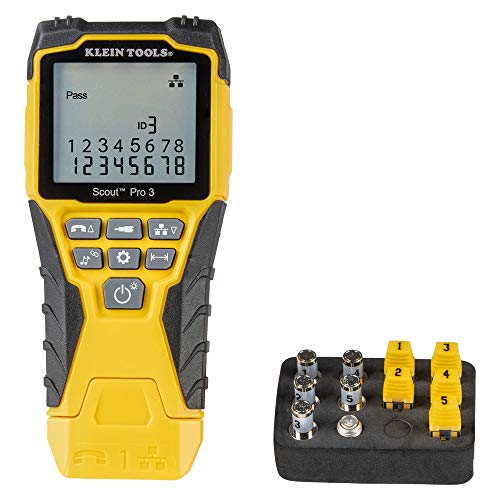
- Tests RJ11/12, RJ45, and coax
- Measures cable length to 2,000 feet
- Includes LAN and coax locator remotes
Best For: Mixed-cable home labs needing detailed diagnostics
Best Network Diagnostic Kit

- IP Scan and PING testing from the main unit
- Wiremap, length, PoE, and gigabit link checks
- Rechargeable tracer and probe with port flash
Best For: Home labs troubleshooting cables and connected network devices
Best Cable Tracing Value

- Traces CAT5/CAT6, PoE, shielded, RJ45, and RJ11 cables
- Checks continuity, sequence, shorts, opens, and crimp quality
- Adds NCV, telephone testing, clips, and work light
Best For: Home labs locating and validating mixed network and telephone wiring
Best Rechargeable Cable Tester

- Tests continuity, crimp quality, length, and wire mapping
- Verifies PoE and 10/100/1000 Mbps link speed
- Rechargeable kit with tracing, port finding, and NCV
Best For: Home labs focused on physical cable and network-link troubleshooting
Advanced Diagnostic Pick

- Measures cable length up to 200 meters
- Tests PoE, wire faults, and port links
- Includes tracing receiver and rechargeable transmitter
Best For: Long runs, PoE troubleshooting, and advanced home-lab diagnostics
Simple RJ45/RJ11 Choice

- Tests Ethernet and telephone cables
- Uses clear LED indicators and one-button operation
- Separate remote unit supports long-run testing
Best For: Routine cable checks and mixed RJ45/RJ11 home-lab wiring
Portable Testing Value

- Supports RJ45 CAT5-CAT7 and RJ11 cables
- Offers fast and slow LED scanning modes
- Split master and remote design for long runs
Best For: Portable continuity checks and DIY Ethernet installations
Best Compact Tester – Klein Tools LAN Scout Jr
For home labs looking for network cable testers, the Klein Tools LAN Scout Jr is a compact option for checking RJ45-terminated CAT5e, CAT6, and CAT6A cables. Its backlit display reports pin-to-pin wiremaps and several common wiring faults.
Best For: Home lab users who want portable RJ45 cable testing with clear LCD results.
Pros:
- Detects opens, shorts, miswires, split pairs, crossovers, and shield issues.
- Backlit LCD is practical in low-light areas.
- Includes a tester, remote, and two batteries.
- Supports single-wire, pair, or all-eight-conductor tone generation.
Cons:
- Designed for RJ45 data cables rather than RJ11, RJ12, or coax connections.
- The tone function requires the separately sold VDV500-123 probe.
The LAN Scout Jr makes sense when your home lab is centered on Ethernet patch cords and you want more detail than a basic pass/fail tester. Its small size and automatic power-off also suit occasional troubleshooting.
Best Simple Tester – LAN Explorer Cable Tester
The LAN Explorer is a straightforward choice among network cable testers for home labs. A single button tests RJ11, RJ12, and RJ45-terminated voice or data cables, while fast LED responses identify basic cable conditions.
Best For: Beginners and home lab users who want quick, uncomplicated cable checks.
Pros:
- Tests RJ11, RJ12, and RJ45 cables, including CAT3 through CAT6A.
- LEDs indicate pass, miswire, open, short, and shield conditions.
- Remote stores securely inside the tester body.
- Compact design fits easily in a pocket and includes a 9V battery.
Cons:
- LED feedback provides less displayed detail than an LCD-based tester.
- Does not list cable length measurement or a tone-generation function.
Choose this model when speed and simplicity matter more than expanded diagnostics. Its built-in remote storage and broad RJ11/RJ12/RJ45 compatibility make it convenient for mixed low-voltage cabling.
Best Wire Tracing Kit – Klein Tools Tone and Probe Kit
Network cable testers for home labs are not always enough when the challenge is identifying an unknown wire. The Klein Tools VDV500-705 combines an analog tone generator and probe for tracing or mapping open-ended, non-active low-voltage wiring up to 60 volts.
Best For: Home lab projects involving cable tracing, unterminated wires, and multiple low-voltage cable types.
Pros:
- Works with Ethernet, telephone, speaker, coax, video, and other low-voltage wires.
- Includes alligator clips for unterminated wires and an RJ45-to-RJ45 test cable.
- Probe has a work light for dark spaces.
- Adjustable volume and a headphone jack help customize tone monitoring.
Cons:
- Intended for open-ended, non-active wiring rather than energized network connections.
- Proper grounding and wire separation may be needed for best tone detection.
- It is primarily a tracing and mapping kit, not a full fault-diagnosis LCD tester.
This kit is a strong complement to a conventional cable tester when your home lab includes hidden runs or unlabeled wiring. Its clips, probe light, and audio controls make physical cable identification more manageable.
Best Feature-Rich Starter Set – Klein Tools Scout Pro 3
The Scout Pro 3 is a versatile pick among network cable testers for home labs that use more than Ethernet. It tests unenergized RJ11/12, RJ45, and coax cables, displays wiremaps and results on a backlit LCD, and measures cable lengths up to 2,000 feet.
Best For: Home labs needing Ethernet, telephone, and coax testing with cable-length measurement.
Pros:
- Supports RJ11/12, RJ45, and coax F-connector cables.
- Measures cable length up to 2,000 feet (610 meters).
- Detects open, short, miswire, and split-pair faults.
- Includes five LanMap and five CoaxMap locator remotes, an adapter, and a battery.
Cons:
- Not designed to test PoE.
- The analog probe needed for cable tracing is sold separately.
- Larger and heavier than the compact tester options.
The Scout Pro 3 is the most capable all-around choice here for a varied home lab. Its cable-length readings, locator remotes, and coax support add useful installation and troubleshooting functions beyond basic Ethernet continuity checks.
Best Network Diagnostic Kit – FNIRSI LPM-10C
For home labs that need more than basic continuity checks, the FNIRSI LPM-10C is a versatile choice among network cable testers for home labs. It combines wire mapping, cable-length measurement, cable tracing, PoE detection, link-speed checks, IP scanning, and PING testing in one rechargeable kit.
Best For: Home lab users troubleshooting switches, access points, IP cameras, and network installations where connectivity and cable diagnostics both matter.
Pros:
- Runs IP Scan and PING tests from the main unit, including response time and packet-loss checks.
- Tests opens, shorts, miswires, cable length, PoE, and 10/100/1000 Mbps link speed.
- Includes adjustable cable tracing, port flashing, a color display, rechargeable USB-C units, and an NCV-equipped probe.
Cons:
- Its broader feature set may be more than you need for simple cable continuity testing.
- The listed kit weighs 6.56 ounces and requires keeping both rechargeable units charged for tracing work.
The LPM-10C stands out when a home lab needs both physical-layer cable checks and basic network-level troubleshooting. Its IP and PING functions are especially useful for validating connected devices after wiring is complete.
Best Cable Tracing Value – TESMEN TLP-900AR
The TESMEN TLP-900AR is a practical option among network cable testers for home labs when cable tracing and basic fault finding are the priorities. It supports CAT5/CAT6, PoE, shielded, RJ45, and RJ11 cables, with tools for continuity, line sequence, crimp inspection, and telephone-line testing.
Best For: Home lab builders and maintenance users locating cables in bundles while checking Ethernet, telephone, and unterminated wiring.
Pros:
- Anti-interference tracing and adjustable cable positioning help locate wires in bundles, walls, ceilings, and under carpets.
- LED indicators check sequence, continuity, opens, shorts, and incorrect connections, while the QC function checks RJ45 crimping.
- Includes NCV detection, telephone-line polarity and status checks, alligator clips, a work light, and automatic shutoff.
Cons:
- Its supplied notes focus on electrical and cable testing rather than IP-level diagnostics such as PING or IP scanning.
- It uses two 9V 6F22 batteries instead of a rechargeable USB-C setup.
The TLP-900AR is well suited to hands-on wiring work where identifying the right cable is as important as checking its termination. Its RJ11 support and included clips also make it more flexible than an Ethernet-only tester.
Best Rechargeable Cable Tester – FNIRSI LPM-10A
The FNIRSI LPM-10A focuses on the core features many home labs need from network cable testers for home labs: tracing, continuity and crimp checks, cable length, PoE detection, and link-speed testing. Its rechargeable transmitter and receiver make it convenient for repeated troubleshooting sessions.
Best For: Home lab users working with switches, cameras, and access points who want cable diagnostics, port identification, and gigabit link checks in a portable kit.
Pros:
- Checks RJ45 continuity, crimp quality, couplers, patch cords, opens, shorts, and miswires.
- Measures cable length, detects standard and non-standard PoE, and verifies 10/100/1000 Mbps link speed.
- Provides adjustable tracing, port finding, NCV detection, USB-C rechargeability, a low-battery alert, and a built-in flashlight.
Cons:
- The supplied features do not include the LPM-10C’s IP Scan or PING testing.
- At 10.72 ounces, it is heavier than the listed LPM-10C kit.
The LPM-10A is a strong fit for physical network installation and repair rather than network-layer diagnostics. It offers a useful balance of tracing, wiremap, PoE, and link testing in a rechargeable format.
Advanced Diagnostic Pick – NOYAFA NF-8209
For home labs that need more than basic continuity checks, the NOYAFA NF-8209 is a feature-rich option among network cable testers for home labs. It combines wire mapping, cable-length measurement, live cable tracing, PoE testing, port flashing, and non-contact voltage detection in one kit.
Best For: Home-lab users troubleshooting long Ethernet runs, PoE devices, and difficult-to-trace cabling.
Pros:
- Tests RJ45 shielded and unshielded cables for shorts, opens, miswiring, and continuity.
- Measures CAT5/CAT6 cable lengths from 2.5 to 200 meters.
- Supports PoE testing, port flash/link testing, and live tracing up to 600 meters.
- Includes a rechargeable transmitter, receiver, remote adapter, accessories, and carrying bag.
Cons:
- More equipment and functions than needed for simple cable checks.
- Uses different power sources for the transmitter and receiver.
The NF-8209 stands out when a home lab involves structured cabling, powered network hardware, or long cable runs. Its broader diagnostic range makes it a versatile choice, though basic users may prefer a simpler tester.
Simple RJ45/RJ11 Choice – TESMEN TLP-123A
The TESMEN TLP-123A keeps cable testing straightforward for home labs. It supports RJ45 and RJ11 connections and uses LED indicators to identify continuity problems, shorts, opens, miswiring, and shielding status without adding advanced diagnostic features.
Best For: Home users and lab builders who want a compact tester for Ethernet and telephone cable maintenance.
Pros:
- Supports RJ45 and RJ11 cables, including multiple CAT cable types.
- Checks connectivity, shorts, opens, miswiring, and shielding.
- Detachable main and remote units support testing at both ends of long cables.
- One-button operation, adjustable test speed, and clear LED results.
Cons:
- Does not list cable-length measurement or PoE testing.
- Basic LED-based reporting may offer less detail than advanced digital testers.
With its compact design and simple controls, the TLP-123A is a practical everyday tester for verifying home-lab patch cables and installed runs. Choose it when straightforward fault detection matters more than length or PoE diagnostics.
Portable Testing Value – HT812A Network Cable Tester
The HT812A is a compact option for network cable testers for home labs, covering common RJ45 and RJ11 troubleshooting tasks. Its split design, fast and slow scan modes, and LED indicators help pinpoint wiring order issues on short cables or longer installed runs.
Best For: DIYers and home-lab users who need portable continuity testing for Ethernet and telephone lines.
Pros:
- Supports RJ45 CAT5 through CAT7 cables and RJ11 telephone lines.
- Detects continuity, shorts, opens, miswiring, and shielding status.
- Fast and slow scan modes make LED-based results easier to inspect.
- Detachable master and remote units support testing across long cable runs.
Cons:
- Does not list cable-length, PoE, or port-link testing.
- Functionality is focused on basic wiring verification rather than advanced network diagnostics.
The HT812A is a sensible pocket-sized tester for installation checks, upgrades, and occasional troubleshooting. Its fast/slow scanning and shield indicator add useful clarity, while users needing PoE or length measurements should consider a more advanced model.
How We Picked the Best Network Cable Testers for Home Labs
We focused on practical capabilities for home networking, homelab racks, DIY Ethernet runs, and small-office troubleshooting. Every selected tester supports common modular connections such as RJ45, while several also accommodate RJ11 telephone wiring. We compared their likely usefulness across continuity testing, wire-map diagnosis, remote testing, cable tracing, PoE checks, length measurement, and active-network functions.
We also considered usability. A good home-lab tester should be quick to operate, easy to interpret, and useful across the cable types you already own. Advanced features are valuable only when they solve a real troubleshooting problem without adding unnecessary complexity.
Quick Comparison
- Basic cable verification: Choose a simple LAN tester for continuity, pair order, and open or short detection.
- Remote outlet and patch-panel testing: Look for a detachable remote or a kit designed for testing installed runs.
- Cable identification: A tone generator and probe are best when tracing wires through walls, bundles, or racks.
- PoE and wiring work: Select a model with PoE detection, NCV capability, or support for both UTP and STP cable.
- Network troubleshooting: IP scanning and ping testing can be useful when the physical cable passes but connectivity still fails.
Key Buying Factors for Network Cable Testers for Home Labs
Supported Connectors and Cable Categories
Confirm that the tester supports the connectors and cable types in your setup. RJ45 Ethernet support is essential for most labs, while RJ11 support helps if you also maintain telephone wiring. CAT5e, CAT6, CAT6A, and CAT7 compatibility is useful, but basic continuity testers generally do not certify performance at the cable’s rated speed.
Test Functions
At minimum, look for continuity and wire-map testing. Pair-split detection, short and open identification, shielding checks, and length testing provide more actionable results. PoE detection is helpful around switches and access points, while a tone generator is preferable for locating an unlabeled cable.
Ease of Use and Kit Contents
Readable indicators, a remote unit, replaceable batteries, adapters, and protective storage can matter as much as the headline feature list. If you regularly test installed cables, a compact remote is especially convenient. For frequent tracing, prioritize a strong probe and adjustable tone controls.
Who Should Buy Which Network Cable Testers for Home Labs?
Casual DIY users should choose a straightforward RJ45/RJ11 tester for checking patch cables and newly terminated runs. Homelab builders will benefit from a tester with remote testing, wire mapping, and cable-length measurement. Rack and structured-wiring users should consider a tone generator and probe for tracing bundled or in-wall cables. Power-over-Ethernet users should prioritize dedicated PoE and NCV features. Finally, advanced network troubleshooters may prefer a model with IP scan and ping functions, provided they understand that these features complement—not replace—physical cable testing.