Moisture can turn otherwise good filament into inconsistent prints, bubbling surfaces, weak layers, and frustrating failures. The right dryer helps protect materials between jobs while making moisture-sensitive filaments easier to print.
We compared 10 filament dryers for home workshops across capacity, temperature control, storage, heating performance, and everyday usability, with options for beginners, multi-spool users, and advanced makers.
Best 10 Filament Dryers for Home Workshops Picks for 2026
Best High-Capacity Pick

- Holds four 1kg spools
- Eight outlets for multiple printers
- 35–70°C control with 0–99-hour timer
Best For: Multi-printer home workshops needing high capacity
Best for Dual-Material Workflows
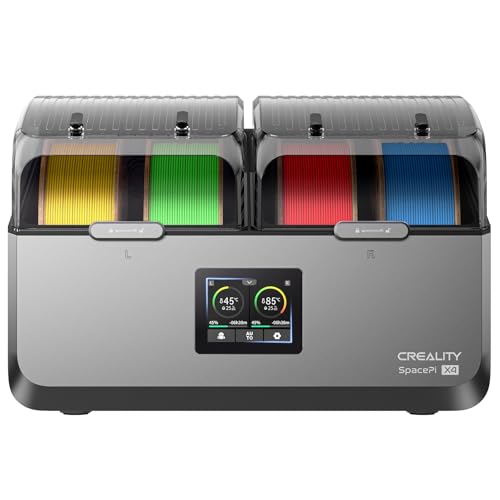
- Two independently heated chambers
- Dries and prints with four spools
- Reaches up to 85°C
Best For: Workshops handling different materials simultaneously
Best Compact Everyday Option

- Compact single-spool design
- 35–70°C control and 0–99-hour timer
- Translucent lid and touchscreen operation
Best For: Beginners and single-printer home workshops
Best Automatic-Control Pick

- Dual chambers for four 1kg spools
- Automatic humidity-based drying mode
- 45–85°C range with safety monitoring
Best For: Workshops wanting automated, multi-spool filament management
Best Dual-Zone Pick

- Independent 45–85°C control across two zones
- Dries up to four 1 kg spools
- Adds annealing and humidity-control modes
Best For: Mixed-material, multi-spool home workshops
Best Large-Capacity Cabinet

- Stores and dries up to 12 one-kilogram spools
- Includes Auto, Stay-Dry, and Manual modes
- Uses a five-layer safety system
Best For: High-volume and multi-printer workshops
Best Straightforward Four-Spool Dryer

- Dries four one-kilogram spools simultaneously
- Uses three fans for even heat circulation
- Includes automatic humidity control and safety monitoring
Best For: Everyday multi-printer filament management
Budget Dual-Spool Dryer
Comgrow SH01 Filament Dryer Box

- Holds two 1 kg spools
- 40–50°C adjustable drying
- LCD temperature and humidity monitoring
Best For: Routine PLA, ABS, and similar filament drying in home workshops
High-Capacity Fast Heater
Creality Space Pi Filament Dryer Plus

- Dries two 1 kg spools
- 160W 360° PTC hot-air heating
- 45–70°C range with 12 material presets
Best For: Busy workshops using varied filament types or two printers
Precision Single-Spool Dryer
Creality Space Pi SE Filament Dryer

- Fits one 1 kg spool
- 45–65°C and 0–24-hour settings
- Heats to 65°C in 15 minutes
Best For: Single-printer users wanting precise, scheduled drying
Best High-Capacity Pick – SUNLU S4 Four-Spool Dryer
For home workshops running several printers, the SUNLU S4 is a practical choice among filament dryers for home workshops. It holds up to four 1kg spools, supports drying while printing, and uses three circulation fans with 360-degree surround heating for more even conditions.
Best For: Multi-printer workshops and users who want high capacity with broad filament compatibility.
Pros:
- Dries up to four 1kg spools at once.
- Eight filament exit holes support multiple printers and loading angles.
- Offers 35–70°C temperature control and a 0–99-hour timer.
- Supports common materials from PLA and PETG to TPU, PA, PC, and nylon.
Cons:
- Its large 460 × 220 × 310mm external footprint may be excessive for compact benches.
- The four-spool capacity and 350W heater may be more than a single-printer user needs.
The S4 stands out when throughput matters. Its capacity, multiple outlets, and circulation system make it well suited to a busy home workshop, while the listed DIY modification options add flexibility for experienced users.
Best for Dual-Material Workflows – Creality Space Pi X4 Dryer
The Creality Space Pi X4 is designed for makers who need independent control rather than a single shared drying setting. Its dual chambers can dry four spools while printing, with each side using its own heater and temperature control.
Best For: Home workshops drying two filament types at different temperatures or working with engineering materials.
Pros:
- Dual independent chambers allow different temperatures simultaneously.
- Supports four-spool drying and printing with eight filament holes.
- Reaches up to 85°C for materials such as PA, PAHT, PC, and flexible filaments.
- Single-chamber operation is designed to save energy compared with dual-chamber use.
Cons:
- The supplied notes caution that other brands’ plastic trays should be heat resistant.
- Independent chamber features may be unnecessary for basic PLA-only printing.
For filament dryers for home workshops, the Space Pi X4’s main advantage is flexibility: separate chambers let you handle different materials without forcing every spool to share one temperature profile.
Best Compact Everyday Option – SUNLU S2 Filament Dryer
The SUNLU S2 is a straightforward option for makers who need to revive damp filament and keep a spool dry during printing. Its compact 265 × 274 × 118mm size, translucent lid, and simple touchscreen make it approachable for everyday home-workshop use.
Best For: Single-spool users, beginners, and printers located in humid areas such as basements.
Pros:
- Works as both a filament dryer and spool holder during printing.
- Adjustable from 35–70°C with a 0–99-hour drying timer.
- Supports 1.75mm, 2.85mm, and 3.00mm filament diameters.
- Translucent lid allows monitoring without opening the box.
Cons:
- Its capacity is smaller than the four-spool models in this roundup.
- The 70°C maximum may be less suitable for higher-temperature engineering materials.
The S2 keeps the feature set focused and easy to use. It is a sensible starting point among filament dryers for home workshops when compact dimensions and uncomplicated operation matter more than multi-spool throughput.
Best Automatic-Control Pick – Comgrow SH03 Four-Spool Dryer
The Comgrow SH03 combines four-spool capacity with dual independent chambers and automatic drying control. For home workshops, its humidity-triggered operation, active airflow management, and monitoring protections make it a feature-rich option for longer drying and storage cycles.
Best For: Users who want four-spool drying, separate chamber settings, and automated humidity-based operation.
Pros:
- Handles up to four 1kg spools in two independently controlled chambers.
- Adjusts from 45–85°C and supports materials including PLA, ABS, PETG, TPU, ASA, PA, and PC.
- Automatic mode starts drying when humidity rises and enters storage mode after the cycle.
- Includes 360-degree hot-air circulation and multiple temperature, fan, and board protections.
Cons:
- The 45°C minimum is higher than the minimum setting listed for some competing dryers.
- Its advanced controls may be more involved than needed for occasional single-spool drying.
- The supplied product notes are truncated, so some operating details are not specified.
The SH03 is aimed at users who want more than basic timed heating. Its dual chambers, automatic mode, and monitoring systems make it a strong fit for organized, higher-throughput filament management.
Best Dual-Zone Pick – SUNLU S4 Pro
For home workshops running several materials or printers, the SUNLU S4 Pro is one of the more versatile filament dryers for home workshops. Its divided chamber lets you set separate temperatures for two groups of filament while supporting drying, humidity control, and annealing.
Best For: Makers who need dual-zone control, four-spool capacity, and support for higher-temperature materials.
Pros:
- Independent 45–85°C temperature control for two zones.
- Holds up to four 1 kg spools at once.
- Includes annealing and automatic humidity-control modes.
- Supports materials including PLA, PETG, ABS, TPU, PA, PC, and Nylon.
Cons:
- The larger 458 × 218 × 340 mm footprint needs dedicated workspace.
- Its 380W heater and expanded controls may be more than a single-printer user needs.
The S4 Pro stands out when flexibility matters more than compactness. Dual-zone operation and an 85°C ceiling make it especially useful for mixed-material workflows, though its size is worth measuring before purchase.
Best Large-Capacity Cabinet – Hydryer H2O
The Hydryer H2O is designed for workshops that need to dry and store a large filament inventory. This cabinet-style option among filament dryers for home workshops holds 12 one-kilogram spools, circulates warm air, and includes modes for drying, storage, and manual control.
Best For: High-volume users who want overnight operation, large capacity, and a durable storage cabinet.
Pros:
- Holds up to 12 one-kilogram spools while maintaining consistent drying time.
- Offers Auto, Stay-Dry, and Manual modes, with a 100–220°F manual range.
- Uses five safety features, including overheat protection and door-open heating shutoff.
- Stainless-steel construction, double tempered-glass doors, and triple-layer insulation support durability.
Cons:
- At 17.5 × 14.4 × 24.19 inches and 22 pounds, it is substantially larger and heavier than smaller dryers.
- The early-batch humidity display may read higher than the actual chamber humidity.
The H2O is the capacity leader in this group and makes the most sense for multi-printer setups or filament-heavy workshops. Its peak-temperature design prioritizes safety, but users should follow the guidance to set the temperature above the desired internal target.
Best Straightforward Four-Spool Dryer – SUNLU S4
The SUNLU S4 offers a simpler four-spool setup for makers who want to keep several filaments ready without moving to a cabinet-sized unit. With heating up to 70°C, three circulation fans, and automatic humidity control, it is a practical choice among filament dryers for home workshops.
Best For: Multi-printer users who need simultaneous four-spool drying in a relatively compact enclosure.
Pros:
- Fits four one-kilogram spools and can feed up to four printers concurrently.
- Three fans provide circulating air and 360° surround heating.
- Supports common filament diameters of 1.75, 2.85, and 3.0 mm.
- Includes a 350W PTC heater, backup thermal switch, and software monitoring.
Cons:
- Its 70°C maximum is lower than the S4 Pro’s 85°C ceiling.
- It does not list a separate annealing mode in the supplied specifications.
The S4 is a balanced option for everyday PLA, PETG, ABS, TPU, and Nylon workflows. It provides useful capacity and circulation without the added dual-zone controls of the Pro model, making it easier to match to a standard multi-printer bench.
Budget Dual-Spool Dryer – Comgrow SH01 Filament Dryer Box
For home workshops needing straightforward filament dryers for home workshops, the Comgrow SH01 focuses on sealed storage and in-process drying. It holds two 1 kg spools, supports 1.75 mm and 2.85 mm filament, and offers adjustable 40–50°C heating with six- to 12-hour timing.
Best For: Makers who want a compact, dual-spool dryer for common PLA, ABS, and similar materials.
Pros:
- Stores two 1 kg spools in its 9.29 × 6.49 × 9.13-inch interior.
- Supports standard 1.75 mm and 2.85 mm filament diameters.
- Includes temperature and humidity monitoring, a two-inch LCD, and touch controls.
- Sealed outlet design uses a silicone cable sheath and Teflon tube for smoother feeding.
Cons:
- Its 40–50°C range is narrower than the ranges on the Creality models.
- The work state must appear on the screen or the motherboard shuts down after three minutes.
- The box is intended for filament drying, not general-purpose material drying.
The SH01 is a practical option when two-spool capacity and basic moisture control matter more than high-temperature drying. Its setup details require attention, but the monitoring and sealed design suit routine home printing.
High-Capacity Fast Heater – Creality Space Pi Filament Dryer Plus
The Creality Space Pi Plus is aimed at users comparing filament dryers for home workshops who need two-spool capacity and broader material support. Its 160W dual PTC system circulates hot air 360° and provides adjustable 45–70°C drying through a four-inch touchscreen.
Best For: Active makers drying two spools or supplying two printers with a wide range of filament types.
Pros:
- Accommodates two 1 kg rolls and includes four filament holes with two PTFE pipes.
- Dual PTC heating and 360° hot-air circulation are designed for more uniform drying.
- One-key presets support up to 12 filament types, including PLA, PETG, TPU, PA, PC, and composite filaments.
- Large four-inch touchscreen displays drying conditions and switches between Celsius and Fahrenheit.
Cons:
- Its feature set and 5.5-pound weight may be more than needed for occasional users.
- The supplied notes do not specify a drying-time range.
- Two-spool operation requires more bench space than a single-spool dryer.
With its wider temperature range, material presets, and double-drying layout, the Space Pi Plus is the most versatile choice here for a busy workshop. It is especially compelling when consistent airflow and simultaneous spool handling are priorities.
Precision Single-Spool Dryer – Creality Space Pi SE Filament Dryer
The Creality Space Pi SE is a focused option among filament dryers for home workshops, pairing a single 1 kg spool capacity with adjustable 45–65°C drying. Its PTC heater, built-in fan, humidity display, and up-to-24-hour timer make it suited to controlled, unattended drying cycles.
Best For: Home users who usually dry one 1 kg spool and want precise time and temperature control.
Pros:
- Reaches 65°C within 15 minutes according to the supplied product notes.
- 360° hot-air circulation and added inner-wall insulation support even heating and heat retention.
- Temperature can be set from 45–65°C, with drying times from zero to 24 hours.
- Real-time humidity monitoring, a countdown timer, and knob controls simplify operation.
Cons:
- It is designed for one 1 kg spool rather than two-spool drying.
- The listed warranty is six months.
- It lacks the larger touchscreen and multi-filament preset system of the Space Pi Plus.
The Space Pi SE offers a balanced middle ground for a single-printer setup: faster heating and more precise scheduling than the Comgrow, without the larger dual-spool format of the Plus. Its insulation and humidity readout are useful for repeatable home-workshop routines.
How We Picked the Best Filament Dryers for Home Workshops
We focused on the features that matter during routine printing rather than headline specifications alone. Our comparison considers spool capacity, maximum and adjustable temperature, heating design, humidity management, controls, drying-time practicality, power use, and whether a unit can feed filament directly to a printer. We also included compact models for occasional use, multi-spool cabinets for busy workshops, and higher-control options for materials such as nylon, TPU, PETG, and ABS.
Because product names and specifications can vary by listing or production revision, verify the current temperature range, supported spool dimensions, included accessories, and power requirements before ordering.
Quick Comparison
| Best For | What to Look For |
|---|---|
| Occasional printing | Compact size, simple controls, and support for one or two spools |
| Multiple printers | Four or more spool positions, stable temperature control, and direct-feed ports |
| Moisture-sensitive filament | Higher heat range, accurate sensing, and dependable circulation |
| Long-term storage | Sealed construction, desiccant compatibility, and low-humidity holding mode |
| Mixed-material workflows | Independent zones or flexible temperature settings for different spools |
Key Buying Factors for Filament Dryers
Capacity and Footprint
Choose capacity based on how many spools you actively use, not how many you own. A single- or dual-spool dryer is easier to place beside a printer, while four- and 12-spool cabinets make more sense for production work but require substantially more bench or floor space.
Temperature Control
PLA generally needs gentler drying than nylon or some moisture-sensitive engineering materials. Adjustable temperature is more useful than a high maximum alone, while independent chambers or zones can help when different filaments need different settings.
Heating, Sensing, and Airflow
PTC heating elements, circulating airflow, and a reliable temperature or humidity sensor can improve consistency. Look for clear controls and a display that makes it easy to confirm the selected setting rather than relying on a vague preset.
Storage and Printer Feeding
A dryer is more practical when it can keep filament dry after the cycle and feed it directly to the printer. Check port placement, spool compatibility, lid seals, and whether the design accommodates wide or specialty spools.
Who Should Buy Which Filament Dryers for Home Workshops?
Buy a compact SUNLU S2 or Creality Space Pi SE-style dryer if you print occasionally, have limited space, or mainly need a dependable single-spool solution. Choose a dual-spool Space Pi or similar unit when you switch between materials frequently and want more flexibility without a large cabinet.
For households running several printers, the SUNLU S4, S4 Pro, Comgrow SH03, or comparable four-spool models offer a better balance of capacity and workshop practicality. Consider independent temperature zones when you regularly dry different materials at the same time.
High-volume makers should look toward the Hydryer H2O 12-spool cabinet or another large-capacity system, provided they have the space and genuinely need centralized storage. Finally, prioritize accurate controls and a higher heat range for nylon, TPU, and other demanding materials; for basic PLA printing, simpler and smaller dryers are usually the better value.