The best light meters make it easier to measure illumination accurately, set exposure with confidence, and verify whether a room or workspace has enough usable light.
This roundup compares 10 light meters across photography, video, industrial, office, and general-purpose applications, with options ranging from compact handheld testers to advanced incident-and-reflected exposure meters.
Best 10 Light Meters Picks for 2026
Best for Photo and Video

- Tenth-stop ambient and flash readings
- Photo, cine, and HD cine modes
- Pocket-sized 3.52-ounce design
Best For: Photographers and videographers needing exposure control
Best All-Purpose Illuminance Meter

- 0.1–200,000 lux measurement range
- Rotating probe and backlit LCD
- Adds temperature, humidity, and MAX/MIN readings
Best For: General lighting, plant, home, and workplace checks
Simple Professional Pick

- Dedicated illuminance meter tester
- Fluke-branded instrument
- Runs on one 9V battery
Best For: Basic illuminance testing with a Fluke instrument
Best Split-Sensor Design
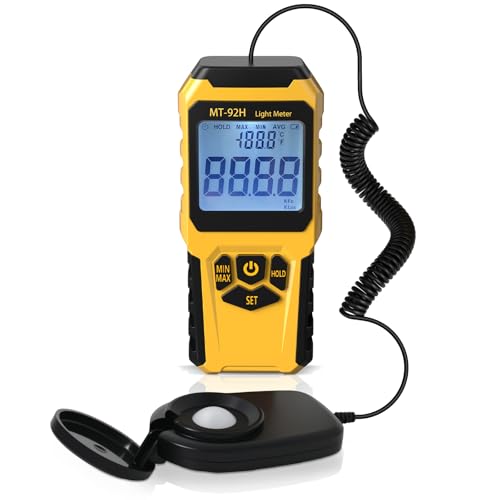
- Up to 200,000 lux with ±3% accuracy
- Separate sensor for flexible positioning
- Switchable backlight and temperature units
Best For: Fast, flexible illuminance and temperature checks
Professional Cine Meter
Sekonic LiteMaster Pro L-478D-U
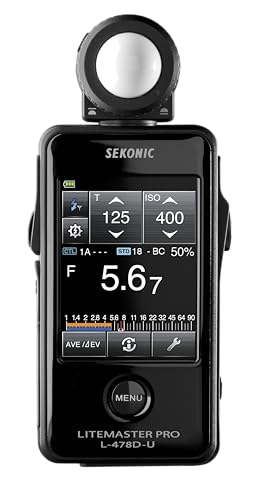
- Touchscreen incident and flash metering
- Cine frame rate and shutter angle controls
- Illuminance, luminance, and optional 5° spot modes
Best For: Professional photography and motion production
Worksite Measurement Pick
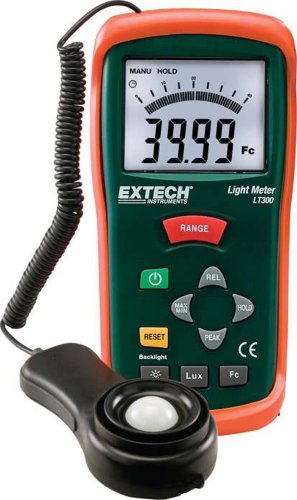
- Reads up to 40,000 lux
- Remote sensor with backlit LCD
- Min/max, data hold, and zero adjustment
Best For: General lighting inspections and facility checks
Compact High-Range Meter

- Measures up to 199,900 lux
- Fast 0.5-second sampling
- Compact design with backlit LCD and max/min
Best For: Portable illuminance checks across varied settings
Compact Professional Pick
Extech LT40 White LED Light Meter
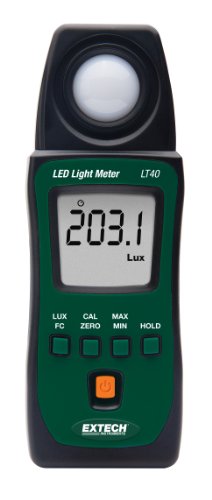
- Measures lux and foot-candles
- Backlit 4000-count LCD
- Data hold and auto power-off
Best For: Portable everyday light readings
High-Range Gardening Choice

- Measures up to 200,000 lux
- Fast readings twice per second
- Peak recording and FC/LUX conversion
Best For: Plant lighting and broad indoor-outdoor measurements
Feature-Rich Budget Tool
S8608 Digital Illuminance Meter

- Measures up to 200,000 lux
- Automatic range conversion
- Hold, backlight, and MAX/MIN functions
Best For: General indoor, outdoor, and grow-light testing
Best for Photo and Video – Sekonic L-308X-U Flashmate
The Sekonic L-308X-U is a pocket-sized choice for photographers and videographers who need versatile light meters for both ambient and electronic flash exposure readings. It supports photo, cine, and HD cine workflows, with readings accurate to a tenth of a stop.
Best For: Still photographers, DSLR and mirrorless videographers, and cinema users who need incident and reflected exposure metering.
Pros:
- Measures ambient and flash exposures with tenth-stop accuracy.
- Offers photo, cine, and HD cine modes with shutter, frame-rate, and shutter-angle controls.
- Compact 4.3-by-2.5-by-0.9-inch design weighs only 3.52 ounces.
- Supports a broad ambient range and shutter speeds up to 1/8000 second.
Cons:
- Requires two AAA batteries.
- Its photography-focused controls may be more than casual illuminance users need.
This is the most specialized option in the group, particularly useful when exposure consistency matters across stills, flash, or video production rather than general room-light checks.
Best All-Purpose Illuminance Meter – TopTes TS-710
The TopTes TS-710 is a practical light meter for measuring everyday visible-light levels in lux or foot-candles. Its rotating probe, large backlit display, and added temperature and humidity readings make it useful for plants, workspaces, lighting checks, and maintenance tasks.
Best For: Home, office, workshop, plant-lighting, school, farm, and facility checks where broad illuminance coverage is useful.
Pros:
- Measures from 0.1 to 200,000 lux and 0.1 to 20,000 foot-candles.
- 180-degree rotating sensor and 0.5-second sampling support flexible measurements.
- Large 2.25-inch backlit LCD is designed for easy reading in low light.
- Also records maximum/minimum values and includes temperature and humidity measurement.
Cons:
- Accuracy is specified as 3% of reading plus 5 digits.
- Auto shut-off occurs after 10 minutes of inactivity.
Choose the TS-710 when you want a general-purpose light meter with environmental readings and data-hold features instead of camera exposure modes.
Simple Professional Pick – Fluke 941 Light Meter
The Fluke 941 is a dedicated illuminance meter from Fluke for buyers who want a straightforward light-measurement instrument. The supplied specifications identify it as a light meter tester and list a 9V battery power source.
Best For: Users seeking a dedicated Fluke-branded illuminance meter for basic light-level testing.
Pros:
- Dedicated illuminance meter design.
- Made by Fluke, a recognized test-equipment brand.
- Uses a single 9V battery.
Cons:
- The supplied product information does not specify measurement range or accuracy.
- Listed dimensions are relatively large at 11.42 by 6.3 by 2.9 inches.
- Weighs 10.6 ounces, making it heavier than the compact meters here.
The Fluke 941 may suit shoppers prioritizing brand familiarity, but compare its detailed specifications and ergonomics with the more fully documented alternatives before buying.
Best Split-Sensor Design – MT-92H Light Meter
The MT-92H is a compact light meter for lux and foot-candle measurements, with a separate split sensor that allows flexible probe placement. Its 0.5-second refresh rate, switchable backlight, and temperature readout support quick checks in varied working conditions.
Best For: Users who need flexible sensor positioning, fast illuminance updates, and both light and temperature measurements.
Pros:
- Measures up to 200,000 lux with stated ±3% accuracy and 0.1-lux resolution.
- Separate split sensor supports flexible positioning during measurements.
- Switches between lux and foot-candles, as well as Celsius and Fahrenheit.
- Compact 188-gram design includes a switchable backlight.
Cons:
- Requires three AAA batteries.
- The supplied notes do not mention humidity measurement or data logging.
The MT-92H is a strong fit when probe placement is the main concern, especially for quick comparisons across fixtures or locations where the meter body would be awkward to position.
Professional Cine Meter – Sekonic LiteMaster Pro L-478D-U
For photographers, filmmakers, and hybrid creators who need versatile light meters, the Sekonic LiteMaster Pro L-478D-U combines touchscreen operation with incident, flash, and advanced lighting measurements. Its cine controls and optional reflected spot capability make it especially adaptable to demanding production workflows.
Best For: Professional photography, studio and location flash work, and motion production.
Pros:
- Measures incident ambient and flash light, including flash-to-ambient analysis.
- Touchscreen interface provides clear data visibility and quick exposure adjustments.
- Cine mode supports frame rate and shutter angle control.
- Includes illuminance and luminance measurement modes, with optional 5° spot capability.
Cons:
- Its advanced feature set may be more than casual users need.
- The reflected spot function requires an optional attachment.
The L-478D-U is a feature-rich choice when exposure control must extend beyond basic brightness readings. It is best suited to users who will take advantage of its flash analysis, cine controls, and technical measurement modes.
Worksite Measurement Pick – Extech LT300 Light Meter
The Extech LT300 is a practical option among light meters for checking workplace, studio, laboratory, and facility lighting. Its remote sensor, backlit display, and measurement-management functions make routine inspections easier to perform and review.
Best For: Lighting inspections, facility checks, studios, labs, and energy-use evaluations.
Pros:
- Measures up to 40,000 lux with lux and foot-candle readings.
- Remote sensor and one-handed operation support convenient testing.
- Min/max, data hold, and zero adjustment functions help compare and stabilize readings.
- Backlit LCD improves readability in dim areas.
Cons:
- Its 40,000-lux maximum is lower than some higher-range meters.
- It is focused on illuminance measurements rather than cine or flash exposure control.
Choose the LT300 when you want a straightforward, portable meter for general light-level verification. The remote sensor and logging-oriented functions are useful for repeated checks, while the design remains accessible for casual users.
Compact High-Range Meter – UNI-T UT383 Light Meter
The UNI-T UT383 is a compact choice among light meters for quick illuminance checks in homes, offices, labs, agriculture, studios, and other settings. It measures across a broad range while adding a backlit display, fast sampling, and portable operation.
Best For: Portable lux and foot-candle checks across household, workplace, studio, and field applications.
Pros:
- Measures from 0 to 199,900 lux and 0 to 18,500 foot-candles.
- Compact 5-ounce design is easy to carry and use.
- Provides 0.5-second sampling, max/min, data hold, and overload indication.
- Backlit four-digit LCD and auto shutdown support convenient field use.
Cons:
- It does not provide the flash, cine, or touchscreen controls found on more specialized meters.
- The stated accuracy is ±(4%+8), so users needing tighter technical precision may want a more advanced instrument.
The UT383 stands out when portability and a wide illuminance range matter more than advanced exposure features. It is a versatile everyday meter for quick readings in both indoor and outdoor-related applications.
Compact Professional Pick – Extech LT40 White LED Light Meter
For shoppers comparing light meters, the Extech LT40 is a compact option for white LED measurements in lux and foot-candles. Its backlit 4000-count display, data hold, and auto power-off support straightforward readings in everyday work.
Best For: Users who want a small, easy-to-read meter with convenient hold and power-saving features.
Pros:
- Measures both lux and foot-candles for flexible readings.
- Backlit 4000-count LCD improves visibility.
- Data hold and auto power-off add convenience.
- Compact 5.3-inch design weighs 4.9 ounces.
Cons:
- Its supplied notes do not specify a maximum lux range.
- Requires two AAA batteries, despite the compact form.
The LT40 stands out among light meters for portability and a clear display. Choose it when practical controls and a compact body matter more than a stated high-range specification.
High-Range Gardening Choice – Dr.meter 200,000 Lux Meter
The Dr.meter digital illuminance meter is one of the more versatile light meters for measuring indoor, outdoor, and plant-growing environments. Its 0–200,000 lux range, fast response, and selectable FC/LUX units make it suitable for comparing changing light levels.
Best For: Gardeners, homeowners, and users measuring sunlight or other variable light sources.
Pros:
- Wide 0–200,000 lux measurement range.
- Reads twice per second for fast response.
- Switches between foot-candles and lux.
- Peak recording captures the highest detected pulse value.
Cons:
- Uses a 9V battery rather than AAA cells.
- The supplied notes do not mention a backlit display or auto power-off.
Among light meters, this model is a strong fit when broad range and peak recording are priorities. Its straightforward controls also make it useful for checking plant lighting and general brightness across different locations.
Feature-Rich Budget Tool – S8608 Digital Illuminance Meter
The S8608 is a practical choice for shoppers seeking light meters with a broad range and useful recording functions. It measures up to 200,000 lux, automatically changes range, and supports lux or foot-candle readings for indoor and outdoor brightness checks.
Best For: Home, school, workplace, and grow-light measurements requiring a wide range and simple data controls.
Pros:
- Measures visible brightness up to 200,000 lux.
- Automatically converts measurement range.
- Includes lux/foot-candle switching, hold, and backlight functions.
- Supports maximum and minimum readings.
Cons:
- Requires three AAA batteries.
- The supplied notes do not specify response speed or display count.
This model balances a wide measurement range with useful features such as maximum/minimum tracking, data hold, and auto power-off. It is a sensible all-purpose option when you want light meters for varied brightness checks without a specialized feature set.
How We Picked These Light Meters
We selected models that cover the main reasons buyers need a light meter: photographic exposure, studio and video work, workplace illumination checks, LED testing, and general lux or foot-candle measurement. We considered measurement range, sensor design, display readability, portability, refresh behavior, operating modes, and whether the meter supports incident, reflected, flash, or cine measurements.
Because requirements vary widely, this list includes both specialized photography meters from Sekonic and practical illuminance testers from brands such as Fluke, Extech, UNI-T, TopTes, and Dr.meter. The right choice depends less on having the highest stated range and more on matching the instrument to the type of light and measurement you actually need.
Quick Comparison
| Best For | What to Look For |
|---|---|
| Photography and flash | Incident and reflected modes, flash analysis, exposure controls |
| Video and cinema | Frame-rate, shutter-angle, and cine exposure settings |
| Office or workplace checks | Lux and foot-candle readings, a readable display, and a useful sensor range |
| Hard-to-reach areas | Remote or split sensors, rotating probes, or a compact body |
| General-purpose testing | Wide range, fast refresh, backlight, and simple controls |
Key Buying Factors for Light Meters
Measurement Type
Photographers should distinguish between incident meters, which measure light falling on the subject, and reflected meters, which measure light bouncing toward the camera. Flash and cine modes are valuable for studio, video, and motion-picture work. For facilities or electrical testing, a straightforward lux meter may be more appropriate.
Range and Units
Check the minimum and maximum lux range for your environment. Bright outdoor or studio conditions may require a high upper limit, while low-light testing benefits from sensitive low-end readings. Foot-candle support is useful when following workplace or lighting specifications that do not use lux.
Sensor and Display Design
A rotating or remote sensor can make it easier to measure awkward fixtures, shelves, ceilings, and equipment interiors. A backlit display helps in dark rooms, while a large screen and clear unit indicators reduce reading errors. Fast refresh rates are helpful when light levels change quickly.
Portability and Specialized Controls
Compact meters suit photographers and technicians who carry tools between locations. Touchscreens, memory functions, relative or peak modes, and temperature readings can improve workflow, but they may be unnecessary for occasional basic measurements.
Who Should Buy Which Light Meters?
Photographers and flash users: Choose a dedicated incident-and-reflected exposure meter with flash support, such as a Sekonic model.
Videographers and filmmakers: Prioritize cine frame-rate and shutter-angle functions, especially when exposure must stay consistent across motion settings.
Facility managers and electricians: Look for a durable illuminance meter with lux and foot-candle units, a remote probe, or peak and relative modes.
Home, office, and hobby users: A simple digital lux meter with a wide range, backlight, and straightforward controls is usually sufficient. Before buying, confirm the meter’s stated accuracy, calibration expectations, battery type, and intended measuring distance for your application.