Choosing the right particle counter can make a major difference in cleanroom compliance, contamination control, and indoor air monitoring. The best models balance accuracy, channel range, sample flow, and ease of use.
Below, we’ve narrowed the field to 10 options suited to professional and industrial applications, including handheld units, multi-channel counters, and models built for lab or computer-connected workflows.
Best 10 Laser Particle Counters Picks for 2026
Cleanroom-Grade Precision
Temtop PMD331 Professional 7-Channel Counter

- ISO 21501-4 certified for regulated environments
- 7 particle sizes monitored simultaneously
- 2M+ record storage with RS-485 Modbus
Best For: Cleanrooms, pharma, labs, and HVAC audits
Simple PC-Connected Meter

- Computer interface for connected monitoring
- Two size ranges with 1 micron detection
- Minute, hour, day, and monitor modes
Best For: Entry-level particle tracking with PC connectivity
Portable Air Quality Tracker
Temtop Handheld Particle Counter

- Counts 0.3μm, 0.5μm, and 1.0μm particles
- Also displays PM2.5, PM10, TSP, temp, and humidity
- 32GB storage with 3500mAh battery
Best For: Portable air-quality checks with logging
Multi-Channel Sampling Detector
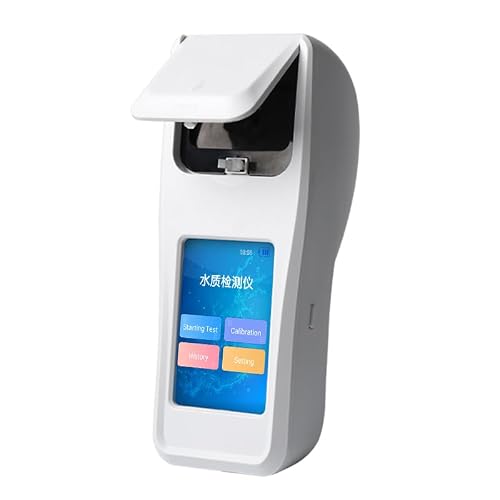
- Compact and lightweight for field use
- Android-style interface with one-click operation
- Wireless cloud upload and long-life light source
Best For: Portable detection with wireless data handling
Professional Cleanroom Monitor
Temtop Particle Counter & Environmental Analyzer
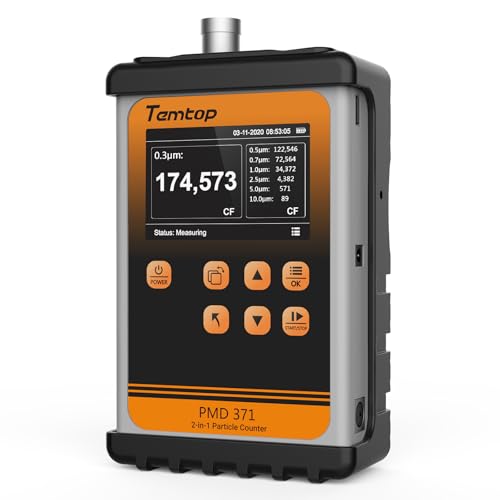
- Measures both PM and particle counts
- 8GB storage with USB and RS-232 Modbus
- Metal build with 8-hour battery life
Best For: Cleanrooms and labs needing broad particulate analysis
Portable Sampling Detector
HM-SS4 Laser Dust Particle Counter

- Compact handheld-style particle detector
- Listed as multi-channel sampling detector
- Specs need seller verification before buying
Best For: Shoppers who want a portable detector and will confirm specs
Industrial Hygiene Logger
Temtop Aerosol Mass Monitor & Laser Counter

- Mass readings for PM1.0 through TSP
- 32GB storage with USB and RS-485 Modbus
- Adds temperature and humidity sensing
Best For: Industrial hygiene and compliance monitoring with data logging
HM-CL1 Precision Sampling

- 6 channels from 0.3–10.0μm
- Android 7.1 with 7-inch touch screen
- FDA 21 CFR Part 11 audit-trace support
Best For: Controlled sampling and traceable reporting
HM-CL2 Reporting Ready

- 6 channels from 0.3–10.0μm
- Wi‑Fi upload and U-disk copying
- 100,000-record memory with printer
Best For: Professionals needing wireless records and documentation
HM-CL3 Data Management
- 6 channels from 0.3–10.0μm
- 220Wh battery for 6+ hours of sampling
- Wi‑Fi, U-disk, and printer support
Best For: Portable sampling with strong record handling
Cleanroom-Grade Precision – Temtop PMD331 Professional 7-Channel Counter
If you need laser particle counters for regulated spaces, the Temtop PMD331 is built around accuracy, repeatability, and cleanroom-ready reporting. It monitors seven size channels at once and uses ISO 21501-4 certification to support demanding environments like cleanrooms, labs, surgical suites, and HVAC verification.
Best For: Cleanroom certification, pharmaceutical facilities, and labs that need ISO-aligned particle data.
Pros:
- ISO 21501-4 certified with rigorous calibration for reliable measurements.
- Simultaneous 7-channel monitoring from 0.3μm to 10μm.
- Large onboard storage for over 2,000,000 records.
- RS-485 Modbus, USB export, and real-time graphing on a 4-inch display.
Cons:
- Heavier and more industrial than basic handheld counters.
- Individual ISO calibration certificates are optional and may require a custom quote.
Overall, the PMD331 is the strongest fit when your particle counting needs are tied to compliance, documentation, and stable long-term use rather than casual spot checks.
Simple PC-Connected Meter – DC1100 Laser Particle Counter
This laser particle counter is a straightforward option for users who want basic particulate monitoring with computer connectivity. The DC1100 measures two size ranges, detects particles down to 1 micron, and includes operating modes for minute, hour, day, and monitor use.
Best For: Basic particle tracking with PC interface support in small facilities or test setups.
Pros:
- True laser particle counter with a computer interface.
- Tracks two size ranges, including small and large particles.
- Multiple counting modes for flexible monitoring intervals.
- Compact and lightweight at 1.55 pounds.
Cons:
- Limited to two size ranges compared with multi-channel models.
- Not the Pro version, so feature set is more basic.
The DC1100 makes sense if you want a no-frills, PC-capable particle counter for entry-level monitoring rather than a high-spec cleanroom instrument.
Portable Air Quality Tracker – Temtop Handheld Particle Counter
For buyers comparing laser particle counters for field work, this Temtop handheld model blends particle measurement with broader air-quality tracking. It reads 0.3μm, 0.5μm, and 1.0μm particles while also showing PM2.5, PM10, TSP, temperature, and humidity for a more complete snapshot.
Best For: Environmental checks, workshops, and labs that want particle counts plus temp/humidity data.
Pros:
- Measures multiple particle sizes and key air quality indices.
- Includes temperature and humidity sensors for broader context.
- 3500mAh battery supports over 4 hours of use.
- 32GB internal storage and USB transfer for logging.
Cons:
- Accuracy details are listed for the device, but the measurement range shown is limited to 0.3–1.0μm in the specs.
- Less focused on cleanroom certification than dedicated professional counters.
This is a practical choice if you need a portable monitor that goes beyond particle counts and helps you track overall indoor or site conditions.
Multi-Channel Sampling Detector – HM-SS6 Laser Dust Counter
If you’re comparing laser particle counters and need a portable sampling detector, the HM-SS6 is positioned as a multi-channel dust measuring instrument for concentration detection. Its compact, lightweight design and long-life cold light source are aimed at users who want an on-site device that is easy to carry and built for regular use.
Best For: Portable field detection where compact size and wireless data handling matter.
Pros:
- Compact and lightweight design for easier transport.
- Stable cold light source rated for up to 100,000 hours.
- Android-based interface with one-click operation.
- Supports wireless cloud upload for data management.
Cons:
- The supplied notes describe aquaculture and water testing features, so the product information appears mixed.
- Particle-counting specifications are not clearly detailed in the provided notes.
Because the listing information is inconsistent, this model is best approached cautiously and checked carefully against your actual particle-monitoring requirements before buying.
Professional Cleanroom Monitor – Temtop Particle Counter & Environmental Analyzer
If you need laser particle counters for cleanrooms, labs, or other sensitive environments, this Temtop unit stands out for measuring both particle concentration and particle count in one handheld analyzer. It combines PM readings with count channels from 0.3 μm to 10 μm, making it a strong fit when you want a broader particulate picture rather than a single metric.
Best For: Cleanrooms, laboratories, hospitals, and industrial settings that need comprehensive particulate monitoring.
Pros:
- Measures both PM mass concentration and particle counts across multiple size channels.
- Uses Mie-scattering detection with a German Furgut pump for professional-grade sampling.
- Includes 8GB of storage, USB and RS-232 Modbus data transfer, and a 4-inch display.
- Built with a full metal body, 8-hour battery life, and a 5-year warranty.
Cons:
- ISO certificates for individual units are optional and may cost extra.
- Positioned as a professional tool, so it may be more than casual users need.
This is a well-rounded option if your priority is detailed particulate analysis with strong data handling and industrial durability. The included calibration support and accessories add value for teams that rely on repeatable monitoring.
Portable Sampling Detector – HM-SS4 Laser Dust Particle Counter
For buyers looking at laser particle counters in a compact sampling format, this HM-SS4 is presented as a multi-channel particle measuring instrument for concentration detection. The listing emphasizes portable use and detection capability, though the supplied notes are not as detailed on technical specs as the other models in this roundup.
Best For: Buyers who want a portable particle sampling detector and can verify fit and specs directly with the seller.
Pros:
- Compact, handheld-style product intended for portable use.
- Described as a multi-channel particle sampling detector for concentration detection.
- Product title and description suggest on-site measurement use.
- May appeal to users prioritizing a simpler field-ready form factor.
Cons:
- The provided notes focus heavily on water-testing language, which creates listing inconsistency.
- Few concrete technical details are supplied for particle measurement performance.
Because the available information is limited and somewhat inconsistent, this is best treated as a listing to verify carefully before purchase. If your use case depends on precise particle-monitoring specifications, confirm the exact application and measurement details first.
Industrial Hygiene Logger – Temtop Aerosol Mass Monitor & Laser Counter
This Temtop model is aimed at users who need laser particle counters for industrial hygiene, environmental compliance, or facility monitoring. It focuses on mass concentration analysis for PM1.0, PM2.5, PM10, and TSP, while also adding temperature and humidity sensing for more complete air-quality context.
Best For: Industrial hygiene teams, field studies, and compliance monitoring that need logged particulate data.
Pros:
- Provides real-time mass concentration readings for PM1.0, PM2.5, PM10, and TSP.
- Uses Mie-scattering technology and a German Furgut pump with constant 2.83 L/min flow.
- Includes 32GB storage, USB export, and RS-485 Modbus connectivity.
- Adds temperature and humidity sensors plus a 5-year warranty and calibration service.
Cons:
- Designed for professional use, so it may be more advanced than basic home monitoring needs.
- ISO certificates for individual units are optional and may require extra charges.
Overall, this is the most data-focused option in the group, especially if you need logging, connectivity, and environmental context alongside particulate readings. Its constant-flow sampling and large memory make it well suited to sustained professional monitoring.
HM-CL1 Precision Sampling – Laser Dust Particle Counter
This laser particle counter is built for structured cleanroom-style sampling, with a 6-channel range from 0.3 to 10.0μm and a 28.3 L/min (1 CFM) flow rate. The Android 7.1 interface, 7-inch touch screen, and built-in temperature, humidity, and air pressure sensors make it easier to manage measurements and record the surrounding conditions at the same time.
Best For: Users who need a feature-rich laser dust particle counter for controlled sampling, environmental tracking, and traceable reporting.
Pros:
- 6 particle-size channels cover 0.3–10.0μm sampling.
- Android 7.1 system with a 7-inch color touch screen.
- Built-in temperature, humidity, and air pressure sensors.
- Supports FDA 21 CFR Part 11 audit-trace functionality and Wi‑Fi upload.
Cons:
- Designed more for professional sampling workflows than quick casual checks.
- Feature set may be more than some users need for basic spot measurements.
Overall, the HM-CL1 is the most reporting-focused option here, combining sampling, environmental monitoring, and data handling in one unit. If traceability and export-ready records matter, it stands out as a practical choice.
HM-CL2 Reporting Ready – Laser Dust Particle Counter
This laser particle counter is aimed at users who want the same professional sampling package with a straightforward interface and strong data management features. It uses a 6-channel 0.3–10.0μm setup, 28.3 L/min sampling flow, and a light-scattering sensor designed to reduce stray light and improve signal-to-noise ratio.
Best For: Professionals who need a multi-channel particle sampler with onboard reporting, wireless transfer, and long-term record handling.
Pros:
- 6 particle-size channels support 0.3–10.0μm measurements.
- Wi‑Fi upload and driver-free U-disk copying simplify data transfer.
- Built-in printer and 100,000-record memory help streamline documentation.
- Supports UCL calculation, clean-level judgment, and audit-trace records.
Cons:
- Shares the same core specification set as the other models, so differentiation is limited.
- More suited to formal sampling than simple one-off readings.
As a reporting-oriented laser dust particle counter, the HM-CL2 is well matched to environments where recordkeeping matters as much as the measurement itself. Its combination of printer, memory, and wireless transfer makes it easy to keep results organized.
HM-CL3 Data Management – Laser Dust Particle Counter
This laser particle counter is built for continuous professional sampling, with the same 6-channel 0.3–10.0μm range and 28.3 L/min flow used across the line. It adds an Android 7.1 touch interface, built-in environmental sensors, and a light-scattering core sensor that is designed to reduce stray light and improve signal-to-noise performance.
Best For: Teams that want a portable particle counter with strong storage, transfer, and compliance-friendly reporting tools.
Pros:
- 6-channel particle counting covers 0.3–10.0μm sizes.
- AC/DC dual-use design with a 220Wh lithium battery supports over 6 hours of sampling.
- Built-in thermal printer plus Wi‑Fi and U-disk export options.
- Supports 95% confidence level UCL calculation and audit-trace records.
Cons:
- Large feature set may be more than needed for simple occasional measurements.
- Best value depends on whether you need the battery-powered, mobile setup.
The HM-CL3 is a strong fit if you need a laser dust particle counter that can move between sites without losing documentation capabilities. Its battery backup, memory, and transfer options make it well suited to longer sampling sessions and record-heavy workflows.
How We Picked These Laser Particle Counters
We focused on models that are relevant to real-world contamination monitoring, not just spec-sheet claims. Priority went to units with meaningful particle size ranges, multiple detection channels, practical sampling methods, and features that support repeatable measurements. For professional use, certifications, data output, and workflow fit matter as much as raw sensitivity.
Quick Comparison: What Matters Most
When comparing Laser Particle Counters, start with the basics: particle size range, channel count, sampling flow, portability, and data logging or computer connectivity. Handheld monitors are easier for spot checks, while bench or interface-ready models are better for ongoing documentation and analysis. If you need cleanroom verification, look for standards-based performance and stable counting consistency.
Key Buying Factors for Laser Particle Counters
Particle Size Range and Channel Count
A wider size range and more channels give you a clearer picture of contamination. Many buyers care most about the smaller end of the range, especially in cleanroom and controlled-environment work. More channels can help separate fine dust from larger airborne particles.
Sampling Method and Flow Control
Check whether the unit uses active pump suction, how quickly it samples, and whether the airflow is consistent. Stable sampling improves repeatability and makes results easier to compare across locations and time.
Data Handling and Connectivity
Some Laser Particle Counters store readings internally, while others connect to a computer for live monitoring or exports. If you need reports, trending, or audit trails, choose a model with straightforward data transfer.
Calibration, Certification, and Build Quality
For professional environments, certifications and calibration support are important. Rugged housings, clear screens, and intuitive controls also reduce operator errors and downtime.
Who Should Buy Which Laser Particle Counters?
If you need a cleanroom-ready tool for compliance-minded checks, prioritize certified, multi-channel handheld units with reliable sampling. If your job involves troubleshooting HVAC, industrial dust, or general air quality, a portable monitor with strong sampling and readable results may be enough. For documentation-heavy environments, computer-interface models are the better fit. In short, the best choice depends on whether you value portability, reporting, or the highest level of measurement control in your Laser Particle Counters.