Stable humidity is critical in laboratories, where small environmental swings can affect samples, instruments, storage, and test reliability. Choosing the right monitor helps you catch problems early and maintain consistent conditions.
This roundup covers 10 options that balance accuracy, usability, and monitoring features for lab settings, from compact displays to smart remote sensors.
Best 10 Humidity Monitoring System for Laboratory Picks for 2026
Calibrated Lab-Grade Pick
Traceable NIST Calibrated Hygrometer

- NIST calibrated with precalibrated humidity/temperature indicator
- Wall-mount design for fixed lab placement
- 10 to 90% RH range with 32 to 120°F temperature range
Best For: Labs wanting a simple calibrated wall-mounted monitor
Smart Connected Monitor

- Real-time updates every 2 seconds with Swiss-made sensor
- Free data storage plus 2 years of export history
- Requires Tapo Hub H100 and secured 2.4 GHz Wi-Fi
Best For: Labs needing connected alerts and data history
Budget Dual-Pack Choice
JEDEW Digital Hygrometer 2-Pack

- Two monitors included for multiple locations
- 10 to 99% RH range with 32 to 158°F temperature range
- Fast updates every 10 seconds
Best For: Labs needing inexpensive monitoring in multiple places
Simple Display Meter
Traceable Digital RH/Temp Meter
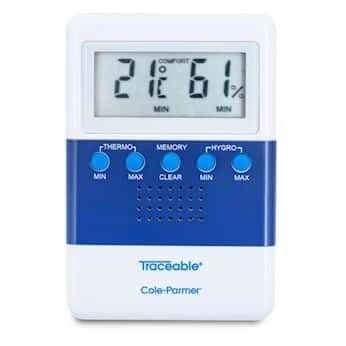
- LCD display with min/max memory
- Runs on two AAA batteries
- No data logging or alarm features
Best For: Labs wanting a basic no-frills meter
Industrial Accuracy Pick
SMARTRO SC42 Professional Digital Hygrometer
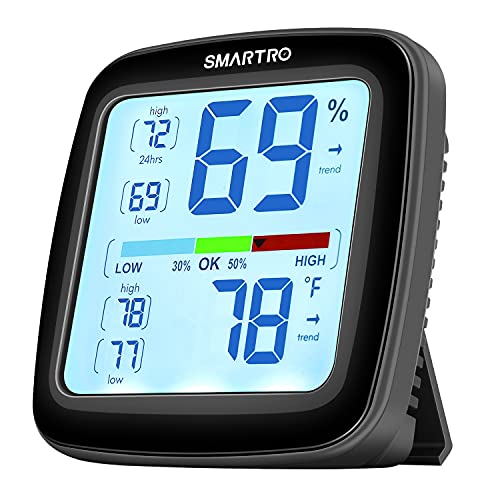
- Swiss sensors update readings every 10 seconds
- 2% RH humidity accuracy and 0.5°F temp tolerance
- Backlit 3.5-inch display with max/min tracking
Best For: Bench-top lab checks and simple environmental monitoring
Multi-Mode Technical Meter
Protmex HT607 Temperature Humidity Meter

- Reads temperature, RH, wet bulb, and dew point
- Data hold, min/max, backlight, and auto shutoff
- Portable ABS body with protective sensor cover
Best For: Portable technical spot checks in lab and HVAC settings
Smart Remote Monitor
Govee Indoor Hygrometer Thermometer H5075
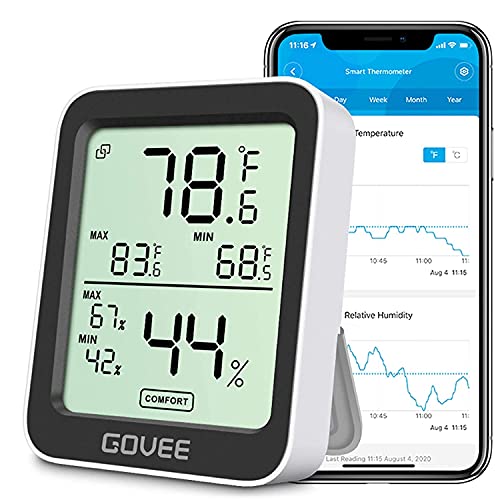
- Bluetooth app control with remote alerts
- 2-second refresh and ±3% RH humidity accuracy
- Stores and exports up to 2 years of data
Best For: Tracked environments that need alerts and history logs
Compact Spot Checks
Mini 2-in-1 Hygrometer Thermometer

- Small digital thermometer/hygrometer
- ±2°F temp and ±5% RH humidity accuracy
- Updates every 10 seconds with included batteries
Best For: Small-scale monitoring in tight spaces and compact enclosures
App-Based Monitoring
Govee 3-Pack Bluetooth Hygrometer

- Bluetooth app control with alerts
- ±0.54°F temp and ±3% RH accuracy
- Stores data and exports CSV files
Best For: Multi-location monitoring with app alerts and trend tracking
Advanced Readouts
Protmex PT6508 Psychrometer Meter
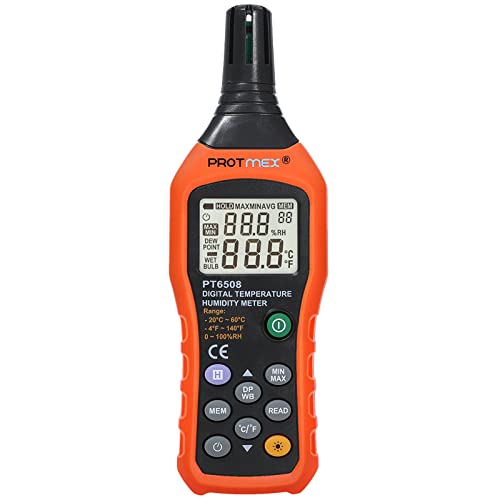
- Measures humidity, temp, dew point, and wet bulb
- Wide 0% to 100% RH range
- Includes min/max, data hold, and backlight
Best For: Technical users needing broader environmental measurements
Calibrated Lab-Grade Pick – Traceable NIST Calibrated Hygrometer
If you need a humidity monitoring system for laboratory use with straightforward readings and calibration confidence, this Traceable NIST calibrated hygrometer is built for that kind of job. It measures temperature from 32 to 120°F and relative humidity from 10 to 90% RH, with specified accuracy of ±5% RH from 40 to 80% RH and ±8% outside that range.
Best For: Labs that want a simple wall-mount humidity and temperature indicator with NIST calibration.
Pros:
- NIST calibrated with a precalibrated humidity and temperature indicator included
- Wall-mount design suits fixed monitoring points
- Useful 10 to 90% RH range for general lab environments
- Compact, battery-powered setup with AAA battery support
Cons:
- No data logging or smart alerts listed
- Accuracy is tighter only within 40 to 80% RH
- Basic display-style monitoring rather than advanced system features
For a lab that prioritizes calibrated, no-frills humidity checks over connectivity or logging, this is a practical pick. It is best viewed as a dependable local monitor for routine environmental checks.
Smart Connected Monitor – TP-Link Tapo T310 Sensor
For a humidity monitoring system for laboratory spaces that benefits from alerts and remote visibility, the Tapo T310 adds smart features to a compact sensor. It uses a Swiss-made sensor for real-time updates every 2 seconds and records temperature and humidity data with free storage and export history.
Best For: Lab users who want connected monitoring, periodic summaries, and real-time notifications.
Pros:
- Real-time updates every 2 seconds with Swiss-made sensor accuracy
- Free data storage and 2 years of exportable history
- Can trigger other Tapo smart devices when readings move outside preset ranges
- Includes wall-mount accessories like adhesive and magnet options
Cons:
- Requires a Tapo Hub H100 and secured 2.4 GHz Wi-Fi
- Battery-powered sensor depends on hub-based communication, not direct Wi-Fi
- Best functionality is tied to the Tapo ecosystem
This is a strong choice if your lab wants more than a basic meter and values notifications and historical data. Just plan for the required hub before adding it to your setup.
Budget Dual-Pack Choice – JEDEW Digital Hygrometer 2-Pack
If you are assembling a humidity monitoring system for laboratory benches, storage areas, or multiple workspaces, this JEDEW 2-pack gives you basic digital monitoring at a low-complexity level. It measures temperature from 32 to 158°F and humidity from 10 to 99% RH, with stated accuracy of ±1°F and ±3% RH.
Best For: Labs that need inexpensive, portable monitoring in more than one spot.
Pros:
- Two sensors in one package for monitoring multiple locations
- Wide 10 to 99% RH range and 32 to 158°F temperature range
- Fast updates every 10 seconds
- Portable freestanding design with tape included for placement
Cons:
- No logging, alarm, or connectivity features listed
- Basic LCD format rather than a dedicated monitoring platform
- Runs on LR44 button cells, so batteries will need replacement over time
This makes sense when you want simple, readable humidity checks in several spots without paying for advanced system features. It is a practical entry-level option for basic lab oversight.
Simple Display Meter – Traceable Digital RH/Temp Meter
When you want a humidity monitoring system for laboratory use without extra software or logging, this Traceable digital meter keeps the setup simple. It uses an LCD display, runs on two AAA batteries, and includes min/max memory for tracking recent conditions.
Best For: Labs that want a basic handheld-style relative humidity and temperature meter.
Pros:
- Simple LCD display for quick readings
- Min/max memory helps review recent changes
- Battery-powered with two AAA batteries
- No data logging means a straightforward, low-maintenance tool
Cons:
- No alarm function listed
- No data logging capability
- Limited feature set compared with connected monitors
This is a sensible pick if you need a basic meter for spot checks rather than a more advanced monitoring network. It focuses on essential measurement and nothing more.
Industrial Accuracy Pick – SMARTRO SC42 Professional Digital Hygrometer
If you need a humidity monitoring system for laboratory-style spot checks, the SMARTRO SC42 is built around fast, repeatable readings and easy visibility. Its Swiss sensors update every 10 seconds, and the unit is pre-calibrated with manual calibration support, making it a practical choice when you want dependable temperature and humidity monitoring without app connectivity.
Best For: Benchtop or wall-mounted environmental checks where accurate, easy-to-read readings matter more than smart features.
Pros:
- Swiss-sensor design with stated humidity accuracy of 2% RH and temperature tolerance within 0.5°F.
- Large 3.5-inch backlit LCD makes readings easy to see in low light.
- Displays 24-hour and all-time max/min records for tracking changes over time.
- Flexible placement with stand, magnets, and wall-mount hole.
Cons:
- No phone or app connectivity.
- Backlight is temporary rather than always on.
- AAA batteries are required but not included.
For a straightforward lab humidity monitor, the SC42 focuses on core measurement quality and simple day-to-day use. It is a strong fit when you want a compact, calibrated display that can be mounted or set on a table.
Multi-Mode Technical Meter – Protmex HT607 Temperature Humidity Meter
The Protmex HT607 is a practical humidity monitoring system for laboratory use when you want more than basic temperature and RH readings. It adds wet bulb and dew point modes, plus min/max hold and a backlit screen, so you can capture a fuller picture of ambient conditions in a compact handheld format.
Best For: Users who want a portable, multi-function meter for lab, HVAC, or technical spot measurements.
Pros:
- Measures ambient temperature, relative humidity, wet bulb temperature, and dew point.
- High-precision probe sensor is designed for fast response and stronger anti-interference.
- Includes data hold, min/max functions, unit conversion, backlight, and auto shutdown.
- Protective cover and rugged ABS build help with portability and handling.
Cons:
- Tabletop handheld design is less suited to fixed, continuous monitoring.
- Temperature range tops out at 60°C.
- No remote app or data export features are listed.
The HT607 stands out if your lab workflow benefits from dew point and wet bulb readings in addition to standard humidity values. It is a versatile field-style meter for quick checks, not a networked monitor.
Smart Remote Monitor – Govee Indoor Hygrometer Thermometer H5075
For a humidity monitoring system for laboratory setups that benefit from remote oversight, the Govee H5075 adds Bluetooth app control, alerts, and long-term data storage. It is designed for watching temperature and humidity trends over time, with fast sensor refreshes and exportable records that make it easier to review environmental changes.
Best For: Lab spaces, storage rooms, or controlled environments where Bluetooth alerts and history tracking are useful.
Pros:
- Bluetooth app support enables remote monitoring within the stated 164 ft range.
- Fast 2-second refresh rate and Swiss-made sensor with ±3% RH humidity accuracy.
- Stores and exports up to 2 years of historical data in CSV format.
- Smart alerts notify you when temperature or humidity moves outside preset limits.
Cons:
- Requires Bluetooth proximity rather than Wi-Fi connectivity.
- Temperature range is more limited than some industrial meters.
- Best suited to tabletop placement rather than wall mounting.
The H5075 is the most data-focused option here, especially if you want to review trends or receive alerts without standing beside the unit. It is a strong fit for monitored rooms where logs matter as much as the live reading.
Compact Spot Checks – Mini 2-in-1 Hygrometer Thermometer
If you need a simple humidity monitoring system for laboratory-style spot checks, this mini hygrometer gives you quick temperature and humidity readings in a very small footprint. It updates automatically every 10 seconds and is easy to place on a tabletop, in a small enclosure, or wherever you need a fast readout without extra setup.
Best For: Small-scale monitoring in tight spaces, jars, tanks, and compact work areas
Pros:
- 2-in-1 thermometer and hygrometer in a compact digital design
- Temperature accuracy is listed at ±2°F and humidity accuracy at ±5% RH
- Wide reading range from -58°F to 158°F and 10% to 99% RH
- Runs on included LR44 batteries with up to 8 months of battery life
Cons:
- No app connectivity or data logging
- Best suited to local readings rather than centralized monitoring
- Small display may be less ideal for long-distance viewing
For buyers who mainly want straightforward, on-the-spot environmental readings, this model keeps things easy. It is a practical fit when you value portability and simple tracking more than advanced monitoring features.
App-Based Monitoring – Govee 3-Pack Bluetooth Hygrometer
For a humidity monitoring system for laboratory tasks that benefit from remote visibility, this Govee 3-pack adds Bluetooth app control, alerts, and data history. The sensors refresh quickly and can notify you when temperature or humidity moves outside your preset range, which is useful when you want closer oversight of multiple locations at once.
Best For: Multi-location monitoring with app alerts and stored trend data
Pros:
- Bluetooth app control with a 196 ft/60 m range
- High accuracy: ±0.54°F temperature and ±3% RH humidity
- Fast 2-second refresh rate helps capture changes quickly
- Supports smart alerts plus data storage and CSV export
Cons:
- Requires the Govee Home app for setup and monitoring
- Bluetooth range is more limited than internet-connected systems
- Designed for room monitoring rather than specialized lab instrumentation
This is a strong choice if you want to watch several spaces and review patterns over time. The three-sensor pack, alerting, and exportable data make it more capable than a basic standalone meter.
Advanced Readouts – Protmex PT6508 Psychrometer Meter
If your humidity monitoring system for laboratory or technical work needs more than basic temperature and RH readings, the Protmex PT6508 adds dew point, wet bulb, min/max, and data hold functions. It is built as a digital psychrometer with a broad measurement range, making it better suited to detailed environmental checks than a simple hygrometer.
Best For: Technical users who need dew point, wet bulb, and broad-range readings
Pros:
- Measures humidity, temperature, dew point, and wet bulb temperature
- Wide ranges include 0% to 100% RH and -20°C to 60°C temperature
- Includes data hold, min/max, backlight, and auto shutoff
- Comes with AAA batteries, carrying bag, and manual
Cons:
- Single-unit design is less scalable than multi-sensor packs
- No app-based remote monitoring or export features
- More technical than necessary for simple room checks
This model stands out when you want deeper environmental context from one handheld device. Its extra psychrometer functions make it a better fit for users who need more than standard humidity and temperature monitoring.
How We Picked the Best Humidity Monitoring System for Laboratory Use
We focused on the features that matter most in controlled environments: measurement accuracy, calibration support, data visibility, alerting, and ease of placement. A strong Humidity Monitoring System for Laboratory work should be dependable enough for routine checks and practical enough for day-to-day use.
We also considered whether the device supports temperature readings, since humidity and temperature are closely linked in lab management. Smart connectivity, logging, and remote access were treated as useful extras rather than replacements for measurement quality.
Quick Comparison: What the 10 Picks Offer
These products fall into a few clear groups: calibrated professional meters, smart app-connected sensors, and budget-friendly digital hygrometers. The calibrated and professional models are best suited for labs that need tighter control, while app-based and multi-pack options work well for monitoring multiple rooms, cabinets, or storage areas.
If you need a Humidity Monitoring System for Laboratory compliance or documentation, prioritize accuracy and calibration. If your goal is broader coverage across several spaces, look for easy deployment, remote alerts, and readable displays.
Key Buying Factors for a Humidity Monitoring System for Laboratory
Accuracy and Calibration
Choose a monitor with clear stated accuracy and, when possible, calibration support or calibration-ready design. In lab environments, even a small drift can matter over time.
Data Access and Alerts
Consider whether you need local readings only or remote monitoring through an app. Alerts are especially helpful for refrigerators, storage rooms, incubators, and archive spaces where humidity spikes can go unnoticed.
Temperature Tracking
Humidity and temperature influence each other, so combined sensors are usually the better choice. A device that tracks both gives you a more complete picture of environmental stability.
Coverage and Placement
Think about how many areas you need to monitor. Single-room labs may only need one unit, while larger facilities often benefit from multiple sensors placed in critical zones.
Display and Usability
Readable screens, simple setup, and intuitive controls matter when several staff members rely on the same device. For fast checks, a clear display can be more useful than a feature-heavy app.
Who Should Buy Which Humidity Monitoring System for Laboratory?
Buy a professional calibrated model if you need higher confidence for sensitive storage, routine verification, or more formal lab oversight. Choose a smart Bluetooth or hub-based sensor if remote monitoring and alerts are your priorities. Pick a budget digital hygrometer if you need broad coverage across multiple rooms without spending heavily.
For many buyers, the best Humidity Monitoring System for Laboratory use is the one that matches the environment, the documentation burden, and the number of spaces you need to watch consistently.