Choosing the right digital food moisture analyzer can save time, reduce waste, and improve product consistency. Whether you test meat, grains, powders, herbs, or prepared foods, the best models balance speed, precision, and ease of use.
Below, we focus on analyzers that are practical for real-world food testing, with clear attention to accuracy, heating performance, capacity, and workflow fit.
Best 10 Digital Food Moisture Analyzer Picks for 2026
Rapid Lab Moisture Analyzer
Portable Halogen Moisture Meter

- Halogen heating and precision sensors deliver fast readings
- Temperature adjusts from 40°C to 160°C in 1°C steps
- Stores 20 data sets and supports printer output
Best For: Food, plant, grain, and lab samples that need quick moisture checks
Compact Meat Moisture Tester

- Measures moisture from 0.01% to 100%
- General samples test in about 3 to 5 minutes
- RS232 output connects to printers and computers
Best For: Meat and ingredient testing with quick automated readings
Feature-Rich Grain Analyzer
JOANLAB MBA1102A Moisture Analyzer
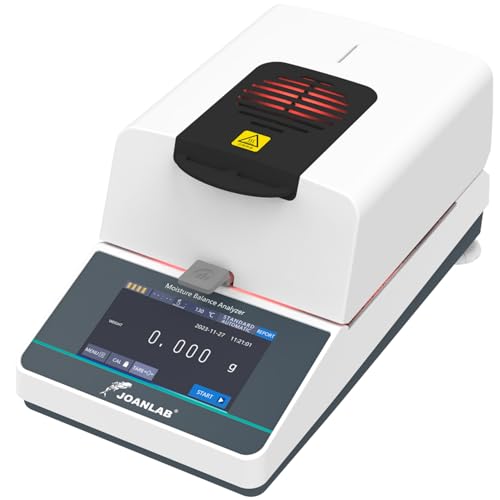
- Touchscreen model with automatic and timing modes
- Three drying modes plus 20 saved methods
- RS232 output for printer or computer transfer
Best For: Lab and production testing that benefits from saved methods
Portable Raw Material Meter
High Frequency Food Moisture Meter

- Portable 210g body with backlit LCD
- Measures 0 to 80% moisture at ±0.5% accuracy
- 235mm needle helps with deeper raw material testing
Best For: On-site checks of meat, paste, puree, and seeds
Lab-Ready Quick Moisture Pick
U.S. Solid 0.01 g Touchscreen Analyzer
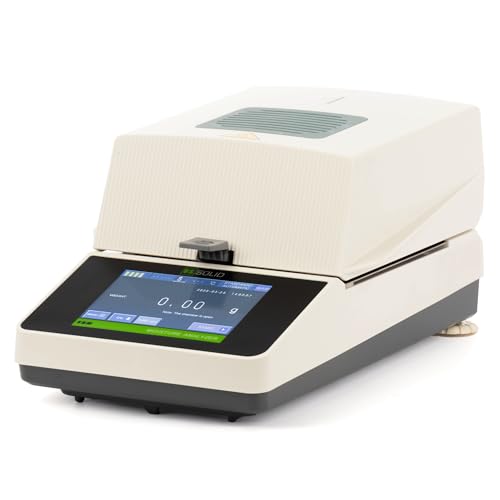
- 0.01 g readability and 0.1% moisture measurement
- 250 W halogen heating up to 160°C
- 5-inch touchscreen with 20 stored methods
Best For: Small labs and QC workflows that need quick, repeatable moisture testing
High-Precision Fast Tester
WapoRich 0.001g Moisture Meter

- 0.001 g precision with halogen rapid heating
- 5-inch touchscreen for easy setup
- Stores 100 records and supports RS232 printing
Best For: Coffee roasters and production users needing fast, precise moisture checks
Heavy-Duty Accuracy Choice
U.S. Solid 5 mg Halogen Analyzer
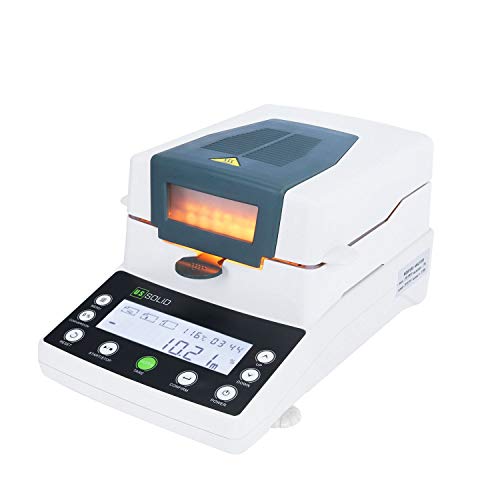
- 5 mg readability with 0.1% moisture measurement
- 450 W halogen heating up to 199°C
- 15 preset method groups and RS-232 output
Best For: Food, grain, and lab testing where higher precision and hotter drying matter
Compact Fast-Read Lab Analyzer
DHS-16A Touch Screen Moisture Meter

- 50g capacity with 0.001g readability
- Halogen heating for quicker test times
- Touch screen, backlit LCD, RS232 support
Best For: small labs needing fast, precise food moisture testing
High-Capacity Precision Pick
120g Halogen Moisture Analyzer

- 120g capacity with 0.001g precision
- 4 drying programs and 3 shutdown modes
- Stores 100 records with RS232 support
Best For: labs and QC teams needing programmable moisture testing
Simple Menu-Controlled Choice
110g Touch Screen Balance Meter

- 110g capacity with 0.001g readability
- 34 memory programs for repeat testing
- 5-inch touchscreen with RS232 output
Best For: buyers wanting easy preset-based moisture testing
Rapid Lab Moisture Analyzer – Portable Halogen Moisture Meter
If you need a digital food moisture analyzer that can replace slow oven-drying methods, this portable halogen model is built for speed and simplicity. It uses halogen heating, precision sensors, and a fast weighing processor to deliver results in minutes, with adjustable temperature and timing controls for a range of sample types.
Best For: Fast moisture testing in food, plants, grains, and other lab or production samples.
Pros:
- Rapid halogen heating cuts test time versus traditional drying methods
- Adjustable 40°C to 160°C temperature range in 1°C steps
- Stores up to 20 historical data sets for basic recordkeeping
- Includes printer interface for easy result output and documentation
Cons:
- Compact lab-style setup may be more than casual kitchen users need
- Best suited to small samples rather than high-volume production
This is a practical pick if you want quick, repeatable moisture measurements and built-in data handling in one unit. It emphasizes testing efficiency and broad sample compatibility over simple handheld convenience.
Compact Meat Moisture Tester – Gowe Fast Meat Moisture Meter
For buyers looking for a digital food moisture analyzer focused on meat and similar raw materials, this Gowe unit emphasizes fast turnaround and a simple automatic workflow. It measures moisture from 0.01% to 100%, supports small sample sizes, and is designed to finish general tests in about 3 to 5 minutes.
Best For: Meat and raw material moisture checks where quick, automated testing matters.
Pros:
- Fast test cycle, with general samples taking about 3 to 5 minutes
- Wide moisture measurement range from 0.01% to 100%
- Automatic mode helps simplify operation
- RS232 connection supports computer and printer linkage
Cons:
- Requires 220V power, so it is less flexible for portable use
- Basic product details are less polished than newer touchscreen models
This model is best if you want straightforward moisture analysis for meat or ingredient testing without a complicated setup. Its strengths are speed, broad range, and external data connection options.
Feature-Rich Grain Analyzer – JOANLAB MBA1102A Moisture Analyzer
This digital food moisture analyzer is a strong fit for users who want a lab-style instrument with more control over testing. The JOANLAB MBA1102A combines halogen heating, a touchscreen interface, multiple drying modes, and storage for up to 20 test methods, making it well suited to repeatable moisture measurement workflows.
Best For: Lab and production users who need flexible testing modes and saved methods.
Pros:
- Touchscreen interface with automatic and timing modes
- Three drying modes: standard, fast, and soft
- Stores up to 20 testing methods for repeat use
- RS232 support for printing or computer data transfer
Cons:
- More advanced than a basic handheld moisture meter
- Primarily aimed at lab-style workflows rather than simple field checks
Choose this one if you want a capable, configurable analyzer for food, agriculture, or other moisture-sensitive materials. It offers the kind of flexibility that helps when the same testing routine is used again and again.
Portable Raw Material Meter – High Frequency Food Moisture Meter
If you need a digital food moisture analyzer for raw ingredients rather than a benchtop lab instrument, this high-frequency model is built for quick field use. It measures moisture from 0 to 80% with stated accuracy of ±0.5%, uses a large backlit LCD, and stays lightweight enough to carry to different testing locations.
Best For: Portable moisture checks on meat stuffing, bean paste, puree, seeds, and similar raw foods.
Pros:
- Portable 210g design is easy to move between work areas
- Measures a wide 0 to 80% moisture range
- ±0.5% accuracy is suitable for practical raw material checks
- 235mm needle supports deeper measurement, with longer options available
Cons:
- More specialized for raw materials than finished products
- Battery-powered design may not suit every fixed lab workflow
This is the most field-friendly option in the group if you need fast moisture checks on soft or raw food materials. Its portability and probe-based design make it a sensible choice for on-site quality control.
Lab-Ready Quick Moisture Pick – U.S. Solid 0.01 g Touchscreen Analyzer
If you need a digital food moisture analyzer for fast lab-style testing, this U.S. Solid unit focuses on simple operation and practical output. It combines halogen drying with weighing, offers a 5-inch color touchscreen, and supports multiple drying modes for foods, grains, and other sample types.
Best For: Small labs and quality-control users who want an easy-to-run moisture balance with touchscreen controls and basic data export.
Pros:
- 0.01 g readability with 0.1% moisture measurement
- 250 W halogen heating with adjustable temperature up to 160°C
- 5-inch color touchscreen with up to 20 stored test methods
- RS-232 output and 50 sample pans included
Cons:
- 110 g maximum capacity may be limiting for larger samples
- Requires manual calibration with a 100 g weight
- Best suited to controlled testing rather than portable use
This model is a solid fit if you want straightforward moisture testing with useful method storage and display options. Its balance of touchscreen convenience and halogen drying makes it practical for routine analysis.
High-Precision Fast Tester – WapoRich 0.001g Moisture Meter
This digital food moisture analyzer is built for users who want fast readings and finer precision than a basic moisture tester. The WapoRich unit uses rapid halogen heating, a 5-inch touchscreen, and a high-sensitivity sensor to handle coffee beans, nuts, wood pellets, dried foods, and other sample types.
Best For: Coffee roasters, food producers, and lab users who want quick moisture readings with 0.001 g precision.
Pros:
- 0.001 g precision for detailed moisture analysis
- Rapid halogen heating delivers results in minutes
- 5-inch touchscreen makes setup simple
- Stores up to 100 test records and supports RS232 printing
Cons:
- Specific sample capacity is not highlighted in the notes
- Designed for bench use with AC power, not portability
- Best value depends on whether you need higher precision or basic testing
If your workflow depends on quick turnaround and detailed measurement logs, this model offers a very strong feature set. It stands out most for precision, record storage, and ease of operation in food and production settings.
Heavy-Duty Accuracy Choice – U.S. Solid 5 mg Halogen Analyzer
For buyers comparing a digital food moisture analyzer for tougher testing needs, this U.S. Solid model emphasizes accuracy, higher heat, and flexible method storage. It is designed for food, grain, chemicals, and lab work, with halogen drying that reaches higher temperatures and a 5 mg readability for more detailed results.
Best For: Users who want a higher-precision moisture balance for food, grain, or lab samples with stronger drying performance.
Pros:
- 5 mg readability and 0.1% moisture measurement
- 450 W halogen heating with drying up to 199°C
- Supports 15 preset method groups for repeat testing
- RS-232 export and 50 sample pans included
Cons:
- Higher output and feature set may be more than casual users need
- 110 g capacity still limits larger batch testing
- Manual calibration is required with a 100 g weight
This is the most performance-focused option in the group for users who want tighter readability and hotter drying. It makes sense when repeatability and data handling matter more than simplicity alone.
Compact Fast-Read Lab Analyzer – DHS-16A Touch Screen Moisture Meter
This digital food moisture analyzer is built for quick lab-style moisture testing across powders, herbs, tea, meat, and other food samples. Its 50g capacity, 0.001g readability, and halogen heating setup make it a practical choice when you want faster drying and an easy-to-read result in a compact instrument.
Best For: Small labs and food testers who want a touch-screen halogen analyzer with fast heating and RS232 output.
Pros:
- 0.001g readability for fine measurement detail.
- Halogen heating supports faster warming and shorter test times.
- Touch screen and backlit LCD make operation easier in dark work areas.
- RS232 interface can connect to computers and printers.
Cons:
- 50g capacity is modest compared with larger lab models.
- Uses a straightforward feature set without the more advanced program options found on some competitors.
Overall, this model fits buyers who want a capable digital food moisture analyzer with strong readability and a simple workflow. It looks especially useful for routine moisture checks where quick drying and clear display visibility matter.
High-Capacity Precision Pick – 120g Halogen Moisture Analyzer
For buyers comparing a digital food moisture analyzer with more control over drying, this model stands out for its 120g capacity, 0.001g precision, and 40℃-180℃ custom temperature range. It is designed for lab and quality-control work where you may want multiple drying programs, stored records, and easy data output.
Best For: Labs, food testing, and quality control users who need higher capacity plus programmable drying options.
Pros:
- 120g maximum capacity suits larger sample loads.
- 0.001g precision and 0.01% moisture readability support detailed testing.
- 4 drying programs and 3 shutdown modes add flexibility.
- Stores up to 100 records and supports RS232 printing/export.
Cons:
- More advanced controls may be more than casual users need.
- Bulkier 8.4 lb design is less portable than mini units.
This is a strong fit if you want a moisture analyzer that balances precision with automation and recordkeeping. The configurable drying settings and touchscreen interface make it better suited to repeat testing than basic one-off measurements.
Simple Menu-Controlled Choice – 110g Touch Screen Balance Meter
If you want a digital food moisture analyzer that is easy to set up and use, this model offers a 5-inch touch screen, 34 memory programs, and automatic/timing drying modes. With 110g capacity and 0.001g readability, it is aimed at food, agriculture, chemical, and pharmaceutical testing where quick access to saved settings matters.
Best For: Users who want straightforward operation, saved drying programs, and broad sample compatibility.
Pros:
- 110g capacity with 0.001g readability.
- 34 memory programs reduce reconfiguration between tests.
- 5-inch touch screen and simple two-mode operation are easy to learn.
- RS232 interface supports computer or printer connection.
Cons:
- Only two drying modes are listed, so it is less flexible than some rivals.
- 110V power may limit use in some locations without suitable power.
This option makes sense for buyers who value convenience and preset workflows over deeper customization. The saved programs and touch interface should help streamline repeated testing in busy lab environments.
How We Picked the Best Digital Food Moisture Analyzer
We prioritized models that offer dependable measurement precision, stable halogen or high-frequency heating, reasonable sample capacity, and clear user controls. For food testing, repeatability matters as much as raw speed, so we favored analyzers with useful readability and temperature control over flashy extras.
Quick Comparison
At a glance, these products split into two broad groups: compact portable units for quick spot checks and larger laboratory-style analyzers for higher-throughput or more repeatable testing. If you need a Digital Food Moisture Analyzer for production work, look closely at readability, max sample size, and drying program options. If you need occasional checks, a simpler portable unit may be enough.
Key Buying Factors for Digital Food Moisture Analyzer
Accuracy and Readability
Lower readability values generally mean finer measurement increments, which can matter for products where small moisture changes affect quality or shelf life. Check both the displayed resolution and the claimed repeatability, especially if you test ingredients with tight specifications.
Heating Method and Drying Range
Halogen heating is common because it dries samples quickly and evenly. A wider temperature range gives you more flexibility across foods with different moisture profiles. Multi-step drying modes can also help if you test varied materials.
Capacity and Pan Size
Sample capacity affects how much material you can test in one run. Larger capacities are useful for bulk ingredients or production batches, while smaller capacities can still work well for lab samples and high-value foods.
Ease of Use and Workflow
Touchscreen controls, language options, preset programs, and straightforward menus reduce training time. If multiple people will use the device, look for a layout that makes setup, calibration, and result reading simple.
Who Should Buy Which Digital Food Moisture Analyzer?
Buy a compact or portable analyzer if you need quick checks for meats, bean pastes, coffee beans, or raw materials and value speed over advanced programming. Choose a lab-grade model if you need better repeatability, more drying control, or higher sample throughput for QA and production use.
For most buyers, the best Digital Food Moisture Analyzer is the one that matches the sample type, target precision, and testing volume—not simply the highest advertised specification. Matching the instrument to your workflow is the fastest way to get reliable results.