The best document cameras for home studios make it easier to share books, artwork, handwritten notes, products, and demonstrations without crowding your desk. The right model can also double as a webcam or overhead camera for lessons, livestreams, and remote meetings.
We compared these 10 options by image quality, focusing flexibility, connectivity, lighting, microphone features, and ease of setup so you can choose a camera that fits your workspace and workflow.
Best 10 Document Cameras for Home Studios Picks for 2026
Best Value for Everyday Demos
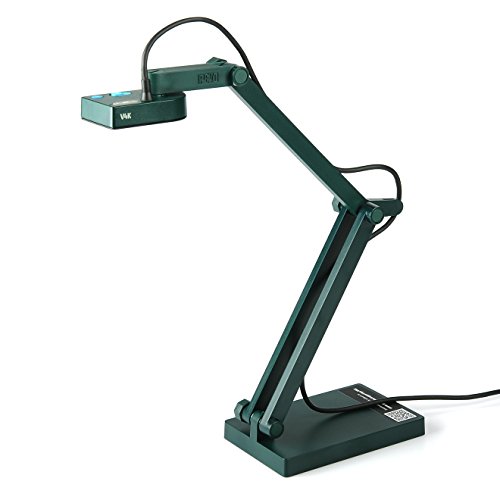
- 8MP capture up to 3264 × 2448
- Up to 30 fps at Full HD
- Mac, Windows, and Chromebook compatible
Best For: Everyday lessons, demos, and remote presentations
Best for Large Artwork

- 4K at 30 fps with a 13MP sensor
- Captures documents up to A3 size
- Includes lighting, OCR, and annotation tools
Best For: Artwork, two-page spreads, and large-format presentations
Best Wide-Angle Pick

- 120° lens for broad tabletop coverage
- 4K capture with swift autofocus
- AI noise reduction for calls
Best For: Wide demonstrations, larger objects, and video conferencing
Best for Scanning and Accessibility
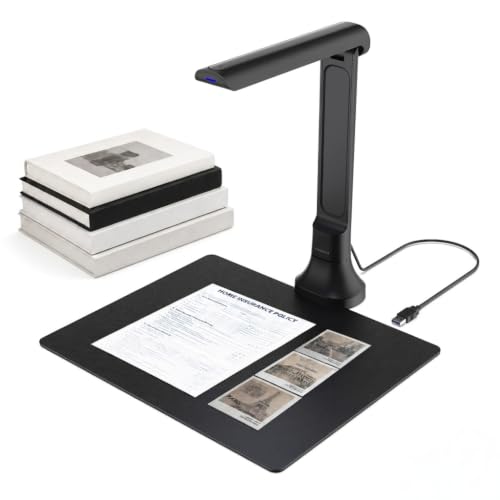
- 16MP autofocus camera
- OCR and text-to-speech features
- Foldable 350-gram design
Best For: Book scanning, home offices, and accessible document workflows
Best Wireless Pick
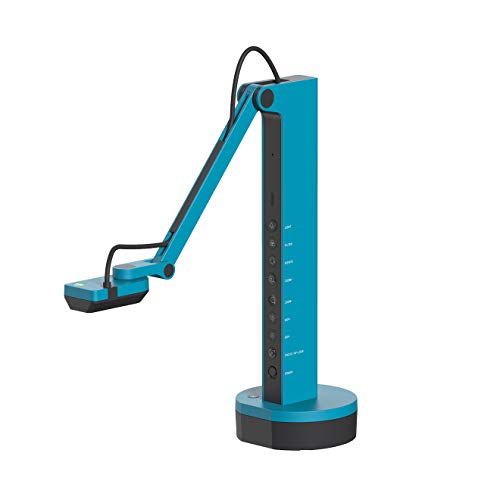
- Wi-Fi, HDMI, and USB connectivity
- 8MP sensor with near-4K USB capture
- 9–12-hour battery and adjustable stand
Best For: Wireless presentations and multi-device home studios
Best USB Studio Camera

- 8MP capture with 30fps streaming
- Autofocus, macro mode, and built-in LED
- Documate software includes annotations and recording
Best For: Compact USB-connected desktop setups
Best for Large Materials

- Wide A3/A4 shooting coverage
- Flexible folding arm for overhead views
- Autofocus, three-level LED, and USB plug-and-play
Best For: Artwork, books, crafts, and large desk demonstrations
Best Adjustable 4K Visualiser

- 8MP/2448P capture at 30fps
- Manual image reversal and brightness controls
- Foldable A3 visualiser with dual microphones
Best For: Flexible home-studio demonstrations and overhead capture
Best Compact USB Option

- 8MP/2448P capture with one-touch autofocus
- Foldable arm covers A3 and A4 formats
- Three LED levels and manual image reversal
Best For: Portable USB demonstrations on compatible computers
Best Plug-and-Play Pick
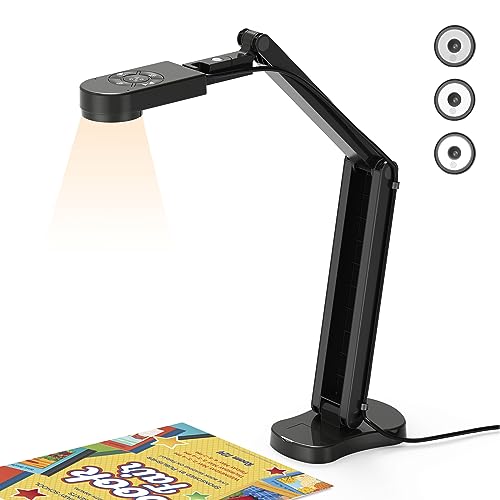
- 8MP capture with 30fps live transmission
- Automatic driver installation for major computer platforms
- Foldable A3 visualiser with ring light and dual microphones
Best For: Quick computer-based presentations and demonstrations
Best Value for Everyday Demos – IPEVO V4K
The IPEVO V4K is a practical choice among document cameras for home studios, offering 8MP detail, quick autofocus, and smooth Full HD streaming for lessons, demonstrations, and video calls.
Best For: Home educators, remote presenters, and creators who need a compact USB camera for documents and tabletop demonstrations.
Pros:
- Captures up to 3264 × 2448 resolution with an 8MP Sony CMOS sensor.
- Streams at up to 30 fps in Full HD for responsive live demonstrations.
- Autofocus and a multi-jointed stand help with frequent material changes and positioning.
- Works with Mac, Windows, and Chromebook software through USB.
Cons:
- The maximum shooting area is about 13.46 × 10.04 inches.
- Full-resolution 3264 × 2448 streaming is limited to 15 fps.
- Listed system requirements may be demanding for older computers.
Its fast focus and broad software compatibility make the V4K a dependable starter option for a home studio, especially when smooth Full HD streaming matters more than the largest capture area.
Best for Large Artwork – INS-2 UHD 4K
The INS-2 UHD 4K stands out among document cameras for home studios when you need to show artwork, two-page spreads, or larger documents. Its A3 capture support and 13MP Sony sensor suit detailed presentations.
Best For: Art instructors, educators, and presenters working with large documents, artwork, or physical displays.
Pros:
- Records 4K video at 3840 × 2160 and 30 fps.
- Flexible multi-joint arm supports documents up to A3 size.
- Includes LED lighting, anti-glare sheet, brightness control, and dual-mode autofocus.
- Documate software adds annotation, OCR, recording, scanning, and whiteboard tools.
Cons:
- Its larger design weighs about 2.3 pounds.
- Compatibility depends on specified operating-system versions for some devices.
- Digital zoom is provided rather than optical zoom.
With its large capture area and presentation-focused software, the INS-2 is a strong fit for creators who regularly display artwork or oversized materials rather than only standard sheets.
Best Wide-Angle Pick – IPEVO V4K PRO 120
The IPEVO V4K PRO 120 is designed for home studios that need a broad view. Its 120-degree lens can cover tabloid-size documents and larger objects while also functioning as a USB webcam for conferencing.
Best For: Presenters, streamers, and remote workers who need wide tabletop coverage alongside webcam functionality.
Pros:
- The 120-degree lens provides a wide capture range for tabloid-size materials and objects.
- 4K capture, a Sony CMOS sensor, LED light, and swift autofocus support clear demonstrations.
- AI noise reduction helps reduce ambient background noise during calls and presentations.
- Plug-and-play USB compatibility works with Mac, Windows, Chromebooks, and major conferencing platforms.
Cons:
- The listed effective still resolution is 8MP rather than 13MP or 16MP.
- Its broad field of view may show more surrounding workspace than a narrower document camera.
- The camera weighs about 860 grams, so it is less lightweight than some portable models.
This model is especially appealing when a home studio serves multiple roles: document camera, tabletop object camera, and wide-angle webcam. The built-in noise reduction adds useful support for calls.
Best for Scanning and Accessibility – VIISAN DB8401
The VIISAN DB8401 expands the role of document cameras for home studios by combining a 16MP camera with book scanning, OCR, text-to-speech, and AI-assisted tools. Its foldable design also helps conserve desk space.
Best For: Home offices, study spaces, language learners, and users who need scanning, searchable text, or read-aloud features.
Pros:
- 16MP autofocus imaging captures documents, books, photos, and 3D objects.
- OCR can convert scans into editable Word, Excel, PDF, and searchable text files.
- Text-to-speech and multilingual recognition support accessibility and language learning.
- Foldable, 350-gram design is portable and works with Windows and macOS without drivers.
Cons:
- Gemini features require the VisualCam Lite Web UI in Chrome and an AI connection.
- The supplied notes specify Windows and macOS compatibility, not Chromebook support.
- It has a one-year warranty.
Choose the DB8401 if digitizing books and papers is as important as live presentation. Its OCR and read-aloud functions give it a broader productivity role than a basic document camera.
Best Wireless Pick – IPEVO VZ-X
For home studios that need flexible setup options, the IPEVO VZ-X stands out among document cameras for home studios with Wi-Fi, HDMI, and USB connectivity. Its 8MP Sony sensor supports HD capture in Wi-Fi and HDMI modes and near-4K still capture in USB mode, while the swiveling head and multi-jointed stand make it easier to frame documents, artwork, and objects.
Best For: Creators, presenters, and teachers who want wireless operation and broad device compatibility.
Pros:
- Three connection modes: Wi-Fi, HDMI, and USB.
- 8MP sensor with up to 3264 × 2448 USB capture and 30fps HD video.
- Built-in LED, adjustable stand, and up to 9–12 hours of battery life.
- Works with computers, mobile devices, Apple TV, projectors, TVs, and monitors.
Cons:
- Weighs 2.6 pounds, making it less lightweight than simpler USB models.
- Manual focus may require more adjustment during demonstrations.
- Wireless range is listed at up to 33 feet.
The VZ-X is the most versatile option here for a home studio that connects to more than a single computer. Choose it if wireless freedom, HDMI output, and long battery life matter more than a basic plug-and-play workflow.
Best USB Studio Camera – INSWAN INS-1 Classic
The INSWAN INS-1 Classic is a practical USB choice for document cameras for home studios, combining an 8MP Sony camera with autofocus, a built-in LED, and a compact multi-joint design. It connects directly by USB-A and supports Windows, Mac, Chromebook, and compatible iPad setups for conferencing, demonstrations, and overhead content.
Best For: Desktop creators who want a compact, plug-and-play camera with software-based annotation tools.
Pros:
- Captures up to 3264 × 2448 and streams at up to 30fps.
- Autofocus and macro capability can capture objects as close as 3.9 inches.
- Includes LED lighting, seven-segment brightness control, and an anti-glare sheet.
- Bundled Documate software supports annotation, rotation, snapshots, and recording.
Cons:
- Uses USB connectivity rather than wireless or HDMI connections.
- Compatibility depends on the listed operating-system versions and available ports.
- The viewing area is smaller than the A3/A4 coverage claimed by the third model.
With autofocus, a built-in microphone, and useful Documate controls, the INS-1 is well suited to a tidy computer-based studio. It is a strong fit when your workflow centers on one USB-connected computer and software-enhanced presentations.
Best for Large Materials – 8MP A3/A4 USB Document Camera
This 8MP USB document camera is designed for home studios that regularly show books, artwork, crafts, or larger worksheets. Its stated A3/A4 coverage, flexible folding arm, autofocus, three-level LED, and 30fps video make it a practical option for overhead demonstrations and desk-based content.
Best For: Artists, tutors, and presenters who need broad coverage for documents and creative projects.
Pros:
- 8MP capture supports detail up to 2448P for documents and objects.
- A3/A4 coverage accommodates books, artwork, worksheets, and crafts.
- Folding multi-joint arm supports overhead, angled, and front-facing views.
- Plug-and-play USB connection works with common camera, meeting, and OBS software.
Cons:
- Does not support HDMI, Wi-Fi, or Bluetooth.
- Requires a compatible Windows PC, Chromebook, or USB-equipped computer.
- Supplied details list a 3fps continuous shooting speed, despite 30fps video claims.
The broad shooting area and flexible arm make this model appealing for creative demonstrations where repositioning materials would be inconvenient. Select it for coverage and simple USB operation, but look elsewhere if your studio requires wireless or HDMI output.
Best Adjustable 4K Visualiser – Kitchbai KB-700
For home studios that need flexible framing, the Kitchbai KB-700 is a document camera for home studios with 8MP capture, 30fps video, adjustable image reversal, and a foldable multi-joint design. Its brightness controls and built-in microphones make it suitable for demonstrations, video calls, and overhead content.
Best For: Creators and educators who need adjustable A3-size overhead capture with built-in audio.
Pros:
- 8MP/2448P video at up to 30fps with one-touch autofocus
- Manually adjustable left/right and up/down image reversal
- Three LED brightness levels plus 10-step brightness adjustment
- Foldable body, dual microphones, and Windows, macOS, and Chrome OS compatibility
Cons:
- Uses USB connectivity rather than HDMI
- Requires a compatible computer for operation
The KB-700 stands out for home setups where lighting and orientation can change from project to project. Its foldable construction helps conserve desk space, while A3 coverage and macro focusing add versatility for documents and close-up objects.
Best Compact USB Option – PAKOTOO 8MP Document Camera
The PAKOTOO 8MP model is a practical document camera for home studios with A3/A4 coverage, a foldable multi-joint arm, three LED brightness levels, and one-touch autofocus. It connects through USB-C and supports Windows, Mac, and Chromebook computers for online teaching, meetings, and demonstrations.
Best For: Budget-conscious users who want a portable USB camera for documents and 3D objects.
Pros:
- 8MP/2448P resolution with one-touch autofocus
- Three brightness levels and 10 exposure adjustments
- Foldable design with multi-angle positioning and A3 coverage
- Supports manual left/right and up/down image reversal
Cons:
- Not plug-and-play; the USB Camera source must be selected on the computer
- Does not support zoom or HDMI
- Not compatible with iPad according to the supplied notes
This is a straightforward choice when portability and basic overhead presentation matter more than advanced connections. Buyers should plan to select the camera manually in their computer’s system and use a USB-equipped compatible device.
Best Plug-and-Play Pick – THUSTAR 8MP 4K Visualiser
The THUSTAR 8MP visualiser is a document camera for home studios built for quick computer-based setup. It combines 4K-listed video capture, 30fps transmission, A3 coverage, adjustable image orientation, three LED brightness levels, and dual microphones in a foldable USB design.
Best For: Home educators and presenters who want a foldable camera with automatic driver installation.
Pros:
- 8MP/2448P output with 30fps live transmission
- Plug-and-play compatibility with Windows, macOS, and Chrome OS
- 14-bead ring light with three brightness levels and manual brightness adjustment
- Foldable multi-joint body, dual microphones, and close focus to 3.94 inches
Cons:
- Uses USB 2.0 connectivity
- Designed for computer-based use rather than standalone HDMI operation
The THUSTAR is appealing when minimizing setup friction is a priority. Its automatic driver installation, flexible arm, and integrated lighting make it well suited to recurring demonstrations, while the image-invert controls help when presenting writing or camera-facing materials.
How We Picked the Best Document Cameras for Home Studios
We focused on features that matter in a compact home setup: resolution, autofocus performance, capture area, lighting, connection options, portability, and compatibility with common computers and conferencing software. Models offering 4K or high-resolution capture can preserve fine writing and product details, while adjustable arms and image-rotation controls make overhead demonstrations easier to frame.
We also considered practical extras such as built-in microphones, OCR or scanning functions, wireless operation, HDMI output, and foldable designs. These features are not essential for everyone, but they can reduce the need for extra equipment.
Quick Comparison
| Feature | What to look for | Best suited to |
|---|---|---|
| Resolution | 8MP for everyday clarity; 4K for fine details and cropping | Teaching, demonstrations, crafts, and product work |
| Connectivity | USB for simplicity; HDMI or Wi-Fi for flexible setups | Computers, monitors, and wireless presentations |
| Capture area | A3 support provides room for books, artwork, and larger objects | Overhead studio demonstrations |
| Lighting | Built-in LED lights with adjustable levels | Dim rooms and consistent desk illumination |
| Audio | Integrated microphone or dual microphones | Lessons, calls, and narrated livestreams |
Key Buying Factors for Document Cameras for Home Studios
Resolution and Autofocus
Choose 8MP or higher for readable text and sharp demonstrations. A 4K model is especially useful when you need to crop into a frame or show small details. Autofocus helps when moving between a flat page and a three-dimensional object, although manual focus can be preferable for fixed scenes.
Framing and Flexibility
Check the arm design, lens angle, and supported page size. A3-compatible cameras offer more room than A4-only models. Adjustable arms, image inversion, and a wide field of view are valuable when your camera must cover a large workspace.
Connections and Compatibility
USB is usually the easiest choice for Mac, Windows, and Chromebook users. HDMI can connect directly to a display, while Wi-Fi is useful when you want to avoid cables. Confirm that your computer supports the required USB connection and that your preferred meeting or streaming software recognizes the camera as a standard webcam.
Lighting, Audio, and Desk Space
Built-in LEDs help control shadows, but they do not replace good room lighting. Integrated microphones are convenient for calls, though a dedicated microphone will generally provide better sound. If your studio is small, prioritize a foldable or portable design.
Who Should Buy Which Document Cameras for Home Studios?
Choose a straightforward USB 8MP camera if you mainly teach, present documents, or join video meetings. Select a 4K model when fine detail, cropping, or polished demonstrations matters. A wireless model is the better fit for presentations that move between rooms or displays, while a scanner-focused camera suits users who want OCR and document digitization. For craft makers, tutors, and product demonstrators, prioritize A3 coverage, strong autofocus, adjustable lighting, and a flexible arm over headline resolution alone.