Finding reliable signal generators under 200 doesn’t mean settling for stripped-down hardware. Today’s budget-friendly models can still deliver dual channels, arbitrary waveforms, and useful frequency range for everyday lab and DIY work.
Below, we focus on practical value: enough precision for testing, enough flexibility for experimentation, and features that matter most when you need dependable output on a tight budget.
Best 10 Signal Generators Under 200 Picks for 2026
Compact Lab Choice
Koolertron 15MHz Dual-Channel DDS Generator

- Dual-channel DDS with independent settings
- 15MHz sine output and sweep modes
- Stores 99 presets and 60 custom waveforms
Best For: Electronics students and general lab testing
Highest Frequency Pick
Koolertron 80MHz Dual-Channel DDS Counter

- Up to 80MHz sine output
- App and PC software control support
- 100 stored states with custom waveform tools
Best For: Users who want the highest frequency ceiling and app control
Best Feature Set
UNI-T UTG932E 30MHz Dual-Channel Generator
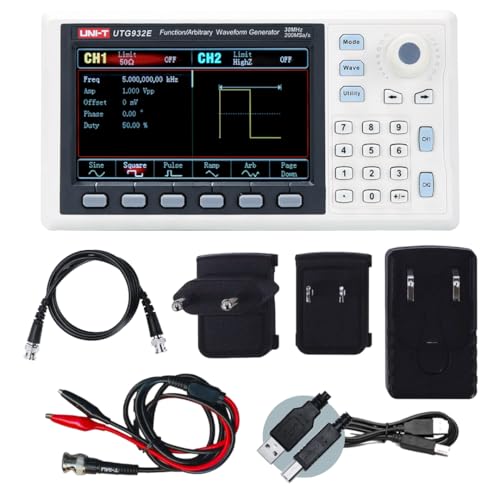
- 30MHz dual-channel output
- Wide modulation set including AM, FM, and PWM
- USB, SCPI, and waveform editing software support
Best For: Flexible bench work that needs many modulation options
Portable Value Pick
SEESII 15MHz Dual-Channel DDS Counter

- Compact 2.2-pound dual-channel design
- 15MHz output with 200MSa/s sampling
- Supports 99 presets and 60 custom waveforms
Best For: Portable lab, teaching, and production tasks
Lab-Grade Dual-Channel Pick
OWON DGE2070 70MHz Arbitrary Waveform Generator

- 70MHz dual-channel output with 300MSa/s sampling
- 14-bit resolution and 150 built-in waveforms
- AM/FM/PM/FSK modulation plus PC control
Best For: Engineers and students who want a portable advanced generator
Budget Counter Combo
YERTAI ET3320C 20MHz DDS Function Generator

- 20MHz dual-channel DDS generator
- Built-in 100MHz frequency counter
- USB communication and waveform editing support
Best For: Budget-minded users needing counting and basic waveform tools
All-in-One Dual Output
SEESII Dual Channel 30MHz DDS Signal Generator

- Independent dual channels with adjustable phase
- 30MHz output, 266MSa/s sampling, 14-bit resolution
- Seven-in-one design with counter, sweeper, and pulse tools
Best For: Users who want a versatile multi-function generator for everyday testing
Portable Precision Pick
GME FG-2020 20MHz Handheld DDS Generator

- Handheld compact design
- Dual-channel DDS output
- 20MHz max frequency
Best For: Portable basic testing where compact size matters
Feature-Rich Lab Choice
ET3360C 60MHz Dual Channel DDS Generator
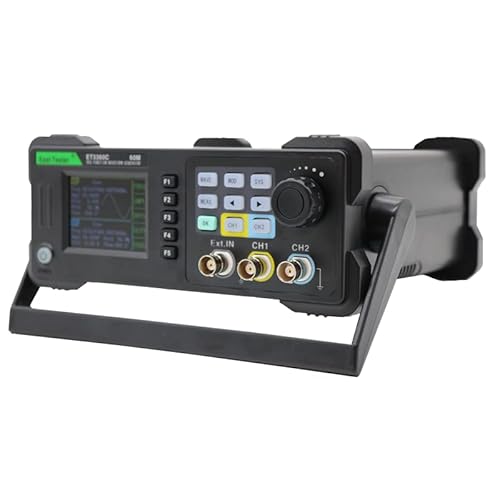
- 60MHz dual-channel output
- AM/FM/PM and ASK/FSK/PSK modulation
- Built-in 100MHz frequency counter
Best For: Lab and electronics testing with advanced waveform control
Value Versatile Option
Seesii JDS6600 60MHz Dual-Channel Generator

- 60MHz dual-channel DDS output
- 200MSa/s sampling and waveform storage
- Built-in measurement and sweep functions
Best For: General-purpose bench use with configurable output options
Compact Lab Choice – Koolertron 15MHz Dual-Channel DDS Generator
If you want signal generators under 200 for bench work, this Koolertron model covers the essentials with dual-channel DDS output, TTL level support, and a 15MHz sine wave range. It focuses on stable, low-distortion signals and gives you a broad set of standard and custom waveforms for everyday electronics testing.
Best For: Electronics students, lab setups, and general-purpose signal generation with dual-channel flexibility.
Pros:
- Dual-channel output with independent parameter settings
- 15MHz sine wave output plus sweep functions
- Includes frequency, period, pulse width, and counting measurements
- Stores 99 user parameter presets and 60 custom waveforms
Cons:
- Lower max frequency than higher-end models in this roundup
- Best suited to standard lab and teaching tasks rather than advanced RF use
This is a practical pick if you want a stable, feature-rich generator without paying for extra high-frequency range. Its preset storage and waveform options make it especially useful for repeat test routines.
Highest Frequency Pick – Koolertron 80MHz Dual-Channel DDS Counter
Among signal generators under 200, this Koolertron unit stands out for its 80MHz sine output and dual-channel DDS design. It also adds phone control, PC software, and arbitrary waveform import/export, making it a stronger fit if you want more control over waveform creation and remote operation.
Best For: Users who want a budget generator with a higher frequency ceiling and software-assisted waveform work.
Pros:
- Up to 80MHz sine wave output
- Dual-channel DDS with TTL output and independent settings
- Mobile app control plus PC software and communication protocol
- Supports arbitrary waveform drawing, import/export, and 100 saved states
Cons:
- Larger and heavier than simpler compact generators
- More features may be more than basic users need
If frequency range matters most, this is the most capable option in the group. The software and app support also make it easier to manage custom waveforms and repeatable setups.
Best Feature Set – UNI-T UTG932E 30MHz Dual-Channel Generator
The UNI-T UTG932E is a strong signal generator under 200 if you want more than basic waveform output. It offers dual channels, 30MHz output, and a wide modulation toolkit, including AM, FM, PM, FSK, PSK, PWM, and sweep functions for more versatile testing.
Best For: Users who need a feature-packed function generator for flexible bench and test work.
Pros:
- 30MHz output on two independently controllable channels
- Broad modulation support including AM, FM, PM, FSK, PSK, PWM, and sweep
- 200MSa/s sampling rate with arbitrary waveform support
- USB connectivity, SCPI compatibility, and free waveform editing software
Cons:
- Lower top frequency than the 80MHz Koolertron option
- Fewer preset-storage details provided than some competing models
This model is the best fit if you care about versatility more than raw frequency. Its modulation options and remote-control support make it a practical upgrade for users doing a wider range of signal tasks.
Portable Value Pick – SEESII 15MHz Dual-Channel DDS Counter
For shoppers comparing signal generators under 200, this SEESII unit offers a compact, portable build with the familiar dual-channel DDS feature set. It delivers 15MHz sine output, 200MSa/s sampling, and a useful collection of standard waveforms, while also including measurement functions and customizable waveform storage.
Best For: Users who want a lightweight, portable dual-channel generator for lab, teaching, or production use.
Pros:
- Lightweight and compact at 2.2 pounds
- Dual-channel DDS output with independently adjustable parameters
- 15MHz sine output, 200MSa/s sampling, and 60 custom waveform slots
- Includes frequency, period, pulse width, and counting functions
Cons:
- Top frequency is limited compared with higher-range options in this list
- Requires software workflow for creating the most customized waveforms
This is a sensible buy if portability matters and you mainly need dependable everyday signal generation. The combination of preset storage, measurement tools, and dual-channel control makes it versatile for routine tasks.
Lab-Grade Dual-Channel Pick – OWON DGE2070 70MHz Arbitrary Waveform Generator
If you need signal generators under 200 for lab work or electronics testing, the OWON DGE2070 stands out for its 70MHz dual-channel output, 300MSa/s sampling rate, and 14-bit resolution. It is built for users who want more control over waveform quality, modulation, and remote operation without giving up portability.
Best For: Engineers, students, and lab users who want a portable dual-channel generator with advanced features.
Pros:
- 70MHz dual-channel arbitrary waveform output with 300MSa/s sampling
- 14-bit resolution and 150 built-in arbitrary waveforms
- Supports AM/FM/PM/FSK modulation, sweep, burst, and PC control
- Compact 3.6-inch LCD design for easier waveform editing and monitoring
Cons:
- May be more generator than casual hobbyists need
- Smaller display than bench units with larger screens
Overall, this is a strong pick if you want a feature-rich signal generator under 200 with enough flexibility for advanced testing. Its mix of dual-channel operation, modulation options, and portable form factor makes it especially appealing for bench use and field-friendly setups.
Budget Counter Combo – YERTAI ET3320C 20MHz DDS Function Generator
For shoppers comparing signal generators under 200, the YERTAI ET3320C focuses on practical everyday function generation with dual channels, USB communication, and a built-in frequency counter. Its 20MHz range and 200MSa/S sampling rate make it a useful choice for general electronics work, troubleshooting, and teaching labs.
Best For: Users who want an affordable dual-channel generator with frequency counting and waveform editing.
Pros:
- 20MHz DDS arbitrary waveform output with 200MSa/S sampling
- Built-in 100MHz high-precision frequency counter and 32-bit counter
- Supports 5 basic waveforms, 32 arbitrary waveforms, and USB communication
- Lightweight design with a clear 2.4-inch TFT LCD
Cons:
- Lower frequency range than higher-end alternatives
- Only 13-bit vertical resolution
- Arbitrary waveform software must be obtained from the manufacturer
This model makes sense if you want a capable, compact generator that adds counting features without a lot of extra complexity. It is not the most powerful option here, but it covers the core needs well for routine lab and repair work.
All-in-One Dual Output – SEESII Dual Channel 30MHz DDS Signal Generator
If you are shopping signal generators under 200 and want a versatile all-rounder, the SEESII dual-channel 30MHz DDS generator is packed with useful test functions. It combines waveform generation, pulse output, noise generation, frequency measurement, counter, and sweep functions in one compact unit.
Best For: Students, technicians, and engineers who want one affordable instrument for many test tasks.
Pros:
- Independent dual channels with adjustable phase from 0° to 359.9°
- 30MHz range, 266MSa/s sampling, and 14-bit resolution
- Includes 60 built-in arbitrary waveforms plus precise pulse-width control
- Combines seven tools in one device, including generator, counter, and sweeper
Cons:
- Lower top frequency than the 70MHz option in this roundup
- 2.4-inch display is functional but compact
For buyers who value versatility over maximum frequency, this SEESII model is a strong fit. It covers a wide spread of lab and classroom tasks, and the independent dual-channel setup adds flexibility for synchronous or differential testing.
Portable Precision Pick – GME FG-2020 20MHz Handheld DDS Generator
If you want a compact signal generator under 200 that’s easy to carry and straightforward to use, the GME FG-2020 is built around portability and precise dual-channel DDS output. Its 20MHz range is more modest than bench-focused alternatives, but it’s a practical fit for quick electronics testing where size and simplicity matter.
Best For: Hobbyists and technicians who want a handheld dual-channel generator for portable testing.
Pros:
- Handheld, compact design for easy transport and small workspaces.
- Dual-channel DDS output for flexible test setups.
- Designed and engineered in the USA.
- 20MHz range suits many common lab and repair tasks.
Cons:
- Lower maximum frequency than 60MHz models.
- No modulation or frequency counter features are listed in the supplied notes.
Overall, the FG-2020 makes sense if you value portability over feature density. Among signal generators under 200, it stands out more for its handheld form factor than for advanced waveform tools.
Feature-Rich Lab Choice – ET3360C 60MHz Dual Channel DDS Generator
The ET3360C is a strong pick if you want a signal generator under 200 with more lab-style capability. It offers 60MHz dual-channel DDS output, 200MSa/s sampling, multiple modulation modes, arbitrary waveform support, and a built-in 100MHz frequency counter, making it a versatile option for electronics testing.
Best For: Electronics testers and lab users who want a wide feature set in a dual-channel generator.
Pros:
- 60MHz output with ±20ppm accuracy and good frequency stability.
- Dual channels with phase synchronization from 0–359.9°.
- AM/FM/PM, ASK/FSK/PSK, sweep, and burst support.
- Built-in 100MHz frequency counter plus USB control.
Cons:
- Larger and heavier than a handheld compact unit.
- Feature set may be more than casual users need.
For buyers comparing signal generators under 200, this model offers the most complete feature mix in the group. It’s a practical choice when you need both waveform flexibility and measurement tools in one unit.
Value Versatile Option – Seesii JDS6600 60MHz Dual-Channel Generator
The Seesii JDS6600 is a well-rounded signal generator under 200 for users who want dual-channel flexibility, a 60MHz sine-wave range, and useful storage features. Its 200MSa/s sampling, arbitrary waveform support, and measurement functions make it a capable pick for bench work, teaching, and general electronics testing.
Best For: Users who want a compact, configurable generator with broad everyday testing features.
Pros:
- 60MHz sine-wave output with dual-channel DDS operation.
- 200MSa/s sampling and user-defined waveform storage.
- Includes frequency, period, pulse width, and counting measurements.
- Supports linear and logarithmic sweep functions.
Cons:
- Maximum precision is listed as 0.1%, not as tight as some higher-end units.
- No modulation formats are listed in the supplied notes.
If you want a balanced option with useful saving and control features, the JDS6600 is easy to justify. It doesn’t try to be the most advanced unit here, but it covers a lot of everyday signal-generation needs well.
How We Picked These Signal Generators Under 200
We prioritized the features that matter most in real-world use: usable frequency range, waveform variety, channel count, output stability, modulation options, and the presence of a frequency counter or display that improves day-to-day control. Since this category is price-sensitive, we also weighed how much capability each model offers for the money.
Because Signal Generators Under 200 often trade premium calibration or ultra-low distortion for affordability, we focused on models that still look practical for electronics labs, hobby benches, repair work, and classroom testing.
Quick Comparison
In this price range, the main split is between basic DDS units for simple bench signaling and more capable arbitrary waveform generators with wider bandwidth and advanced modulation. Lower-frequency models are usually enough for audio, sensor, and beginner circuit testing, while higher-frequency options are better if you work with RF-adjacent projects, filtering, or faster digital systems.
Dual-channel designs are especially useful because they let you compare signals, drive separate parts of a circuit, or test phase relationships without buying two tools. If you want the most versatility, look for models with arbitrary waveform output, counter support, and a clear front panel or display.
Key Buying Factors for Signal Generators Under 200
Frequency Range
Choose a range that matches your projects. For audio and general electronics, 15MHz to 20MHz may be enough. If you want more headroom, 60MHz to 80MHz gives you broader testing flexibility.
Waveforms and Modulation
Basic sine, square, and triangle outputs cover many needs, but arbitrary waveform support is a major plus. Modulation modes such as AM, FM, PM, FSK, and PSK can be valuable for communication experiments and more advanced troubleshooting.
Sampling Rate and Resolution
Higher sampling rates and 14-bit output resolution typically improve waveform fidelity and control. If you care about cleaner shapes and finer adjustment, these specs are worth attention.
Usability
Look for a readable screen, straightforward controls, and a stable interface. USB connectivity and built-in counters are helpful if you plan to automate tests or verify frequencies quickly.
Portability and Build
If you travel between benches or work in the field, a compact or handheld design may matter more than extra channels. For stationary labs, a larger desktop unit with more outputs and features is often the better value.
Who Should Buy Which Signal Generators Under 200?
Beginners and casual hobbyists can usually start with a simpler dual-channel DDS unit and save money for other tools. Makers and repair techs should look for a midrange model with arbitrary waveform support and a frequency counter. If you need broader bandwidth, advanced modulation, or more refined output, choose one of the higher-spec Signal Generators Under 200 and prioritize capability over extras you may never use.
The best choice is the one that matches your typical test signals, not the one with the longest spec sheet. Focus on the features you’ll use weekly, and you’ll get far more value from your purchase.