Finding the right conductivity meter depends on more than reading range. Accuracy, temperature compensation, calibration options, durability, and the ability to measure related values such as TDS or salinity all affect how useful a meter will be.
We compared 10 conductivity meters for field testing, water-quality checks, classroom demonstrations, hydroponics, and laboratory work. The guide below explains the practical differences so you can choose the right fit for your applications and budget.
Best 10 Conductivity Meters Picks for 2026
Best All-in-One Pick
Apera PC60 5-in-1 Pocket Tester

- Measures pH, EC, TDS, salinity, and temperature
- Replaceable probe and stability indicators
- Includes calibration supplies and carrying case
Best For: Portable multi-parameter water testing
Best Professional Option
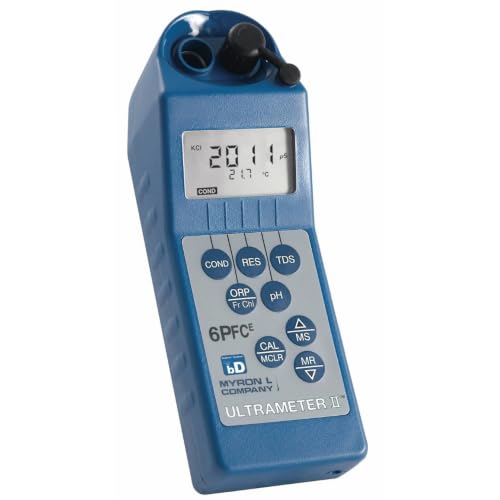
- Measures seven water-quality parameters
- Four-electrode conductivity technology
- One-handed controls and long battery life
Best For: Professional and industrial water-quality monitoring
Best Simple EC/TDS Meter
HM Digital COM-80 Hydro Tester

- Measures electrical conductivity and TDS
- Four EC and TDS display scales
- Automatic temperature compensation and water resistance
Best For: Straightforward nutrient and water testing
Best Memory Features

- Measures five parameters with one electrode
- Nine units of measure and trend bargraph
- Stores 25 labeled readings
Best For: Multi-parameter testing with basic reading storage
Best All-Around Pocket Tester
Apera EC60 4-in-1 Conductivity Tester

- Measures conductivity, TDS, salinity, and temperature
- Replaceable probe with ±1% F.S. accuracy
- IP67 waterproof kit with calibration supplies
Best For: Portable multi-parameter water testing
Best Compact Value Meter
Extech EC210 Conductivity and TDS Meter

- Measures conductivity, TDS, and temperature
- Three conductivity and TDS measurement ranges
- Compact design with Data Hold and soft case
Best For: Portable routine water measurements
Best Benchtop Choice
Apera EC700 Benchtop Conductivity Meter

- 0–200.0 mS/cm conductivity range
- One- to four-point automatic calibration
- Stores up to 50 groups of measurements
Best For: Stationary laboratory and workshop testing
Best Overall
Extech EC600 Waterproof Conductivity Kit

- 7-in-1 testing covers conductivity, TDS, salinity, resistivity, pH, mV, and temperature.
- Automatic pH and conductivity calibration features simplify setup.
- Includes probe, standards, and carrying case.
Best For: Broad water-quality and solution-testing needs
Best for Classrooms
United Scientific Electric Conductivity Tester

- Ten-level green LED display gives quick qualitative readings.
- Dual brass probes work with solids and liquids.
- Battery included; no calibration required.
Best For: Classroom demonstrations and basic conductivity comparisons
Best for Advanced Field Testing
Myron L 6PIIFCE Multiparameter Meter

- Measures conductivity, resistivity, TDS, pH, ORP/free chlorine, and temperature.
- Adjustable temperature compensation and conductivity/TDS ratio settings.
- Includes LSI/hardness calculation and date-time stamping.
Best For: Detailed multiparameter testing and organized records
Best All-in-One Pick – Apera PC60 5-in-1 Pocket Tester
The Apera PC60 is a versatile choice among conductivity meters when you also need pH, TDS, salinity, and temperature readings. Its replaceable probe, clear backlit LCD, and included calibration supplies make it practical for routine water testing.
Best For: Users who want one portable meter for multiple water-quality measurements.
Pros:
- Measures pH, EC, TDS, salinity, and temperature.
- Replaceable multi-parameter probe simplifies maintenance.
- Includes calibration solutions, storage solution, batteries, and carrying case.
- Large dual-display LCD shows temperature alongside readings.
Cons:
- The instrument has a six-month electrode warranty, shorter than its two-year instrument warranty.
- It measures several parameters, which may be more capability than users seeking conductivity only require.
With helpful stability and calibration indicators plus a complete kit, the PC60 is a strong convenience-focused option for portable conductivity and general water testing.
Best Professional Option – Myron L Ultrameter II 6PIIFCE
The Myron L Ultrameter II is a high-precision choice among conductivity meters for demanding water-quality work. Four-electrode conductivity technology, automatic temperature compensation, and adjustable conversion settings support consistent readings across varied applications.
Best For: Water treatment, industrial, laboratory, and field users who need multiple measurement functions.
Pros:
- Measures pH, ORP, conductivity, TDS, resistivity, FCE, and temperature.
- Uses advanced four-electrode conductivity technology and microprocessor-controlled performance.
- Supports one-handed operation with automatic range selection and temperature compensation.
- Battery life is rated for more than 100 hours or 5,000 tests.
Cons:
- Its broad professional feature set may be unnecessary for basic conductivity checks.
- At 1.43 pounds, it is less lightweight than pocket-style testers.
This is the most comprehensive option in the group for users who value measurement breadth, adjustability, and extended battery performance over minimal size.
Best Simple EC/TDS Meter – HM Digital COM-80 Hydro Tester
The HM Digital COM-80 keeps conductivity testing focused on the essentials: electrical conductivity and total dissolved solids. With automatic temperature compensation, multiple display scales, and a water-resistant design, it suits straightforward nutrient and water checks.
Best For: Users who primarily need EC and TDS readings without additional water-quality parameters.
Pros:
- Measures both EC and TDS.
- Offers EC readings in µS and mS plus TDS readings in ppm and ppt.
- Includes automatic temperature compensation.
- Water-resistant construction supports routine testing.
Cons:
- Does not measure pH, salinity, or temperature as separate parameters.
- The supplied notes specify a TDS range and accuracy, but do not provide a conductivity measurement range.
For uncomplicated EC and TDS testing—especially nutrient testing—the COM-80 avoids unnecessary features while retaining useful scale flexibility and temperature compensation.
Best Memory Features – Extech EC500 ExStik II
The Extech EC500 combines conductivity testing with pH, TDS, salinity, and temperature measurement in a waterproof handheld format. Its analog trend bargraph, nine measurement units, and labeled memory make it useful when you want to review readings as well as take them.
Best For: Users who want a compact multi-parameter meter with trend indication and stored readings.
Pros:
- Measures conductivity, TDS, salinity, pH, and temperature with one electrode.
- Provides nine units of measure, including µS/cm, mS/cm, ppm, ppt, mg/L, and g/L.
- Analog bargraph helps indicate measurement trends.
- Stores up to 25 labeled readings.
Cons:
- Memory capacity is limited to 25 labeled readings.
- The supplied notes do not specify a replaceable electrode or included calibration kit.
The EC500 is a practical middle ground for users who need more than conductivity alone and appreciate quick trend feedback plus basic data storage in a waterproof design.
Best All-Around Pocket Tester – Apera EC60 4-in-1 Conductivity Tester
For buyers who want flexible conductivity meters for field or routine water testing, the Apera EC60 combines conductivity, TDS, salinity, and temperature readings in a waterproof pocket-sized design. Its replaceable probe, automatic calibration, and automatic temperature compensation make it a convenient choice for repeat measurements.
Best For: Portable testing when you want conductivity, TDS, salinity, and temperature in one meter.
Pros:
- Measures conductivity, TDS, salinity, and temperature with a one-tap mode switch.
- Replaceable platinum-black probe and ±1% F.S. accuracy support consistent measurements.
- IP67 waterproof, floatable construction with a backlit dual-display LCD.
- Includes calibration solutions, bottles, batteries, lanyard, and carrying case.
Cons:
- Temperature range is limited to 0–50°C.
- Uses four AAA batteries rather than a built-in rechargeable power system.
The EC60 is a well-equipped option for users who value portability and multiple measurement modes. Its replaceable probe and complete kit add practical value for ongoing conductivity testing.
Best Compact Value Meter – Extech EC210 Conductivity and TDS Meter
The Extech EC210 is one of the more straightforward conductivity meters for portable water testing. It measures conductivity, TDS, and temperature, while its selectable ranges and adjustable temperature-compensation factor help accommodate different sample conditions.
Best For: Field users who need a compact conductivity and TDS meter with simple data-capture features.
Pros:
- Measures conductivity, TDS, and temperature in water samples.
- Offers three conductivity ranges up to 100 mS/cm and TDS ranges up to 66,000 ppm.
- Adjustable temperature compensation from 0–5% per °C.
- Includes Min/Max, Data Hold, a one-meter cable, battery, and soft case.
Cons:
- Uses a 9V battery.
- Does not list automatic calibration or a replaceable probe in the supplied specifications.
With its compact body, cable-connected cell, and multiple measurement ranges, the EC210 is suited to practical on-the-go testing. It is a sensible pick when you want core conductivity and TDS functions without a larger benchtop setup.
Best Benchtop Choice – Apera EC700 Benchtop Conductivity Meter
For laboratory, workshop, or other stationary applications, the Apera EC700 provides the larger format and electrode support that many portable conductivity meters lack. It measures conductivity and temperature together, supports a 0–200.0 mS/cm range, and stores up to 50 groups of data.
Best For: Benchtop testing where broad conductivity range, guided calibration, and data storage are priorities.
Pros:
- Measures conductivity and temperature simultaneously.
- Provides a 0–200.0 mS/cm range with ±1% F.S. accuracy.
- Supports one- to four-point automatic calibration with guidance and self-diagnosis.
- Includes a platinum-black ATC electrode, detachable holder, calibration solutions, and 50 data-storage groups.
Cons:
- Its benchtop design is less suited to field portability than a pocket tester.
- IP54 protection is spill-proof and dust-proof, but lower than the EC60’s IP67 rating.
The EC700 stands out for controlled, repeatable bench work rather than quick outdoor checks. Its wide range, guided calibration, electrode holder, and storage capacity make it the strongest fit for users building a more organized testing station.
Best Overall – Extech EC600 Waterproof Conductivity Kit
The Extech EC600 is a versatile choice for shoppers seeking conductivity meters that also cover several related water and solution measurements. Its 7-in-1 design measures conductivity, TDS, salinity, resistivity, pH, mV, and temperature.
Best For: Users who need one handheld meter for broad water-quality and solution-testing tasks.
Pros:
- Measures conductivity, TDS, salinity, resistivity, pH, mV, and temperature.
- Supports automatic one-button pH calibration at pH 4, 7, and 10.
- Offers three-point pH calibration and automatic recognition of eight conductivity calibration solutions.
- Includes a probe, standards, and carrying case.
Cons:
- Its six-month warranty is relatively short.
- The multi-function design may be more than needed for basic conductivity-only testing.
The EC600 stands out when measurement flexibility matters more than simplicity. Automatic calibration features and included accessories make it a practical, broad-purpose conductivity meter for users who also need pH and other readings.
Best for Classrooms – United Scientific Electric Conductivity Tester
The United Scientific tester is a straightforward option among conductivity meters, using a ten-level green LED display for qualitative readings. Dual brass probes test both immersed liquids and solids, and the included 12V battery allows immediate use without calibration.
Best For: Classroom demonstrations, introductory chemistry experiments, and quick qualitative comparisons.
Pros:
- Ten-level LED display provides an immediate visual indication of conductivity.
- Dual brass probes test solids and liquids.
- Includes a 12V battery and operating instructions.
- Requires no setup or calibration before use.
Cons:
- Provides qualitative, rather than detailed numerical, conductivity readings.
- Its capabilities are more limited than those of multi-parameter meters.
This tester prioritizes ease of use and visual feedback over precision reporting. It is a sensible pick for education and basic demonstrations where quick conductivity comparisons are more important than calibrated measurements.
Best for Advanced Field Testing – Myron L 6PIIFCE Multiparameter Meter
Myron L 6PIIFCE Conductivity, Resistivity, TDS, pH, ORP/Free Chlorine, Temperature Meter
Check Price On AmazonThe Myron L 6PIIFCE is designed for users who want conductivity meters with a wider analytical range. It measures conductivity, resistivity, TDS, pH, ORP/free chlorine, and temperature, while adding adjustable temperature compensation, conductivity/TDS ratio control, and date-and-time stamping.
Best For: Users who need multiparameter testing with configurable compensation and recorded measurement timing.
Pros:
- Measures conductivity, resistivity, TDS, pH, ORP/free chlorine, and temperature.
- Includes an LSI/hardness calculator.
- Offers adjustable temperature compensation and conductivity/TDS ratio settings.
- Date-and-time stamping supports organized measurement records.
Cons:
- The supplied notes do not specify included accessories, calibration features, or warranty coverage.
- Its broader feature set may be unnecessary for simple conductivity checks.
With multiple water-quality measurements and configurable calculation features, the 6PIIFCE is suited to more involved testing workflows. Its date-and-time stamping is particularly useful when measurements need to be tracked systematically.
How We Picked These Conductivity Meters
We selected meters across several common use cases, including portable water testing, laboratory analysis, education, hydroponics, and multiparameter monitoring. Our evaluation focused on measurement range, stated accuracy, resolution, temperature compensation, calibration flexibility, waterproofing, display usability, and the number of parameters each instrument can measure.
Because Conductivity Meters vary significantly in design, we included simple EC/TDS testers as well as advanced instruments that also measure pH, salinity, resistivity, oxidation-reduction potential, or free chlorine. This makes the roundup useful for both occasional testing and routine professional work.
Quick Comparison
| Best For | Look For | Typical Choice |
|---|---|---|
| Basic TDS or EC checks | Simple controls, clear readout, useful range | Compact pocket tester |
| Field water-quality testing | Waterproof housing, automatic temperature compensation, replaceable probes | Rugged handheld meter |
| Multiple water parameters | pH, EC, TDS, salinity, temperature, or ORP functions | Multiparameter meter |
| Laboratory work | Wide range, multipoint calibration, benchtop stability | Benchtop conductivity meter |
| Classroom use | Simple operation, readable display, low cost | Basic conductivity tester |
Key Buying Factors for Conductivity Meters
Measurement Range and Resolution
Choose a range that covers the samples you expect to test without sacrificing readability at the low end. Resolution matters when you need to detect small changes, while a broad range is more useful for samples spanning purified water to concentrated solutions.
Accuracy and Calibration
Check the stated accuracy and determine whether the meter supports one-point, multipoint, or automatic calibration. Frequent professional testing generally benefits from more calibration points and a wider selection of standards. Calibration solutions should match the meter’s recommended range and be replaced regularly.
Temperature Compensation
Conductivity changes with temperature, so automatic temperature compensation is valuable for repeatable results. Confirm whether compensation is built in, whether the temperature sensor is integrated into the probe, and whether the reference temperature or coefficient can be adjusted.
Probe Design and Durability
Waterproof construction is helpful for fieldwork, but also consider probe replacement, cable or pocket format, cleaning requirements, and resistance to the chemicals or sample types you handle. A replaceable probe can reduce long-term ownership costs.
Extra Measurements and Ease of Use
A multiparameter model may be worthwhile if you also need pH, TDS, salinity, temperature, ORP, or resistivity. For occasional checks, however, a simpler EC meter may be faster and less expensive. Look for clear units, automatic range selection, stable readings, and straightforward calibration prompts.
Who Should Buy Which Conductivity Meters?
Choose a pocket tester for quick checks in aquariums, hydroponic systems, drinking water, or classroom demonstrations. These meters are convenient and affordable, but they may offer less control over calibration and fewer options for demanding samples.
Choose a waterproof handheld meter if you test outdoors, move between tanks or process areas, or need a durable instrument with temperature compensation and multiple measurement modes.
Choose a multiparameter meter when carrying several separate instruments would be inconvenient. It is often the best value for users who routinely monitor pH, conductivity, TDS, salinity, or temperature together.
Choose a benchtop model for laboratories and production environments where repeatability, broad measurement range, stable sample handling, and flexible calibration are more important than portability. Before buying, verify the included probe, calibration accessories, warranty, and replacement-part availability.