The best beginner chemistry sets make science feel tangible, combining guided experiments with real tools, clear instructions, and age-appropriate challenges. This roundup compares 10 popular kits for young learners, families, and budding scientists.
Use the guide below to narrow your choices by experiment count, project depth, included equipment, safety considerations, and the kind of learning experience each set provides.
Best 10 Beginner Chemistry Sets Picks for 2026
Best Real-Lab Starter
Chem C1000 Beginner Chemistry Set

- 125 guided experiments with an 80-page manual
- Real lab equipment and seven included chemicals
- Ages 10+; adult supervision required
Best For: Students ready to move beyond kitchen-science activities
Best Colorful First Station

- 57-piece setup with a large plastic lab station
- Includes slime, fizzing, bubbles, and chromatography activities
- Ages 6+ with non-hazardous chemicals
Best For: Young children who prefer colorful, activity-led science
Best Three-in-One Variety
National Geographic Mega Science Lab
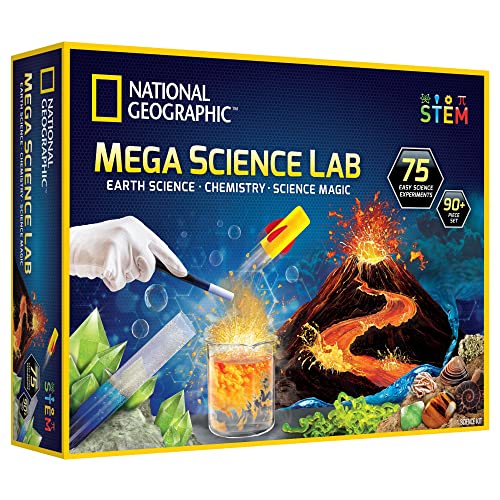
- 75 experiments spanning chemistry, Earth science, and science magic
- Includes specimens, crystals, volcano, and chemistry activities
- Ages 8+ with 30 bonus household-material experiments
Best For: Kids who want several branches of science in one kit
Best Advanced Upgrade

- More than 333 experiments and 103 pieces
- 192-page manual covers inorganic, organic, and electrochemistry
- Ages 12+; adult supervision required
Best For: Older students seeking a sustained home chemistry program
Best for Young Beginners
National Geographic Junior Chemistry Set

- 50 hands-on experiments
- 20+ child-friendly lab tools
- Illustrated instructions for ages 4+
Best For: Young children beginning STEM exploration
Most Comprehensive
Doctor Jupiter Ultimate Science Experiments Kit

- 135+ science experiments
- Includes lab equipment and ingredients
- Leak-proof bottles help limit mess
Best For: Ages 8+ seeking an extensive activity library
Best for Variety
UNGLINGA 210 Experiments Science Kit

- 210+ experiments
- Covers chemistry, physics, and geology
- Includes a clear color manual
Best For: Ages 8+ who enjoy varied STEM projects
Most Experiments

- 272 activities across chemistry, physics, and STEM themes
- Includes kid-sized plastic lab tools
- Illustrated guide supports beginner-friendly use
Best For: Families wanting maximum experiment variety
Most Chemistry-Focused

- 66 activities with 26 guided experiments
- Covers pH, acid-base reactions, and gas expansion
- Includes reaction materials, tools, and a volcano mold
Best For: Beginners focused on core chemistry concepts
Best for Extended STEM Play

- More than 300 chemistry, physics, and STEM activities
- Illustrated manual explains procedures and reactions
- Includes dropper, test tubes, beaker, and conical flask
Best For: Kids seeking weeks of varied STEM exploration
Best Real-Lab Starter – Chem C1000 Beginner Chemistry Set
For families looking beyond simple kitchen activities, the Chem C1000 is one of the more authentic beginner chemistry sets for ages 10 and up. It combines 125 guided experiments with real lab equipment, seven chemicals, and a detailed manual covering foundational chemistry topics.
Best For: Curious elementary and middle school students, homeschool families, and aspiring young scientists ready for hands-on lab work.
Pros:
- Includes 125 experiments across 10 themed chapters.
- Provides real equipment such as glass test tubes, beakers, pipettes, goggles, and a funnel.
- Explores chromatography, electrochemistry, crystals, indicators, surface tension, and more.
- The 80-page manual includes safety, first-aid, hazard-labeling, and disposal guidance.
Cons:
- Adult supervision is required.
- Its chemistry focus may be more involved than some younger children expect.
- Some experiments require a 9-volt battery or common household additions.
The C1000 is a strong choice when you want beginner chemistry sets to feel like an introduction to genuine laboratory technique rather than a collection of quick demonstrations. Its structured progression and substantial equipment make it suitable for repeated use.
Best Colorful First Station – Ooze Labs Chemistry Station
The Ooze Labs Chemistry Station is a colorful, approachable option among beginner chemistry sets, especially for children ages 6 and up. Its large plastic station organizes 57 pieces for activities such as glowing slime, fizzing reactions, bubbles, and chromatography.
Best For: Younger children who benefit from a visually engaging, organized setup and short, activity-driven experiments.
Pros:
- Includes 57 pieces, including beakers, test tubes, flasks, pipettes, and a petri dish.
- The built-in station provides a dedicated place for materials and experiments.
- Experiment cards clip onto the station for convenient reference.
- Uses non-hazardous chemicals and does not contain borax.
Cons:
- The primarily plastic equipment is less like a traditional laboratory setup.
- It offers a shorter introductory scope than more advanced chemistry kits.
- Adult guidance may still be helpful for measuring and cleanup.
This kit emphasizes accessible play and visual results over deep chemical theory. It is a practical starting point for children who may be more engaged by slime, bubbles, and colorful reactions than by lengthy written explanations.
Best Three-in-One Variety – National Geographic Mega Science Lab
The National Geographic Mega Science Lab expands beyond chemistry, making it a versatile choice for families comparing beginner chemistry sets with broader science kits. It combines 45 Earth science, chemistry, and science-magic experiments with 30 additional activities using common household items.
Best For: Children ages 8 and up who want variety across chemistry, Earth science, collecting, and demonstration-style experiments.
Pros:
- Offers 75 total experiments across three science themes.
- Chemistry activities include gooey worms, bubbling reactions, gas-powered rockets, and crystal fireworks.
- Earth science activities include a volcano, glow-in-the-dark crystal, water tornadoes, fossils, and specimen collecting.
- The bonus guide extends the kit with household-material experiments.
Cons:
- Chemistry is only one part of the overall kit.
- It may provide less focused chemistry instruction than a dedicated chemistry set.
- Some activities depend on common household items.
This is a good fit when keeping children interested matters more than following a single chemistry curriculum. Its broad mix supports exploration, though families seeking sustained laboratory progression may prefer a chemistry-focused set.
Best Advanced Upgrade – Chem C3000 Chemistry Set
The Chem C3000 is an advanced step beyond basic beginner chemistry sets, with more than 333 experiments, 103 pieces, and a 192-page manual. Designed for ages 12 and up, it covers inorganic, organic, and electrochemistry with equipment intended for a more complete home laboratory.
Best For: Older students, homeschoolers, and serious young scientists preparing for high school chemistry.
Pros:
- Includes more than 333 experiments organized into 27 chapters.
- Covers atomic structure, bonding, the periodic table, acids and bases, redox, electrolysis, and organic chemistry.
- Provides extensive equipment, including an Erlenmeyer flask, tripod, alcohol burner, electrodes, wires, and safety goggles.
- The 192-page manual combines procedures with substantial scientific explanations.
Cons:
- It is substantially more advanced than a typical first chemistry set.
- Adult supervision is required throughout.
- Some experiments require clearly listed household additions.
The C3000 is best viewed as a long-term chemistry program rather than a casual starter toy. Its breadth and lab-style equipment can support serious study, but younger or completely new learners may find the C1000 or a more playful kit easier to approach.
Best for Young Beginners – National Geographic Junior Chemistry Set
For families looking for beginner chemistry sets for younger children, this National Geographic kit offers an accessible introduction through 50 hands-on activities. It includes illustrated instructions and more than 20 child-safe lab tools, while many experiments use familiar household items such as baking soda and vinegar.
Best For: Children ages 4 and up who are starting to explore chemistry and STEM concepts with adult guidance.
Pros:
- Includes 50 interactive experiments.
- Comes with more than 20 kid-friendly lab tools, including test tubes and goggles.
- Illustrated, step-by-step instructions support independent participation.
- Does not require batteries.
Cons:
- Designed for younger beginners, so it may offer less depth for older children.
- Many activities also require common household materials.
Its age-appropriate format, broad experiment count, and included tools make it a practical first chemistry set for early learners.
Most Comprehensive – Doctor Jupiter Ultimate Science Experiments Kit
This Doctor Jupiter kit is a strong option for shoppers comparing beginner chemistry sets for children ages 8 and up who want lots of repeatable activities. It combines more than 135 experiments with ingredients, lab-style equipment, illustrated instructions, and bonus activities using everyday household items.
Best For: Children ages 8 and up who want an extensive science kit for independent projects and parent-child learning.
Pros:
- Offers more than 135 combined experiments and bonus activities.
- Includes equipment such as a measuring cylinder, conical flask, funnel, test tubes, and tray.
- Step-by-step illustrated instructions are designed for children and parents.
- Separate leak-proof bottles help reduce mess when using the included chemical materials.
Cons:
- The recommended age is 8 and up, making it less suitable for preschool-age children.
- The kit includes multiple ingredients and tools, so setup may take more organization.
With its unusually large experiment library and included materials, this is suited to families seeking long-term educational use rather than a brief introduction.
Best for Variety – UNGLINGA 210 Experiments Science Kit
Families searching beginner chemistry sets with a wide range of projects may appreciate the UNGLINGA kit. Its 210-plus activities span chemistry, physics, geology, and the natural environment, with examples including volcano building and crystal growing.
Best For: Children ages 8 and up who enjoy varied STEM projects, group activities, and school-break learning.
Pros:
- Provides more than 210 experiments across several science topics.
- Includes projects such as volcanoes and growing crystals.
- Color manual provides clear, step-by-step guidance.
- Supports hands-on problem solving, teamwork, and critical thinking.
Cons:
- The kit is recommended for ages 8 and up.
- Its broad chemistry, physics, geology, and nature focus may feel less chemistry-specific.
This kit stands out for experiment volume and subject variety, making it a flexible choice for children who like switching between different types of science projects.
Most Experiments – 272-Experiment Chemistry Set
For shoppers comparing beginner chemistry sets, the UNGLINGA 272 Experiments Science Kit offers a broad selection of hands-on activities for children ages 8 and up. It combines chemistry- and physics-themed projects, including volcanoes, crystal growing, holographic projection, and walking water, with kid-sized plastic lab tools.
Best For: Families seeking a high-variety STEM activity kit for shared experiments, school breaks, birthdays, or weekend learning.
Pros:
- Includes 272 experiments for extended play and exploration.
- Features familiar projects such as volcanoes, crystals, and rainbow walking water.
- Includes plastic test tubes, a measuring spoon, beaker, and conical flask.
- Illustrated instructions are designed to make each activity easier to follow.
Cons:
- The manufacturer recommends adult supervision for children ages 8 and up.
- The set uses plastic tools rather than laboratory-grade equipment.
- The large experiment count may require household support and preparation for some activities.
This is a strong pick when experiment variety matters most. Its illustrated manual and broad mix of activities make it approachable for beginners, while the reusable-style tools support a more realistic at-home lab experience.
Most Chemistry-Focused – Super Reactions Science Kit
Among beginner chemistry sets, the Discovery Super Reactions Science Kit stands out for its focused introduction to reactions and related concepts. Recommended for ages 8 and up, it includes 26 guided activities plus 40 bonus ideas using household items, with projects involving pH indicators, acid-base reactions, gas expansion, slime, and volcanoes.
Best For: Curious children who want a structured introduction to core chemistry ideas through colorful, reaction-based projects.
Pros:
- Provides 66 experiments, including 26 guided activities and 40 bonus ideas.
- Introduces acid-base reactions, pH indicators, states of matter, and gas expansion.
- Includes tools and materials such as test tubes, food coloring, a volcano mold, citric acid, and slime mix.
- Offers varied projects including glowing potions, blue lava, gas balloons, and slime.
Cons:
- Adult supervision is specified for the recommended age group.
- Some bonus activities rely on additional household items.
- The set includes fewer total experiments than the UNGLINGA kits in this roundup.
Choose this kit when teaching chemistry concepts is a higher priority than maximizing the number of activities. Its guided format and included ingredients give beginners a clear path into reaction-based science.
Best for Extended STEM Play – 300+ Experiment Chemistry Set
The UNGLINGA 300+ Experiments Science Kit is one of the broadest beginner chemistry sets for children ages 8 and up. It combines volcano, crystal-growing, physics, and STEM activities with an illustrated lab manual and tools such as test tubes, a dropper, beaker, and conical flask.
Best For: Kids who want weeks of varied science activities and families looking for a kit that supports hands-on practice with measurement and the scientific method.
Pros:
- Offers more than 300 experiments for substantial activity variety.
- Combines chemistry, physics, and broader STEM projects.
- Includes illustrated step-by-step instructions with explanations of why reactions happen.
- Provides lab-style plastic tools for practicing measurement and procedures.
Cons:
- The manufacturer recommends it for children ages 8 and up, with some activities needing parent help.
- Its broad chemistry, physics, and STEM scope may be less focused than a dedicated reaction kit.
- Plastic components are intended for educational play, not professional laboratory use.
This kit makes sense for households prioritizing longevity and variety. The combination of a large activity count, lab-style tools, and explanations of the scientific method can help beginners build confidence across several STEM topics.
How We Picked the Best Beginner Chemistry Sets
We evaluated these Beginner Chemistry Sets on the factors that matter most for successful home experimentation: the clarity and quality of the instructions, the range of activities, the usefulness of the included equipment, age suitability, and overall educational value. We also considered whether a kit emphasizes chemistry specifically or blends chemical reactions with broader STEM projects such as slime, volcanoes, crystals, and color changes.
Experiment count is useful, but it is not the only measure of value. A smaller kit with better explanations and more reusable tools may provide a stronger learning experience than a larger set filled with brief demonstrations. Adult supervision, replacement-supply requirements, and storage were also considered because they affect how practical a kit is after the first few activities.
Quick Comparison
| Best For | What to Look For | Recommended Type |
|---|---|---|
| First-time young scientists | Simple instructions, broad activity variety, and visible reactions | Junior or general science kits |
| Children seeking structured chemistry practice | Dedicated lab equipment and a detailed manual | Beginner chemistry sets with substantial guides |
| Older or especially curious learners | More tools, progressive experiments, and greater depth | Larger chemistry-focused sets |
| Families wanting maximum variety | High experiment count and projects using common household supplies | Large multi-experiment kits |
Key Buying Factors for Beginner Chemistry Sets
Age and Supervision
Choose a kit that matches the child’s reading ability, patience, and coordination—not just the age printed on the box. Younger children typically need an adult to measure ingredients, explain steps, and manage cleanup. Even “safe” educational kits should be used with supervision, eye protection where recommended, and careful hand washing afterward.
Experiment Quality and Instructions
Look for manuals with clear preparation steps, explanations of what is happening, and guidance for interpreting results. A high experiment count can be appealing, but activities should be distinct and repeatable rather than minor variations of the same reaction.
Equipment and Consumables
Be sure the kit includes practical tools such as test tubes, droppers, measuring items, containers, or protective accessories when applicable. Check which ingredients are supplied and which must come from home. Reusable equipment improves long-term value, while replacement consumables determine how easily the set can be used again.
Learning Depth and Mess
Consider whether the child wants quick visual demonstrations or a more systematic introduction to chemistry. Also check the cleanup involved. Slime, foaming reactions, crystals, and color experiments can be engaging, but they may require trays, towels, and extra workspace.
Who Should Buy Which Beginner Chemistry Sets?
For a first science gift, choose a junior or broadly focused set with accessible instructions and colorful, easy-to-see results. For children who already enjoy science and want a more authentic lab experience, select a chemistry-focused kit with dedicated equipment and a detailed manual. Older learners or families planning repeated sessions should favor larger sets with more advanced tools and a progression of experiments. If variety and entertainment are the priority, a high-count STEM kit may be the best fit—but confirm what supplies are included before buying.