Moisture-sensitive filament can cause weak prints, inconsistent extrusion, and wasted class time. The right dryer helps schools protect materials and keep shared 3D printers running reliably.
These 10 filament dryers for schools cover compact single-spool units, high-capacity four-spool models, and advanced dual-zone systems for classrooms, labs, and makerspaces.
Best 10 Filament Dryers for Schools Picks for 2026
High-Volume Choice

- Holds four 1kg or two 2kg spools
- Dual 200W chambers reach 85°C
- Sealed storage reduces moisture reabsorption
Best For: School makerspaces with multiple printers
Multi-Printer Workhorse

- Dries four 1kg spools at once
- Eight outlets support multiple printers
- 350W heater and three circulation fans
Best For: Busy labs feeding several printers
Compact Classroom Pick

- Compact single-spool design
- 35–70°C temperature range and 0–99-hour timer
- Touch controls and translucent lid
Best For: Small classrooms and individual printer stations
Best Value Classroom Dryer
Comgrow SH01 Filament Dryer Box

- Holds two 1kg spools
- Supports 1.75mm and 2.85mm filament
- 40–50°C control with LCD monitoring
Best For: Smaller classrooms needing simple two-spool drying and storage
Best Multi-Spool Dryer

- Dries four 1kg spools at once
- Independent 45–85°C dual zones
- Includes annealing and humidity control
Best For: Busy school labs managing multiple filament types
Best Automated Four-Spool Dryer

- Four-spool capacity with dual chambers
- 45–85°C independent temperature control
- Automatic humidity-based drying mode
Best For: Larger labs needing flexible, lower-supervision drying
Best for Multi-Printer Labs

- Dries four 1 kg spools at once
- Reaches up to 70°C with three fans
- Supports multiple printer diameters
Best For: Shared school makerspaces and high-volume printing
Best Heavy-Duty Pick

- Fan-assisted single-spool drying
- LCD shows temperature, time, and humidity
- Adjusts from 35°C to 55°C
Best For: Small classrooms and single-printer stations
Best for Guided Student Use
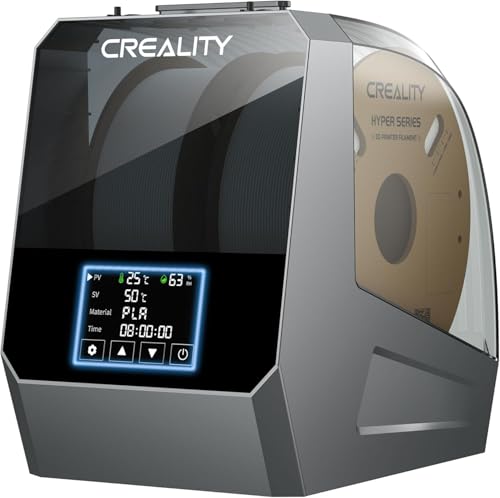
- Holds two 1 kg spools
- Uses 360° PTC hot-air heating
- Offers presets for up to 12 filament types
Best For: Material-diverse STEM classrooms with touchscreen controls
High-Volume Choice – Creality Space Pi X4
For schools managing multiple printers, the Creality Space Pi X4 is a high-capacity option among filament dryers for schools. It holds four standard 1kg spools—or two 2kg spools—and uses dual heating chambers to dry different filament loads efficiently.
Best For: School makerspaces and print labs running several printers or larger filament inventories.
Pros:
- Holds four 1kg spools or two 2kg spools.
- Dual independent 200W heating chambers reach up to 85°C.
- Sealed storage helps prevent moisture from returning during pauses.
- Supports common materials from PLA and PETG to ABS, PC, ASA, and nylon.
Cons:
- Its larger capacity requires more workspace than a single-spool dryer.
- The advanced temperature range may be more than a small classroom needs.
The X4 is especially practical when multiple students or classes share equipment. Independent chambers, illuminated viewing, and moisture-controlled storage help reduce handling and keep filament ready between print jobs.
Multi-Printer Workhorse – SUNLU S4
The SUNLU S4 is designed for busy school labs that need to dry and feed several spools at once. Its four-spool capacity, eight filament outlets, and three circulating fans make it a strong candidate among filament dryers for schools.
Best For: Classrooms or makerspaces supplying multiple 3D printers from one dryer.
Pros:
- Dries up to four 1kg spools simultaneously.
- Eight filament outlets support different printer positions and loading angles.
- Three fans and a 350W PTC heater promote even heating.
- Temperature settings range from 35–70°C with a 0–99-hour timer.
Cons:
- Its 4kg weight and large footprint require a dedicated location.
- The 70°C maximum is lower than some competing high-temperature dryers.
- Modification for 3kg rolls is a DIY project rather than a standard configuration.
For shared school equipment, the S4’s outlet layout and four-spool capacity can simplify classroom setup. It also supports a broad range of materials and filament diameters, making it flexible for varied student projects.
Flexible Lab Storage – Sovol SH03
The Sovol SH03 combines four-spool drying with independently controlled chambers, giving schools flexibility when different classes use different materials. Its automatic dehumidification and sealed storage make it a capable choice among filament dryers for schools.
Best For: Educational labs that need separate temperature settings or want to dry and store filament at the same time.
Pros:
- Two independently controlled chambers can run at different temperatures.
- Dual 200W heaters reach up to 85°C and heat quickly.
- Four filament holes support four 1kg spools and multiple printers.
- One-key presets cover 10 filament types.
Cons:
- Its dual-chamber controls may require more setup than a basic dryer.
- The supplied notes do not specify a timer range or exact chamber dimensions.
The SH03 is a useful fit where a school regularly switches between materials such as PLA, TPU, PETG, ABS, and nylon. Running one chamber while using the other for storage can also make better use of shared lab equipment.
Compact Classroom Pick – SUNLU S2
The SUNLU S2 is a simpler single-spool solution for classrooms that need to revive damp filament without adding a large appliance. Its transparent lid, touch controls, and adjustable settings make it one of the more approachable filament dryers for schools.
Best For: Smaller classrooms, individual printer stations, and schools beginning to manage filament moisture.
Pros:
- Compact design is easier to place beside a classroom printer.
- Adjustable temperature runs from 35–70°C with a 0–99-hour timer.
- Built-in spindle rotates filament for more even drying.
- Supports 1.75mm, 2.85mm, and 3.00mm filament.
Cons:
- It is intended for a single spool rather than a multi-printer lab.
- The 70°C maximum may not suit every high-temperature material.
- Its smaller capacity offers less throughput than four-spool models.
The S2 makes sense when space and ease of use matter more than batch capacity. Students or instructors can monitor the spool through the translucent lid and adjust drying time and temperature from the large touch screen.
Best Value Classroom Dryer – Comgrow SH01 Filament Dryer Box
For schools seeking filament dryers for schools on a practical budget, the Comgrow SH01 offers a compact way to dry and store filament while printing. It holds two 1-kilogram spools, supports 1.75mm and 2.85mm filament, and provides adjustable temperature and drying-time controls.
Best For: Classrooms that need straightforward drying and storage for a few commonly used filament spools.
Pros:
- Stores up to two 1-kilogram spools in its drying chamber.
- Supports common materials such as PLA, ABS, and SILK filament.
- Offers adjustable 40–50°C temperature settings and 6–12-hour drying times.
- Includes temperature and humidity monitoring on a 2-inch LCD screen.
Cons:
- Its maximum temperature of 50°C may be limiting for some higher-temperature materials.
- Users must select a work state after powering on or the motherboard shuts down after three minutes.
- The drying vent must be opened while operating and closed for storage.
The SH01 is a sensible option for smaller school makerspaces that prioritize simple operation, sealed storage, and simultaneous drying of two spools rather than advanced multi-zone control.
Best Multi-Spool Dryer – SUNLU S4 Pro Filament Dryer
The SUNLU S4 Pro is designed for schools that need filament dryers for schools with higher capacity and more control. Its divided chamber can hold up to four 1-kilogram spools, with independent temperature settings for each side and support for materials from PLA to Nylon.
Best For: Busy school labs that regularly prepare multiple filament types or spools at the same time.
Pros:
- Dries up to four 1-kilogram spools simultaneously.
- Provides independent temperature control across two zones from 45–85°C.
- Supports 1.75mm, 2.85mm, and 3.00mm filament.
- Includes annealing mode and automatic humidity control.
Cons:
- Its larger size and 10.4-pound weight require more dedicated workspace.
- The advanced controls may be more than a small classroom needs.
- Its 380W heater may use more power than a smaller single-chamber dryer.
With dual-zone operation, broad material compatibility, and four-spool capacity, the S4 Pro is a strong fit for school makerspaces where multiple classes or printers share a central filament-preparation station.
Best Automated Four-Spool Dryer – Comgrow SH03 Filament Dryer
For larger school makerspaces comparing filament dryers for schools, the Comgrow SH03 combines four-spool capacity with independent chambers and automated drying. Its dual 200W PTC heating modules, humidity-triggered mode, and multiple monitoring systems are suited to shared equipment that may run for extended periods.
Best For: School labs that need flexible, higher-temperature drying for several filament types and spools.
Pros:
- Holds up to four 1-kilogram spools in two independently controlled chambers.
- Offers adjustable 45–85°C drying with separate chamber temperature and power controls.
- Automatic mode responds to humidity and enters energy-saving storage mode after drying.
- Includes hot-air circulation, temperature regulation, and four protection and monitoring functions.
Cons:
- Its larger dual-chamber design may take substantial classroom or lab space.
- Separate controls and automated features may require more training for student users.
- The supplied notes do not specify the unit’s external dimensions or weight.
The SH03 stands out when a school needs capacity, independent chamber control, and reduced hands-on supervision. Its 85°C maximum and broad material support also make it more flexible than basic low-temperature drying boxes.
Best for Multi-Printer Labs – SUNLU S4 Four-Spool Dryer
For schools seeking filament dryers for schools with several FDM printers, the SUNLU S4 is built around shared, continuous use. It holds four 1 kg spools, reaches up to 70°C, and supports simultaneous feeding to multiple printers.
Best For: School makerspaces, STEM labs, and classrooms running multiple printers or multicolor projects.
Pros:
- Holds four 1 kg spools for higher-throughput drying.
- Three fans and 360° circulation help provide even heating.
- Supports 1.75 mm, 2.85 mm, and 3.0 mm filament diameters.
- Includes temperature monitoring, a backup thermal switch, and humidity control.
Cons:
- Its 10.56-pound weight and large footprint require dedicated bench space.
- The 350W heater may be more capacity than a small classroom needs.
The S4 is the strongest choice here for centralized school printing because its four-spool capacity can reduce interruptions between student projects. Its size makes it better suited to a shared lab than a compact classroom station.
Best Heavy-Duty Pick – SUNLU S1 Plus Filament Dryer
The SUNLU S1 Plus is a practical option when filament dryers for schools need to fit beside a printer. Its fan-assisted design, adjustable 35–55°C range, and LCD display help students manage routine filament drying while printing.
Best For: Small classrooms, beginner-friendly setups, and single-printer workstations.
Pros:
- Fan design helps discharge moisture from filament.
- Displays temperature, time, and humidity on a 2-inch LCD screen.
- Works with 1.75 mm, 2.85 mm, and 3.00 mm filament.
- Supports drying while printing.
Cons:
- Its maximum capacity is limited to one filament spool.
- The 35–55°C range is narrower than the higher-temperature options in this roundup.
For schools prioritizing straightforward controls and a smaller footprint, the S1 Plus is easy to position near an individual printer. It is less appropriate for labs that need to dry several spools simultaneously.
Best for Guided Student Use – Creality Space Pi Plus
The Creality Space Pi Plus suits schools looking for filament dryers for schools with guided controls and flexible material presets. It dries two 1 kg spools, uses 360° hot-air circulation, and provides one-key settings for up to 12 filament types.
Best For: STEM classrooms that use varied materials and want a clear touchscreen workflow.
Pros:
- Dries two 1 kg spools and can support two printers at once.
- 160W double-PTC heating provides circulating 360° hot air.
- Four-inch touchscreen simplifies temperature and drying controls.
- Supports materials including PLA, ABS, PETG, TPU, PA, PC, ASA, and composite filaments.
Cons:
- Two-spool capacity is lower than the SUNLU S4.
- Its temperature range starts at 45°C, offering less low-temperature adjustment than the S1 Plus.
The Space Pi Plus balances classroom capacity with accessible controls. Its touchscreen and material presets can help instructors standardize drying, while the two-spool design remains manageable for many school printer stations.
How We Picked These Filament Dryers for Schools
We focused on features that matter in shared educational environments: spool capacity, maximum temperature, heating consistency, compatibility with common materials, ease of operation, and storage performance. Models supporting materials such as PLA, PETG, ABS, TPU, or nylon can give schools more flexibility as projects become more advanced.
We also considered classroom practicality. A useful dryer should be straightforward for students and staff to load, simple to monitor, and suitable for repeated use. Four-spool models can reduce bottlenecks in busy makerspaces, while compact units may be easier to place beside individual printers or store between classes.
Quick Comparison
- Best for high-throughput classrooms: Four-spool models such as the Creality Space Pi X4, SUNLU S4, Sovol SH03, and Comgrow SH03.
- Best for smaller setups: Single- or two-spool dryers such as the SUNLU S2, Comgrow SH01, SUNLU S1 Plus, and Creality Space Pi Plus.
- Best for flexible material handling: Models with broad temperature ranges, dual-zone control, or support for higher-temperature materials.
- Best for simple operation: Dryers with clear displays, uncomplicated controls, and presets that reduce setup errors.
Key Buying Factors for Filament Dryers for Schools
Capacity and Workflow
Match capacity to printer count and class size. A four-spool dryer is useful when several students print at once, while a smaller unit may be more efficient for a classroom with one or two printers. Check that the internal space accommodates your school’s preferred spool sizes.
Temperature Range and Material Support
PLA generally needs less heat than moisture-sensitive materials such as nylon. If students will work with ABS, PETG, TPU, or nylon, choose a dryer with suitable temperature control and dependable heat distribution. Avoid assuming that a high maximum temperature alone guarantees compatibility; follow the filament manufacturer’s drying recommendations.
Safety and Classroom Usability
Look for stable construction, clear controls, readable displays, and predictable shutoff behavior. Place the dryer on a ventilated, heat-resistant surface, keep cords organized, and establish a procedure for loading and unloading spools. Adult supervision is especially important when students are using higher temperatures.
Drying While Printing
For classroom convenience, check whether the dryer can feed filament directly to a printer and whether its outlet arrangement works with your machines. Sealed storage after drying is also valuable because filament can reabsorb moisture while waiting for the next project.
Who Should Buy Which Filament Dryers for Schools?
Choose a four-spool dryer for busy school makerspaces, robotics programs, or labs managing multiple printers. Choose a compact dryer for introductory classrooms, mobile carts, or schools with limited bench space. Choose dual-zone or advanced temperature-control models when students regularly use different materials at the same time. For most schools, prioritize dependable operation, manageable capacity, and clear safety procedures over extra features that add complexity.