A dependable network switch can add more wired connections, reduce congestion, and help your existing router or access point deliver its full potential. The right choice depends on port speed, device count, management features, and upgrade plans.
We compare 10 high-speed network switches spanning compact 2.5GbE models, larger Gigabit switches, and smart-managed options for homes, gaming setups, offices, and small networks.
Best 10 High Speed Network Switches Picks for 2026
Best Multi-Gig Upgrade
TP-Link TL-SG108S-M2 8-Port 2.5G Switch

- Eight 2.5Gbps RJ45 ports
- Up to 40Gbps switching capacity
- Fanless and plug-and-play
Best For: Multi-gig home networks and small offices
Best 8-Port Metal Design
UGREEN 8-Port 2.5G Ethernet Switch

- Eight 2.5Gbps ports
- Metal case with thermal design
- Fanless plug-and-play operation
Best For: Quiet multi-gig home and office networks
Best Managed Expansion
MikroTik CSS318-16G-2S+IN Switch

- 16 Gigabit Ethernet ports
- Two SFP+ ports
- Managed metal network switch
Best For: Expandable networks with servers and SFP+ equipment
Best Compact 2.5G Switch
UGREEN 5-Port 2.5G Ethernet Switch

- Five 2.5Gbps ports
- Compact metal enclosure
- Silent plug-and-play setup
Best For: Small gaming, home, and desktop networks
Best Silent 2.5G Upgrade

- Five 2.5Gbps RJ45 ports
- Up to 25Gbps switching capacity
- Fanless metal desktop/wall-mount design
Best For: Quiet multi-gig home offices, gaming setups, and NAS connections
Best 8-Port 2.5G Value

- Eight 2.5Gbps RJ45 ports
- Up to 40Gbps switching capacity
- Fanless plug-and-play operation
Best For: Gaming rooms, home offices, and entertainment setups with many wired devices
Best High-Port Gigabit Expansion
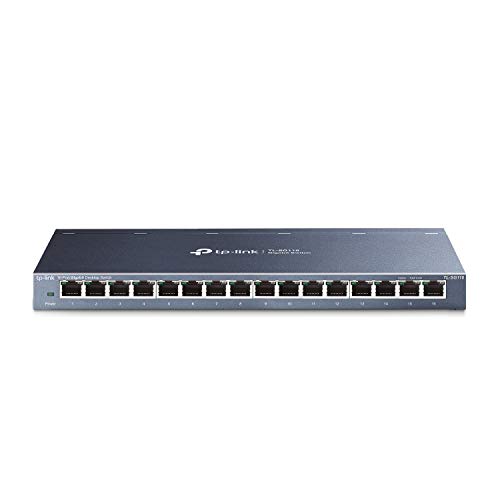
- Sixteen 10/100/1000Mbps ports
- Fanless metal desktop/wall-mount design
- QoS and IGMP Snooping support
Best For: Larger home networks and small offices using standard gigabit devices
Best Smart Managed Pick

- Five 1.0Gbps Ethernet ports
- VLAN, QoS, and port monitoring controls
- Fanless metal design with flexible mounting
Best For: Small business networks needing manageable gigabit connectivity
Best Plug-and-Play Value

- Eight 10/100/1000 Mbps ports
- No configuration required
- Fanless metal housing with shielded ports
Best For: Quiet, simple network expansion at home or in a small office
Best for Larger Wired Networks

- Sixteen 1.0Gbps Ethernet ports
- Plug-and-play unmanaged operation
- Fanless metal housing with desktop or wall mounting
Best For: Larger home or office networks needing many wired connections
Best Multi-Gig Upgrade – TP-Link TL-SG108S-M2 8-Port 2.5G Switch
The TP-Link TL-SG108S-M2 is a practical choice for shoppers seeking high speed network switches without a complicated setup. Its eight 2.5Gbps ports, automatic speed negotiation, and fanless design suit multi-gig home networks, workstations, gaming setups, and small offices.
Best For: Home users, small offices, LAN parties, and households connecting several 2.5G devices.
Pros:
- Eight 2.5Gbps ports provide up to 40Gbps of switching capacity.
- Automatically supports 100Mbps, 1Gbps, and 2.5Gbps connections.
- Fanless operation keeps the switch quiet.
- Supports desktop or wall mounting and works with existing Cat5e wiring.
Cons:
- It is an unmanaged switch, so advanced network controls are not included.
- All ports use RJ45 connections; there are no SFP+ ports.
Choose this model when you want a straightforward 2.5G upgrade with eight ports and silent operation. It is especially useful for connecting a NAS, Wi-Fi 6 access point, gaming computer, or other multi-gig equipment.
Best 8-Port Metal Design – UGREEN 8-Port 2.5G Ethernet Switch
The UGREEN 8-port model combines the convenience expected from high speed network switches with a metal enclosure and added thermal design. All eight RJ45 ports support 2.5Gbps, while automatic negotiation makes it easy to connect mixed-speed devices such as NAS hardware, gaming PCs, and Wi-Fi 6 or 6E routers.
Best For: Users who need eight 2.5G connections with quiet cooling and a durable metal case.
Pros:
- Eight full 2.5Gbps Ethernet ports support multi-gig devices.
- Automatically adapts to 100Mbps, 1Gbps, and 2.5Gbps links.
- Metal housing, heatsinks, thermal pads, and ventilation support heat management.
- Fanless, plug-and-play design supports desktop or wall placement.
Cons:
- It is unmanaged and does not provide configurable network features.
- It has no fiber or SFP+ interfaces.
This is a strong fit for a busy home or office network that needs several 2.5G ports and quiet operation. Its metal construction and thermal features may appeal to buyers planning extended high-speed use.
Best Managed Expansion – MikroTik CSS318-16G-2S+IN Switch
MikroTik CSS318-16G-2S+in Managed Network Switch, 16 Gigabit Ethernet Ports, 2 SFP+ Ports
Check Price On AmazonThe MikroTik CSS318-16G-2S+IN takes a different approach to high speed network switches, emphasizing port count and managed connectivity rather than 2.5Gbps RJ45 speeds. It provides 16 Gigabit Ethernet ports plus two SFP+ ports for network equipment, servers, and more expandable installations.
Best For: Users who need many Gigabit connections and SFP+ connectivity in a managed switch.
Pros:
- Provides 16 Gigabit Ethernet ports for larger wired networks.
- Includes two SFP+ ports for compatible network links.
- Managed switch design is suited to more structured network installations.
- Metal construction and a listed upper temperature rating of 70°C support equipment-room use.
Cons:
- The listed Ethernet data rate is 1Gbps, so it is not a 2.5G access switch.
- The supplied notes list no warranty.
- Its larger port count may be excessive for a basic home network.
Consider this MikroTik when expandability, management, and SFP+ ports matter more than multi-gig RJ45 speeds. It is better suited to network equipment and server-oriented setups than to a simple plug-and-play upgrade.
Best Compact 2.5G Switch – UGREEN 5-Port 2.5G Ethernet Switch
The compact UGREEN 5-port switch is a useful option for buyers who need high speed network switches for a smaller setup. Each port supports 2.5Gbps, and automatic negotiation allows 100Mbps, 1Gbps, and 2.5Gbps devices to share the network without configuration.
Best For: Desks, entertainment centers, gaming setups, and small networks with up to five wired devices.
Pros:
- Five 2.5Gbps RJ45 ports support fast wired connections.
- Automatically adapts to 100Mbps, 1Gbps, and 2.5Gbps devices.
- Metal housing and thermal components help manage heat.
- Fanless design, LED indicators, and desktop or wall placement simplify installation.
Cons:
- Five ports provide less expansion room than an eight- or 16-port switch.
- It is unmanaged and lacks SFP+ or fiber ports.
This is the sensible choice when a larger switch would waste space or unused ports. It delivers the same 2.5G port speed as the larger UGREEN model in a smaller enclosure for focused home, gaming, or office deployments.
Best Silent 2.5G Upgrade – TP-Link TL-SG105S-M2
If you want high speed network switches for a home office, gaming setup, or compact workstation area, the TP-Link TL-SG105S-M2 delivers five 2.5Gbps ports in a small, fanless design. Its auto-negotiation supports 100Mbps, 1Gbps, and 2.5Gbps devices, while the plug-and-play setup requires no software configuration.
Best For: Multi-gig home networks, LAN parties, NAS connections, and users who want quiet operation.
Pros:
- Five 2.5Gbps ports provide up to 25Gbps of switching capacity.
- Auto-negotiation supports 100Mbps, 1Gbps, and 2.5Gbps connections.
- Fanless metal design supports silent desktop or wall-mounted operation.
Cons:
- Only five ports are available.
- It is an unmanaged switch, so advanced network configuration features are not included.
This is a practical choice when you need a quiet, straightforward 2.5G upgrade without replacing existing wiring. Its compact port count makes it better suited to focused setups than larger networks.
Best 8-Port 2.5G Value – BrosTrend 2.5Gb Switch
For buyers comparing high speed network switches with more wired capacity, the BrosTrend 2.5Gb Switch offers eight 2.5Gbps RJ45 ports and up to 40Gbps of switching capacity. It is unmanaged and plug-and-play, making it a simple way to connect gaming systems, PCs, NAS devices, access points, and other Ethernet equipment.
Best For: Multi-device home offices, gaming rooms, entertainment systems, and LAN parties needing eight multi-gig connections.
Pros:
- Eight ports support 2.5Gbps connections across the switch.
- Up to 40Gbps switching capacity handles multiple high-speed devices.
- Fanless design provides silent operation without optical SFP hardware.
Cons:
- The plastic case may feel less rugged than a metal alternative.
- It is an unmanaged switch without software-based configuration.
Choose this model when port count matters and your devices already use 2.5G Ethernet. It offers broad compatibility and a straightforward setup, though buyers seeking enterprise management features will need a different class of switch.
Best High-Port Gigabit Expansion – TP-Link TL-SG116
The TP-Link TL-SG116 is a strong option among high speed network switches when you need many wired connections more than multi-gig throughput. It provides 16 auto-negotiating 10/100/1000Mbps ports, a fanless metal chassis, and plug-and-play installation for expanding a home, office, or media network.
Best For: Larger wired networks, small offices, media systems, and users needing 16 reliable gigabit ports.
Pros:
- Sixteen gigabit RJ45 ports expand network capacity substantially.
- Fanless metal design supports quiet desktop or wall-mounted placement.
- 802.1p/DSCP QoS and IGMP Snooping help prioritize video and voice traffic.
Cons:
- Ports top out at 1Gbps rather than 2.5Gbps.
- The larger chassis takes more space than compact five- or eight-port models.
This switch makes sense for offices and home networks with many standard gigabit devices. Its traffic optimization features add useful functionality, but it is not the right pick if your priority is multi-gig transfer speed.
Best Smart Managed Pick – NETGEAR GS305E
The NETGEAR GS305E is a practical choice for small businesses seeking high speed network switches with basic management controls. Its five gigabit ports support auto-negotiation, while the software interface enables VLAN configuration, QoS traffic prioritization, port monitoring, and network security management.
Best For: Small business networks that need compact gigabit connectivity with easy management features.
Pros:
- Five 1.0Gbps Ethernet ports support high-speed wired connections.
- Easy Smart Managed features include VLANs, QoS, port monitoring, and security management.
- Fanless metal design operates quietly and supports desktop or wall mounting.
- IEEE 802.3az Energy Efficient Ethernet helps reduce power consumption.
Cons:
- Only five Ethernet ports are available.
- Made for use in the U.S. and Canada only.
Choose this model when network control matters more than having a large number of ports. It offers a useful balance of gigabit speed, quiet operation, and straightforward management for smaller installations.
Best Plug-and-Play Value – TP-Link TL-SG108
The TP-Link TL-SG108 is an easy-to-install option for expanding a home office or small network with high speed network switches. Its eight gigabit RJ45 ports connect computers, printers, gaming consoles, and other Ethernet devices without requiring software or configuration.
Best For: Home offices and small networks that need quiet, simple, and affordable wired expansion.
Pros:
- Eight ports support 10/100/1000 Mbps Ethernet connections.
- Plug-and-play setup requires no configuration.
- Fanless design provides silent operation in noise-sensitive spaces.
- Metal housing, shielded ports, and traffic optimization support reliable data transfer.
Cons:
- As an unmanaged switch, it does not provide configurable VLAN or port-management features.
- The 40°C upper temperature rating may limit placement in hotter environments.
The TL-SG108 is well suited to straightforward network expansion. Its eight ports, sturdy metal case, quiet fanless design, and automatic power adjustment make it a practical choice when advanced controls are not needed.
Best for Larger Wired Networks – NETGEAR GS316v3
The NETGEAR GS316v3 provides 16 gigabit ports for connecting more wired devices without adding complex setup. As one of the higher-capacity high speed network switches in this roundup, it offers plug-and-play operation, a fanless metal design, and desktop or wall-mount installation.
Best For: Homes, offices, and workspaces that need many gigabit Ethernet connections from one compact switch.
Pros:
- Sixteen 1.0Gbps Ethernet ports provide substantial wired capacity.
- Plug-and-play setup requires no software installation or configuration.
- Fanless operation supports quiet use in offices and living spaces.
- Supports 802.1p QoS and 9K jumbo frames, with energy-efficient operation.
Cons:
- It is an unmanaged switch, so advanced network configuration is not available.
- Its larger 11.3-inch length and 2.9-pound weight require more installation space.
- Made for use in the U.S. and Canada only.
This model is the strongest fit when port count is the priority. It expands a wired network substantially while keeping installation simple, operation silent, and mounting flexible.
How We Picked the Best High Speed Network Switches
We selected models that cover the most practical networking needs, from simple plug-and-play expansion to flexible managed switching. Our comparison considers port speed, total port count, installation difficulty, enclosure design, noise, and likely use cases. The lineup includes 2.5GbE switches for faster local transfers and modern broadband connections, as well as Gigabit models that remain cost-effective for standard wired devices.
We also included both unmanaged and smart-managed options. Unmanaged switches require virtually no configuration, while managed models can provide features such as VLAN support, traffic controls, monitoring, and more deliberate network segmentation.
Quick Comparison
- Best for compact 2.5GbE expansion: Five-port models such as the TP-Link TL-SG105S-M2 and UGREEN five-port switch.
- Best for multiple multi-gig devices: Eight-port 2.5GbE models from TP-Link, UGREEN, and BrosTrend.
- Best for more wired endpoints: The TP-Link TL-SG116 and NETGEAR GS316v3 provide 16 Gigabit ports.
- Best for network control: The MikroTik CSS318-16G-2S+in and NETGEAR GS305E offer management capabilities.
- Best for basic plug-and-play use: Unmanaged Gigabit switches are simple choices for printers, TVs, computers, cameras, and access points.
Key Buying Factors for High-Speed Network Switches
Port Speed and Uplinks
Choose 2.5GbE when your computers, NAS, Wi-Fi access points, or internet service can use speeds above 1Gbps. A Gigabit switch is sufficient when all connected devices have 1GbE ports. Remember that the network is limited by the slowest link between the switch, router, client, and cabling.
Port Count and Expansion
Count the devices you need today, then leave room for growth. Five ports suit a desk or small media setup, while eight ports offer more flexibility. A 16-port switch is more practical for offices, wired access points, cameras, and larger entertainment systems.
Managed Versus Unmanaged
Unmanaged switches are the easiest option: connect the cables and use the network. Select a smart or managed switch if you need VLANs, traffic monitoring, priority controls, or more detailed troubleshooting. Those features add flexibility but require additional setup.
Noise, Power, and Placement
Fanless models are usually preferable in bedrooms, offices, and living spaces. Check the switch’s power requirements and allow ventilation around the enclosure. Metal cases can improve durability, but they do not replace adequate airflow.
Who Should Buy Which High Speed Network Switches?
Choose a five-port 2.5GbE switch for a small workstation, gaming setup, NAS, or home office with a few multi-gig devices. Choose an eight-port 2.5GbE model if several computers, access points, or storage devices need faster wired links.
Choose a 16-port Gigabit switch for a larger home or small office where port capacity matters more than multi-gig speed. Choose a managed model if you are comfortable configuring the network or need VLANs and traffic controls. For straightforward device expansion, an unmanaged switch remains the quickest and least complicated solution.