The best USB hub can turn a single computer port into a practical workstation for drives, cameras, phones, keyboards, and other peripherals. If fast file transfers matter, a USB hub with 20Gbps ports is designed for higher-bandwidth devices and demanding workflows.
Our roundup covers powered hubs with varied port counts, USB-C and USB-A combinations, individual switches, front-panel installation, and charging support. Use the guide below to match capacity, speed, and power delivery to your setup.
Best 10 USB Hub with 20gbps Ports Picks for 2026
Best Hybrid Expansion
7-Port 10Gbps USB-C and USB-A Hub

- Four USB-C and three USB-A ports
- 10Gbps transfer on every port
- Powered design with individual switches
Best For: Mixed-device desktop and laptop workstations
Best True 20Gbps Pick
GRAUGEAR 3.5-Inch Front-Panel Hub

- USB-C port supports up to 20Gbps
- Fits an available 3.5-inch desktop bay
- Requires compatible motherboard headers
Best For: Desktop upgrades needing front-panel 20Gbps USB-C
Best High-Capacity Powered Hub

- Ten ports with six USB-C connections
- Three ports reach up to 10Gbps
- Includes a 60W power supply
Best For: Powering and organizing many USB peripherals
Best for Maximum Port Count

- Sixteen USB-A and USB-C ports
- 10Gbps data bandwidth with 96W power
- Independent switches for every port
Best For: Large, permanent desktop workstations
Best Hybrid 9-Port Pick

- Three 10Gbps data ports and four 5Gbps USB-A ports
- Two dedicated USB-C PD charging ports up to 45W
- Powered aluminum design with no video output
Best For: Mixed USB-C and USB-A desktop expansion
Best High-Capacity Expansion
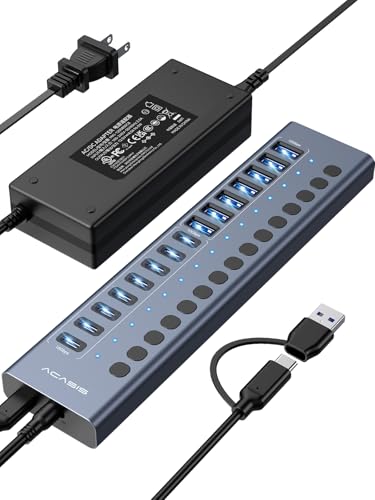
- Eight USB-A and eight USB-C 10Gbps ports
- Individual switches for every port
- 96W powered aluminum enclosure
Best For: Large, permanently connected workstations
Best Charging-Focused Hub

- Three 10Gbps data ports plus five 5Gbps USB-A ports
- 100W USB-C PD connection for laptop charging
- Angled aluminum design with 15 total functions
Best For: USB-C laptops needing data and charging expansion
Flexible Powered Pick

- Seven mixed USB-A and USB-C ports
- Individual switches with LED indicators
- Powered 10Gbps expansion with surge protection
Best For: Flexible desktop and laptop port expansion
Best Heavy-Duty Pick
ACASIS 10-Port Powered USB 3.2 Hub

- Ten total USB-A and USB-C ports
- 48W power adapter for multiple devices
- Independent switches on every port
Best For: High-device-count desktop workstations
Mac-Friendly Design

- Four USB-A and two USB-C data ports
- PD 60W charging port with 72W adapter
- Angled aluminum housing for Mac desks
Best For: Powered MacBook, iMac, and Mac mini expansion
Best Hybrid Expansion – 7-Port 10Gbps USB-C and USB-A Hub
If you need a USB hub with 20Gbps ports, this Rosonway model is not the fastest option in the category, but it offers a flexible seven-port layout with 10Gbps data transfer on every port. Four USB-C and three USB-A connections make it practical for mixed-device workstations.
Best For: Users who need a powered, mixed USB-C and USB-A hub for laptops, desktops, storage drives, and gaming accessories.
Pros:
- Seven USB 3.2 ports, including four USB-C and three USB-A ports.
- Up to 10Gbps data transfer across every port.
- Includes a 36W power adapter, individual port switches, and surge protection.
- Detachable 3.3-foot host cable and aluminum housing suit desktop or travel setups.
Cons:
- Does not support USB-C Power Delivery or DisplayPort video output.
- USB-C ports provide standard 1.5A charging rather than high-power charging.
This is a strong choice when port variety and independent device control matter more than reaching 20Gbps. Its powered design is especially useful for several peripherals connected at once.
Best True 20Gbps Pick – GRAUGEAR 3.5-Inch Front-Panel Hub
For shoppers specifically seeking a USB hub with 20Gbps ports, the GRAUGEAR G-MP01 is the clearest match here. It installs in a desktop’s 3.5-inch bay and adds one USB 3.2 Gen 2×2 USB-C port capable of up to 20Gbps, plus two USB 3.0 ports.
Best For: Desktop builders who want a front-panel USB-C port with 20Gbps capability and have the required motherboard headers.
Pros:
- USB-C port supports USB 3.2 Gen 2×2 speeds up to 20Gbps.
- Converts a 3.5-inch drive bay into three convenient front-facing USB ports.
- Includes USB 3.2 Type-E and USB 3.0 header cables, screws, and safety protections.
- Compatible with Windows 7, 8, 10, and 11.
Cons:
- Requires both a USB 3.0 19-pin header and a USB 3.2 Type-E 20-pin header for full installation.
- Two USB 3.0 ports are limited to up to 5Gbps.
- It is an internal desktop front-panel hub, not a portable laptop accessory.
This is the best fit when actual 20Gbps USB-C performance is the priority. Check the motherboard headers before buying, since older systems may need an adapter or expansion card.
Best High-Capacity Powered Hub – RSHTECH 10-Port USB-C Hub
The RSHTECH RSH-ST10C-6 is designed for busy setups that need many connections rather than a USB hub with 20Gbps ports. It provides ten total ports, including three USB 3.2 ports up to 10Gbps and seven USB 3.0 ports up to 5Gbps, with a 60W power supply.
Best For: Multi-device workflows involving external drives, printers, controllers, and other USB peripherals.
Pros:
- Ten-port layout with six USB-C and four USB-A connections.
- Three USB 3.2 ports support data transfer up to 10Gbps.
- 60W power supply helps distribute power across multiple connected devices.
- Detachable dual USB-A/USB-C host cable and independent touch switches add flexibility.
Cons:
- It does not provide 20Gbps ports.
- Seven ports are USB 3.0 with speeds up to 5Gbps.
- USB-C ports do not support video output.
Choose this model when the priority is connecting a large number of peripherals with stable external power. It is more about capacity and convenience than maximum single-port throughput.
Best for Maximum Port Count – VANGREE 16-Port USB Hub
Although it is not a USB hub with 20Gbps ports, the VANGREE 16-port model stands out for users who need extensive USB expansion. It combines eight USB-A and eight USB-C USB 3.2 ports, with up to 10Gbps data bandwidth and a 96W UL-certified power adapter.
Best For: Offices, studios, and desktop workstations that need to keep a large collection of USB devices connected and individually controlled.
Pros:
- Provides 16 total ports split evenly between USB-A and USB-C.
- Supports data transfer speeds up to 10Gbps and backward compatibility with USB 3.0, 2.0, and 1.1 devices.
- Includes a 96W UL-certified power adapter with protections against common electrical issues.
- Every port has an independent on/off switch and blue status indicator.
Cons:
- Does not support USB-C DisplayPort, video, or audio output.
- Maximum listed data rate is 10Gbps, not 20Gbps.
- Its 16-port design and 1.5-pound weight are better suited to a permanent setup than travel.
This hub makes sense for a heavily populated workstation where port count, power distribution, and individual controls are more valuable than 20Gbps throughput. Its large power adapter is a useful match for many simultaneously connected peripherals.
Best Hybrid 9-Port Pick – 10Gbps Powered USB-C Hub
If you need a USB hub with 20Gbps ports, this model is worth comparing for its practical mix of 10Gbps data ports, slower USB-A expansion, and dedicated charging connections. It includes one USB-C and two USB-A 10Gbps ports, four USB-A 5Gbps ports, and two USB-C PD charging ports. Note that it does not support video output.
Best For: Users who want a powered desktop hub with both USB-C and USB-A connectivity.
Pros:
- Three 10Gbps data ports plus four additional 5Gbps USB-A ports.
- Includes two USB-C PD charging ports rated up to 45W.
- 65W power adapter, aluminum housing, angled design, and built-in protection features.
- Includes a USB-C-to-USB-C cable and an 18-month support promise.
Cons:
- It has 10Gbps ports rather than 20Gbps ports.
- The PD charging ports do not transfer data.
- It does not provide video output and is not recommended for charging computers.
This is a sensible choice when dependable peripheral expansion matters more than maximum USB bandwidth. Its dedicated charging ports and powered design are useful for a busy desk, but buyers should avoid running multiple SSDs simultaneously.
Best High-Capacity Expansion – ACASIS 16-Port 10Gbps Hub
For shoppers comparing a USB hub with 20Gbps ports, the ACASIS focuses instead on maximum port count: eight USB-A and eight USB-C 3.2 ports, all rated for 10Gbps. Its 96W power adapter and individual switches make it suited to a large, permanently connected workstation, though it does not support video output.
Best For: Workstations that need many switched USB-A and USB-C data connections.
Pros:
- Provides 16 USB 3.2 ports, split evenly between USB-A and USB-C.
- Individual on/off switches let you control connected devices without unplugging them.
- 96W power adapter supports multiple connected devices, with surge protection and hot swapping.
- Aluminum housing is designed for heat dissipation and durability.
Cons:
- The ports are rated at 10Gbps, not 20Gbps.
- No video output functionality is included.
- Its large 16-port design is less convenient for a minimal or travel setup.
The ACASIS is the strongest fit here for users prioritizing quantity and desk-based device management. Independent switches add convenience for drives and peripherals, while the powered enclosure is better suited to sustained multi-device use than a basic bus-powered hub.
Best Charging-Focused Hub – 15-in-1 10Gbps USB-C Hub
If your search for a USB hub with 20Gbps ports also includes charging flexibility, this 15-in-1 model combines 10Gbps data connections with USB-C power features. It offers two USB-C and one USB-A 10Gbps data ports, several 5Gbps USB-A ports, a 100W USB-C PD input, and additional charging ports. It does not support video output.
Best For: USB-C laptop users who need data expansion alongside high-power charging support.
Pros:
- Includes three 10Gbps data ports and five additional 5Gbps USB-A data ports.
- Provides a 100W USB-C PD charging connection when used with the computer’s original adapter.
- Additional USB-C charging ports offer up to 45W single-port output.
- Aluminum, angled housing has non-slip feet and supports plug-and-play operation.
Cons:
- The data ports are 10Gbps rather than 20Gbps.
- All ports lack video output support.
- The hub requires its included 65W power adapter to operate, and its extra PD ports are not recommended for computers.
This model is appealing when charging is nearly as important as peripheral connectivity. It offers a broad selection of ports for modern USB-C systems, but buyers seeking display support or true 20Gbps data should look elsewhere.
Flexible Powered Pick – Rosonway 7-Port USB 3.2 Hub
If you need a USB hub with 20Gbps ports, note that this Rosonway model provides up to 10Gbps rather than 20Gbps. Its mix of USB-A and USB-C connections, powered design, and individual switches makes it a practical option for expanding a laptop or desktop setup.
Best For: Users who need flexible USB-A/USB-C expansion, individual port controls, and powered operation.
Pros:
- Offers one USB-A 3.2 port, two USB-C 3.2 ports, and four USB-A 3.0 ports.
- Individual switches with LED indicators let you disable ports without unplugging devices.
- Includes a 12V/2A power adapter, surge protection, and a 3.3-foot dual-format cable.
Cons:
- Its maximum listed data rate is 10Gbps, not 20Gbps.
- The seven ports share the hub’s available bandwidth.
The aluminum housing and broad operating-system compatibility add everyday practicality. Choose it when port variety and per-port control matter more than achieving 20Gbps transfer speeds.
Best Heavy-Duty Pick – ACASIS 10-Port Powered USB 3.2 Hub
For shoppers comparing a USB hub with 20Gbps ports, this ACASIS hub is another 10Gbps solution rather than a 20Gbps model. It stands out with ten USB-A/USB-C data ports, a 48W power adapter, and independent switches for high-device-count workstations.
Best For: Power users connecting many USB peripherals, drives, flash storage devices, or accessories at once.
Pros:
- Provides five USB-A 3.2 and five USB-C 3.2 ports.
- Includes a 48W adapter and supports up to 5V/1.5A per connected device according to the listing.
- Independent switches, aluminum construction, surge protection, and plug-and-play compatibility improve convenience.
Cons:
- Maximum listed transfer speed is 10Gbps, not 20Gbps.
- It does not support video output.
- Ten ports share the hub’s total bandwidth.
With the largest port count in this roundup, the ACASIS is suited to a permanent desk setup where numerous devices need to remain connected. Its powered design is more appropriate for multiple peripherals than an unpowered travel hub.
Mac-Friendly Design – ORICO 7-Port USB 3.2 Gen2 Hub
If your search for a USB hub with 20Gbps ports includes Mac-focused accessories, this ORICO model offers a polished alternative at up to 10Gbps. It combines four USB-A ports, two USB-C ports, a PD 60W port, and a powered aluminum design.
Best For: MacBook, iMac, Mac mini, and other USB-A/USB-C computers needing a neat, powered seven-port expansion hub.
Pros:
- Includes four USB-A and two USB-C data ports in a seven-port design.
- Supplied with a 72W adapter and features a PD 60W port for charging compatible devices.
- Angled aluminum housing and included USB-C cable plus USB-A adapter suit Mac-oriented desks.
Cons:
- The listed data speed is 10Gbps, not 20Gbps.
- The USB 3.2 data ports do not support charging; charging is handled through the PD port.
- The seven ports share 10Gbps transmission bandwidth.
The ergonomic slanted design and included connection options make this a strong fit for Apple-style workspaces. It is best selected for appearance, powered expansion, and PD charging rather than 20Gbps performance.
How We Picked the Best USB Hub with 20gbps Ports
We focused on hubs that expand connectivity without making speed or power claims difficult to interpret. The selection includes compact seven-port models, high-capacity 10- and 16-port hubs, desktop units with dedicated power adapters, and an internal front-panel option. We considered advertised USB data rates, port mix, power supply, charging support, switching controls, construction, and how each design fits common desktop workflows.
One important distinction: several products in this roundup advertise USB 3.2 Gen 2 speeds up to 10Gbps, while a true USB Hub with 20gbps Ports should be paired with compatible USB 3.2 Gen 2×2 hardware to reach 20Gbps. Actual performance depends on the computer, cable, storage device, and shared hub bandwidth.
Quick Comparison
- Best for maximum expansion: Choose a 15- or 16-port powered hub when many peripherals must remain connected.
- Best for balanced desktop use: Seven- to 10-port hubs provide useful capacity without taking over the workspace.
- Best for storage and creative work: Prioritize USB-C ports, high-speed ratings, and short, quality cables.
- Best for internal PC upgrades: A front-panel hub can provide convenient access, but it requires a compatible internal header and installation.
Key Buying Factors for a USB Hub with 20gbps Ports
Port Speed and Compatibility
Check whether 20Gbps refers to USB 3.2 Gen 2×2, or whether the hub is limited to 10Gbps USB 3.2 Gen 2. Your host computer must support the same standard, and connected devices share the upstream connection. A faster port will not increase the speed of an older drive.
Port Mix and Layout
Count the ports you actually need, then allow room for future devices. USB-C is useful for modern SSDs and phones, while USB-A remains common for input devices and older accessories. Front-facing ports are easier to reach; rear-facing ports usually create a cleaner permanent setup.
Power and Charging
Powered hubs are preferable for external hard drives, multiple SSDs, capture devices, and other high-draw accessories. Review the included adapter’s wattage and confirm whether any USB-C PD port is for charging, data, or both. A hub’s total power is shared across connected devices.
Convenience and Build Quality
Individual switches can simplify troubleshooting and reduce cable clutter. Aluminum housings may improve durability and heat handling, while a longer host cable offers more placement flexibility. Confirm operating-system support and cable requirements before buying.
Who Should Buy Which USB Hub with 20gbps Ports?
Choose a high-port-count powered hub if you run a workstation with several drives, cameras, controllers, or accessories. A seven-port model suits everyday laptop and desktop users who need a practical expansion point. Select a USB Hub with 20gbps Ports when rapid transfers are central to your workflow and both the host and storage devices support that standard. For a gaming or office setup, individual switches can be more useful than maximum speed. PC builders should consider the internal front-panel model only after checking the motherboard header, available bay space, and installation requirements.