Reliable noise monitoring is easier when a meter can record measurements instead of displaying only a momentary reading. The best sound level meters with data logging help you identify patterns, document exposure, and review changes over time.
This roundup compares 10 options with features such as USB export, wireless connectivity, alarms, rechargeable batteries, large displays, and extended memory. Use the guide below to match recording capacity and connectivity with your monitoring needs.
Best 10 Sound Level Meters with Data Logging Picks for 2026
Best Value Logging Meter
Rechargeable 30–130 dB Sound Level Meter

- Stores up to 43,000 readings with USB PC sync
- A/C weighting and fast/slow response modes
- Three-color customizable noise alarm
Best For: Everyday indoor and field noise monitoring
Professional Pick
CRY2832-2 Lite Data Logging Sound Level Meter

- Records Leq, Lmax, Lmin, and Lpeak
- Multiple timing, trigger, and weighting options
- CSV export plus USB-C, RS232, Bluetooth, and Wi-Fi
Best For: Workplace, environmental, and industrial noise surveys
Best for Long-Term Recording
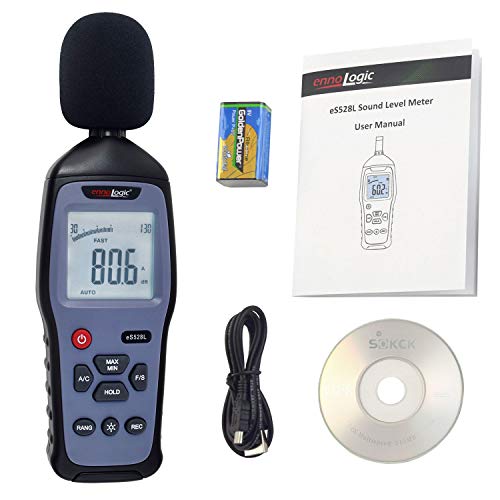
- Records noise for hours or days
- Includes Windows software and USB cable
- Max/min/hold, A/C weighting, and analog outputs
Best For: Neighborhood, workplace, and equipment noise documentation
Best Smart Monitor
Wi-Fi Sound Level Meter with Data Logging

- Wi-Fi app access with historical trend charts
- Measures noise, temperature, and humidity
- 4000mAh battery with wall or desk placement
Best For: Connected indoor monitoring in homes and facilities
Best Rechargeable Pick
GAIN EXPRESS SLM-442 Data Logger

- 3,100-record storage with PC export
- Up to 8 hours per charge
- A/C weighting with visual alarms
Best For: Portable home, classroom, office, and industrial monitoring
Best Visual Reporting

- CSV export and printable graph support
- 3,100 data points with real-time recording
- Adjustable three-color alarms
Best For: Computer-based noise analysis and documentation
Best High-Capacity Logger
SLM-25 Professional Noise Meter

- Stores up to 32,000 data groups
- Fast/slow response selection
- AC/DC outputs for connected equipment
Best For: Longer logging sessions and technical measurement setups
Best Data Capacity
43,000-Record Sound Level Meter

- Stores up to 43,000 readings
- Exports data to Excel via Windows PC
- A/C weighting and three-color alarm
Best For: High-volume logging and PC-based analysis
Best Large-Display Monitor

- 13-inch display with large digits
- Stores up to one year of readings
- 16.4-foot sensor and adjustable alarm
Best For: Classroom and fixed-location monitoring
Best Portable App Logger

- Logs over 20,000 data points
- Connects to Android and iOS apps
- Lightweight body with backlit LCD
Best For: Portable monitoring with smartphone data management
Best Value Logging Meter – Rechargeable 30–130 dB Sound Level Meter
If you need sound level meters with data logging for everyday checks and basic documentation, this model offers a practical mix of accuracy, alerts, and computer connectivity. It measures 30–130 dB with stated ±1.5 dB accuracy, supports A/C weighting, and can store up to 43,000 readings for later review.
Best For: Home, classroom, office, and factory users who want portable monitoring with PC data transfer and visual noise alerts.
Pros:
- Stores up to 43,000 data points and supports USB connection for downloads and real-time monitoring on compatible Windows versions.
- A and C frequency weightings, plus fast and slow response modes, cover general sound checks and changing noise levels.
- Three-color alarm lights can provide immediate visual warnings when customizable sound limits are exceeded.
- Compact housing and automatic shutoff support portable indoor or field use.
Cons:
- PC compatibility is specified for Windows 7, 8, 10, and 11.
- The stated range begins at 30 dB, so it is not intended for very quiet measurements below that level.
- The notes specify a 9V battery power source rather than a built-in rechargeable battery.
This is a versatile choice when you want straightforward logging, visual alerts, and familiar handheld operation without moving into a more advanced professional measurement platform.
Professional Pick – CRY2832-2 Lite Data Logging Sound Level Meter
For workplace, environmental, or industrial surveys, this professional sound level meter with data logging is built around longer-term analysis rather than one-time readings. The CRY2832-2 Lite records metrics such as Leq, Lmax, Lmin, and Lpeak, with multiple test modes and export options for documenting noise over time.
Best For: Acousticians, safety officers, engineers, EHS teams, and facility managers conducting recurring noise assessments.
Pros:
- Supports Leq, Lmax, Lmin, and Lpeak for more comprehensive noise evaluation.
- Offers Auto, Timing, Trigger, Custom, and Delay modes for different monitoring workflows.
- Provides A, C, and Z frequency weightings with F, S, and I time weightings.
- Supports CSV export through a microSD card and includes USB-C, RS232, Bluetooth, and Wi-Fi connectivity.
Cons:
- The microSD card required for CSV export must be purchased separately.
- Its broader professional feature set may be more than casual users need for simple spot checks.
- The stated measurement range is 30–130 dBA, which may not suit measurements outside that range.
Choose this model when logged data needs to support review, comparison, reporting, or follow-up work. Its connectivity and measurement options make it the most workflow-focused option in this group.
Best for Long-Term Recording – ennoLogic eS528L Noise Logger
The ennoLogic eS528L is a practical option among sound level meters with data logging when you need to record noise for hours or days and review it later. It combines a 30–130 dBA range and stated ±1.5 dB accuracy with USB software, max/min/hold functions, and both A and C weighting.
Best For: Home, neighborhood, workplace, construction, equipment, and appliance noise investigations that benefit from recorded evidence.
Pros:
- Can record noise for hours or days for later review and supporting documentation.
- Includes Windows software CD, USB cable, 9V battery, and user manual.
- Offers A/C weighting, fast/slow response, max reading, hold, and an analog bar graph display.
- Includes analog DC and AC outputs, a tripod mount, backlit display, and a stated 10-year warranty.
Cons:
- The included software is specified for Windows only.
- A tripod is not included despite the tripod mount.
- The 30–130 dBA range and A/C weighting may be limiting for users needing broader measurement specifications.
This meter stands out for practical evidence gathering. It is especially useful when a single reading is not enough and you need a record to examine later or share during a noise discussion.
Best Smart Monitor – Wi-Fi Sound Level Meter with Data Logging
If you want sound level meters with data logging that can be checked remotely, this Wi-Fi model adds app access and environmental monitoring to its noise readings. It measures 30–130 dBA with stated ±1.5 dBA accuracy, while also tracking temperature and humidity through the Tuya Smart or Smart Life app.
Best For: Indoor home, office, hospital, classroom, and factory monitoring where remote access and historical trend charts are useful.
Pros:
- Connects to Wi-Fi and provides real-time readings and historical trend charts through compatible smart-home apps.
- Combines sound, temperature, and humidity readings in one device.
- Large LED screen offers eight brightness levels and automatic day/night scheduling.
- Rechargeable 4000mAh battery and wall-mount or desk-stand placement provide flexible installation.
Cons:
- It is designed for indoor use rather than general outdoor field logging.
- Wi-Fi and app features depend on network connectivity and compatible Tuya Smart or Smart Life setup.
- The notes specify A-weighted noise measurement and do not list C-weighting or selectable response modes.
This is the strongest fit for connected indoor monitoring rather than detailed acoustic field analysis. Its app history, environmental sensors, and flexible display make it convenient for ongoing room or facility oversight.
Best Rechargeable Pick – GAIN EXPRESS SLM-442 Data Logger
For shoppers comparing sound level meters with data logging, the GAIN EXPRESS SLM-442 combines a rechargeable design, graphical readings, and PC data export in a compact handheld meter. It measures both A- and C-weighted sound across broad ranges and adds visual alarm indicators for quick monitoring.
Best For: Home, classroom, office, neighbor-noise, and general industrial monitoring where rechargeable operation and visual alerts are useful.
Pros:
- Stores up to 3,100 data records and supports PC connectivity for data export.
- Rechargeable battery provides up to 8 hours of operation per charge.
- Offers 30–130 dB(A), 35–130 dB(C), and ±1.5 dB accuracy.
- Three-color alarm lights and a graphical display make changes easier to spot.
Cons:
- Data storage is lower than some competing logger models.
- Listed PC compatibility is limited to Windows 7, 10, and 11.
Choose this model if convenient USB-C charging and at-a-glance alerts matter more than maximum onboard storage. Its calibration knob and adjustable auto-shutoff add flexibility for ongoing monitoring.
Best Visual Reporting – Landtek 3-Color Data Logger
The Landtek meter is a practical choice among sound level meters with data logging when computer-based review is important. Its USB connection supports real-time recording, CSV export, and printable graphs, while the color display and adjustable alarm thresholds simplify everyday noise checks.
Best For: Users who want logged sound data they can review, export, and visualize on a Windows computer.
Pros:
- Stores up to 3,100 data points and supports real-time PC recording.
- Exports data to CSV and provides line charts, analog bars, and date/time details.
- Rechargeable 1,000mAh battery runs for up to 8 hours.
- Includes A/C weighting, manual alarm thresholds, fast/slow response, and data hold.
Cons:
- Computer connectivity is specified for Windows 7, 10, and 11.
- Its 3,100-point capacity may be limiting for longer unattended studies.
This is the stronger fit for users who need more than an on-screen reading. The combination of adjustable alarms and computer-friendly reporting makes it especially useful for documenting changing noise levels.
Best High-Capacity Logger – SLM-25 Professional Noise Meter
For buyers prioritizing storage, the SLM-25 stands out among sound level meters with data logging by recording up to 32,000 groups of data. It also provides fast and slow time weighting, a bar-graph display, and AC/DC outputs for users who need more than basic handheld readings.
Best For: Longer logging sessions in homes, offices, classrooms, and environmental measurement applications.
Pros:
- Records up to 32,000 groups of data and supports Windows 10, 8, 7, Vista, and XP.
- Measures 30–130 dB with ±1.5 dB accuracy and a 31.5–8.5 kHz frequency response.
- Offers selectable fast/slow weighting and a bar-graph display with time and date.
- Provides both AC and DC signal outputs for connected measurement equipment.
Cons:
- The supplied notes do not mention rechargeable-battery operation or USB charging.
- It does not list A/C weighting modes or color alarm indicators.
- The older Windows compatibility list may be less convenient for newer systems.
The SLM-25 is the logical pick when maximum stated logging capacity is the priority. Its output connections and selectable response settings also make it more versatile for technical measurement setups than a basic consumer meter.
Best Data Capacity – 43,000-Record Sound Level Meter
For shoppers comparing sound level meters with data logging, this DANOPLUS model stands out with storage for up to 43,000 readings and PC export. It also adds adjustable A/C weighting, FAST/SLOW response settings, and a color alarm display for practical day-to-day monitoring.
Best For: Users who need substantial onboard storage, spreadsheet export, and visual noise-level alerts.
Pros:
- Stores up to 43,000 data points and exports them to Excel through a Windows PC.
- Measures 30–130 dB with stated ±1.5 dB accuracy.
- Offers A/C frequency weighting, FAST/SLOW response, a line chart, and three-color alarm indicators.
- Rechargeable 1,000mAh battery and DC output add flexibility for extended monitoring.
Cons:
- PC connectivity and exporting are specified for Windows 7, 10, and 11.
- The feature-rich interface may be more than casual users need.
Choose this model when data capacity and computer-based analysis matter more than the simplest possible controls. Its adjustable measurement settings and alarm threshold make it suitable for structured noise surveys.
Best Large-Display Monitor – Wall-Mount Sound Meter
This DANOPLUS unit is a strong choice among sound level meters with data logging when readings need to be visible from across a room. Its 13-inch display, 16.4-foot sensor, adjustable alarm, and one-year data storage are designed for classrooms, studios, and fixed monitoring locations.
Best For: Classrooms, studios, and other spaces needing a highly visible wall- or desktop-mounted noise monitor.
Pros:
- Records readings every two seconds and can store up to one year of data.
- 13-inch HD screen uses large, approximately 4-inch digits for at-a-glance viewing.
- Includes a 16.4-foot sensor for flexible placement around the monitored area.
- Provides adjustable audible and visual alarms plus a 12V external alarm output.
Cons:
- Its 2.66-pound, 13-inch design is less portable than handheld meters.
- The default alarm threshold is 120 dB and may require manual adjustment for typical rooms.
This is the most practical option when visibility and long-term logging are priorities. The large display and remote sensor favor permanent or semi-permanent installations rather than quick handheld checks.
Best Portable App Logger – Bluetooth Sound Level Meter
For portable sound level meters with data logging, this Bluetooth model combines a compact design with smartphone recording through its Android and iOS app. It stores more than 20,000 data points and adds MAX/MIN, data hold, backlit display, and alarm functions for field measurements.
Best For: Mobile users who want to carry a lightweight meter and manage logged readings on a smartphone.
Pros:
- Connects to Android and iOS devices through Bluetooth for data transfer and management.
- Stores over 20,000 measurement points for monitoring and analysis.
- Measures 30–130 dB with stated ±1.5 dB accuracy and 0.1 dB display resolution.
- Lightweight 3.4-ounce body includes a backlit LCD and 1/4-inch mounting thread.
Cons:
- Uses three AAA batteries rather than a rechargeable battery.
- App-based data management depends on Bluetooth and a compatible smartphone.
This model makes the most sense for users who value portability and phone-based logging. Its compact body is convenient for repeated measurements, while the storage capacity supports more than occasional spot checks.
How We Picked These Sound Level Meters with Data Logging
We focused on meters that combine sound-level measurement with some form of recording, memory, or app-based history. The selection includes compact handheld models, professional-style data loggers, Wi-Fi and Bluetooth devices, and large wall-mounted displays. We also considered practical features such as stated measurement range, A/C weighting, Leq or peak readings, alarm indicators, rechargeable power, sensor placement, and the ability to export or review stored data.
Specifications can vary by seller and model revision, so verify the included accessories, software requirements, calibration options, and memory capacity before purchasing.
Quick Comparison
| Feature | Why It Matters | Best For |
|---|---|---|
| Internal data logging | Stores readings for later review or export | Audits, reports, and unattended monitoring |
| Wi-Fi or Bluetooth | Moves readings to a phone, computer, or network | Remote viewing and app-based records |
| Large display and alarm | Makes changing noise levels easy to see | Classrooms, offices, and public spaces |
| Leq and peak readings | Shows average exposure as well as short spikes | Workplace and compliance-oriented checks |
| Extended memory | Reduces the need to download data frequently | Long monitoring sessions |
Key Buying Factors for Sound Level Meters with Data Logging
Measurement Range and Weighting
Most models in this roundup cover approximately 30 to 130 dB, which is suitable for general room, equipment, event, and workplace checks. A-weighting is commonly used for environmental and human-hearing assessments, while C-weighting is useful when low-frequency sound and louder sources matter. If you need formal compliance measurements, confirm the meter’s accuracy class and calibration support rather than relying on range alone.
Recording Method and Capacity
Check whether the meter records continuously, at fixed intervals, or only when manually saved. Memory figures such as 31,000 or 43,000 readings are useful, but the sampling interval and file format determine how much time they represent. USB export is convenient for spreadsheets; Bluetooth and Wi-Fi are better when you want mobile access or remote monitoring.
Readability, Alarms, and Power
A three-color display or adjustable alarm can provide an immediate warning when noise exceeds a chosen threshold. For unattended use, prioritize battery life, rechargeable convenience, automatic logging, and a clear low-battery indicator. A remote sensor or wall-mount design can also improve placement when the display needs to remain visible away from the measurement point.
Who Should Buy Which Sound Level Meters with Data Logging?
Choose a compact rechargeable logger for occasional home, office, classroom, or workshop checks. Select a model with Leq, peak, larger memory, and straightforward export when you need records for repeated workplace or equipment assessments. Wi-Fi or Bluetooth models suit users who want smartphone access and easier sharing, while a wall-mounted meter is most useful for continuously displaying sound levels in a classroom, studio, or shared workspace.
For regulated industrial, occupational-health, or legal documentation, treat these products as screening and monitoring tools unless the manufacturer confirms the required standards, accuracy, calibration process, and certification.