Portable light meters make it easier to measure illumination than relying on visual judgment alone. The right model can help you check workplace lighting, tune grow lights, evaluate photography setups, or troubleshoot uneven brightness.
This roundup compares ten practical options, from Bluetooth-enabled color meters to straightforward lux and foot-candle testers. Use the guide below to match sensor range, controls, portability, and specialized features to your work.
Best 10 Portable Light Meters Picks for 2026
Best Connected Meter

- Measures light, color temperature, chromaticity, and DUV
- Bluetooth app sync with multi-meter support
- Compact design with up to 40 hours of battery use
Best For: Connected photography and production lighting workflows
Best High-Range Lux Meter
Dr.meter Digital Illuminance Meter

- Measures up to 200,000 lux
- Switches between lux and foot-candle units
- Includes fast readings and peak-value recording
Best For: Plant lighting, sunlight, and general illuminance checks
Best for LED Measurement

- Measures white LED sources up to 400,000 lux
- Supports several common lighting technologies
- Provides minimum, maximum, average, and hold functions
Best For: High-intensity LED and industrial lighting checks
Best All-Around Display

- Wide 0.1–200,000 lux range with lux/FC modes
- Rotating probe and large backlit display
- Adds temperature, humidity, max/min, and hold functions
Best For: Plant, home, office, and workshop measurements
Best Connected Pick
UNI-T UT383BT Bluetooth Light Meter

- 0–199,900 Lux and 0–18,500 Fc range
- Bluetooth app support for recording and analysis
- Backlit display with 0.5-second sampling
Best For: App-connected light measurement and data logging
Best Split-Sensor Option
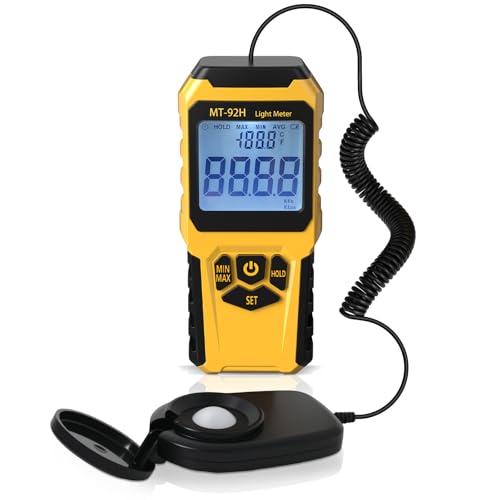
- 0–200,000 Lux range with 0.1 Lux resolution
- Separate probe enables flexible positioning
- Measures Lux/Fc and Celsius/Fahrenheit
Best For: Flexible professional measurements with temperature monitoring
Best Simple Value
UNI-T UT383 Digital Light Meter

- 0–199,900 Lux and 0–18,500 Fc range
- Lightweight 5-ounce handheld design
- Fast sampling with useful hold and Max/Min functions
Best For: Simple everyday illuminance checks without app connectivity
Best Wide-Range Pick
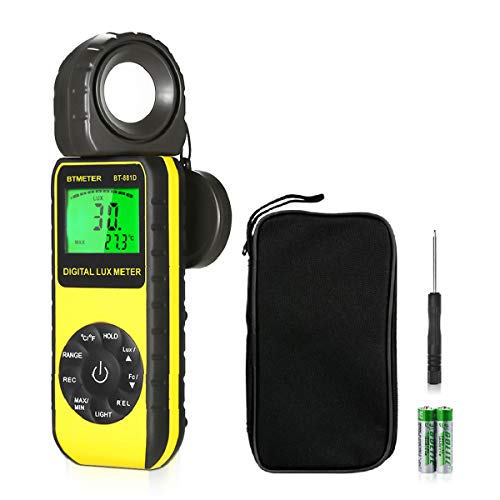
- 0.01–400,000 lux measurement range
- 270° rotating sensor
- Stores 33 readings
Best For: Wide-ranging light checks and repeated measurements
Best Ready-to-Use Option

- 0–200,000 lux range
- Backlit digital and analog display
- Includes batteries and 2-year warranty
Best For: Routine plant, studio, and workplace light checks
Best Rotating-Sensor Design

- 360° rotating sensor
- 0–200,000 lux range
- MIN/MAX and Data Hold functions
Best For: Measurements around fixtures and hard-to-reach areas
Best Connected Meter – Datacolor LightColor Meter
The Datacolor LightColor Meter is a strong choice among portable light meters for photographers, filmmakers, and production teams who need both exposure-related light data and color information. It measures ambient and flash lighting, lux, chromaticity, color temperature, and green-magenta balance, then syncs readings to a mobile app over Bluetooth.
Best For: Connected lighting workflows, flash and ambient measurements, and users who need color-temperature data.
Pros:
- Measures lux, chromaticity, 1,600K–20,000K color temperature, and DUV.
- Works with LED, tungsten, HMI, fluorescent, strobe, and outdoor lighting.
- Bluetooth app integration and support for multiple meters up to 80 feet away.
- Compact, drop-resistant design with up to 40 hours of use on two AAA batteries.
Cons:
- Its advanced color and Bluetooth features may be more than needed for basic illuminance checks.
- Requires a compatible mobile device for app-based data syncing.
This is the most feature-rich option in the group for users who need portable color and light analysis rather than lux readings alone. Its compact design and wireless workflow are particularly useful on active sets.
Best High-Range Lux Meter – Dr.meter Digital Illuminance Meter
The Dr.meter Digital Illuminance Light Meter is a practical pick among portable light meters for broad illuminance checks. Its 0–200,000 lux range, fast response, and selectable lux or foot-candle readout make it suitable for plant areas, workplaces, homes, and outdoor sunlight measurements.
Best For: General-purpose lux and foot-candle measurements, especially plant-light and high-intensity readings.
Pros:
- Wide 0–200,000 lux measurement range.
- Switches between lux and foot-candle units.
- Reads twice per second and includes a peak-value recording function.
- Includes a low-battery alert and 9V battery.
Cons:
- Uses a relatively large 9V battery rather than AAA cells.
- Does not list color-temperature or wireless app features.
Choose this meter when straightforward illuminance measurement and a high maximum range matter most. The peak function also makes it useful for brief high-intensity sources such as flashes, lasers, or lightning.
Best for LED Measurement – Triplett LT80 Light Meter
The Triplett LT80 is a capable option among portable light meters for measuring intense LED illumination and other common light sources. It reaches 400,000 lux, or 40,000 foot-candles, and adds minimum, maximum, average, and data-hold functions for comparing readings.
Best For: LED-heavy environments, industrial checks, and users who need min/max/average analysis.
Pros:
- Measures white LED light up to 400,000 lux.
- Also supports fluorescent, metal halide, high-pressure sodium, and incandescent sources.
- Min, max, and average functions help evaluate changing readings.
- Includes a 9,999-count LCD, data hold, and disable-able auto power-off.
Cons:
- Its listed functions focus on illuminance rather than color temperature or wireless connectivity.
- The larger handheld form may be less convenient than the smallest compact meters.
The LT80 stands out when maximum light intensity is a priority, particularly for white LED sources. Its statistical reading functions make it more useful than a basic meter for documenting variable lighting conditions.
Best All-Around Display – TopTes TS-710 Light Meter
The TopTes TS-710 combines a wide measurement range with an adjustable probe and a large backlit display, making it one of the more convenient portable light meters for plants, homes, offices, and workshops. It measures up to 200,000 lux, displays lux or foot-candles, and also records temperature and humidity.
Best For: Plant lighting, home and office troubleshooting, and users who want extra environmental readings.
Pros:
- Measures 0.1–200,000 lux and 0.1–20,000 foot-candles.
- 180-degree rotating probe supports measurements from different angles.
- Fast 0.5-second sampling and a large 2.25-inch backlit LCD.
- Adds temperature, humidity, max/min, data hold, and a soft case.
Cons:
- Requires three AAA batteries.
- Its temperature sensor adapts to new environments over time, so readings may not be immediate.
- It is intended for visible-light measurements and does not list color-temperature analysis.
This is a versatile choice for everyday users who want easy viewing and flexible positioning. The rotating sensor and environmental functions give it an edge for plant rooms, uneven household lighting, and general workplace checks.
Best Connected Pick – UNI-T UT383BT Bluetooth Light Meter
For shoppers comparing portable light meters, the UNI-T UT383BT combines a broad 0–199,900 Lux range with Bluetooth data transfer. Its iENV app supports recording, exporting, storing, and analyzing readings, making it useful when measurements need to be documented rather than simply viewed.
Best For: Users who want app-connected measurements for photography, studios, offices, laboratories, or field work.
Pros:
- Measures in Lux or foot-candles across a wide range.
- Bluetooth connectivity supports recording, export, storage, and analysis through the iENV app.
- Compact design with a backlit four-digit display and 0.5-second sampling.
- Includes Max/Min, data hold, overload indication, and auto shutdown.
Cons:
- App functionality may be unnecessary for users who only need on-device readings.
- Listed accuracy is ±(4%+8), so it is not positioned as a laboratory-grade precision instrument.
The UT383BT is a strong choice among portable light meters when wireless data handling matters. If you prefer a straightforward handheld meter without Bluetooth, one of the other UNI-T models may be a better fit.
Best Split-Sensor Option – MT-92H Light Meter
The MT-92H stands out among portable light meters for its separate probe, which lets you position the sensor independently from the display. It measures up to 200,000 Lux, refreshes every 0.5 seconds, and also includes temperature readings for broader environmental checks.
Best For: Professionals who need flexible sensor positioning, dual Lux/foot-candle readings, and temperature measurement.
Pros:
- Measures 0–200,000 Lux with ±3% accuracy and 0.1 Lux resolution.
- Split-sensor design allows flexible probe placement.
- Switches between Lux/Fc and Celsius/Fahrenheit.
- Backlit display is designed for readability in darkness or bright conditions.
Cons:
- At 188g, it is heavier than the two UNI-T meters listed here.
- Requires three AAA batteries for operation.
Choose the MT-92H if the split probe and temperature function are more valuable than the smallest possible form factor. Its high range and fast refresh rate also suit users monitoring changing light conditions.
Best Simple Value – UNI-T UT383 Digital Light Meter
If you want portable light meters without app connectivity, the UNI-T UT383 focuses on the essentials. It covers 0–199,900 Lux, displays Lux or foot-candles, and adds practical functions such as Max/Min, data hold, a backlight, and automatic shutdown.
Best For: Buyers seeking a compact, straightforward meter for offices, homes, photography, studios, or general field checks.
Pros:
- Wide 0–199,900 Lux and 0–18,500 Fc measurement range.
- Compact, lightweight design weighing 5 ounces.
- Fast 0.5-second sampling with a backlit four-digit LCD.
- Includes data hold, Max/Min, overload indication, and auto shutdown.
Cons:
- Does not include the UT383BT’s Bluetooth or app-based data features.
- Listed accuracy is ±(4%+8).
The UT383 is a practical pick for routine illuminance checks when you want a compact meter and do not need wireless reporting. Its feature set covers common indoor, photographic, and workplace tasks while keeping operation simple.
Best Wide-Range Pick – BTMETER BT-881D Light Meter
For shoppers comparing portable light meters, the BTMETER BT-881D stands out for its exceptionally broad 0.01–400,000 lux measurement range and quick 0.4-second response. Its rotating sensor and reading memory make it practical for checking grow lights, offices, schools, and other indoor or outdoor settings.
Best For: Users who need an unusually wide measurement range and stored readings for repeated light checks.
Pros:
- Measures from 0.01 to 400,000 lux, or up to 40,000 foot-candles.
- 270-degree rotating sensor helps with readings from different angles.
- Records 33 sets of readings and includes a relative measurement mode.
- Samples two to three times per second for fast results.
Cons:
- Accuracy varies by range, from ±4% to ±5% plus 10 digits.
- The supplied notes do not specify included batteries or a warranty.
The BT-881D is a versatile choice when measurement flexibility matters more than having the smallest possible meter. Its large range and memory functions are especially useful for comparing lighting conditions over time.
Best Ready-to-Use Option – POROMETISTO LT01 Light Meter
The POROMETISTO LT01 is a practical choice among portable light meters for users who want a compact, ready-to-use device. It combines a 0–200,000 lux range with a backlit display, analog bar graph, hold function, and included batteries for immediate testing.
Best For: Home growers, photographers, and facility users who value simple operation, clear readings, and included accessories.
Pros:
- Measures up to 200,000 lux or 20,000 foot-candles.
- Backlight and analog bar graph make changing light levels easier to view.
- Data Hold and MAX/MIN modes support quick comparisons.
- Includes batteries, a sensor cap, lanyard, and a two-year warranty.
Cons:
- Its maximum range is lower than the BTMETER BT-881D’s 400,000 lux.
- The product details list the included batteries inconsistently as AAA in the bullets and AA in the specifications.
With its compact design and straightforward functions, the LT01 is well suited to routine lighting checks. The included batteries and two-year warranty also make it a convenient option for first-time buyers.
Best Rotating-Sensor Design – DANOPLUS DP-331 Light Meter
The DANOPLUS DP-331 offers a flexible design for portable light meter users who need to position the sensor independently of the display. Its 360-degree rotating sensor, automatic range selection, and 0–200,000 lux capacity suit lighting checks for plants, homes, offices, and other facilities.
Best For: Users who need maximum sensor positioning flexibility when measuring light in awkward spaces.
Pros:
- 360-degree rotating sensor can be positioned independently for measurement.
- Provides four automatic lux ranges from 200 to 200,000, plus foot-candle measurement.
- Includes MIN/MAX, Data Hold, auto power-off control, and low-battery indication.
- Uses a 400–700 nm visible-light spectral range.
Cons:
- Maximum range is lower than the BT-881D’s 400,000 lux capacity.
- The supplied notes do not mention a warranty.
The DP-331 is a strong fit when sensor positioning is the deciding factor. Its rotating head and practical measurement controls make it easier to take readings around fixtures, plants, and hard-to-reach areas.
How We Picked These Portable Light Meters
We focused on handheld meters that provide a useful illumination range, clear readings, and controls suited to real-world measuring. The selection includes compact single-body designs, models with rotating or split sensors, backlit displays, temperature functions, and Bluetooth connectivity. We also considered whether each meter supports lux, foot-candle, or color-temperature measurements, since those capabilities determine where it is most useful.
Because accuracy can vary with calibration, sensor position, and light source, treat advertised specifications as a starting point. For professional compliance work, choose a calibrated instrument and follow the relevant measurement standard.
Quick Comparison
| Best For | Look For |
|---|---|
| Photography and color evaluation | Color-temperature measurement and Bluetooth logging |
| General home, office, or workshop checks | Wide lux range, simple controls, and a readable display |
| Bright lamps and grow lights | High maximum range, data hold, and overload indication |
| Hard-to-reach locations | Rotating or split sensor with a long lead |
| Low-light measurements | Low minimum range and a backlit display |
Key Buying Factors for Portable Light Meters
Measurement Range and Units
Check both the minimum and maximum lux values, not just the headline maximum. A meter that reaches 200,000 lux is useful in direct sunlight, while low-range sensitivity matters for rooms, displays, and photography. Foot-candle support is helpful when working from lighting specifications that use imperial units.
Sensor Design
A rotating sensor lets you aim the detector without twisting the entire meter. Split-sensor designs are especially convenient for ceilings, cabinets, equipment interiors, and other awkward spaces. A fixed sensor is usually smaller and simpler for routine spot checks.
Display and Controls
Large digits, a backlight, data hold, auto-ranging, and a fast refresh rate make readings easier to capture. Consider whether the controls can be operated with one hand and whether the screen remains visible at the measuring angle you expect to use.
Connectivity and Extra Measurements
Bluetooth can simplify recording and comparing readings, but it adds value mainly when you need repeatable logs or color data. Temperature readings, maximum or minimum capture, and automatic power-off are useful extras, though they should not outweigh sensor performance and usability.
Who Should Buy Which Portable Light Meters?
Photographers and lighting designers: Choose a color-aware Bluetooth meter when color temperature and repeatable setup records matter more than basic lux readings.
Homeowners, office managers, and hobbyists: A straightforward digital lux meter with a wide range, backlight, and data hold is generally the best balance of price and convenience.
Grow-light and bright-light users: Prioritize a high-range model that can handle intense illumination without frequent overload warnings.
Technicians and installers: Select a split or rotating sensor for access around fixtures and machinery. For regulated inspections or documented workplace testing, verify calibration requirements before buying.