The best physics experiment sets for middle school students turn abstract ideas into observable results. Instead of only reading about force, light, electricity, or magnetism, students can build, measure, test, and revise their own experiments.
This roundup covers beginner-friendly kits and more focused lab sets for classroom demonstrations, homeschool lessons, science fairs, and independent STEM projects. The options vary widely, so consider the student’s age, interests, supervision needs, and the concepts you want to teach before choosing.
Best 10 Physics Experiment Sets for Middle School Students Picks for 2026
Hands-On Electricity Lab
Basic Electricity & Magnetism Kit
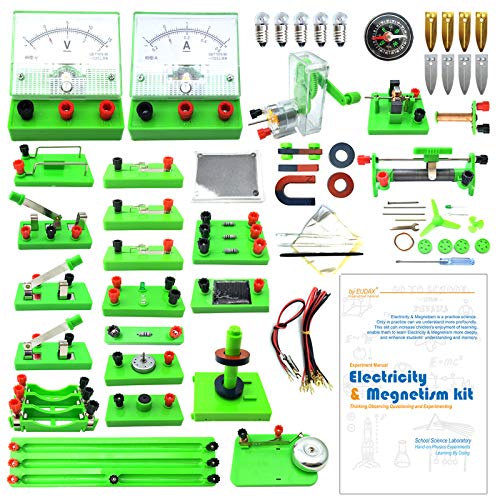
- 79 items for electricity and magnetism activities
- Build circuits, electromagnets, bells, and generators
- Color manual and storage bag included
Best For: Older middle school beginners exploring electricity and magnetism
Motion Model Builder
Inertia, Friction & Circular Motion Kit

- Build six working physics models
- Explores inertia, friction, and circular motion
- Includes theory, experiments, quizzes, and a 3D app
Best For: Ages 9+ who prefer construction-based STEM learning
Optics Discovery Set
Light, Lenses & Reflection Experiments

- Includes lenses, mirrors, a prism, and light source
- Demonstrates refraction and several reflection types
- English color manual included; AAA batteries required
Best For: Introductory optics demonstrations with supervision
Simple Machines Workshop

- Build 26 models using six simple machines
- Includes a force-measuring spring scale
- No batteries required; full-color manual included
Best For: Ages 8+ learning force through model building
Best Optics Exploration Kit
Teenii Physics & Optics Science Kit

- 15+ hands-on light experiments
- 25+ optics components included
- 32-page illustrated experiment guide
Best For: Students exploring lenses, mirrors, prisms, and light
Best All-Around Physics Fundamentals Set

- 20 experiments and model builds
- Covers forces, motion, and energy
- Includes an NGSS-aligned lesson plan
Best For: Ages 8–14 learning foundational mechanics
Best Circuit-Building Kit
EUDAX Electricity & Magnetism Lab Set

- Builds series and parallel circuits
- Includes wires, switches, bulbs, and LEDs
- Supports electromagnet and generator projects
Best For: Grades 7–11 studying electricity and magnetism
Best Comprehensive Mechanics Kit

- Covers forces, motion, pressure, buoyancy, pulleys, and levers.
- Includes balances, pulleys, a trolley, ramp, and force gauge.
- Comes with a manual and organized storage box.
Best For: Broad classroom or home mechanics instruction for ages 14 and up
Best Magnetism-Focused Set
38-Piece Electromagnet Experiment Kit

- Includes 38 pieces for magnetic and electromagnetic experiments.
- Explores fields, levitation, attraction, repulsion, and Earth’s magnetism.
- Provides magnets, an electromagnet, compass, shavings, wires, and battery box.
Best For: Focused magnetism and electromagnetism instruction for ages 15 and up
Best Pulley Teaching Set

- Includes four fixed and four movable pulleys with ropes and hooks.
- Supports single and double pulley arrangements.
- Iron construction suits repeated classroom demonstrations.
Best For: Focused middle school lessons on pulley systems and mechanical advantage
Hands-On Electricity Lab – Basic Electricity & Magnetism Kit
For shoppers comparing physics experiment sets for middle school students, this EUDAX kit offers a broad introduction to electricity and magnetism through hands-on projects. The color manual and 79 included items support experiments such as series and parallel circuits, fruit batteries, electromagnets, and electric bells. Note that three AA batteries are required and are not included.
Best For: Older middle school students or beginners who want a wide-ranging electricity and magnetism project set.
Pros:
- Includes 56 electricity items, 21 magnetism items, repair tools, and a storage bag.
- Covers multiple projects, including circuits, Ohm’s law, electromagnets, and a hand-crank generator.
- Provides a full-color manual to explain principles and guide exploration.
Cons:
- Requires three AA batteries, which are not included.
- The manufacturer recommends ages 8–18, but the electricity concepts may suit older learners best.
Choose this set when variety matters more than a single focused topic. Its mix of circuit and magnetism activities makes it a flexible option for guided lessons or independent STEM exploration.
Motion Model Builder – Inertia, Friction & Circular Motion Kit
This Engino set is a strong choice among physics experiment sets for middle school students who learn best by building. It focuses on inertia, friction, and circular motion, with six working models—including a rocket launcher and crash-test rig—plus theory, experiments, quizzes, and an interactive 3D app.
Best For: Children ages 9 and up who enjoy construction-based STEM activities and motion demonstrations.
Pros:
- Offers six model options that demonstrate laws of motion.
- Includes theory, experiments, fun facts, and a four-page quiz section.
- Provides an interactive 3D app for virtual building alongside physical construction.
- Supports concentration, critical thinking, construction, and logical-thinking skills.
Cons:
- Focuses primarily on inertia, friction, and circular motion rather than a broad range of physics topics.
- The plastic construction pieces may appeal more to model builders than to students seeking traditional lab equipment.
This is a particularly approachable pick for students who like assembling models and seeing physics principles in action. The quiz and theory materials add structure, while the app provides an extra interactive learning path.
Optics Discovery Set – Light, Lenses & Reflection Experiments
Students interested in light and vision may find this optical set a useful addition to physics experiment sets for middle school students. It includes lenses, a triangular prism, mirrors, a reflector, and a three-way linear light source for demonstrating refraction, reflection, and related optics concepts. Two AAA batteries are needed but not included.
Best For: Classroom demonstrations or supervised home activities focused specifically on introductory optics.
Pros:
- Supports experiments with convex and concave lenses, prisms, and mirrors.
- Covers refraction, plane-mirror reflection, diffuse reflection, and curved-mirror reflection.
- Includes an adjustable three-way linear light source and an English color manual.
- Uses acrylic lens materials described as durable and practical.
Cons:
- Two AAA batteries are required and not included.
- Its subject range is limited to optical physics rather than general mechanics or electricity.
- The light direction requires adjustment with a screwdriver.
Consider this kit when optics is the main learning goal. Its varied lens and mirror components allow repeated demonstrations of how light travels, bends, and reflects, though setup may benefit from adult guidance.
Simple Machines Workshop – Physics & Engineering Set
For hands-on physics experiment sets for middle school students, this Simple Machines set connects physics concepts to familiar tools and structures. Its 26 model-building exercises cover all six classic simple machines, while the included spring scale lets students measure how machines affect the direction and magnitude of forces.
Best For: Students ages 8 and up who enjoy building models while learning about force, mechanical advantage, and everyday engineering.
Pros:
- Covers wheels and axles, levers, pulleys, inclined planes, screws, and wedges.
- Includes a spring scale for measuring force changes.
- Provides 26 model-building exercises with step-by-step instructions.
- Requires no batteries and includes a 32-page full-color manual.
Cons:
- The set centers on simple machines rather than a broad selection of physics topics.
- Model building may require patience and careful following of the manual.
This is a practical pick for learners who benefit from seeing force principles in familiar objects such as wheelbarrows, seesaws, and flagpoles. The force-measuring spring scale adds a useful quantitative element beyond basic construction.
Best Optics Exploration Kit – Teenii Physics & Optics Science Kit
For shoppers comparing physics experiment sets for middle school students, this Teenii kit is a focused choice for exploring light and optics. It includes 15+ experiments using prisms, lenses, mirrors, optical blocks, and light sources, with a 32-page illustrated guide to support classroom, homeschool, or at-home learning.
Best For: Students interested in light, reflection, refraction, lenses, mirrors, and rainbow or image-forming experiments.
Pros:
- Offers 15+ hands-on optics experiments.
- Includes more than 25 components, including lenses, mirrors, prisms, screens, and light emitters.
- Provides step-by-step guidance in a 32-page full-color manual.
- Designed for ages 8–16, with the manufacturer listing a recommended range of 8–18.
Cons:
- The experiments are concentrated on optics rather than covering a broad range of physics topics.
- The light emitter uses alkaline batteries, so batteries may need to be supplied separately.
Choose this set when visual demonstrations of light and optical effects are more useful than a general physics survey. Its varied components and guided activities make it particularly practical for demonstrations and introductory lab work.
Best All-Around Physics Fundamentals Set – T&K Forces, Motion & Energy
Among physics experiment sets for middle school students, the T&K Forces, Motion & Energy set stands out for its broad introduction to core mechanics. Its 20 experiments and model builds address forces, energy, motion, mass, gravity, friction, impact, inertia, and Newton’s laws through hands-on activities.
Best For: Ages 8–14 students who need a broad, introductory physics set for home learning or educational settings.
Pros:
- Covers a wide range of foundational forces, motion, and energy concepts.
- Includes 20 hands-on experiments and model-building activities.
- Explores topics such as acceleration, velocity, mass, gravity, friction, impact, work, inertia, and Newton’s laws.
- Comes with a ready-to-use lesson plan aligned to NGSS standards.
Cons:
- The supplied component list is relatively limited, naming a spring scale, plastic building parts, and rubber bands.
- Its manufacturer-recommended age range ends at 14, so it may be less suitable for advanced high-school learners.
This is a sensible pick when you want breadth rather than a kit dedicated to one branch of physics. The included lesson plan may also make it easier to incorporate the experiments into a structured educational setting.
Best Circuit-Building Kit – EUDAX Electricity & Magnetism Lab Set
For older middle school students and beginners moving into practical electronics, this EUDAX set is one of the more specialized physics experiment sets for middle school students. It supports projects involving simple, series, and parallel circuits, switches, LEDs, bulbs, electromagnets, generators, and other electricity and magnetism concepts.
Best For: Students in grades 7–11, particularly learners ready to build circuits and explore electricity and magnetism.
Pros:
- Supports multiple projects, including series and parallel circuits, electromagnets, a hand-crank generator, and a traffic-light model.
- Includes switches, wires, bulbs, and LEDs for hands-on circuit building.
- Parts can be stored in the included transparent box.
- Full-color manuals help introduce basic electricity and magnetism principles.
Cons:
- Requires two AA batteries, which are not included.
- The manufacturer-recommended age is 14–17, making it less suitable for younger middle school students without supervision.
- Its focus is electricity and magnetism rather than general physics.
This kit makes the most sense for students who specifically want to wire and test circuits rather than perform broad mechanics or optics experiments. The project variety gives learners several ways to revisit basic electrical principles.
Best Comprehensive Mechanics Kit – 26-Experiment Physics Lab Set
For buyers comparing physics experiment sets for middle school students, this 26-experiment mechanics kit offers a broad collection of equipment for exploring forces, motion, pressure, buoyancy, and simple machines. Its included manual and storage box make it a practical choice for structured classroom or home activities.
Best For: Middle and high school learners ages 14 and up who need a wide-ranging mechanics lab set.
Pros:
- Covers Newton’s laws, kinematics, gravity, friction, pressure, buoyancy, pulleys, and levers.
- Includes useful equipment such as a balance, spring dynamometer, pulleys, trolley, ramp, and U-tube pressure gauge.
- Comes with a professional manual, organized storage, and metal-and-plastic components.
Cons:
- The manufacturer recommends it for ages 14 and up, so it may be advanced for younger middle school students.
- Its broad assortment may require more setup and supervision than a single-concept kit.
This is the strongest all-around option when you want one set to support multiple classical mechanics lessons rather than focusing on just one topic.
Best Magnetism-Focused Set – 38-Piece Electromagnet Experiment Kit
This 38-piece magnet kit is a focused choice among physics experiment sets for middle school students, especially for lessons on magnetic fields, attraction and repulsion, electromagnets, and magnetic levitation. The varied components support demonstrations as well as guided, step-by-step exploration.
Best For: Magnetism and electromagnetism lessons, classroom demonstrations, and exploratory STEM activities for learners ages 15 and up.
Pros:
- Includes horseshoe, bar, and ring magnets, an electromagnet, compass, magnetic shavings, wires, and a battery box.
- Supports experiments involving magnetic fields, Earth’s magnetic field, levitation, attraction, and repulsion.
- Includes small cars, magnetic butterflies, pins, and cotton thread for more varied activities.
Cons:
- The manufacturer recommends it for ages 15 and up, limiting suitability for younger students.
- It is specialized for magnetism rather than a broad range of physics topics.
- The notes mention a lithium-ion battery description, but do not clarify all battery requirements.
Choose this set when magnetism is the lesson priority and you want many components for visual demonstrations and hands-on investigation in one compact kit.
Best Pulley Teaching Set – Fixed and Movable Pulley Kit
For a straightforward introduction to mechanical advantage, this pulley set is one of the more focused physics experiment sets for middle school students. It lets learners assemble fixed and movable pulley arrangements and observe how rope movement changes force direction and load handling.
Best For: Middle school mechanics lessons centered on pulley systems, lifting tasks, assembly, and force observation.
Pros:
- Includes four fixed pulleys, four movable pulleys, four ropes, and eight hooks.
- Supports single and double pulley setups for flexible demonstrations and experiments.
- Iron construction is intended for repeated classroom handling.
Cons:
- It focuses primarily on pulley mechanics rather than covering multiple physics units.
- The supplied notes do not list weights, force gauges, or a detailed experiment manual.
- Students may need additional classroom materials to measure loads or calculate mechanical advantage.
This is a sensible pick for teachers who already have measurement equipment and want a dedicated, reusable pulley system for hands-on mechanics instruction.
How We Picked These Physics Experiment Sets for Middle School Students
We selected kits that support active learning rather than simple display. The roundup includes options for circuits and electromagnetism, optics, mechanics, forces, motion, energy, pulleys, and simple machines. We also considered the variety of included activities, the likelihood that students can reuse components across multiple experiments, and how well each set suits middle-school-level instruction.
Because these products target different learning styles, the list includes structured experiment kits, construction-based engineering sets, and individual lab equipment. Adult guidance may be appropriate for small parts, magnets, sharp component edges, or experiments involving electrical connections.
Quick Comparison
| Best For | Look For |
|---|---|
| Electricity and circuits | Wires, circuit components, switches, bulbs, motors, and clear connection diagrams |
| Optics and light | Prisms, lenses, mirrors, a light source, and adjustable holders |
| Forces and motion | Force gauges, pulleys, weights, tracks, or parts for repeatable tests |
| Engineering challenges | Buildable mechanisms, reusable pieces, and open-ended project instructions |
| Classroom demonstrations | Durable components, multiple activities, and easy-to-follow documentation |
Key Buying Factors
Concept Coverage
Choose a kit that matches the lessons you plan to teach. A circuit-focused set is useful for current, conductors, resistance, and electromagnets, while an optics kit better supports reflection, refraction, lenses, and image formation. Mechanics sets can make force, balance, work, and mechanical advantage easier to demonstrate.
Age Level and Difficulty
Check the stated age range, especially when a kit contains many small pieces or requires careful measurement. Younger students often benefit from guided activities and visual instructions. Older middle-school students may prefer kits that leave room for calculations, variable testing, and independent investigation.
Included Equipment and Documentation
Look beyond the experiment count. Confirm whether the kit includes essential accessories such as stands, cords, weights, measuring tools, light sources, batteries, or connectors. Clear diagrams and explanations can make the difference between a productive lesson and a frustrating setup.
Safety and Supervision
Review the manufacturer’s safety guidance before use. Keep magnets away from sensitive electronics and supervise experiments involving electricity, heated components, glass optics, or small parts. A sturdy storage case or organized compartments are also valuable for repeated classroom use.
Who Should Buy Which Physics Experiment Sets for Middle School Students?
For a student fascinated by wiring and technology, choose an electricity, circuit, or electromagnetism kit. For lessons about light and vision, an optics set with prisms, lenses, and mirrors is the more focused choice. Families exploring several introductory topics may prefer a broad physics lab kit with reusable apparatus.
Students who learn best by building should consider an engineering-oriented set covering simple machines, inertia, friction, circular motion, or mechanical advantage. Teachers may want a durable, multi-activity kit or separate specialized sets that can rotate through small groups. For pulley and force demonstrations, select equipment with stable supports, clearly marked components, and enough range for repeated measurements.