Choosing among optical dissolved oxygen meters can be difficult when specifications, probe designs, compensation features, and included accessories vary widely. The right meter should match your sampling environment, required accuracy, and workflow.
This roundup compares 10 notable options for aquaculture, wastewater treatment, laboratory work, education, and general field testing. Use the guide below to narrow your choices by performance, portability, durability, and budget.
Best 10 Optical Dissolved Oxygen Meters Picks for 2026
Low-Maintenance Premium Pick
Apera AI480 DO850 Optical Meter Kit

- Optical sensor minimizes routine maintenance
- 10-foot probe and rugged case included
- IP67 waterproof and dust-proof design
Best For: Field testing, aquaculture, and complete-kit convenience
Budget Manual-Calibrating Choice
Milwaukee MW600 Portable DO Meter

- 0.0–19.0 mg/L range with 0.1 mg/L resolution
- Two-point manual calibration
- 3-meter polarographic probe cable
Best For: Education, aquaculture, and basic water analysis
Feature-Rich Portable Value
AIOMEST AI-5000R Optical DO Tester

- Fluorescent sensor needs minimal maintenance
- 99-record memory with backlit display
- Salinity and altitude compensation included
Best For: Aquariums, ponds, aquaculture, and portable water checks
Professional Fieldwork Option

- One-touch calibration in about three seconds
- Automatic barometric pressure compensation
- Stores 50 data sets
Best For: Laboratory and field users with compatible probe requirements
Best Low-Maintenance Pick
Sper Scientific 860067 Optical DO Meter
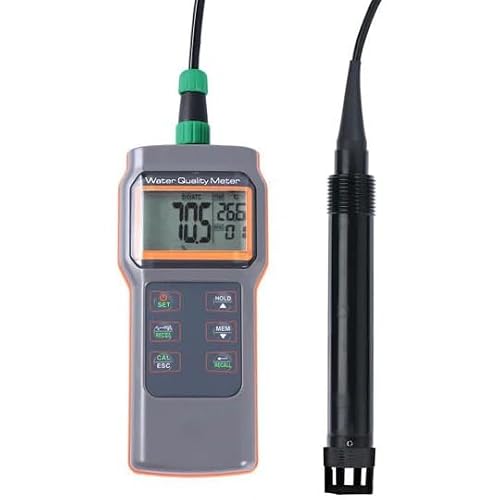
- Measures 0.0–20.0 mg/L or 0.0–200.0% DO
- No probe maintenance or polarization time
- Includes case, batteries, and optical probe
Best For: Portable aquaculture, brewing, and water-quality checks
Best Long-Reach Kit

- Includes handheld meter and ODO/T probe
- Supplied with a 4-meter cable
- Includes soft-sided carrying case
Best For: Field sampling where extended cable reach is useful
Best Rugged Flexible Platform
YSI Pro20 DO/Temperature Meter

- IP67 impact-resistant waterproof housing
- Three-second One Touch Cal feature
- Supports field and lab probe configurations
Best For: Durable lab or field measurement with flexible probe options
Low-Maintenance Field Pick
Portable Fluorescent Optical DO Meter

- Fluorescent sensor needs no electrolyte or membrane replacement
- IP68 probe with 0.00–20.00 mg/L measurement range
- Backlit display with compensation, calibration, and data storage
Best For: Aquaculture, ponds, lakes, wastewater, and field monitoring
Complete Kit Choice
APERA AI485 DO8500 Optical Meter
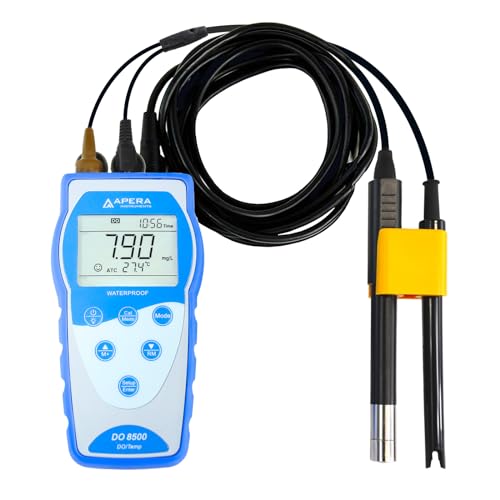
- Automatic temperature, air-pressure, and salinity compensation
- Stores 500 data groups with USB output
- Includes 10-foot optical probe, salinity probe, cap, and case
Best For: Professional field testing and organized water-quality records
Simple Low-Oxygen Pick
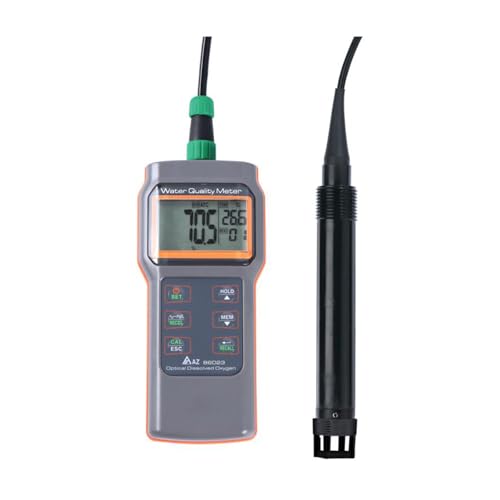
- Fluorescent probe avoids polarization time and routine maintenance
- Large display shows DO and temperature
- Supports two-point calibration and manual compensation
Best For: Straightforward low-oxygen and temperature testing
Low-Maintenance Premium Pick – Apera AI480 DO850 Optical Meter Kit
The Apera AI480 DO850 is a strong choice among optical dissolved oxygen meters for users who want a complete, low-maintenance setup. Its optical sensor avoids routine electrolyte refills and frequent membrane changes, while the included 10-foot probe helps reach tanks, ponds, or other testing points.
Best For: Field testing, aquaculture, and users who want a ready-to-use optical DO kit.
Pros:
- Optical sensor requires minimal maintenance.
- Supports automatic calibration for saturated air and zero oxygen.
- IP67 waterproof and dust-proof construction.
- Includes meter, 10-foot probe, calibration cap, and carrying case.
Cons:
- At 3 pounds, it is heavier than some compact handheld testers.
- Its full kit format may be more than casual users need.
Choose this model if convenience, probe reach, and rugged protection matter more than having the smallest possible meter.
Budget Manual-Calibrating Choice – Milwaukee MW600 Portable DO Meter
The Milwaukee MW600 is a straightforward portable option for educational, aquaculture, water-analysis, and environmental applications. Unlike newer optical dissolved oxygen meters, it uses a polarographic probe, but its two-point manual calibration and automatic temperature compensation provide practical everyday functionality.
Best For: Students, aquaculture users, and budget-conscious buyers who prefer a simple portable meter.
Pros:
- Measures from 0.0 to 19.0 mg/L with 0.1 mg/L resolution.
- Offers two-point manual calibration.
- Automatic temperature compensation from 0 to 30°C.
- Includes a polarographic probe with a 3-meter cable and screw-on membrane cap.
Cons:
- Manual calibration is less convenient than automatic optical calibration.
- Polarographic probes use a membrane-style setup that may require more upkeep.
- Temperature compensation is limited to 0–30°C.
The MW600 is a sensible basic tester when affordability and familiar manual operation take priority over optical-sensor convenience.
Feature-Rich Portable Value – AIOMEST AI-5000R Optical DO Tester
The AIOMEST AI-5000R combines an optical fluorescent sensor with useful compensation and recording features. This optical dissolved oxygen meter measures both mg/L and percent saturation, stores up to 99 readings, and includes salinity and altitude settings for freshwater, brackish, and marine testing.
Best For: Aquarium, pond, aquaculture, hydroponic, and general water-quality checks requiring portability and data recall.
Pros:
- Low-maintenance fluorescent sensor avoids frequent membrane or electrolyte replacement.
- Measures 0–20.0 mg/L and 0–199.9% saturation.
- Provides automatic temperature, manual salinity, and manual altitude compensation.
- Backlit display, 99-record memory, and Type-C rechargeable battery.
Cons:
- Accuracy is specified as ±3% of full scale.
- Salinity and altitude compensation require manual entry.
- The included 6.6-foot probe cable is shorter than some extended-probe kits.
This is an appealing value when you want optical sensing plus logging and compensation controls in a compact rechargeable design.
Professional Fieldwork Option – YSI Pro20 Handheld DO Meter
The YSI Pro20 is designed for laboratory and field use, with one-touch dissolved oxygen calibration and automatic barometric pressure compensation. It is supplied as a meter only, so buyers should verify probe and accessory requirements before choosing it over complete optical dissolved oxygen meters or bundled kits.
Best For: Field and laboratory users who value quick calibration, pressure compensation, and onboard data storage.
Pros:
- One-touch calibration can be completed in about three seconds.
- Automatically compensates for barometric pressure.
- Stores up to 50 data sets.
- Graphic backlit display and glow-in-the-dark keypad improve usability.
Cons:
- This listing is for the meter only.
- It does not provide the optical-sensor maintenance benefits described for optical models.
- Probe and related accessories may need to be sourced separately.
The Pro20 makes sense for professional workflows that need fast calibration and saved readings, provided the required probe setup is already available.
Best Low-Maintenance Pick – Sper Scientific 860067 Optical DO Meter
The Sper Scientific 860067 is a practical choice among optical dissolved oxygen meters for users who want portable, low-maintenance measurement. It reads dissolved oxygen from 0.0–200.0% or 0.0–20.0 mg/L, displays temperature simultaneously, and supports automatic temperature plus manual salinity and pressure compensation.
Best For: Aquaculture, brewing, environmental monitoring, and wastewater applications requiring a portable optical meter with minimal upkeep.
Pros:
- No probe maintenance or polarization time is required.
- Large LCD shows dissolved oxygen and temperature together.
- Includes automatic temperature compensation, manual salinity and pressure compensation, and 2-point DO calibration.
- Comes with an optical probe, six AAA batteries, hard case, and manual.
Cons:
- Salinity and pressure compensation are manual rather than automatic.
- The supplied notes do not specify a data-logging or connectivity feature.
Choose this model when straightforward operation and reduced maintenance matter more than advanced connectivity. Its complete portable kit also makes it convenient for immediate field use.
Best Long-Reach Kit – YSI ProSolo ODO/T Meter
YSI ProSolo Handheld Optical Dissolved Oxygen Meter Kit, ODO/T Probe with 4-m Cable
Check Price On AmazonThe YSI ProSolo kit is a field-oriented option among optical dissolved oxygen meters, pairing the ProSolo handheld with an ODO/T probe and a 4-meter cable. Its included soft-sided carrying case supports transport between sampling locations.
Best For: Field users who need an optical dissolved oxygen and temperature probe with extended cable reach.
Pros:
- Includes the ProSolo handheld and ODO/T probe assembly.
- The 4-meter cable helps reach sampling points away from the operator.
- Comes with a soft-sided carrying case.
Cons:
- The supplied notes do not provide measurement ranges, display details, or compensation features.
- At 4.3 pounds, it may be less convenient to carry than lighter handheld options.
This kit is most compelling when cable length and an included probe-and-meter package are priorities. Consider another model if you need clearly documented range or calibration specifications before buying.
Best Rugged Flexible Platform – YSI Pro20 DO/Temperature Meter
The YSI Pro20 is a rugged lab-and-field meter for dissolved oxygen and temperature measurement. It covers 0 to 50 mg/L, offers a graphical backlit display, and accepts compatible cables and polarographic or galvanic probes for field use; probes and cables are sold separately.
Best For: Lab or field users who want a waterproof handheld platform with flexible probe and cable options.
Pros:
- Measures dissolved oxygen and temperature for lab or field work.
- One Touch Cal feature calibrates the meter within three seconds.
- Graphical backlit display and glow-in-the-dark keypad improve usability in low light.
- Impact-resistant, waterproof construction is rated IP67.
Cons:
- Cables and probes are sold separately.
- It is not supplied as a complete optical probe kit in the listed package.
- The supplied notes do not identify automatic temperature or salinity compensation features.
The Pro20 suits buyers who value durability, quick calibration, and interchangeable probe configurations. Factor in the additional cable and probe purchase when comparing its total cost with complete optical dissolved oxygen meters.
Low-Maintenance Field Pick – Portable Fluorescent Optical DO Meter
For field users comparing optical dissolved oxygen meters, this portable tester combines a fluorescent sensor with a waterproof detachable probe. It measures 0.00–20.00 mg/L, displays saturation and temperature, and supports freshwater, marine, wastewater, and outdoor monitoring.
Best For: Aquaculture, ponds, lakes, wastewater treatment, and routine field water-quality checks.
Pros:
- Requires no electrolyte or membrane replacement and does not consume oxygen during measurement.
- Offers automatic temperature compensation plus manual salinity and atmospheric-pressure compensation.
- IP68 probe with a 316 stainless steel head is designed for wet and deep-water sampling.
- Backlit LCD, shortcut keys, two-point calibration, and data storage support field work.
Cons:
- Salinity and atmospheric-pressure compensation require manual adjustment.
- Listed response time is up to 60 seconds.
- Uses a detachable probe and cable, adding components to carry and maintain.
This is a practical choice when low maintenance and waterproof field operation matter more than advanced data-management features. Its fluorescent sensor and broad application range make it versatile for routine monitoring.
Complete Kit Choice – APERA AI485 DO8500 Optical Meter
The APERA AI485 DO8500 is one of the more complete optical dissolved oxygen meters for users who want automatic compensation and organized records. Its kit includes the meter, a 10-foot optical probe, salinity probe, calibration cap, and rugged carrying case.
Best For: Professionals and researchers who need portable testing with salinity measurement and GLP-style data management.
Pros:
- Optical DO sensor is designed for reliable, low-maintenance measurement.
- Automatically compensates for temperature, air pressure, and salinity.
- Stores up to 500 groups of data and supports USB data output.
- Complete kit includes a long 10-foot probe and protective carrying case.
Cons:
- The complete kit weighs 3 pounds, making it less lightweight than a minimal handheld setup.
- Its listed package includes several components that may be unnecessary for simple spot checks.
Choose this model when documentation and included accessories are priorities. The 500-group storage, USB output, and automatic compensation make it especially suitable for repeated testing and record keeping.
Simple Low-Oxygen Pick – AZ-86023 Optical DO Meter
The AZ-86023 is a straightforward option among optical dissolved oxygen meters, using a fluorescent DO probe for low-maintenance testing. It displays dissolved oxygen and temperature on a large screen and supports both percentage and mg/L readings.
Best For: Users who want uncomplicated DO and temperature testing with minimal probe upkeep.
Pros:
- Fluorescent probe requires no polarization time and no routine probe maintenance work.
- Designed to retain accuracy in low-oxygen conditions and resist acid-gas effects.
- Provides automatic temperature compensation and selectable DO units.
- Includes manual salinity and pressure compensation plus two-point DO calibration.
Cons:
- Salinity and pressure compensation are manual rather than automatic.
- The supplied notes do not list data storage or USB connectivity.
- Requires six AAA batteries.
This model fits routine users who value simple operation and reduced probe maintenance. It offers useful calibration and compensation controls, but buyers needing logged records or automatic salinity and pressure adjustments may prefer a more feature-rich kit.
How We Picked These Optical Dissolved Oxygen Meters
We focused on meters with optical or fluorescent dissolved oxygen sensing, while also including a conventional portable option where it offers useful value for comparison. Selection criteria included stated measurement range, resolution, calibration approach, temperature and environmental compensation, probe cable length, display usability, waterproofing, portability, and intended application.
We also considered whether each listing is sold as a complete kit or as a meter-only package. That distinction matters because a lower purchase price may not include the probe, cables, carrying case, calibration accessories, or replacement components needed for immediate testing.
Quick Comparison
| Best For | What to Prioritize | Suitable Product Types |
|---|---|---|
| Routine field sampling | Rugged housing, long cable, simple calibration | Portable optical kits and handheld meters |
| Aquaculture | Waterproof probe, temperature compensation, dependable repeatability | Fluorescent DO testers and complete optical kits |
| Wastewater work | Wide range, salinity and pressure compensation, durable construction | Professional handheld optical meters |
| Laboratories and teaching | Readable display, stable readings, easy calibration | Bench-friendly portable meters |
| Budget testing | Low upfront cost and affordable replacement parts | Economy or entry-level meters |
Key Buying Factors for Optical Dissolved Oxygen Meters
Sensor Technology and Maintenance
Optical sensors generally avoid the electrolyte and membrane maintenance associated with many polarographic probes. Check the expected sensor cap life, replacement cost, warm-up requirements, and whether calibration supplies are included. Optical does not mean maintenance-free.
Range, Resolution, and Accuracy
Match the published range to your water conditions. A 0–20 mg/L range covers many freshwater, aquaculture, and wastewater applications, while broader specifications may help with unusual or highly oxygenated samples. Resolution is not the same as accuracy, so review both figures before comparing models.
Compensation Controls
Temperature compensation is important for reliable readings. Salinity and barometric-pressure compensation become increasingly valuable in marine environments, wastewater, and changing field conditions. Confirm whether these adjustments are automatic, manual, or unavailable.
Probe Design and Durability
Consider cable length, probe diameter, waterproof rating, response time, and the depth or access points you need to reach. An IP-rated probe can be essential for tanks, ponds, treatment systems, and outdoor sampling, but inspect the manufacturer’s limits rather than relying on the rating alone.
Complete Kit Versus Meter Only
Verify exactly what is in the box. A meter-only listing may require a separate optical probe, and some kits include longer cables or calibration accessories that materially improve field usability.
Who Should Buy Which Optical Dissolved Oxygen Meters?
Choose a professional YSI or Apera optical kit when dependable field measurements, broader compensation controls, and long-term serviceability matter more than the lowest price. These are the strongest choices for researchers, treatment professionals, consultants, and frequent sampling.
Choose a Milwaukee, AZ, Sper Scientific, or similar portable model when you need straightforward monitoring for education, routine maintenance, or occasional field checks. Compare probe inclusion and replacement costs carefully.
For aquaculture and wet environments, prioritize a waterproof fluorescent probe, automatic temperature compensation, and a cable long enough to reach the sampling point safely. For laboratories, favor readable displays, repeatable calibration, and stable temperature measurement over extra ruggedness.