The best mineral collection kits for classrooms turn geology lessons into hands-on investigations. Students can examine color, texture, hardness, streak, crystal form, and mineral variety instead of relying only on textbook images.
These 10 options range from compact 15-specimen sets to large collections with hundreds of rocks, gemstones, and crystals. Use the guide below to match specimen variety, testing tools, labeling, and classroom practicality to your students and lesson plans.
Best 10 Mineral Collection Kits for Classrooms Picks for 2026
Classroom Foundation
Introductory Earth Science Collection

- 75 numbered rock and mineral samples
- Includes streak plate, magnet, and magnifier
- Covers major rock types and the rock cycle
Best For: Middle-school geology lessons and sample-based classification
Hands-On Starter
STEM Rock & Mineral Science Kit

- 30 real rock and mineral specimens
- Includes viewer, streak plate, and nail
- Compact, organized format for ages 8+
Best For: Young geologists and small-group classroom centers
Collection Builder
National Geographic 300+ Specimen Set

- Includes 300+ genuine rocks, minerals, and crystals
- Adds two break-open geodes
- Includes guide, magnifier, and storage bag
Best For: Large collections, enrichment stations, and geology clubs
Mineral Testing Basics

- Includes 15 real mineral specimens
- Provides streak plate, nail, viewer, and guide
- Compact battery-free beginner kit
Best For: Early mineral-identification lessons and classroom centers
Hands-On Classroom Explorer

- 15 authentic rock specimens
- Magnifier and identification guide
- 12 activities and 12 games
Best For: Elementary geology lessons for ages 6–12
Testing-Ready Geology Lab
Rock Science Kit with Testing Tools

- 15 certified specimens
- Includes streak plates, nail, copper, and hand lens
- Portable organized storage case
Best For: Classroom mineral-property demonstrations and fieldwork
Display-Friendly Discovery Set
National Geographic Rock Collection
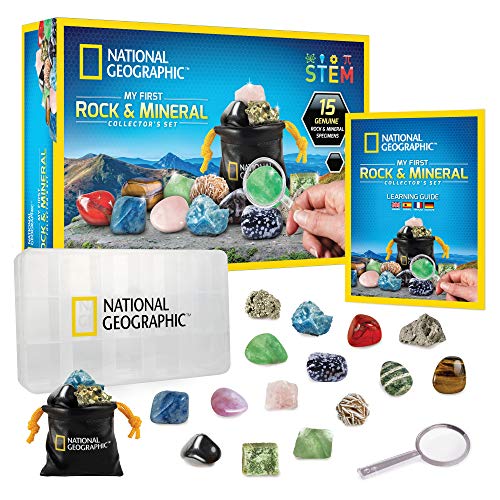
- 15 gemstones and crystals
- Clear case and storage pouch
- Full-color learning guide
Best For: Visual Earth science stations and collectors ages 8+
Classroom Starter Set

- 54 specimens with 9 polished gems
- Identification cards, guidebook, and magnifier
- Compartmented case for sorting and display
Best For: Introductory classroom geology and STEM activities
Bulk Exploration Pick

- Approximately 450–500 small stones
- 40-plus crystal and gemstone types
- Includes tumbled chips and rough specimens
Best For: Large-group sorting and hands-on specimen stations
Guided Observation Choice

- 30 named rocks, gems, and crystals
- Includes study guide, magnifier, and brush
- Focused format for beginner observation
Best For: Small-group geology lessons and beginner identification
Classroom Foundation – Introductory Earth Science Collection
Geosciences Industries 13357 Introductory Earth Science Classroom Rocks and Minerals Collection
Check Price On AmazonFor classrooms seeking mineral collection kits for classrooms with broad earth-science coverage, this set provides 75 numbered rock and mineral samples in approximately 1- to 2-inch pieces. Its index sheet, study guide, streak plate, magnifier, and magnet support structured identification and introductory geology lessons.
Best For: Middle-school earth science instruction, classification activities, and lessons on the rock cycle.
Pros:
- Includes 75 mineral and rock samples.
- Samples are numbered for use with the collection index.
- Covers igneous, sedimentary, and metamorphic rocks.
- Includes testing tools and rock-cycle study materials.
Cons:
- Its recommended age range is 11–13, so it may be advanced for younger students.
- The collection is larger and heavier than compact introductory kits.
This is the most lesson-oriented option in the group, especially when teachers want enough samples for comparison, classification, and guided demonstrations rather than simple collecting.
Hands-On Starter – STEM Rock & Mineral Science Kit
This compact choice among mineral collection kits for classrooms combines 30 real specimens with identification and testing tools. Fifteen rocks and 15 minerals, plus a viewer, streak plate, and nail, give younger learners a manageable introduction to observation and comparison.
Best For: Ages 8–12, small-group activities, classroom centers, and beginner geology exploration.
Pros:
- Includes 30 real specimens split between rocks and minerals.
- Provides a magnifying viewer, streak plate, and nail for hands-on testing.
- Compact trays help keep materials organized and accessible.
Cons:
- Has fewer specimens than the larger classroom collections.
- The supplied notes do not mention a full study guide or detailed classification charts.
Its smaller format and age-8-plus positioning make it a practical starter set when portability and simple testing matter more than maximum sample variety.
Collection Builder – National Geographic 300+ Specimen Set
For classrooms that prioritize sheer variety, this option stands out among mineral collection kits for classrooms with more than 300 genuine rocks, minerals, and crystals. It also adds two break-open geodes, a magnifying glass, a learning guide, and a storage bag for extended exploration and display.
Best For: Collection-building, enrichment stations, geology clubs, and hands-on demonstrations with many examples.
Pros:
- Includes over 300 genuine specimens from around the world.
- Two break-open geodes add an engaging hands-on activity.
- Features a full-color learning guide and magnifying glass.
- Storage bag supports organization and repeated use.
Cons:
- The set is designed for ages 8 and up rather than a specific older science curriculum.
- The supplied notes do not list testing tools such as a streak plate or hardness tool.
This is the strongest pick for breadth and visual engagement, although teachers seeking formal mineral-testing equipment may need to add tools separately.
Mineral Testing Basics – Toysmith 15-Specimen Kit
This beginner-friendly option among mineral collection kits for classrooms focuses on examining and comparing 15 real mineral specimens. Its magnifying viewer, streak plate, nail, and identification guide support basic investigations into hardness, streak, luster, color, shape, and weight.
Best For: Early learners, learning centers, homeschool science units, and short mineral-identification activities.
Pros:
- Uses real mineral specimens for direct observation.
- Includes a viewer, streak plate, nail, and identification guide.
- Compact dimensions suit tabletop activities and storage.
- Requires no batteries.
Cons:
- With 15 specimens, it offers less variety than the larger collections.
- The supplied notes identify the included components generally as a toy, so classroom organization may require additional containers.
Choose this set when the goal is a straightforward introduction to mineral properties and testing rather than a comprehensive rock-and-mineral reference collection.
Hands-On Classroom Explorer – 15-Piece Rock Collection
For classrooms seeking mineral collection kits for classrooms with structured activities, this set combines 15 real rock specimens with a magnifier, identification guide, games, and geology activities. It introduces students to observation and classification across igneous, metamorphic, and sedimentary rocks.
Best For: Elementary learners ages 6–12 and introductory classroom geology activities.
Pros:
- Includes 15 authentic rock specimens, including obsidian, granite, basalt, and pumice.
- Magnifier and identification key support close examination and classification.
- Includes 12 activities and 12 games for interactive STEM learning.
Cons:
- Focused on rocks and basic classification rather than a broad mineral-testing toolkit.
- The manufacturer-recommended age begins at 6 years, so activities may need adaptation for older students.
This is a practical choice when you want a ready-to-use introductory kit with specimens and guided learning materials in one compact package.
Testing-Ready Geology Lab – Rock Science Kit with Testing Tools
Among mineral collection kits for classrooms, this option stands out for adding simple testing tools to 15 certified rock and mineral specimens. The streak plates, nail, copper, and hand lens give students more ways to explore identification and mineral properties than a specimen-only set.
Best For: Geology classrooms, hands-on mineral-property demonstrations, and organized fieldwork.
Pros:
- Includes 15 certified specimens spanning rocks such as granite, basalt, shale, marble, quartzite, and schist.
- Provides two unglazed porcelain streak plates, a nail, copper, and a hand lens.
- Lightweight case with organized compartments supports storage and portability.
- Includes simplified instructions for beginners and more advanced users.
Cons:
- The notes do not specify an age range or the number of classroom activities.
- Testing tools may require teacher guidance and appropriate classroom procedures.
This kit is a strong fit for instructors who want students to practice basic identification methods rather than only observe and label specimens.
Display-Friendly Discovery Set – National Geographic Rock Collection
This National Geographic set is one of the more display-oriented mineral collection kits for classrooms, featuring 15 colorful gemstones and crystals, a clear storage box, a pouch, and a full-color learning guide. It can add visual appeal to an Earth science station while giving students reference material for specimen identification.
Best For: Classrooms and learners ages 8 and up who enjoy collecting, displaying, and identifying colorful specimens.
Pros:
- Includes 15 gemstones and crystals such as tiger’s eye, rose quartz, pyrite, and fluorite.
- Clear storage case and pouch help keep the collection organized.
- Full-color learning guide supports learning about and identifying specimens.
- Designed to encourage continuing interest in geology and collecting.
Cons:
- It emphasizes gemstone and crystal collecting rather than hands-on testing tools.
- Recommended for ages 8 and up, which may limit use with younger classes.
Choose this set when presentation, specimen variety, and an engaging visual introduction to geology matter more than formal rock-testing activities.
Classroom Starter Set – 54-Piece Rock & Mineral Kit
For classrooms seeking mineral collection kits for classrooms with identification support, this 54-piece set combines 9 polished gemstones and 45 raw rocks, crystals, and minerals with labeled cards, a learning book, and a compartmented display case. Its organized format makes it practical for introductory earth science activities and small-group observation.
Best For: Elementary and middle-school geology lessons, rock identification practice, classroom exhibits, and STEM exploration.
Pros:
- Includes 54 assorted specimens, including 9 polished gems and 45 raw samples.
- Comes with illustrated identification/game cards and a colorful reference book.
- Transparent compartment storage case supports sorting, display, and classroom organization.
- Includes a magnifier for closer observation.
Cons:
- Specimens are relatively small, approximately 1–1.5 inches each.
- The manufacturer’s recommended age guidance varies between the listing details.
This is the most complete teaching-oriented option of the three, particularly for educators who want specimens paired with reference materials and reusable activity cards rather than loose stones alone.
Bulk Exploration Pick – 450-Piece Crystal & Rock Set
For teachers who need a high-volume option among mineral collection kits for classrooms, this set provides approximately 450–500 small stones, including tumbled crystal chips and tiny rough specimens in many varieties. It is suited to hands-on sorting, counting, craft, and observation stations, though it offers less structured identification support than a traditional study kit.
Best For: Large-group sorting activities, specimen handling stations, craft projects, and classrooms that need many small samples.
Pros:
- Provides approximately 450–500 pieces across more than 40 crystal and gemstone types.
- Includes about 1.5 pounds of tumbled chips and 1 pound of tiny rough stones.
- Useful for geology observation, collection, jewelry-making, and DIY activities.
- Offers enough pieces for distributing samples among multiple students.
Cons:
- Pieces are very small, with tumbled stones around 0.2–0.5 inch and rough stones around 0.3–0.8 inch.
- Random assortment may make consistent specimen sets difficult to plan.
- The notes do not indicate included identification cards, a guidebook, or storage case.
This set stands out for quantity rather than curriculum structure. It can work well when several students need materials at once, but teachers may need to supply labels, reference resources, and organizers separately.
Guided Observation Choice – 30-Piece Rock Collection
This 30-piece collection is a manageable choice for mineral collection kits for classrooms where students need a focused set of named specimens and simple observation tools. It includes natural rocks, gemstones, and crystals alongside a full-color study guide, magnifying glass, and brush for examining surface details.
Best For: Small-group earth science work, beginner rock identification, guided observation, and take-home or individual student kits.
Pros:
- Includes 30 named rocks, gemstones, and crystals covering a broad variety of materials.
- Full-color study guide supports learning about each gem’s formation and origins.
- Magnifying glass and brush encourage detailed specimen examination.
- Compact kit format is easier to manage than a large bulk assortment.
Cons:
- Includes fewer specimens than the 54-piece and bulk alternatives.
- The notes do not specify individual labels or a compartmented storage case.
- At roughly 1.73 kg, it may be relatively heavy for a 30-piece kit.
This collection offers a useful middle ground for teachers who value guided learning tools but do not need hundreds of samples. It is especially practical for rotating through small groups or setting up focused observation exercises.
How We Picked the Best Mineral Collection Kits for Classrooms
We focused on kits that offer useful specimen variety, clear identification support, and activities suitable for supervised classroom use. We also considered the number of samples, included tools, labeling, age guidance, storage, and whether a set supports observation as well as basic testing.
A larger piece count is not automatically better. Some collections count multiple small specimens or tumbled chips, while others provide fewer but more purposeful samples. Teachers should compare what is included—not just the number printed on the package.
Quick Comparison
- Best for structured earth science lessons: Choose an introductory classroom collection with organized specimens and identification information.
- Best for testing activities: Look for hand lenses, streak plates, nails, hardness tools, or other testing accessories.
- Best for specimen variety: Large sets with dozens of minerals, gemstones, and crystals give groups more samples to sort and compare.
- Best for younger learners: Select a smaller kit with simple labels, sturdy pieces, and age-appropriate directions.
- Best for stations or demonstrations: Compact 15- or 30-piece sets are easier to distribute, collect, and store.
Key Buying Factors for Mineral Collection Kits for Classrooms
Specimen Variety and Authenticity
Look for a useful mix of rocks, minerals, crystals, and gemstones rather than many visually similar pieces. Natural variation helps students practice classification, while tumbled samples may be safer and easier to handle but can obscure texture and crystal structure.
Tools and Learning Materials
Identification cards, name labels, magnifiers, streak plates, and hardness-testing items can turn a display collection into an activity set. Check whether tools are included or must be purchased separately, and confirm that instructions explain safe use.
Piece Size, Safety, and Durability
Classroom specimens should be large enough to examine without being difficult to manage. Small pieces may present a choking risk for younger children, and sharp or fragile samples need supervision. Consider how well the container protects specimens between lessons.
Quantity and Classroom Logistics
One kit may work for teacher demonstrations, but group work often requires multiple sets or enough specimens for rotating stations. Favor collections with secure packaging, readable labels, and a storage box or tray that makes inventory simple.
Who Should Buy Which Mineral Collection Kits for Classrooms?
Elementary teachers should prioritize approachable kits with labeled specimens, simple guides, and safe handling. Middle school science classrooms may benefit more from testing tools and specimens that support hardness, streak, luster, and classification exercises.
Homeschool groups and small clubs can choose a compact, tool-rich set with enough variety for repeated activities. Large classrooms, libraries, and science centers should consider higher-count collections or multiple matching kits so students can work in teams without waiting for a single specimen.
Before buying, match the kit to your curriculum, student age, storage space, and intended activity. The strongest choice is the collection that gives learners enough distinct samples and guidance to investigate geology—not simply the one with the highest piece count.