Building a connected home does not require expensive proprietary hardware. The right microcontroller kit gives you the boards, sensors, wiring, and tutorials needed to experiment with lights, temperature monitoring, relays, displays, and automation routines.
These 10 picks cover approachable Arduino starter sets, Wi-Fi-enabled ESP32 boards, and purpose-built options for Home Assistant and ESPHome projects. Use the guide below to match a kit to your experience, software preferences, and project goals.
Best 10 Microcontroller Kits for Home Automation Picks for 2026
Best Complete Smart Home Learning Kit
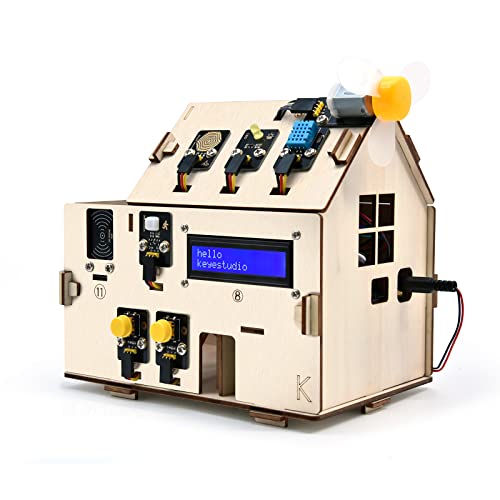
- 13 progressive home-automation projects
- Arduino C++ and MicroPython tutorials
- Includes sensors, motors, house parts, and ESP32 board
Best For: Guided smart-home electronics learning
Best Multi-Board Value
ELEGOO ESP32 Dev Boards 3-Pack
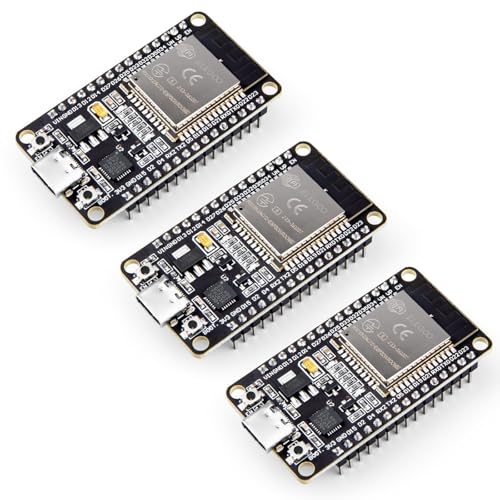
- Three ESP32 boards for multiple prototypes
- Wi-Fi, Bluetooth 4.2, and USB-C programming
- GPIO, UART, SPI, and I2C expansion options
Best For: Wireless automation prototyping with existing components
Best No-Code Home Assistant Starter
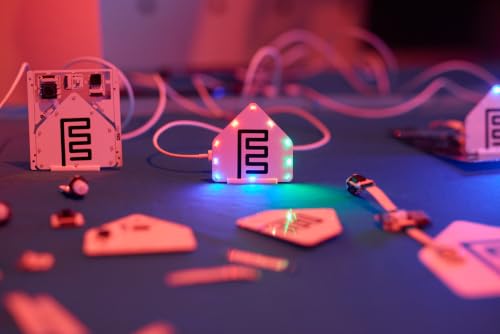
- No soldering with visual device setup
- Local Wi-Fi, BLE, Thread, and Zigbee support
- Includes motion, climate, RGB, and button modules
Best For: Beginner-friendly Home Assistant projects
Best Sensor Variety for Learning
SunFounder Arduino Uno R4 Sensor Kit

- Arduino Uno R4 Minima with 30+ sensors
- 50+ basic, IoT, and advanced projects
- Online tutorials, videos, code, and support
Best For: Broad Arduino and sensor experimentation
Best ESP32 Starter Kit

- Wi-Fi and Bluetooth ESP32 board
- Includes DHT11, PIR, OLED, and relay modules
- Tutorial supports introductory Arduino IDE projects
Best For: Beginners building connected home-automation prototypes
Best Learning Value
ELEGOO UNO R3 Project Starter Kit

- Includes 22-plus guided hands-on lessons
- Wide selection of sensors, motors, displays, and relay
- Solderless setup with pre-soldered LCD
Best For: Structured Arduino learning and offline automation prototypes
Best AI Voice Control Kit
LAFVIN ESP32-S3 AIoT Starter Kit

- ESP32-S3 kit with MCP-based AIoT control
- Includes relays, lights, fan, and environmental sensors
- Pre-compiled firmware and online documentation
Best For: Voice-controlled smart-home and IoT prototypes
Connected Beginner Pick
ELEGOO UNO R4 WiFi Starter Kit

- Arduino-compatible UNO R4 WiFi board with Bluetooth
- 200+ components including relay and motion sensor
- Guided tutorials for circuits and IoT projects
Best For: Beginners building guided wireless automation prototypes
IoT Learning Choice
LAFVIN ESP32 Ultimate Starter Kit
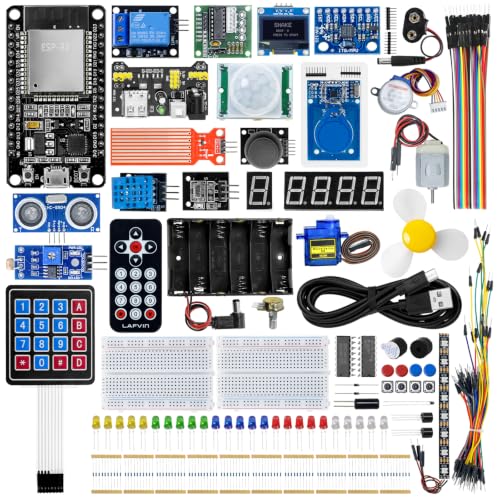
- ESP32 platform built for Wi-Fi IoT learning
- Browser-based control and real-time sensor monitoring
- Includes modules for alarms, access control, and monitoring
Best For: Learners prioritizing web-connected ESP32 projects
Most Comprehensive Course
SunFounder UNO R4 WiFi Elite Kit

- Original UNO R4 WiFi with wireless connectivity
- 300+ components and 50+ hands-on projects
- 100+ video lessons plus IoT coursework
Best For: Learners wanting extensive guided Arduino and IoT instruction
Best Complete Smart Home Learning Kit – ESP32 Smart Home Starter Kit
For shoppers comparing microcontroller kits for home automation, the KEYESTUDIO ESP32 kit offers a structured, hands-on path from basic electronics to connected smart-home features. You assemble a wooden house and complete 13 progressive projects involving motion, lighting, temperature, gas detection, RFID access, motors, and Wi-Fi control.
Best For: Adults, teens 15+, classrooms, and self-learners who want guided Arduino C++ and MicroPython practice with realistic home-automation projects.
Pros:
- Includes 13 progressive projects covering sensors, alarms, displays, motors, lighting, and remote control.
- Supports both Arduino C++ and MicroPython, with tutorials for each language.
- Includes the ESP32 board, wooden house parts, sensors, modules, motors, and connection cables.
- Online resources provide wiring diagrams, code explanations, and assembly guidance.
Cons:
- Six AA batteries are required but not included.
- The kit arrives unassembled, so setup takes time before projects can begin.
- Its structured focus may be less suitable for shoppers seeking only a standalone development board.
This is the most complete choice for learning how multiple smart-home components work together. Its project sequence and dual-language tutorials make it especially useful for education, though the unassembled design and battery requirement should be considered.
Best Multi-Board Value – ELEGOO ESP32 Dev Boards 3-Pack
These ELEGOO boards are a practical pick among microcontroller kits for home automation when you already have sensors and modules or want several boards for concurrent prototypes. Each ESP32 provides Wi-Fi, Bluetooth 4.2, USB-C programming, and common interfaces for connected-device projects.
Best For: Makers, developers, and classrooms that need three wireless ESP32 boards for sensor networks, automation experiments, or multiple connected devices.
Pros:
- Three ESP32 boards provide flexibility for separate projects or distributed devices.
- Built-in 2.4 GHz Wi-Fi and Bluetooth Classic/BLE support wireless automation applications.
- Dual-core processing up to 240 MHz supports sensor processing and connected-device logic.
- GPIO, UART, SPI, and I2C interfaces accommodate sensors, displays, and motor drivers.
Cons:
- No sensors, modules, or project accessories are listed as included.
- USB-C cable is not included.
- Using OTA updates requires configuration through a compatible ESP32 software framework.
This three-pack is best viewed as a capable hardware foundation rather than a complete starter kit. It suits buyers who want wireless connectivity and multiple boards, but you will need to supply the peripherals and learning materials for a full automation build.
Best No-Code Home Assistant Starter – ESPHome Starter Kit
ESPHome Starter Kit | ESP32 Electronics Kit for Home Assistant | Official ESPHome Hardware
Check Price On AmazonFor shoppers seeking approachable microcontroller kits for home automation, the ESPHome Starter Kit emphasizes plug-and-play setup rather than soldering or extensive coding. Its modules can be configured in the visual ESPHome Device Builder, then used locally or connected with Home Assistant.
Best For: Home Assistant users, beginners, and makers who want a modular multisensor with local wireless control and minimal hardware setup.
Pros:
- No soldering is required, and setup uses the visual ESPHome Device Builder.
- Supports local Wi-Fi, Bluetooth LE, Thread, and Zigbee connectivity without cloud accounts or subscriptions.
- Includes a PIR motion sensor, temperature/humidity module, RGB notification module, and button module.
- Two 14-pin FPC ports allow two modules to run simultaneously.
Cons:
- The kit is centered on the ESPHome ecosystem, which may be less suitable for learners seeking traditional Arduino programming.
- Home Assistant integration is available but not required, so some advanced functionality may require additional setup.
This is a strong convenience-focused option for local smart-home experimentation. Its included modules and no-solder design reduce the barrier to entry, while the modular ports leave room for expansion.
Best Sensor Variety for Learning – SunFounder Arduino Uno R4 Sensor Kit
The SunFounder kit is a broad learning platform for microcontroller kits for home automation, combining an original Arduino Uno R4 Minima with more than 30 sensors and modules. Its 50-plus projects include IoT and automation examples, with online tutorials, video lessons, sample code, and support resources.
Best For: Beginners, students, teachers, and engineers who want a large component selection and progressively challenging Arduino projects.
Pros:
- Includes the original Arduino Uno R4 Minima and more than 30 sensors and modules.
- Offers over 50 projects spanning basic, IoT, and advanced activities.
- Uno R4 Minima provides a 32-bit Cortex-M4 processor, 256 KB flash, 48 MHz clock, DAC, CAN bus, and 14-bit ADC.
- Online tutorials, video courses, sample code, technical support, and troubleshooting forums are provided.
Cons:
- Its primary programming focus is Arduino C++, rather than a two-language curriculum.
- The large number of components may feel less focused than a dedicated smart-home project kit.
- Wireless and IoT projects may require the included communication modules and additional configuration.
This kit offers the widest experimentation range of the four options, making it a good long-term learning purchase. Choose it when sensor variety and project volume matter more than a prebuilt smart-home model or no-code setup.
Best ESP32 Starter Kit – LAFVIN ESP32 WiFi IoT Kit
For beginners exploring microcontroller kits for home automation, the LAFVIN ESP32 Basic Starter Kit offers a practical way to experiment with Wi-Fi, Bluetooth, sensors, displays, and relays. Its included tutorial and broad selection of modules support introductory Arduino IDE projects.
Best For: Beginners building connected sensor, display, motion, and relay-control prototypes.
Pros:
- ESP32 board provides Wi-Fi and Bluetooth connectivity for IoT projects.
- Includes useful home-automation components such as a DHT11, PIR motion sensor, OLED, relay, and photosensitive resistor.
- Includes a breadboard, jumper wires, resistors, LEDs, buzzer, and tutorial lessons for getting started.
Cons:
- Designed for introductory learning rather than an advanced, production-ready automation system.
- The tutorial must be downloaded separately after receiving the kit.
This is a well-rounded choice when wireless connectivity matters and you want to learn by combining sensors with simple actuators. The relay and motion, temperature, and light modules make it especially useful for early smart-home experiments.
Best Learning Value – ELEGOO UNO R3 Project Starter Kit
The ELEGOO UNO R3 Project Super Starter Kit is a strong educational option among microcontroller kits for home automation. Its 22-plus guided lessons cover sensing, displays, motors, relays, and inputs, giving beginners a structured path from basic wiring to practical control projects.
Best For: Families, homeschoolers, coding clubs, and beginners learning Arduino-based circuits.
Pros:
- Offers more than 22 hands-on lessons with included example code and a PDF tutorial.
- Includes a DHT11, ultrasonic sensor, relay, LCD, joystick, IR remote, servo, stepper motor, and DC motor.
- Solderless breadboard setup and pre-soldered LCD help beginners focus on wiring and programming.
Cons:
- The UNO R3 platform does not provide built-in Wi-Fi connectivity.
- The breadboard power supply should not be used with voltage higher than 9V.
- First-time builders may need to carefully check polarity, breadboard rows, and board-port settings.
This kit is best viewed as a broad Arduino learning platform rather than a ready-made connected-home controller. It provides plenty of parts for learning automation concepts, but networked control would require additional hardware.
Best AI Voice Control Kit – LAFVIN ESP32-S3 AIoT Starter Kit
The LAFVIN ESP32-S3 AIoT Starter Kit stands out among microcontroller kits for home automation by combining an ESP32-S3 board with AI voice-control support and modules for environmental monitoring and device control. Pre-compiled firmware and MCP-based hardware recognition are intended to reduce the programming barrier for early AIoT projects.
Best For: Makers and educators prototyping voice-controlled smart-home, agriculture, and IoT applications.
Pros:
- ESP32-S3 platform supports the kit’s stated AI voice-control and MCP protocol features.
- Includes RGB lighting, an eight-LED WS2812 strip, DHT11, servo, DC fan, dual relay, raindrop sensor, and soil sensor.
- Pre-compiled firmware, online documentation, and technical support can help shorten setup time.
Cons:
- Its advanced AIoT features may be more complex than a conventional beginner Arduino kit.
- The listed warranty is two months.
- The notes do not specify built-in wireless connectivity details for the kit.
This is the most specialized option here for experimenting with voice-driven hardware interactions. Its relay, fan, lighting, and environmental sensors provide a useful foundation for smart-home demonstrations, while the documentation supports further development.
Connected Beginner Pick – ELEGOO UNO R4 WiFi Starter Kit
For shoppers comparing microcontroller kits for home automation, the ELEGOO UNO R4 WiFi Super Starter Kit offers a gradual path from basic circuits to connected projects. Its UNO R4 WiFi board includes built-in Wi-Fi and Bluetooth, while the included relay, motion sensor, temperature and humidity sensor, display, and other modules support practical automation experiments.
Best For: Beginners, students, and hobbyists who want guided Arduino-compatible projects with room to progress into wireless IoT experiments.
Pros:
- UNO R4 WiFi board supports Arduino IDE, original UNO R3 shields, Wi-Fi, and Bluetooth.
- Includes more than 200 components, including a relay, PIR motion sensor, RFID module, OLED display, and environmental sensor.
- Step-by-step tutorials, wiring diagrams, and sample code help reduce setup confusion.
- USB-C connectivity and a built-in 12 × 8 LED matrix add useful project options.
Cons:
- The large number of components may feel overwhelming before parts are organized and identified.
- The kit is focused on learning and prototyping rather than a ready-to-install home automation system.
This is a well-rounded choice when you want guided learning materials and a broad selection of parts in one box. The relay and wireless connectivity make it especially suitable for exploring automation concepts, although completed household installations will require additional planning and hardware.
IoT Learning Choice – LAFVIN ESP32 Ultimate Starter Kit
The LAFVIN ESP32 Ultimate Starter Kit is aimed at learners who want to use Wi-Fi as part of their projects from the beginning. For microcontroller kits for home automation, its ESP32 platform and tutorials support browser-based control, remote operation of modules, and real-time sensor monitoring.
Best For: Beginners and makers focused on learning ESP32 Wi-Fi development, web controls, and smart-home-style prototypes.
Pros:
- Designed around ESP32 Wi-Fi IoT development and Arduino IDE compatibility.
- Tutorials include wiring diagrams, sample code, and progressive project courses.
- Includes sensors and modules such as PIR, ultrasonic, RFID, OLED, temperature and humidity, servo, and MPU6050 units.
- Supports projects including motion alarms, access control, environmental monitoring, and smart-home prototypes.
Cons:
- The supplied details do not specify the exact component count or full module list.
- Its six-month warranty is shorter than the one-year warranties listed for the other kits in this roundup.
This kit stands out for a practical IoT-first learning path. Choose it if browser-based controls and remote sensor data matter more to you than broad Arduino shield compatibility or an especially large stated component count.
Most Comprehensive Course – SunFounder UNO R4 WiFi Elite Kit
Among microcontroller kits for home automation, the SunFounder Elite Explorer Kit provides an extensive guided curriculum alongside an original Arduino UNO R4 WiFi. With 300+ components, 50+ projects, and 100+ video lessons, it is built for learners who want structured practice that extends from fundamentals into IoT applications.
Best For: Beginners, educators, students, and engineers seeking a large Arduino learning kit with dedicated video instruction and IoT projects.
Pros:
- Includes an original Arduino UNO R4 WiFi with built-in Wi-Fi and Bluetooth.
- Offers 300+ components and 50+ projects divided across basic, fun, and IoT activities.
- More than 100 free video lessons complement step-by-step tutorials and open-source code.
- Supports Arduino C++ and compatibility with Arduino Uno R3 and Nano boards.
Cons:
- The extensive curriculum and component selection may be more than a casual learner needs.
- It is a project and learning platform, not a turnkey home automation installation.
This is the strongest fit for buyers who value depth, instruction, and a wide project range. Its original UNO R4 WiFi and dedicated IoT coursework can help users move from simple electronics to connected prototypes with more structured support than a parts-only kit.
How We Picked These Microcontroller Kits for Home Automation
We focused on kits that can support practical connected-home projects rather than simple electronics demonstrations alone. The selection includes Arduino and ESP32 platforms, since both have large communities, extensive documentation, and broad sensor compatibility. We also considered included components, wireless connectivity, programming support, tutorials, expansion potential, and how easily each kit can fit into a home automation workflow.
Because bundles vary widely, the best choice depends on whether you want a structured beginner course, spare development boards, direct Home Assistant integration, or a flexible parts collection for custom builds.
Quick Comparison
- Best for Home Assistant and ESPHome: Choose an ESPHome-focused ESP32 kit or another Wi-Fi ESP32 bundle.
- Best for learning fundamentals: Arduino UNO R3 and UNO R4 kits typically provide clear tutorials and many guided projects.
- Best for wireless experiments: ESP32 and UNO R4 WiFi kits add Wi-Fi, Bluetooth, or both, depending on the board.
- Best for broad component variety: Ultimate and super starter kits often include displays, sensors, motors, relays, and breadboard accessories.
- Best for voice or AIoT experiments: An ESP32-S3 kit is a better starting point for supported voice-control and edge-computing projects.
Key Buying Factors for Microcontroller Kits for Home Automation
Board and Wireless Connectivity
ESP32 boards are popular for automation because they generally combine Wi-Fi and Bluetooth with useful processing power and low cost. Arduino UNO boards are excellent for learning electronics and controlling sensors, but verify the exact model and wireless features before planning network-connected projects. A wired board may need an additional network module.
Compatibility with Your Software
Check whether the kit works with Arduino IDE, MicroPython, ESPHome, or Home Assistant. ESPHome can simplify Wi-Fi device creation through configuration files, while Arduino IDE offers more control and a large library ecosystem. Official or well-maintained tutorials can reduce setup time considerably.
Included Parts and Expansion Room
Count the components that matter to your project: relays for switching compatible loads, temperature and humidity sensors for room monitoring, displays for local status, and sufficient jumper wires and breadboards for prototyping. A kit with several boards can be useful when testing multiple rooms or keeping a spare available.
Safety and Installation Limits
Begin with low-voltage LEDs, sensors, and USB-powered devices. Do not connect household mains wiring directly to a breadboard or uncertified relay module. For permanent electrical installations, use appropriately rated hardware and consult a qualified electrician. Also confirm voltage requirements before connecting sensors or accessories.
Who Should Buy Which Microcontroller Kits for Home Automation?
New to electronics: Start with an Arduino UNO starter kit that provides a structured tutorial and a broad selection of components. It is usually the least intimidating route into circuits and programming.
Planning Wi-Fi sensors or Home Assistant devices: Select an ESP32 kit, especially one designed around ESPHome. It offers a more direct path to room sensors, dashboards, presence experiments, and network-triggered automations.
Want flexibility for several projects: Choose an ultimate or multi-board bundle with spare controllers and varied sensors. This is useful for learning while building more than one prototype.
Interested in voice, AI, or advanced IoT features: Look for an ESP32-S3-based kit, but confirm software examples and library support for the exact board.