The best linear benchtop power supplies provide stable, low-noise DC power for circuit testing, repair work, prototyping, and laboratory experiments. The right model depends on required voltage and current, channel count, programmability, display resolution, and protection features.
This roundup compares 10 selected supplies, from straightforward single-output units to programmable multi-channel systems, so you can match your bench equipment to your workload and budget.
Best 10 Linear Benchtop Power Supplies Picks for 2026
Practical 30V/5A Workhorse

- 0–30V, 0–5A adjustable output
- Constant-voltage and constant-current modes
- Back-lit display with automatic fan control
Best For: General-purpose hobby and repair benches
Flexible Triple-Output Platform
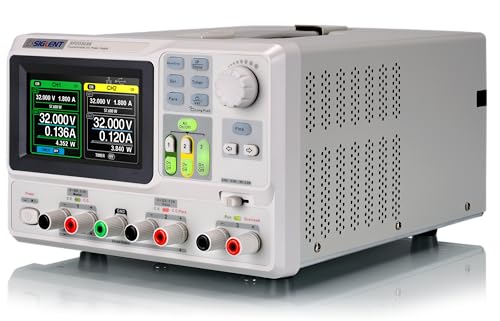
- Three isolated, independently controlled outputs
- Series, parallel, and independent modes
- 220W total output with trending graphs
Best For: Multi-rail lab development and testing
Precision-Controlled Bench Supply

- 0–30V, 0–5A regulated output
- 0.001V and 0.001A display resolution
- Memory recall and multiple protection features
Best For: Precise hobby, repair, and small-lab work
Programmable Three-Channel Supply

- Three fully isolated programmable channels
- 210W total linear output
- Built for multi-rail laboratory testing
Best For: Engineering labs needing isolated programmable rails
Reliable 12V Workhorse
Pyramid PS12KX 12A Linear Supply

- 12A constant, 14A surge output
- 12V and 13.8V DC settings
- Protection and cooling fan included
Best For: High-current 12V radio and tabletop applications
Precision Lab Power

- Adjustable 0–30V and 0–5A output
- 10mV/1mA display resolution
- Low ≤2mVrms ripple and noise
Best For: Laboratory testing and precision electronics development
Feature-Rich Bench Kit

- 0–30V, 0–5A adjustable output
- Presets, locks, and output on/off control
- Includes three lead sets and protections
Best For: Repair benches, labs, and repeatable testing setups
Best Multi-Channel Pick

- Four output channels with up to 328W total power
- 10mV/1mA resolution and 4.3-inch display
- USB, RS232, LAN, digital I/O, and test sequencing
Best For: Multi-rail and automated laboratory testing
Best Traditional Triple-Output Value

- Triple linear output with 315W capacity
- 30V/5A capability and 10mV/1mA adjustment
- Series and parallel modes with three-year warranty
Best For: General-purpose multi-output bench testing
Best Programmable Compact Pick

- Three isolated outputs with 1mV/1mA resolution
- 40 stored settings and timed output programming
- 110V/220V input with remote sensing and protections
Best For: Precise, repeatable testing in compact workspaces
Practical 30V/5A Workhorse – Tekpower TP3005T
Tekpower TP3005T Variable Linear DC Power Supply, 0-30V @ 0-5A with Alligator Test Leads
Check Price On AmazonThe Tekpower TP3005T is a straightforward choice among linear benchtop power supplies when you need adjustable output up to 30V and 5A. Its constant-voltage and constant-current modes, readable back-lit display, and automatic fan control suit general electronics work.
Best For: Hobbyists and small workbenches needing a simple 30V/5A regulated supply.
Pros:
- Adjustable 0–30V and 0–5A output range
- Supports constant-voltage and constant-current operation
- Back-lit display shows voltage to 0.1V and current to 0.01A
- Thermo-sensor-controlled cooling fan and one-year warranty
Cons:
- Single-output design
- At 12 pounds, it is not especially lightweight
- Listed as a 110V AC input model
The TP3005T emphasizes useful core functions rather than advanced programmability. It is a sensible fit for bench testing, repairs, and projects that need dependable manual adjustment.
Flexible Triple-Output Platform – Siglent SPD3303X-E
The Siglent SPD3303X-E stands out among linear benchtop power supplies for its three isolated, independently controlled outputs. With series and parallel modes, a fixed auxiliary output, and trending graphs, it offers more configuration flexibility than a basic single-channel supply.
Best For: Labs and electronics developers who need multiple outputs and configurable power arrangements.
Pros:
- Two adjustable 32V/3.2A outputs plus a 2.5V/3.3V/5V/3.2A output
- Independent, series, and parallel output modes
- Three isolated, independently controlled outputs
- Includes timing output functionality and trending graphs
Cons:
- Total power is limited to 220W
- At 17.6 pounds, it is relatively heavy for a benchtop unit
- Its larger listed dimensions may require substantial bench space
For multi-rail experiments, the SPD3303X-E provides a broader operating toolkit than single-output alternatives. Its three-output layout and series/parallel capability are the main reasons to choose it.
Precision-Controlled Bench Supply – KORAD KA3005D
The KORAD KA3005D is a precision-focused option among linear benchtop power supplies, combining 30V/5A output with fine adjustment, memory recall, and a four-digit back-lit display. Its protection features and load on/off control also make routine bench work easier to manage.
Best For: Hobbyists, small labs, and users who value precise manual settings and repeatable setups.
Pros:
- 0–30V and 0–5A adjustable output
- 0.001V and 0.001A display resolution
- Four memory recall buttons for saved settings
- Includes thermal, overload, short-circuit, grounding, lock, and load controls
Cons:
- Single-output 150W design
- Listed input voltage is 220V
- Its metal-and-plastic enclosure is less substantial than an all-metal construction
The KA3005D is particularly appealing when adjustment precision and repeatability matter. It remains a manual bench supply, but its controls and safeguards add convenience for frequent testing.
Programmable Three-Channel Supply – Rigol DP932A
The Rigol DP932A is a strong candidate among linear benchtop power supplies when three fully isolated channels and programmable operation are priorities. Its 210W total rating gives test setups multiple power rails while retaining a linear supply design.
Best For: Engineering labs and developers working with multiple isolated, programmable power channels.
Pros:
- Three-channel fully isolated programmable linear output
- 210W total power capacity
- Designed for multi-rail testing with a relatively compact listed footprint
Cons:
- The supplied notes do not specify individual channel voltage or current ratings
- More than 9kg, so it is not a lightweight portable option
- The supplied notes do not list display resolution or included accessories
The DP932A is best evaluated for its channel architecture and programmability rather than for basic single-output work. Confirm the detailed channel specifications before matching it to a particular load.
Reliable 12V Workhorse – Pyramid PS12KX 12A Linear Supply
For users seeking straightforward linear benchtop power supplies, the Pyramid PS12KX provides regulated 12V DC power with a 13.8V output option and up to 12A of constant current. Its screw terminals, plug-in operation, and built-in protection suit radio equipment, device testing, and general home-lab work.
Best For: CB radios, scanners, HAM radio equipment, and tabletop 12V applications requiring higher current.
Pros:
- Delivers 12A constant current, with a 14A surge rating.
- Includes electronic overload, short-circuit, and fuse protection.
- Built-in cooling fan and cabinet heatsink help manage operating heat.
- Screw-type terminals support a broad range of connections.
Cons:
- Output is limited to fixed 12V and 13.8V settings rather than a broad variable range.
- The screw-terminal design is less convenient for users wanting quick-connect leads.
- Its 12V focus makes it less versatile for adjustable electronics development.
This is a practical choice when dependable, high-current 12V output matters more than laboratory-style voltage adjustment. It is less suitable for experiments requiring fine control across a wide voltage range.
Precision Lab Power – UNI-T UTP3315TFL-II 30V 5A
The UNI-T UTP3315TFL-II is one of the more precision-oriented linear benchtop power supplies in this group. It offers adjustable 0–30V and 0–5A output, 4-digit displays, low ripple, and automatic constant-voltage/constant-current switching for laboratory and development work.
Best For: Electronics R&D, prototype testing, production environments, and users who need clean adjustable power.
Pros:
- Provides a flexible 0–30V, 0–5A output range.
- 4-digit displays offer 10mV voltage and 1mA current precision.
- Specified ripple and noise are limited to ≤2mVrms.
- Supports 110V/220V ±5% AC input at 50Hz/60Hz.
Cons:
- It is substantially heavier than compact desktop supplies at nearly 10 kg.
- The listed rack form factor and large dimensions may be excessive for casual home use.
- Only one output channel is provided.
Choose this model when regulation quality, display resolution, and clean output are central to the job. Its size and single-channel design make it better suited to a dedicated bench than a highly portable setup.
Feature-Rich Bench Kit – X-Tronic PX-70 30V 5A
The X-Tronic PX-70 combines adjustable 0–30V, 0–5A output with practical controls that make linear benchtop power supplies easier to use during repeated testing. Output on/off control, memory presets, lock functions, fine adjustment, multiple protections, and included lead sets make it a well-equipped option for repair benches and labs.
Best For: Computer repair, educational labs, production work, and users who value included accessories and programmable convenience.
Pros:
- Offers 0–30V and 0–5A output with 1mA current resolution.
- Memory recall, output on/off, and voltage/current lock functions streamline setup.
- Includes three sets of leads, a power cord, instructions, and a project mat.
- Provides overcurrent, over-temperature, over-power, and 5V limit protections.
Cons:
- It does not offer 220V input according to the supplied specifications.
- The USB output adds versatility but may be unnecessary for users seeking a basic supply.
- Its many controls and features may be more than needed for simple voltage-source tasks.
The PX-70 stands out as a complete, convenience-focused package rather than a bare power source. It is especially attractive if you want accessories and repeatable presets, provided 110/120V operation fits your setup.
Best Multi-Channel Pick – UNI-T UDP3305S-E
For demanding test benches, the UNI-T UDP3305S-E is a versatile choice among linear benchtop power supplies. It provides four channels, up to 328W of output power, fine 10mV/1mA resolution, and USB, RS232, LAN, and digital I/O connectivity.
Best For: Multi-rail testing, automated test sequences, aging tests, and users who need four output channels.
Pros:
- Four channels, including dual 0–30V/5A main channels, a 0–6V/3A channel, and a 5V/2A channel.
- Built-in series and parallel connection for CH1 and CH2 simplifies higher-voltage or higher-current testing.
- List and delay functions support up to 2,048 data sets and up to 99,999 cycles.
- 4.3-inch display shows set and actual output values in real time.
Cons:
- At 12.5 kg, it is relatively heavy for a desktop instrument.
- The extensive control and interface options may be more than needed for simple manual projects.
The UDP3305S-E stands out when channel count, sequencing, and remote control matter more than compact size. Its combination of programmable testing features and flexible outputs makes it a strong laboratory-oriented option.
Best Traditional Triple-Output Value – MATRIX MPS-3005H-3
The MATRIX MPS-3005H-3 is a straightforward triple linear bench supply for users comparing linear benchtop power supplies by channel count, output capacity, and adjustment resolution. It delivers 315W, 30V/5A output capability, 10mV/1mA adjustment, and series and parallel modes.
Best For: General laboratory work requiring three outputs, adjustable 30V/5A capability, and low-ripple performance.
Pros:
- Triple-output design with up to 315W of stated output power.
- 10mV/1mA adjustment resolution supports controlled voltage and current settings.
- Series and parallel modes add flexibility for different test setups.
- Three-year warranty provides additional ownership support.
Cons:
- The supplied notes do not specify remote-control or computer-interface features.
- At 19.8 pounds, it is not especially lightweight for a benchtop unit.
This MATRIX model is a practical fit for conventional bench work where three outputs and solid power capacity are priorities. Its feature set is less automation-focused than some programmable alternatives, but its series/parallel capability is useful for hands-on testing.
Best Programmable Compact Pick – MATRIX MPS-3033X
The MATRIX MPS-3033X combines three independent, isolated outputs with programmable controls in a relatively compact 1/2 2U chassis. For shoppers comparing linear benchtop power supplies, it offers 1mV/1mA resolution, computer software monitoring, memory storage, timing output, and switchable 110V/220V input.
Best For: Programmable bench testing, compact workspaces, and applications needing isolated channels with saved settings.
Pros:
- Three independent and isolated outputs: two 0–30V/3A channels plus one 0–6V/3A channel.
- Fine 1mV/1mA resolution, remote sensing, and low-ripple operation support precise testing.
- Stores and recalls 40 settings, with timed output from 0.1 to 3,600 seconds.
- Includes over-voltage, thermal, power overload, leakage, and short-circuit protection.
Cons:
- Total output power is 198W, lower than the other listed models.
- Its 3A-per-channel ratings provide less current than a 5A main-channel supply.
The MPS-3033X is a strong choice when precision, isolation, and programmable operation outweigh maximum wattage. Its compact format and memory features are especially useful for repeatable testing and smaller benches.
How We Picked These Linear Benchtop Power Supplies
We selected models across several common bench-use categories, including single-output adjustable supplies, triple-output units, programmable laboratory supplies, and higher-current options. We considered stated voltage and current ranges, output power, channel configuration, regulation and resolution claims, control features, protection modes, display clarity, and suitability for electronics work.
Because specifications and included accessories can vary by seller or regional version, verify the listing before purchase. Pay particular attention to input-voltage compatibility, output isolation, remote-control interfaces, and whether test leads are included.
Quick Comparison
| What to Compare | Why It Matters |
|---|---|
| Output range | Determines which circuits and devices you can power. |
| Channels | Multiple isolated outputs simplify dual-rail and multi-voltage projects. |
| Maximum current and wattage | Sets the practical load limit and headroom. |
| Programmability | Useful for repeatable tests, automated sequences, and remote operation. |
| Ripple and regulation | Lower noise and tighter regulation benefit sensitive analog and RF circuits. |
Key Buying Factors for Linear Benchtop Power Supplies
Voltage, Current, and Power Capacity
A common 0–30V, 0–5A supply covers many hobby, repair, and educational projects. Higher-power models are better for motors, amplifiers, lighting, and other demanding loads. Leave headroom rather than operating continuously at the maximum rating.
Single Output Versus Multiple Channels
Single-output units are simpler and often more affordable. Triple- and four-channel supplies are more flexible for analog circuits, microcontroller projects, and systems needing positive, negative, or separate auxiliary rails. Check whether channels are independent and isolated before assuming they can be combined.
Controls, Displays, and Programming
Digital displays should be easy to read and sufficiently precise for your work. Fine voltage and current adjustment, output enable controls, memory recall, locking, and programmable presets improve repeatability. USB, LAN, or other remote interfaces matter if the supply will be integrated into automated testing.
Protection and Electrical Performance
Look for over-voltage, over-current, over-temperature, and short-circuit protection. For sensitive circuits, prioritize low ripple, stable regulation, and published accuracy specifications. A linear supply can be a strong choice when clean output is more important than compact size or maximum efficiency.
Who Should Buy Which Linear Benchtop Power Supplies?
Choose a basic single-channel 30V/5A model for general electronics repair, classroom work, and hobby prototyping. Pick a compact or higher-current unit when bench space is limited or your projects regularly draw more current. A triple-output supply is the better fit for dual-rail analog circuits and projects requiring several independent voltages.
Choose a programmable model if you need repeatable test sequences, saved settings, remote control, or detailed monitoring. For laboratory development and demanding measurement work, prioritize the models with stronger published specifications, multiple isolated channels, higher resolution, and more comprehensive protection. Before ordering, confirm the required input voltage, connector style, channel isolation, and included leads.