Docking stations with PCIe expansion give laptops and compact PCs a practical way to add capabilities normally limited to desktop systems. Depending on the design, you can connect an external GPU, install NVMe storage, add expansion cards, or build a more flexible workstation setup.
This roundup compares 10 options across Thunderbolt, OCuLink, and specialized PCIe designs. Before buying, confirm your computer’s port type, PCIe bandwidth, operating-system support, power requirements, and the expansion hardware you plan to use.
Best 10 Docking Stations with Pcie Expansion Picks for 2026
Dual-Slot PCIe Expansion
Thunderbolt 3 PCIe Expansion Chassis

- Adds two PCIe 3.0 x16 slots
- 40Gbps Thunderbolt connectivity
- Silent passive-cooled aluminum design
Best For: External capture, networking, and storage card expansion
High-Port Workstation Dock
CalDigit TS5 Plus Thunderbolt 5 Dock

- 20-port Thunderbolt 5 workstation hub
- PCIe-based 10GbE networking
- Up to 140W host charging
Best For: High-speed multi-display and networked workstations
External GPU Platform
RGEEK OCuLink PCIe 5.0 eGPU Dock
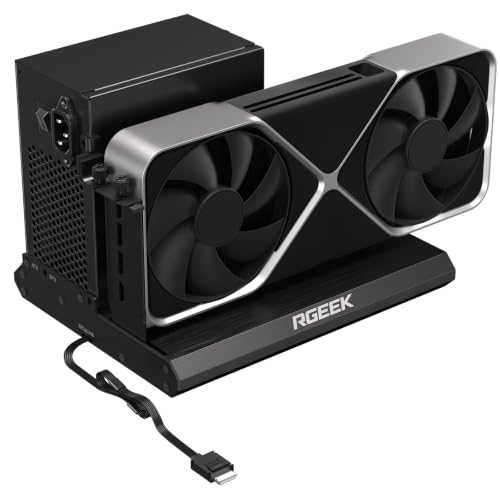
- PCIe 5.0 x4 up to 128Gbps
- Supports NVIDIA and AMD GPUs
- Works with ATX, SFX, and SFX-L PSUs
Best For: Gaming and professional GPU upgrades for mini PCs and laptops
Storage-Ready Thunderbolt Dock
UGREEN Maxidok Thunderbolt 5 Dock

- Built-in PCIe Gen4x4 M.2 slot
- 17 ports with 2.5GbE networking
- Up to 140W charging and 8TB NVMe support
Best For: Expandable storage and multi-monitor Thunderbolt workstations
Best for Expandable Storage
MINISFORUM ESP4B PCIe M.2 Dock

- Four PCIe 4.0 M.2 SSD slots
- OCuLink expansion for four SATA drives
- Switches between speed and capacity modes
Best For: Workstations, NAS builds, media libraries, and backups
Best Mac Mini Storage Hub

- Dual NVMe/SATA M.2 enclosure
- RAID 0, RAID 1, and JBOD support
- Adds HDMI, Ethernet, USB, and card readers
Best For: Mac mini and MacBook desktop setups
Best High-End Thunderbolt Dock

- Internal PCIe 4.0 x4 NVMe slot
- Supports dual high-resolution displays
- Includes 2.5GbE and up to 140W charging
Best For: Creative workstations and multi-monitor setups
Dedicated GPU Expansion
MINISFORUM DEG1 Oculink eGPU Dock

- PCIe 4.0 x4 Oculink connection
- ATX/SFX power supply support
- GPU and PSU sold separately
Best For: Oculink mini PC users building an external GPU setup
High-Speed Desktop Hub

- Thunderbolt 5 up to 80Gbps
- M.2 PCIe Gen4x4 NVMe expansion
- Up to 140W power delivery
Best For: TB5 users needing displays, peripherals, charging, and storage
Flexible PCIe Card Adapter
JMT PCIe 5.0 Oculink Expansion Dock

- External GPU and PCIe card support
- PCIe 5.0 x4 with Gen4/Gen3 backward compatibility
- ATX/SFX/1U PSU compatibility
Best For: Users expanding mini PCs, handhelds, or laptops with varied PCIe cards
Dual-Slot PCIe Expansion – Thunderbolt 3 PCIe Expansion Chassis
For users seeking docking stations with PCIe expansion, this Maskedfish chassis focuses on adding two full-length PCIe 3.0 x16 slots through a Thunderbolt 3, Thunderbolt 4, or USB4 connection. It is suited to card-based upgrades rather than a broad collection of everyday dock ports.
Best For: Laptop, NUC, and desktop users who need external PCIe slots for capture cards, network adapters, or NVMe storage.
Pros:
- Provides two PCIe 3.0 x16 expansion slots.
- Uses a 40Gbps Thunderbolt connection and supports Windows, macOS, and Linux.
- Compact aluminum design uses passive cooling for silent operation.
- Includes a 60W adapter and an 8-pin cable for cards needing extra power.
Cons:
- It has one primary connection rather than a full multiport docking layout.
- PCIe cards require their own drivers.
- Card dimensions are limited to 205mm x 25mm x 145mm.
This is a practical choice when external PCIe access matters more than display, USB, or networking convenience. Check your card dimensions, power requirements, and host compatibility before buying.
High-Port Workstation Dock – CalDigit TS5 Plus Thunderbolt 5 Dock
The CalDigit TS5 Plus is a high-end workstation dock for users who want extensive connectivity alongside PCIe-based 10GbE networking. Its Thunderbolt 5 platform, 20 ports, and high-power charging make it a strong option among docking stations with PCIe expansion for demanding desktop setups.
Best For: Thunderbolt 5 users building multi-display workstations with fast Ethernet, storage, and numerous USB accessories.
Pros:
- Offers 20 ports, including Thunderbolt 5, USB, DisplayPort, card readers, audio, and 10GbE.
- Provides up to 140W dedicated host charging with a 330W power supply.
- Supports advanced multi-display configurations, including up to dual 6K displays on compatible Macs.
- Dual USB controllers help reduce bottlenecks between front and rear USB devices.
Cons:
- Maximum performance requires a Thunderbolt 5 or USB4 v2 80Gbps host.
- Thunderbolt 3, Thunderbolt 4, and some USB4 hosts may have reduced functionality.
- Its feature set may be more than needed for a basic laptop desk setup.
The TS5 Plus is best viewed as a connectivity hub with PCIe-based 10GbE rather than an enclosure for installing expansion cards. Confirm your computer’s Thunderbolt, USB4, display, and operating-system support before choosing it.
External GPU Platform – RGEEK OCuLink PCIe 5.0 eGPU Dock
The RGEEK OCuLink eGPU Dock is a focused PCIe expansion solution for adding a desktop graphics card to a compatible laptop, mini PC, NUC, or desktop. Unlike general-purpose docking stations with PCIe expansion, it is built specifically around external GPU use and high-bandwidth OCuLink connectivity.
Best For: Gaming, 3D modeling, rendering, and AI workloads that need an external NVIDIA or AMD graphics card.
Pros:
- Supports PCIe 5.0 x4 bandwidth up to 128Gbps and is backward compatible with PCIe 4.0 and 3.0.
- Accepts mainstream NVIDIA and AMD graphics cards without a stated card-size restriction.
- Aluminum construction helps with heat dissipation and durability.
- Supports ATX, SFX, and SFX-L power supplies.
Cons:
- Graphics card and power supply are not included.
- Full PCIe 5.0 speed requires a compatible M.2 or PCIe-to-OCuLink setup; the adapter is not included.
- Hot plugging is not supported, and drivers must be installed after assembly.
This dock can deliver a flexible external-GPU upgrade path, but it requires more setup than a conventional USB or Thunderbolt dock. Verify that your system exposes a compatible OCuLink connection and plan for a separate GPU and power supply.
Storage-Ready Thunderbolt Dock – UGREEN Maxidok Thunderbolt 5 Dock
The UGREEN Maxidok combines broad workstation connectivity with a built-in PCIe Gen4x4 M.2 NVMe slot, making it a versatile option among docking stations with PCIe expansion. It is designed for users who want fast removable storage, multiple displays, wired networking, and laptop charging in one aluminum enclosure.
Best For: Thunderbolt 5 users who want integrated NVMe storage and a multi-monitor desktop setup.
Pros:
- Includes a PCIe Gen4x4 M.2 slot supporting 2230–2280 NVMe SSDs up to 8TB.
- Provides 17 ports, including Thunderbolt 5, 10Gbps USB, DisplayPort, card readers, audio, and 2.5GbE.
- Supports triple independent displays on Windows and dual displays on Mac, subject to system compatibility.
- Offers up to 140W charging and 240W total system power.
Cons:
- The M.2 slot has size and heatsink limits, including a maximum heatsink height of 12mm and width of 24mm.
- HDMI monitors require an active DisplayPort-to-HDMI adapter or cable.
- The cooling fan can produce noise while operating, though the stated level is below 30dB.
The Maxidok is a strong all-in-one choice when internal dock storage is as important as ports and displays. Check the SSD’s physical dimensions and your computer’s Thunderbolt, macOS, or Windows display support before purchase.
Best for Expandable Storage – MINISFORUM ESP4B PCIe M.2 Dock
MINISFORUM ESP4B AMD 850 PCIe Expansion Card 4X M.2 PCIe4.0 Slot Docking Station
Check Price On AmazonThe MINISFORUM ESP4B is a focused choice among docking stations with PCIe expansion, offering four PCIe 4.0 M.2 slots plus OCuLink-based SATA expansion. Its operating modes let you prioritize speed with fewer drives or capacity with all four slots populated.
Best For: Workstation storage expansion, NAS and home server builds, video production, and high-capacity backups.
Pros:
- Supports four PCIe 4.0 M.2 SSD slots.
- Offers full PCIe 4.0 x4 performance for SSD1 and SSD2 in high-performance mode.
- OCuLink connection expands storage with four SATA 3.0 ports.
- Includes a 20Gbps USB-C port and ASPM power management.
Cons:
- With all four M.2 slots populated, each SSD operates at PCIe 4.0 x2.
- It is primarily a storage expansion device rather than a broad peripheral dock.
The ESP4B stands out when internal storage flexibility matters more than display or networking features. Its switch between high-performance and full-configuration modes makes it adaptable for both fast working drives and larger storage pools.
Best Mac Mini Storage Hub – ORICO Dual M.2 Mac Dock
The ORICO Mac mini dock combines PCIe-connected M.2 storage expansion with a broad selection of everyday ports. It supports two M.2 NVMe or SATA drives, while also adding display, Ethernet, USB, card-reader, audio, and charging connections.
Best For: Mac mini and MacBook users who want expandable storage, RAID options, and a centralized desktop connection hub.
Pros:
- Two independent M.2 slots support NVMe and SATA drives up to 8TB each.
- Includes hardware RAID 0, RAID 1, and JBOD modes.
- Provides 10-port connectivity, including 4K HDMI, gigabit Ethernet, USB, SD/TF, and audio.
- Supports offline SSD cloning without a connected computer.
Cons:
- When using different M.2 protocols, only the drive in Slot 1 is recognized.
- Compatibility is positioned primarily around Apple computers and specific Mac mini generations.
This is a strong all-in-one option for a Mac-based desk where storage and connectivity need to share one compact enclosure. RAID and offline cloning add useful flexibility for performance-focused work or routine backups.
Best High-End Thunderbolt Dock – Nusyn Thunderbolt 5 Dock
The Nusyn Thunderbolt 5 dock is a high-bandwidth pick among docking stations with PCIe expansion, pairing three downstream Thunderbolt 5 ports with an internal M.2 NVMe slot. It also delivers extensive display, networking, card-reader, USB, and charging capability for demanding setups.
Best For: Creative professionals, high-resolution multi-monitor workstations, and users who need fast removable connectivity plus configurable NVMe storage.
Pros:
- Built-in M.2 slot supports up to 8TB of PCIe 4.0 x4 NVMe storage.
- Supports up to dual 6K at 60Hz on Mac or dual 8K at 120Hz on Windows.
- Offers 2.5GbE, USB ports, SD and MicroSD readers, and 15W downstream Thunderbolt charging.
- Provides up to 140W laptop charging and Thunderbolt Share support.
Cons:
- Its highest display capabilities depend on the host platform and setup.
- Mac support is specified from macOS 15 Sequoia, while Windows support starts at Windows 10.
The Nusyn dock is designed for users who can take advantage of Thunderbolt 5 bandwidth rather than simply needing basic port expansion. Its internal NVMe slot makes it especially appealing for a fast, consolidated workstation.
Dedicated GPU Expansion – MINISFORUM DEG1 Oculink eGPU Dock
The MINISFORUM DEG1 is a focused choice among docking stations with PCIe expansion when your priority is connecting a desktop graphics card to a compatible mini PC through Oculink. It supports PCIe 4.0 x4 upstream and a PCIe x16 physical slot, plus ATX or SFX power supplies, but it requires a powered-off connection and does not support Thunderbolt.
Best For: Oculink-equipped mini PC users building an external GPU setup with their own graphics card and power supply.
Pros:
- Supports GPUs such as the RTX 4090 and AMD RX 7900 XTX.
- Accepts standard ATX and SFX power supplies.
- Provides a PCIe x16 slot through a PCIe 4.0 x4 Oculink link.
Cons:
- Only supports Oculink and does not support Thunderbolt.
- GPU and power supply are not included.
- Oculink is not hot-swappable; the system must be turned off first.
The DEG1 makes sense for a purpose-built Oculink eGPU system, especially if you already have a compatible GPU and PSU. Verify your mini PC’s interface and plan for shutdowns before disconnecting or reconnecting the dock.
High-Speed Desktop Hub – Brydge Stone Pro TB5 Dock
The Brydge Stone Pro TB5 is a versatile option among docking stations with PCIe expansion, combining Thunderbolt 5 connectivity with an internal M.2 NVMe PCIe Gen4x4 slot. It is designed for compatible Windows and macOS systems that need high-speed peripherals, multiple displays, laptop charging, and optional storage expansion from one dock.
Best For: Thunderbolt 5 laptop users who want multi-display connectivity, strong charging, and upgradeable NVMe storage.
Pros:
- Offers up to 80Gbps bandwidth, with up to 120Gbps Bandwidth Boost.
- Supports up to three 4K displays at 144Hz or two 8K displays at 60Hz with compatible devices.
- Includes an M.2 NVMe PCIe Gen4x4 expansion slot with active cooling.
- Provides up to 140W laptop power delivery and a 180W adapter.
Cons:
- Requires a compatible Thunderbolt 5 laptop to use its headline performance.
- The M.2 SSD is sold separately.
- Its extensive feature set may be unnecessary for basic docking needs.
Choose the Stone Pro TB5 when your setup benefits from fast displays, storage, networking, and charging in one aluminum dock. Its PCIe expansion is storage-focused rather than a full-size external graphics-card enclosure.
Flexible PCIe Card Adapter – JMT PCIe 5.0 Oculink Expansion Dock
The JMT Dock-OC7 is one of the more flexible docking stations with PCIe expansion, providing an Oculink route for external GPUs and other PCIe cards. It can connect through an existing Oculink port or a compatible M.2-to-Oculink adapter, and it supports graphics, networking, sound, capture, and NVMe/U.2/U.3 storage devices.
Best For: Mini PC, handheld, and laptop users who need a direct-connect PCIe expansion platform beyond graphics cards.
Pros:
- Supports external GPUs, network, sound, capture, and multiple SSD types.
- Offers PCIe 5.0 x4 capability with backward compatibility for Gen4 and Gen3.
- Works with ATX, SFX, and small 1U power supplies.
- Supports external GPUs up to the 5090 model according to the supplied specifications.
Cons:
- Maximum PCIe 5.0 performance requires a host that supports PCIe 5.0 speeds.
- A power supply is required, with 500W or more recommended.
- Cross-brand adapter accessories may cause incompatibility or reduced performance.
The Dock-OC7 is a strong fit when you want one Oculink expansion platform for varied PCIe hardware. Confirm the host interface, adapter-board requirements, and power budget before choosing it for a high-end GPU.
How We Picked the Best Docking Stations with Pcie Expansion
We evaluated these docks by looking at expansion interface, theoretical bandwidth, compatibility, power delivery, storage support, connectivity, and practical installation requirements. The selection includes full-featured Thunderbolt 5 docks, external GPU platforms using OCuLink, multi-slot PCIe enclosures, and compact storage-focused designs.
Because “PCIe expansion” can mean very different things, we also considered whether each product provides a standard PCIe slot, a dedicated GPU connection, M.2 storage bays, or a combination of dock and expansion functions. Specifications such as PCIe generation and lane count are important, but real-world performance also depends on the host computer, cable, drivers, and installed component.
Quick Comparison
- Best for a broad desktop replacement: Thunderbolt 5 docks with high-power charging, fast networking, and many peripheral ports.
- Best for external graphics: OCuLink and direct PCIe GPU docks, which can offer a more direct connection than general-purpose USB-based solutions.
- Best for storage expansion: Docks with multiple M.2 slots or integrated NVMe/SATA enclosure support.
- Best for add-in cards: Dedicated PCIe chassis with one or more standard expansion slots.
- Best for compact computers: Mini PC and Mac mini docks designed to match the host’s dimensions and available interfaces.
Key Buying Factors for Docking Stations with Pcie Expansion
Interface and Bandwidth
Check whether the dock uses Thunderbolt 3, Thunderbolt 5, OCuLink, USB4, or a direct PCIe connection. Thunderbolt is usually more versatile for displays and peripherals, while OCuLink and direct PCIe designs may be better suited to external graphics. Also verify the actual PCIe generation and lane allocation rather than relying only on a headline speed.
Compatibility
Confirm support for your operating system, laptop or mini PC, and expansion card. Some docks require a compatible Thunderbolt or USB4 port; others need an M.2 slot, OCuLink connector, or a specific internal adapter. Mac support can vary by GPU, storage format, and driver availability.
Power and Cooling
External GPUs and high-performance PCIe cards may need substantial power beyond what the host connection supplies. Look for included or required power supplies, appropriate GPU power connectors, ventilation, and fan behavior. A compact enclosure may not suit a large, high-wattage card.
Ports and Daily Usability
For a primary desk dock, prioritize display outputs, Ethernet, USB ports, audio, SD card access, and reliable power delivery. If you mainly need an expansion card or GPU, avoid paying extra for ports you will not use.
Who Should Buy Which Docking Stations with Pcie Expansion?
Choose a Thunderbolt 5 model if you want one cable for displays, networking, storage, peripherals, and charging. Pick an OCuLink or direct PCIe GPU dock if graphics performance is the priority and your computer has the necessary connection. A multi-slot PCIe chassis makes more sense for professional cards or specialized hardware, while an M.2-focused dock is ideal for adding fast storage to a mini PC or Mac setup.
Before ordering, measure the available desk space, check cable length and connector type, and confirm that your planned card or SSD is supported. The best choice is the one that matches your host interface and expansion goal—not necessarily the dock with the highest advertised bandwidth.