Light meters with data logging make it easier to capture changing illumination over time instead of relying on one-point readings. They are useful for plant lighting, facility checks, photography, and compliance-oriented measurements.
This roundup compares ten options across lux, foot-candle, PAR, PPFD, DLI, sensor design, calibration, connectivity, and export features so you can choose a meter suited to your measurements and workflow.
Best 10 Light Meters with Data Logging Picks for 2026
Best Calibrated Pick
Digi-Sense Data Logging Light Meter

- NIST traceable calibration
- Stores up to 87,000 readings via PC
- Measures up to 40,000 foot-candles
Best For: Professional measurement and extensive PC-based logging
Best iPhone-Connected Option
Bluetooth Split-Sensor Lux Meter

- Logs through iPhone and PC apps
- Split sensor supports remote positioning
- Measures up to 200,000 lux
Best For: iPhone users needing flexible, app-based light logging
Best for Grow Lights

- Measures 400–700 nm PAR
- Reads up to 4,000 µmol/m²/sec
- Stores 100 data groups
Best For: Indoor gardening, hydroponics, greenhouses, and aquariums
Best Compact General Meter
AIOMEST Illuminance Light Meter

- Measures up to 400,000 lux/foot-candles
- Stores 32 data sets
- Rotating sensor and temperature measurement
Best For: Portable general-purpose light checks and short comparisons
Best for Long-Term Plant Tracking

- Measures PPFD and DLI from 400–700nm
- Records up to five years and exports CSV
- IP65 waterproof with power-saving mode
Best For: Growers needing extended DLI records
Best for Professional Illuminance Testing
EasyView Light Meter with Memory

- Measures up to 99,990 Fc and 999,900 lux
- Stores up to 50 readings with optional timestamps
- Offers averaging, alerts, and comparator functions
Best For: General lighting and facilities measurements
Best for Flexible Grow-Light Measurements

- Measures PPFD up to 4000µmol/m²/sec
- Stores up to 100 measurement groups
- Includes 4.9-foot and 12-foot sensor cables
Best For: Greenhouse and LED grow-light checks
Compact Choice

- Measures 0.1–400,000 lux
- Stores 33 readings
- Rotating sensor with temperature display
Best For: Home growing and everyday light checks
Professional Logging Pick
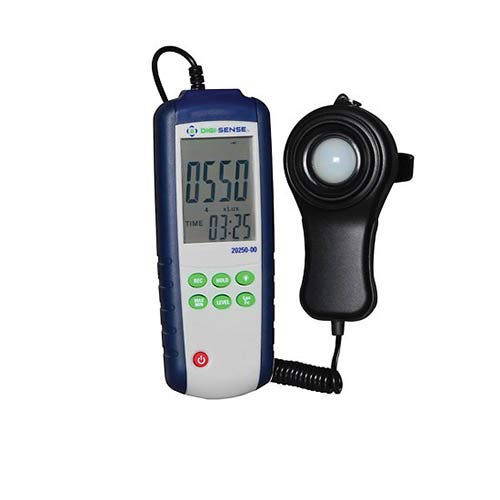
- Stores up to 87,000 readings
- NIST-traceable calibration
- 0–400,000 lux range
Best For: Extensive professional measurement records
Value 400,000-Lux Meter

- Measures up to 400,000 lux
- Stores 33 readings
- Fast sampling with rotating sensor
Best For: Plants, greenhouses, and general lighting checks
Best Calibrated Pick – Digi-Sense Data Logging Light Meter
For buyers seeking light meters with data logging for structured measurement work, this Digi-Sense model stands out with NIST traceable calibration and substantial PC-connected storage. It measures up to 40,000 foot-candles and offers multiple lux ranges for broad testing needs.
Best For: Professionals who need calibrated readings and extensive manual or automatic data collection through a PC.
Pros:
- NIST traceable calibration supports documented measurement workflows.
- Stores up to 87,000 manual or automatic readings when connected to a PC.
- Offers 0–40,000 foot-candle measurement and multiple lux ranges.
- Provides 0.01 resolution.
Cons:
- Data logging depends on connection to a PC.
- Its feature set may be more than casual users need.
This is the strongest option here for measurement records and calibration-focused work, especially when large datasets matter more than a compact, app-first design.
Best iPhone-Connected Option – Bluetooth Split-Sensor Lux Meter
This Bluetooth model is a practical choice among light meters with data logging when you want app-based records and a sensor that can be positioned away from the display. It supports up to 32,752 logged groups, with unlimited recording and storage when linked to an iPhone or PC through the app.
Best For: iPhone users who need flexible sensor placement and connected logging for plants, rooms, or other lighting checks.
Pros:
- Split-type sensor helps measure bright beams while keeping the display accessible.
- Supports up to 32,752 groups and unlimited app-linked recording and storage.
- Includes four ranges up to 200,000 lux and adjustable recording intervals.
- Provides lux, foot-candle, temperature, MAX/MIN/AVG, hold, and alarm functions.
Cons:
- The app is compatible with iPhone iOS but not Android.
- Bluetooth and app functionality may be unnecessary for simple spot checks.
Its split sensor and connected workflow make it particularly versatile, but the iOS-only limitation is important to confirm before buying.
Best for Grow Lights – PAR Meter with Data Logging
For indoor gardening, this PAR meter is a specialized alternative to general light meters with data logging. It measures photosynthetically active radiation from 400–700 nm, reaches up to 4,000 µmol/m²/sec, and records up to 100 groups for reviewing recent readings.
Best For: Growers, hydroponic gardeners, greenhouse users, and aquarium keepers evaluating LED light intensity for photosynthesis.
Pros:
- Measures the 400–700 nm PAR range used for photosynthesis.
- Handles readings up to 4,000 µmol/m²/sec.
- Records up to 100 data groups for later review.
- Includes a 1/4-inch tripod mount and two cable lengths for flexible sensor placement.
Cons:
- Its PAR-focused readings are not a substitute for a general lux meter in every application.
- Data storage is limited to 100 groups.
- Requires two AAA batteries.
This is the most purpose-built choice for plant lighting because it reports PAR rather than only general illuminance, with enough logging for recent comparisons.
Best Compact General Meter – AIOMEST Illuminance Light Meter
This AIOMEST unit offers a broad 0.1–400,000 lux/foot-candle range with straightforward onboard storage, making it a convenient pick among light meters with data logging for everyday comparisons. Its rotating sensor head and temperature measurement add flexibility for room, plant, greenhouse, and workplace checks.
Best For: Users who want a portable general-purpose meter with basic logging, maximum/minimum readings, and a flexible sensor head.
Pros:
- Measures 0.1–400,000 lux or foot-candles with 0.1 resolution.
- Records up to 32 data sets and supports MAX/MIN and REL modes.
- 270-degree rotating photo detector improves access to awkward measurement angles.
- Also measures ambient temperature and includes a carrying case.
Cons:
- Storage is limited to 32 data groups.
- It does not list PC, Bluetooth, or app-based data transfer.
- Its stated accuracy is ±4% of the reading.
Choose this model for portable, uncomplicated measurements and short comparison sessions; buyers needing large exports or connected logging should consider the Digi-Sense or Bluetooth option instead.
Best for Long-Term Plant Tracking – 2-in-1 PAR & DLI Meter
For growers comparing light meters with data logging, this model combines PPFD and DLI measurement in one compact device. It measures the 400–700nm range, records up to five years of data, and can export records to a PC as CSV files.
Best For: Gardeners and indoor or outdoor growers who want long-term DLI tracking and plant-focused light measurements.
Pros:
- Measures both PPFD and DLI across the 400–700nm range.
- Records up to five years of data and supports CSV export.
- IP65 waterproof construction suits garden and lawn use.
- Screen-off power-saving mode continues measuring and recording.
Cons:
- Its measurement focus is plant lighting rather than general illuminance.
- PC export is required for convenient access to the full long-term record.
This is the strongest fit when historical DLI data matters more than general-purpose lux readings. The built-in date and clock display, 30-day on-device view, soil rod, and 1/4-inch mount add practical flexibility for plant monitoring.
Best for Professional Illuminance Testing – EasyView Light Meter with Memory
If you need light meters with data logging for conventional lighting checks, the Extech EA33 offers a broad illuminance range and memory for up to 50 readings. Its five ranges cover both foot-candles and lux, with fine resolution for detailed measurements.
Best For: Technicians and facilities users measuring general illuminance across workplaces, interiors, and other lighting environments.
Pros:
- Measures up to 99,990 Fc or 999,900 lux across five ranges.
- Stores up to 50 readings, with optional date and time stamps.
- Includes averaging, relative mode, timed hold, comparator mode, and high/low alerts.
- Cosine- and color-corrected sensor supports readings across varied light angles.
Cons:
- Memory capacity is limited to 50 readings.
- It measures illuminance rather than plant-focused PPFD or DLI.
- The supplied specification lists six AAA batteries, adding more battery requirements than compact alternatives.
The EA33 is the most versatile general-purpose option here for lux and foot-candle work. Its sensor cable, protective holster, built-in stand, and included carrying case make it well suited to repeated field or facility measurements.
Best for Flexible Grow-Light Measurements – High-Precision PAR Meter
For growers seeking light meters with data logging, this PAR meter records up to 100 PPFD readings while covering the 400–700nm plant-lighting range. Its calibration function, tripod mount, and two cable options make it practical for checking LED grow lights from different positions.
Best For: Greenhouse and indoor growers who need portable PPFD checks with short-term measurement memory.
Pros:
- Measures PPFD up to 4000µmol/m²/sec across 400–700nm.
- Records up to 100 measurement groups for quick review.
- Includes 4.9-foot coiled and 12-foot straight cables.
- Provides calibration, a 1/4-inch tripod mount, and one-key RCFS functionality.
Cons:
- Data logging is limited to 100 groups rather than multi-year storage.
- It does not provide the supplied model’s dedicated DLI recording and CSV export features.
This meter is a practical middle ground for mapping PPFD around LED fixtures or comparing plant-lighting positions. Choose it over a general lux meter when PAR readings and sensor placement flexibility are the priority.
Compact Choice – Kethvoz 881D
If you need light meters with data logging for plant care, indoor lighting, photography, or aquariums, the Kethvoz 881D offers a compact handheld design and straightforward controls. It measures from 0.1 to 400,000 lux and stores up to 33 readings.
Best For: Home growers, greenhouse checks, planted aquariums, reptile enclosures, and basic lighting plans.
Pros:
- Measures both lux and foot candles across a wide 0.1–400,000 lux range.
- Stores up to 33 readings and includes maximum, minimum, and relative modes.
- 270-degree rotatable sensor, backlit display, temperature readout, and carrying case.
Cons:
- Its 33-reading storage capacity is limited for larger measurement projects.
- Accuracy varies by light level, with stated tolerances increasing at higher readings.
The Kethvoz is a practical everyday meter when portability and simple onboard logging matter more than extensive record storage. Its rotating sensor and temperature display add useful flexibility for indoor growing environments.
Professional Logging Pick – Digi-Sense 20250-00
The Digi-Sense 20250-00 is aimed at buyers who need light meters with data logging and substantial measurement capacity. It covers 0 to 400,000 lux and 0 to 40,000 foot candles, with NIST-traceable calibration and storage for up to 87,000 readings.
Best For: Professional inspections, facilities work, laboratories, and users who need extensive logged measurements.
Pros:
- Stores up to 87,000 readings for large or ongoing measurement tasks.
- Offers a broad 0–400,000 lux and 0–40,000 foot-candle range.
- Includes NIST-traceable calibration and 0.01 lux/foot-candle resolution.
Cons:
- The supplied information does not specify display features, sensor rotation, or other ergonomic details.
- Its professional calibration and high-capacity logging may be more than casual users need.
Choose the Digi-Sense when measurement records and calibration documentation are priorities. Its dramatically larger storage capacity distinguishes it from compact meters designed for occasional spot checks.
Value 400,000-Lux Meter – AIOMEST AI-881D
For buyers comparing light meters with data logging for plants, photography, or general illumination checks, the AIOMEST AI-881D combines a broad range with quick sampling. It records up to 33 measurements, displays ambient temperature, and uses a rotatable sensor for easier positioning.
Best For: Plant growth checks, greenhouse use, decoration-related lighting measurements, and indoor or outdoor inspections.
Pros:
- Measures up to 400,000 lux and 40,000 foot candles.
- Records up to 33 readings and supports maximum/minimum modes.
- Samples two to three times per second and includes a 270-degree rotatable sensor.
Cons:
- Data logging is limited to 33 stored readings.
- The supplied specifications state different resolution and accuracy details across measurement ranges, so high-level readings should be interpreted accordingly.
The AIOMEST is a versatile handheld option for routine light checks, particularly where sensor positioning and fast response are useful. It offers similar compact logging capacity to other basic meters while covering very bright environments.
How We Picked the Best Light Meters with Data Logging
We focused on meters that record measurements internally or through a connected app, rather than basic instant-read instruments. The selection covers general illuminance meters, Bluetooth-enabled loggers, and PAR-focused tools for horticulture. We also considered measurement range, sensor format, resolution, calibration claims, storage capacity, export options, and how easily each device fits a repeatable testing routine.
Because lux and PAR are not interchangeable, we separated conventional light meters from products designed to measure PPFD or calculate DLI. That distinction matters when evaluating grow lights, sunlight exposure, or plant-canopy conditions.
Quick Comparison
| Best For | Look For | Why It Matters |
|---|---|---|
| Workplace and facility checks | Lux/foot-candle readings, broad range, calibration documentation | Supports consistent lighting assessments and reporting |
| Remote monitoring | Bluetooth, app support, PC compatibility, export tools | Makes longer logging sessions easier to review |
| Grow lights | 400–700nm PAR range, PPFD measurement, data logging | Measures usable photosynthetic light rather than visible brightness alone |
| Sunlight and plant scheduling | DLI calculation or recording | Shows accumulated daily light exposure |
Key Buying Factors for Light Meters with Data Logging
Measurement Type and Range
Choose lux or foot candles for architectural, workplace, and general illumination checks. For plants, select a PAR or PPFD meter covering the 400–700nm range. A high maximum reading is useful outdoors or near powerful fixtures, while fine resolution helps with low-light measurements.
Logging and Data Access
Check whether readings are saved to internal memory, a phone app, or a computer. Review sampling intervals, session capacity, timestamps, export formats, and whether data can be downloaded as a file. Bluetooth is convenient for remote placement, but app compatibility and connection stability are equally important.
Calibration and Sensor Design
NIST-traceable calibration can be valuable when measurements need stronger documentation. A separate or split sensor helps position the sensing element accurately, while a built-in sensor is generally simpler for quick checks. Confirm whether calibration applies to the current sensor and measurement mode.
Usability and Environment
Look for a readable display, hold and min/max functions, battery information, protective housing, and a sensor cable long enough for the intended setup. If you will log for hours or days, prioritize dependable memory, clear controls, and a practical power plan.
Who Should Buy Which Light Meters with Data Logging?
Choose a calibrated Digi-Sense or Extech-style general illuminance meter for professional inspections, workplace documentation, or users who prioritize conventional lux and foot-candle readings. A Bluetooth logger is the better fit for people who want phone or PC access and convenient data export.
For indoor gardens and LED grow lights, choose a PAR or PPFD meter rather than a standard lux meter. If comparing total daily exposure, a DLI-capable model is more useful than one that reports only instantaneous intensity. Budget-oriented plant users may prefer a straightforward lux logger, while advanced growers should prioritize spectral suitability, calibration information, and dependable logging controls.