Choosing the right meter can make inductor testing faster, cleaner, and far more accurate. The best LCR meters for inductors help you verify coil values, spot faulty parts, and measure related parameters with confidence.
In this roundup, we focus on practical options for hobbyists, technicians, and bench users, from compact handheld tools to higher-precision instruments built for serious component testing.
Best 10 Lcr Meters for Inductors Picks for 2026
Top Pick
FNIRSI LC1020E 100kHz LCR Meter for Precision Screening

- Measures inductors up to 100H with up to 100kHz test frequency.
- Shows primary and secondary parameters together on a color TFT display.
- Sorting mode helps compare parts against preset tolerance values.
Best For: Detailed bench testing and tolerance screening
Budget-Friendly Bench Meter
Proster BM4070 LCR Meter with Rotatable LCD
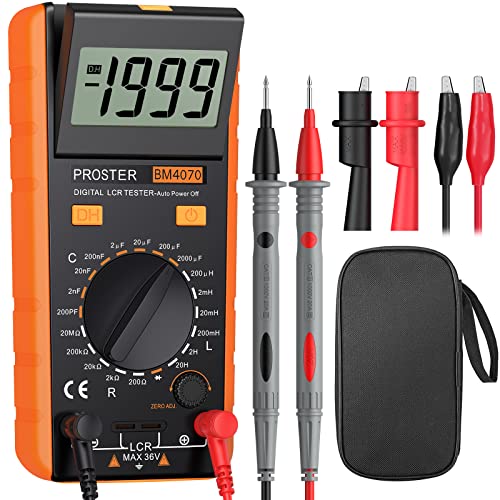
- Measures inductors from 200µH to 20H across 6 ranges.
- Zero adjust helps reduce stray measurement errors.
- Rotatable LCD and included clips make bench use easier.
Best For: Hobbyists needing a practical, affordable tester
Best Calibrated Tester
Extech LCR200 Passive Component Meter
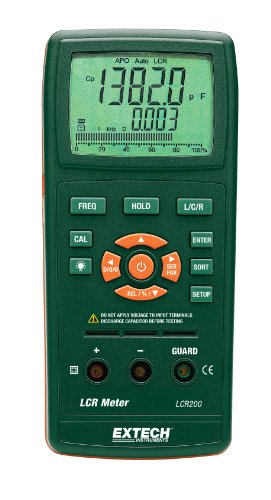
- Measures inductance, capacitance, resistance, and secondary parameters.
- Offers five test frequencies from 100 Hz to 100 kHz.
- Open/short calibration helps reduce stray impedance.
Best For: Lab-style testing with flexible frequency control
Specialty Repair Tool
Type-C Motherboard Coil Inductance Tester

- Gives a simple normal/abnormal coil check.
- Type-C powered and compact for repair work.
- Designed for fast troubleshooting on phone boards.
Best For: Repair technicians needing quick coil fault checks
Compact Auto Tester
FNIRSI LCR-P1 Transistor Tester

- Measures inductors, capacitors, resistors, and semiconductors.
- Auto-identifies pins and component parameters.
- USB-C rechargeable with a color display.
Best For: Quick, pocket-size component testing and identification
Handheld Precision Meter

- Measures capacitance, inductance, resistance, and impedance.
- Shows D and Q for more detailed analysis.
- Offers 100Hz, 1kHz, and 10kHz test frequencies.
Best For: Detailed portable testing and component sorting
Tweezer-Style Scan Meter
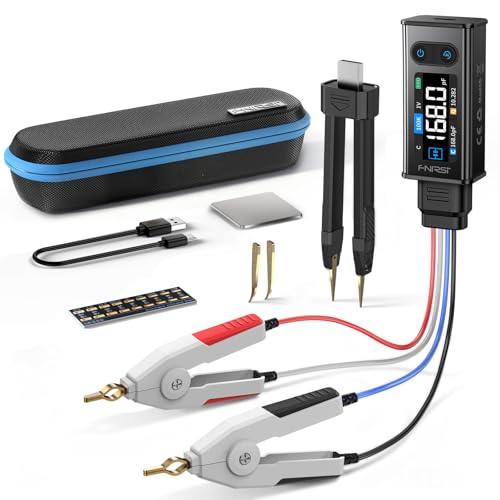
- Measures inductors from 1 µH to 10 H.
- Scans from 100 Hz up to 100 kHz.
- Tweezer tips make SMD testing easier.
Best For: Fast SMD and through-hole component testing
Portable Auto-Range Component Tester

- Auto-ranges inductance without manual switching
- Backlit LCD helps in dim workspaces
- Overload protection and auto power-off add convenience
Best For: Technicians and hobbyists needing a compact inductance checker
Benchtop Precision Bridge

- 0.1% precision target for bench testing
- Supports capacitor, inductor, and resistor checks
- SCPI support and calibration suit lab workflows
Best For: Engineers and labs needing a precision benchtop tester
Smart Tweezer LCR Tester

- Tweezer design works well on SMD parts
- Measures L, R, C, and diode values
- Data storage plus Excel export support logging
Best For: SMD repairs and board-level component testing
Top Pick – FNIRSI LC1020E 100kHz LCR Meter for Precision Screening
If you want one of the most capable lcr meters for inductors, the FNIRSI LC1020E is built for detailed component testing. It covers inductance, capacitance, resistance, and AUTO detection, while also showing secondary values like ESR, Q, D, θ, and X on its color display.
Best For: Bench users who want a feature-rich meter for fast component sorting and detailed inductor checks.
Pros:
- Measures inductors from 1µH to 100H with selectable test frequencies up to 100kHz.
- Dual-parameter display shows main and secondary readings at the same time.
- Sorting and comparison mode helps screen parts against preset tolerance limits.
- Includes open/short calibration, data hold, and Kelvin-style test sockets.
Cons:
- Requires open/short calibration before accurate measurements.
- Best results depend on fully discharging capacitors and inductors first.
- More advanced than a basic go/no-go component tester.
Overall, this is a strong choice if you want detailed readings and flexible test settings rather than a simple pass/fail tool. The display, frequency range, and comparison features make it especially useful for careful inductor evaluation.
Budget-Friendly Bench Meter – Proster BM4070 LCR Meter with Rotatable LCD
This Proster LCR meter is aimed at practical component testing, especially if you need a straightforward tool for lcr meters for inductors. It measures inductance, capacitance, and resistance with manual ranges, plus data hold and a rotatable display for easier bench use.
Best For: Hobbyists and repair users who want a capable, affordable meter for inductors, capacitors, and resistors.
Pros:
- Covers inductors from 200µH to 20H across 6 ranges.
- Zero adjust helps reduce stray lead and circuit capacitance errors.
- Rotatable LCD makes readings easier to see at different angles.
- Includes leads, clips, battery, and a storage bag for ready-to-use convenience.
Cons:
- Lower count display than more advanced bench meters.
- Inductance testing is range-based rather than highly automated.
- Uses a 9V battery, so long sessions may need battery management.
For everyday parts checking, this meter gives you the core functions without extra complexity. It is a solid choice when you want a portable bench meter with useful inductance coverage and practical accessories.
Best Calibrated Tester – Extech LCR200 Passive Component Meter
The Extech LCR200 is a more traditional bench-style option for buyers comparing lcr meters for inductors. It measures inductance, capacitance, and resistance, and adds secondary readings like Q, D, phase, and ESR for a fuller picture of passive components.
Best For: Users who want a calibrated passive component meter with dual display and flexible test modes.
Pros:
- Supports inductance, capacitance, and resistance with secondary parameter readings.
- Five selectable test frequencies from 100 Hz to 100 kHz.
- Open and short calibration helps reduce stray impedance.
- Built-in test fixture and external leads add bench flexibility.
Cons:
- Requires a 9V battery.
- More of a bench instrument than a pocketable tool.
- Not as simple as a basic component checker.
If you need a meter that goes beyond simple inductance readings, the LCR200 offers a useful mix of calibration, display detail, and test control. It is a strong fit for lab-style troubleshooting and component verification.
Specialty Repair Tool – Type-C Motherboard Coil Inductance Tester
This Type-C inductance tester is a specialty option for quick fault checking rather than full lcr meters for inductors. It is designed to indicate whether a coil is working normally or abnormally, making it useful for fast troubleshooting on phone motherboards and similar circuit boards.
Best For: Phone repair technicians and electronics maintenance users who need a fast normal/abnormal coil check.
Pros:
- Simple binary result makes fault checking fast and easy.
- Compact, lightweight design is easy to carry for on-site repairs.
- Type-C powered for convenient use with compatible devices.
- Built for technician-focused troubleshooting workflows.
Cons:
- Does not provide numeric inductance readings.
- Only checks normal versus abnormal coil behavior.
- Specialized for repair diagnostics, not general component measurement.
This is best treated as a targeted diagnostic tool, not a replacement for a full LCR meter. If your work is focused on quick coil fault isolation, its simplicity is the main advantage.
Compact Auto Tester – FNIRSI LCR-P1 Transistor Tester
If you need one of the more compact lcr meters for inductors and general component checks, the FNIRSI LCR-P1 is built for quick identification rather than bench-style deep analysis. It measures inductors, capacitors, resistors, diodes, transistors, and batteries, and its auto-recognition helps speed up everyday sorting and troubleshooting.
Best For: Hobbyists and repair users who want a pocket-size tester for fast component identification, basic inductance checks, and mixed parts testing.
Pros:
- Measures inductors along with R/C, diodes, transistors, MOSFETs, and batteries.
- Auto-identifies component pins and parameters for faster testing.
- Replaceable patch seat helps with both tiny parts and higher-power devices.
- Includes a 1.44-inch full-color screen and USB-C charging/data support.
Cons:
- More focused on convenience and broad testing than advanced lab-style analysis.
- Smaller handheld design may be less ideal for extended work sessions.
- Best suited to component checks rather than specialized precision workflows.
Overall, the LCR-P1 makes sense if you want a lightweight tester that can quickly handle inductors and a wide mix of common electronic parts. It is a practical choice for everyday diagnostics, but users needing deeper measurement controls may want a more advanced meter.
Handheld Precision Meter – LCR-101A Digital LCR Meter
For buyers comparing lcr meters for inductors, the LCR-101A stands out as a more measurement-focused handheld option. It measures capacitance, inductance, resistance, and impedance, while also showing secondary values like dissipation factor and quality factor, making it a strong pick when you want more than a basic pass/fail tester.
Best For: Engineers, technicians, and serious hobbyists who want a portable meter for detailed component measurement and sorting.
Pros:
- Measures C, L, R, and Z, plus D and Q for deeper analysis.
- Automatic component identification speeds up sorting and testing.
- Selectable test frequencies of 100Hz, 1kHz, and 10kHz improve flexibility.
- Large backlit display and 180-degree screen rotation aid readability.
Cons:
- USB cable is not included for data logging.
- Less compact than a tweezer-style tester for tiny SMD parts.
- Geared more toward detailed testing than ultra-simple, one-step checks.
The LCR-101A is a sensible middle ground if you want portability without giving up measurement depth. Its frequency options and extra parameters make it especially useful when inductors need more careful evaluation than a basic tester can provide.
Tweezer-Style Scan Meter – FNIRSI LCR-ST2 Tweezer Tester
If your shortlist of lcr meters for inductors includes SMD work, the FNIRSI LCR-ST2 is designed for fast probing and broad component coverage. Its tweezer form factor, full-range scan options, and support for inductors up to 10 H make it well suited to mixed boards, especially when you need to check small parts without setting up a separate bench tool.
Best For: Electronics users who test SMD and through-hole parts and want a portable tweezer-style meter for inductors and other components.
Pros:
- Measures inductors from 1 µH to 10 H, plus resistors, capacitors, diodes, and voltage.
- 100 Hz to 100 kHz scan range supports everything from RF parts to large electrolytics.
- Tweezer design with gold-plated tips is convenient for SMD components.
- Shows primary and secondary parameters such as X, D, Q, and θ.
Cons:
- Tweezer-style testing may not suit every bench workflow.
- Higher-end measurement features may be more than casual users need.
- Small handheld format can be less comfortable for long, repetitive sessions.
Overall, the LCR-ST2 is the most specialized option here for fast SMD handling and wide-ranging scans. If your work includes inductors and mixed-component boards, it brings useful flexibility in a very portable package.
Portable Auto-Range Component Tester – Pocket LCD Inductance Meter
If you need one of the more practical lcr meters for inductors for bench troubleshooting or field repairs, this pocket component tester keeps setup simple. It auto-ranges inductance measurements from 1uH to 10H, includes a backlit LCD for dim spaces, and adds overload input protection to help guard against accidental live-circuit contact.
Best For: Technicians, hobbyists, and repair shops that want a compact inductance meter with auto-ranging and basic protection.
Pros:
- Auto-ranging inductance measurement eliminates manual scale switching.
- Backlit LCD is easier to read in low-light work areas.
- Overload input protection helps reduce damage from charged capacitors or accidental connections.
- 10-minute auto power-off helps conserve battery life.
Cons:
- Inductance range in the notes is listed as 1uH to 100mH in one place and up to 10H in another.
- It is a handheld tester, so it lacks the bench-style workflow of a dedicated lab unit.
This is a straightforward pick when you want a portable meter for quick component checks rather than a full-featured lab instrument. The strength here is convenience: automatic range selection and a readable display make it easy to use during fast repairs.
Benchtop Precision Bridge – ET4401 LCR Meter
For buyers comparing lcr meters for inductors in a bench setting, the ET4401 is positioned as a high-precision component tester for capacitor, inductor, and resistor measurements. Its notes emphasize 0.1% accuracy, SCPI support, and the need for open and short calibration before use, which makes it better suited to structured lab workflows than quick handheld checks.
Best For: Engineers and labs that need a precision benchtop LCR meter with calibration and remote-control support.
Pros:
- 0.1% precision target suits more controlled measurement work.
- Supports capacitor, inductor, and resistor testing in one bench unit.
- SCPI support can fit automated or remote test setups.
- Open and short calibration helps reduce fixture-related measurement error.
Cons:
- Requires calibration before use, which adds setup time.
- As a benchtop instrument, it is less portable than handheld testers.
- The supplied notes are brief on exact inductance range and detailed operating limits.
This is the most lab-oriented option in the group and makes sense when repeatability matters more than portability. If your workflow includes fixture calibration and remote control, it offers a more serious test platform than a basic component checker.
Smart Tweezer LCR Tester – FNIRSI LCR-ST1 SMD Meter
If you want lcr meters for inductors that are optimized for small parts, the FNIRSI LCR-ST1 stands out as a smart tweezer-style tester. It measures inductance from 1uH to 10H, supports 100 Hz, 1 kHz, and 10 kHz test frequencies, and displays secondary parameters like D, Z, Q, R, and ESR for more complete component checks.
Best For: SMD repair work, circuit board fault-finding, and users who need a portable tweezer-style LCR tester.
Pros:
- Tweezer form factor is convenient for SMD components and tight spaces.
- Supports inductance, resistance, capacitance, and diode testing.
- Multiple test frequencies and voltage options add flexibility.
- Data storage and Excel export are useful for logging results.
Cons:
- Fixed screen design does not rotate or flip.
- Best suited to small-component work rather than general benchtop use.
This is the most specialized pick here, especially if your work involves SMD repairs and board-level fault isolation. The combination of auto recognition, detailed parameter readouts, and tweezer heads makes it efficient for small parts that are awkward to probe with leads.
How We Picked the Best Lcr Meters for Inductors
We prioritized models that make inductor measurement useful in real-world work, not just on a spec sheet. That means clear readouts, reliable auto-ranging or auto-identification, and the ability to measure more than one component type when needed. We also weighed frequency range, accuracy, display quality, portability, and whether the meter suits quick troubleshooting or deeper analysis.
Quick Comparison
For fast bench checks and general repair, handheld and pocket-style testers are usually the easiest to live with. Tweezer-style testers are a strong fit for small SMD parts, while full-size bench units are better when you need more stability, tighter accuracy, or repeatable results. If you work on boards often, convenience and probe style can matter as much as raw measurement range.
Key Buying Factors for Lcr Meters for Inductors
Test Frequency
Inductors can read differently depending on test frequency, so higher-frequency support is often useful for coils and RF-related parts. If you only need basic troubleshooting, a lower-frequency meter may still be sufficient. For more demanding work, look for adjustable or broader frequency coverage.
Accuracy and Resolution
Accuracy matters when you are matching components or validating designs. For general repair, moderate precision is often enough. For lab or production use, choose a meter with higher stated accuracy, stable readings, and finer resolution.
Component Recognition and Measurement Modes
Auto-detect features save time when sorting mixed parts. Helpful meters will also measure ESR, Q, D, phase angle, and related parameters, giving you a fuller picture of inductor behavior instead of only a single value.
Form Factor and Probing
Handheld meters work well for service calls and everyday use. Tweezers are ideal for tiny SMD inductors, while bench bridges are best when you want the most consistent setup. Choose the physical format that matches the parts you test most often.
Who Should Buy Which Lcr Meters for Inductors?
DIY repair users and electronics hobbyists should look for a compact, easy-to-read meter with auto component detection. SMD-focused users will benefit most from tweezer-style testers. For motherboard work, small board testers can speed up fault finding. If you need lab-grade repeatability or SCPI support, a precision benchtop option is the strongest choice. In short, the best Lcr Meters for Inductors are the ones that match your parts, your workspace, and how often you test.