Large-format resin printers make it easier to produce oversized miniatures, prototypes, display pieces, and multi-part models with smooth surfaces and fine detail. The right choice depends on more than maximum build volume: resolution, print speed, workflow automation, resin compatibility, and operating costs all matter.
We’ve gathered 10 notable options ranging from high-resolution production machines to more accessible printers with large build areas and useful automatic features. Use the guide below to narrow the list according to your projects, workspace, and budget.
Best 10 Large Format Resin Printers Picks for 2026
Best for High-Volume Detail
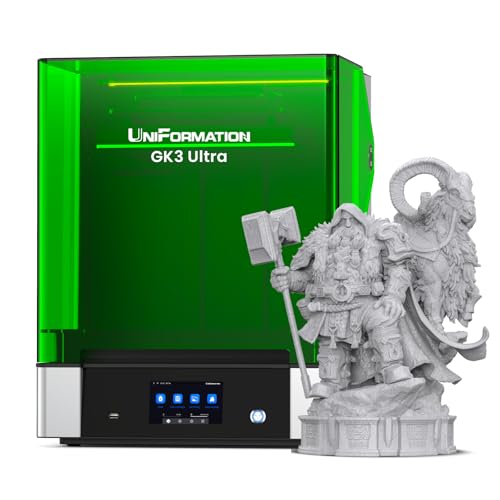
- 300 × 160 × 300mm build volume
- 16K detail with 20 × 26μm pixels
- Heating and automatic resin feeding
Best For: Professional studios, prototyping, and batch production
Best for Automated Large Prints

- 298 × 164 × 300mm build volume
- Automatic resin management with 1300ml vat
- Up to 60mm/h printing and self-checks
Best For: Large models and batch printing with less supervision
Best for Premium Large-Format Resolution

- 302.4 × 161.98 × 300mm build volume
- 16K resolution with 20 × 26μm XY detail
- Heating, auto resin supply, and camera monitoring
Best For: Detailed professional models and connected workflows
Best for Speed and Fine Detail

- Up to 170mm/h with high-speed resin
- 14K LCD with fine 16.8 × 24.8μm XY resolution
- Temperature control and automatic resin filling
Best For: Fast prototyping and detailed models
Best High-Resolution Speed

- 16K mono LCD with 14 × 19 μm pixels
- Fixed plate eliminates manual leveling
- Automated heating and resin management
Best For: High-detail, high-throughput resin printing
Best Dual-Material Option

- Prints with two colors or materials
- Factory-calibrated automatic leveling
- Handles resin viscosity up to 8,000 cps
Best For: Creative and advanced-material applications
Best for Crisp 14K Detail

- 10.1-inch 14K mono LCD
- Auto-leveling with pre-print checks
- Supports resins up to 8,000 cps
Best For: Fine-detail printing with simplified setup
Production Powerhouse

- 33 × 18.5 × 30 cm build plate
- 43 µm detail with 15-inch 8K LCD
- Built for high-volume production
Best For: Professional studios and high-volume batch printing
Large-Model Workhorse

- 298 × 164 × 300 mm build volume
- Automatic filling and resin recycling
- Temperature-controlled 1300 ml vat
Best For: Large props, masks, terrain, and cosplay models
Compact Detail Specialist

- 10K LCD with 17 × 17 µm pixels
- Beginner-friendly four-point leveling
- Compact 153.4 × 87 × 165 mm build volume
Best For: Detailed hobby prints and first-time resin users
Best for High-Volume Detail – UniFormation GK3 Ultra
The UniFormation GK3 Ultra is one of the more capable large format resin printers for users who need substantial build capacity without giving up fine detail. Its 300 × 160 × 300mm build volume, 16K screen, automatic resin feeding, and heated resin system support large models, batch production, and more consistent printing in cooler environments.
Best For: Industrial prototyping, professional studios, small and medium-sized businesses, and makers printing large or multiple detailed parts.
Pros:
- Large 300 × 160 × 300mm build volume for sizable models or batch jobs
- 16K LCD with 20 × 26μm pixel size for sharp detail
- Automatic resin feeding and built-in heating support longer, more consistent prints
- Rigid KK60 Z-axis module and quick-release vat simplify repeatable operation
Cons:
- Large footprint and 85.8-pound weight require substantial workspace
- Its extensive feature set may be more than occasional hobbyists need
The GK3 Ultra stands out when productivity and repeatability matter as much as resolution. The heated resin system, automatic refill, and precise Z-axis architecture make it a practical choice for demanding workflows, provided you have room for its sizable enclosure.
Best for Automated Large Prints – ANYCUBIC Photon Mono M7 MAX
The ANYCUBIC Photon Mono M7 MAX combines a generous build area with automation aimed at reducing interruptions. Among large format resin printers, it is a strong option for users who want to produce large models or batches while benefiting from temperature-controlled resin, automatic material management, and built-in print checks.
Best For: Large model printing, batch production, and users who value automated resin handling and operational checks.
Pros:
- 298 × 164 × 300mm build volume accommodates large models without splitting
- 7K screen with 46 × 46μm XY resolution supports detailed textures
- Automatic resin management and a 1300ml vat help support extended prints
- Up to 60mm/h print speed plus five intelligent inspections improves workflow efficiency
Cons:
- Its 30.91-inch depth and 60.9-pound weight demand considerable space
- 7K resolution is lower than the 14K and 16K options in this roundup
The M7 MAX is best suited to buyers prioritizing capacity and convenience over maximum pixel resolution. Its flip-top access, automated refill system, and inspection features can make large or repeated jobs easier to manage.
Best for Premium Large-Format Resolution – ELEGOO Jupiter 2
The ELEGOO Jupiter 2 is designed for buyers who want a large format resin printer with high resolution and a broad set of assisted features. Its 302.4 × 161.98 × 300mm build volume, 16K exposure system, heated tank, automated resin system, and monitoring tools make it well suited to sizable, detail-focused projects.
Best For: Large detailed models, multi-part jobs, professional users, and makers who want integrated monitoring and safety features.
Pros:
- 302.4 × 161.98 × 300mm build volume supports large or multiple objects
- 16K resolution and 20 × 26μm XY resolution target fine surface detail
- Smart tank heating, automatic resin supply, and multi-point leveling support easier setup
- Camera monitoring, Wi-Fi, power-loss recovery, and resin-related alarms add workflow support
Cons:
- Large 27.95 × 20.08 × 19.29-inch footprint requires dedicated space
- The many automated and connected features may increase setup complexity
Jupiter 2 is a feature-rich choice for users who want both scale and detailed output. Its combination of 16K imaging, temperature control, safety alerts, and remote monitoring makes it particularly appealing for professional or frequent printing workflows.
Best for Speed and Fine Detail – ANYCUBIC Photon Mono M7 Pro
The ANYCUBIC Photon Mono M7 Pro is a speed-focused resin printer for users who need highly detailed parts turned around quickly. Its 14K monochrome LCD, 16.8 × 24.8μm XY resolution, temperature-controlled vat, automatic resin filling, and claimed speeds up to 170mm/h make it an appealing alternative to larger, slower-format machines.
Best For: Fast prototyping, fine-detail models, and users who want automated resin handling with a relatively lighter printer.
Pros:
- Up to 170mm/h with high-speed resin and 130mm/h with standard resin
- 14K resolution and 16.8 × 24.8μm XY resolution support very fine details
- Temperature-controlled vat and automatic resin filling simplify operation
- Six intelligent detection functions help identify setup, resin, and print issues
Cons:
- The supplied notes do not specify its build volume, so large-object capacity is less clear
- Maximum speed depends on using high-speed resin and the stated test conditions
The M7 Pro is the most speed-oriented option here, with strong resolution for detailed work and automation intended to reduce common operating errors. Consider it when turnaround time matters more than choosing a printer explicitly defined by the largest build volume.
Best High-Resolution Speed – Creality Halot-X1 Combo
For large format resin printers that prioritize detail and throughput, the Creality Halot-X1 Combo combines a 10.1-inch 16K mono LCD with a 211.68 × 118.37 × 200 mm build volume. Its fixed build plate, automated resin handling, and claimed print speeds up to 170 mm/h make it a practical choice for demanding workflows.
Best For: Makers and professionals who want high-resolution prints, automated resin management, and a stable, low-adjustment setup.
Pros:
- 16K resolution with a 14 × 19 μm pixel size for highly detailed prints.
- Fixed build plate eliminates routine manual leveling.
- Resin heating, RFID parameter recognition, laser detection, and weight monitoring streamline material handling.
- Dual linear rails and dual lead screws support 0.01 mm Z-axis positioning precision.
Cons:
- At 38 pounds, it is a substantial desktop machine.
- The automated resin system may add complexity compared with a basic resin printer.
- Its build volume is generous but not the largest available for every large-format project.
The Halot-X1 Combo stands out when fine detail, automation, and motion stability matter more than simplicity or minimal size. Its resin-management features are particularly useful for users planning frequent, extended print sessions.
Best Dual-Material Option – ANYCUBIC Photon P1 Dual-Color
The ANYCUBIC Photon P1 is one of the more versatile large format resin printers for creative work because it supports dual-color or dual-material printing. It also combines factory-calibrated leveling, AI monitoring, and compatibility with resins up to 8,000 cps for a workflow aimed at convenience and advanced materials.
Best For: Creative users and professional makers who want dual-material experiments, automated checks, and industrial-resin capability.
Pros:
- Dual-color or dual-material printing expands design possibilities and can reduce resin waste on small models.
- Smart Leveling 3.0 performs automatic checks and provides corner pressure feedback.
- Wave Release Technology reduces release force by 60% for easier model removal.
- Supports ultra-high-viscosity resins up to 8,000 cps.
Cons:
- The supplied specifications do not state the printer’s resolution or build volume.
- Dual-material functionality may require more involved material setup than single-resin printing.
- Its 39-pound weight makes it less convenient to relocate.
The Photon P1 is best differentiated by its dual-color or dual-material capability rather than by a stated resolution or volume figure. Choose it when material versatility and automated monitoring are central to your projects.
Best for Crisp 14K Detail – ANYCUBIC Photon P1 14K
For buyers comparing large format resin printers around fine-detail output, the ANYCUBIC Photon P1 14K offers a 10.1-inch 14K mono LCD with a 16.8 × 24.8 micrometer XY pixel size. Its auto-leveling, release-assistance technology, and resin monitoring are designed to make detailed printing easier to manage.
Best For: Detail-focused creators who want crisp 14K output, automatic leveling, and support for high-viscosity resins.
Pros:
- 14K LCD resolution and a stated minimum aperture of 0.3 mm support fine detail reproduction.
- Smart Leveling 3.0 performs factory calibration and automatic pre-print checks.
- Wave Release Technology reduces release force by 60%.
- Supports ultra-high-viscosity resins up to 8,000 cps and includes pre-configured Anycubic settings.
Cons:
- The supplied notes do not specify the build volume.
- Its 14K display is lower resolution than the 16K display on the Creality comparison model.
- At 29.7 pounds, it still requires a stable, dedicated location.
The Photon P1 14K is a strong fit when detailed output and simplified setup are the priorities. Its automated inspection and high-viscosity resin support add flexibility for both everyday projects and more advanced applications.
Production Powerhouse – Phrozen Sonic Mega 8K S
For studios evaluating large format resin printers, the Phrozen Sonic Mega 8K S emphasizes high-volume output without giving up fine detail. Its spacious build plate, 43 µm XY resolution, and production-focused workflow make it suited to demanding batch work.
Best For: Professional studios producing large batches of miniatures, prototypes, jewelry masters, or collectibles.
Pros:
- Large 33 × 18.5 × 30 cm build plate can accommodate up to 80 1/32-scale miniatures in under 1.5 hours, according to the supplied specifications.
- 15-inch 8K mono LCD provides 43 µm XY resolution for detailed models.
- Lift-up lid and built-in metal drip hanger help with access and resin recovery.
- ACF film and TR300 resin are designed for faster production and reduced suction force.
Cons:
- At 57.3 pounds, it is a substantial printer to position and move.
- Its professional-scale capacity may be more than occasional hobby printing requires.
- The printer occupies a large physical footprint despite its space-saving lid design.
The Sonic Mega 8K S is the strongest fit here for commercial throughput and large, highly detailed batches. Choose it when production capacity and resolution matter more than portability.
Large-Model Workhorse – Anycubic Photon Mono M7 Max
The Anycubic Photon Mono M7 Max is one of the more capable large format resin printers for making sizable models in fewer sections. Its generous build volume, automatic resin features, and temperature-controlled vat are practical advantages for extended or repeated jobs.
Best For: Makers creating full-size masks, cosplay props, game terrain, and other large models.
Pros:
- 298 × 164 × 300 mm build volume supports large models with less cutting and assembly.
- 7K 13.6-inch display and LighTurbo 3.0 light source are designed for consistent, detailed exposure.
- Automatic resin filling and one-key recycling simplify resin management.
- Dynamic vat temperature control helps maintain an appropriate resin temperature during printing.
Cons:
- Its 20.47 × 20 × 31-inch dimensions require considerable workspace.
- At 52.8 pounds, it is not especially portable.
- The maximum listed speed of 60 mm/h may not match the fastest production-focused printers.
The M7 Max balances a very large build area with convenience features that reduce hands-on resin handling. It is a sensible choice for large props and terrain where minimizing seams is a priority.
Compact Detail Specialist – Anycubic Photon Mono 4
Although smaller than many large format resin printers, the Anycubic Photon Mono 4 offers exceptionally fine pixel resolution in a compact, approachable package. It is a practical option for detailed everyday projects when maximum build volume is not the main requirement.
Best For: Beginners and hobbyists making detailed small-to-medium models, miniatures, and daily projects.
Pros:
- 10K mono LCD delivers 17 × 17 µm X/Y pixel size for highly detailed prints.
- 153.4 × 87 × 165 mm build volume provides useful space for routine projects.
- Laser-engraved platform improves adhesion while keeping model removal manageable.
- Four-point leveling is designed to reduce repeated leveling, and printing can resume after power restoration.
Cons:
- Its build volume is substantially smaller than the other printers in this roundup.
- It is not intended for full-size props or very large single-piece models.
- The supplied notes state that Anycubic APP service is not supported.
The Photon Mono 4 prioritizes precision, simplicity, and a small footprint rather than large-scale output. Consider it when fine detail and beginner-friendly setup matter more than printing oversized parts.
How We Picked the Best Large Format Resin Printers
We focused on printers that offer meaningfully larger build capacity than typical desktop resin models, while also considering the features that affect everyday results. Our comparison includes LCD/MSLA machines with different combinations of build volume, pixel resolution, print speed, automatic leveling, material handling, and workflow automation.
Specifications such as 16K or 14K resolution can indicate strong detail potential, but they do not guarantee better prints by themselves. Exposure control, mechanical stability, resin quality, slicing settings, and model orientation remain equally important. Product availability and specifications can change, so confirm current details before purchasing.
Quick Comparison
| What to Compare | Why It Matters |
|---|---|
| Build volume | Determines the maximum model size and how many parts you can print together. |
| LCD resolution and pixel size | Affects fine edges, surface detail, and the visibility of layer or pixel artifacts. |
| Print speed | Shortens production time, although resin, layer height, exposure, and model geometry also matter. |
| Automation | Features such as auto-leveling, resin management, and failure detection can reduce setup work. |
| Material support | Check whether the printer handles standard, tough, flexible, water-washable, or specialty resins you plan to use. |
Key Buying Factors for Large-Format Resin Printers
Build Volume and Machine Footprint
Measure the printer, wash-and-cure equipment, ventilation, and clearance together. A large build platform is useful only if you have enough space to operate and maintain the machine safely. Also check the Z height if you print tall props, engineering parts, or multiple figures at once.
Resolution Versus Throughput
Higher pixel counts can support sharper details, but they may increase file sizes and do not automatically improve every model. If you produce functional prototypes or large smooth forms, build volume and dependable exposure may be more valuable than the highest advertised resolution. For miniatures and intricate surfaces, pixel size and consistent LCD performance deserve closer attention.
Reliability, Leveling, and Resin Handling
Auto-leveling and guided setup can make a substantial difference for frequent users. Look for a rigid platform, dependable vat design, accessible replacement parts, and clear maintenance procedures. Consider ventilation, resin odor, spill protection, and the recurring cost of films, screens, build plates, and cleaning supplies.
Software and Workflow
Confirm that the printer works with your preferred slicer and operating system. Wi-Fi, USB, remote monitoring, automatic feeding, or dual-material functions can be valuable in a production setting, but only if the supporting software is stable and easy to use.
Who Should Buy Which Large Format Resin Printers?
- Choose a maximum-volume model if you regularly print large props, batches of parts, or tall assemblies and can accommodate the footprint.
- Choose a high-resolution large-format printer if miniature detail, crisp text, and fine mechanical features are your main priorities.
- Choose a fast model if you run repeated jobs or operate a small print service, but budget for suitable high-speed resin and careful calibration.
- Choose an automated model if you want less manual setup and more repeatable operation across frequent print sessions.
- Choose a smaller 10K-class option if you want improved detail and a relatively manageable machine while still printing larger pieces than standard entry-level resin printers.
Before ordering, compare the complete workflow rather than the printer alone: resin, ventilation, wash and cure equipment, spare release film, protective gear, and post-processing space can significantly affect the true cost of large-format resin printing.