The best interactive solar system models turn astronomy into a hands-on activity. Children can build planets, demonstrate orbital motion, explore gears, and use light or projection features to make space concepts easier to understand.
These 10 picks cover DIY construction kits, rotating mechanical models, classroom teaching aids, and glow-in-the-dark planetariums. Use the guide below to match the right model with the learner’s age, goals, available space, and preferred level of involvement.
Best 10 Interactive Solar System Models Picks for 2026
Hands-On Builder
Smartivity DIY Solar System Kit

- Gear-driven rotating planet model
- STEM construction for ages 8–14
- Child-safe, eco-friendly MDF design
Best For: Young builders learning basic astronomy through hands-on play
Advanced Building Pick
964-Piece Spinning Solar System

- 964-piece construction challenge
- Hand-powered rotating gear system
- Includes planets, moon, rocket, and satellites
Best For: Older kids and adults who enjoy detailed space builds
Projector STEM Kit
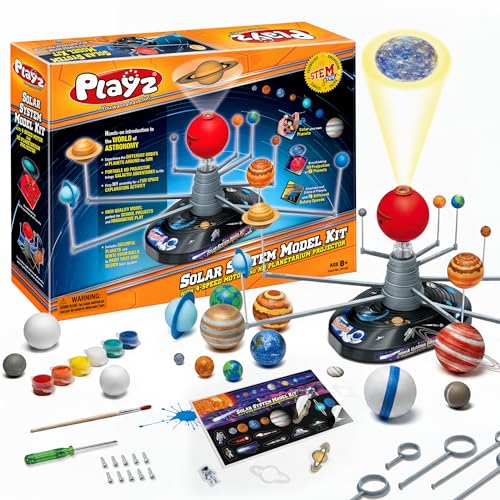
- Four-speed motorized orbit
- Projects eight planets onto surfaces
- Includes 75-plus parts and paint set
Best For: School projects and kids who enjoy visual, creative STEM activities
Classroom Demonstrator
EISCO 13-Inch Solar System Model

- Manual planetary motion on metal rods
- Month-labeled sturdy base
- Includes experiment guide and activities
Best For: Classroom or homeschool demonstrations of planetary positions
Hands-On Starter
Wookidel 64-Piece Solar System Kit

- 64-piece foam craft kit with paints and tools
- Combines planet building with astronomy lessons
- Designed for ages 6–12 and school projects
Best For: Creative classroom or family projects for children
Wall-Display Pick
Pllieay Solar System Model Kit

- Felt-backed project designed to hang on a wall
- Includes paints, labels, hooks, and instructions
- Covers orbital positions and planet names
Best For: Ages 8–17 needing a compact science-project display
Glow-In-The-Dark Favorite
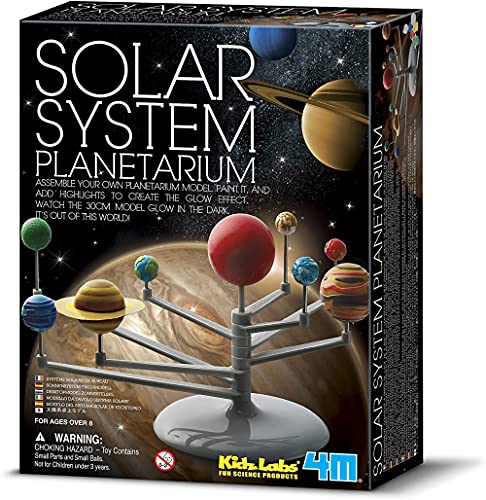
- Paint-and-assemble planetarium with glow paint
- Includes wall chart and 10 quiz sets
- Battery-free kit for ages 8 and up
Best For: Older children who want astronomy learning with a glow effect
Best Wind-Up STEM Build

- Wind-up planetary motion
- Explores gear ratios
- Battery-free STEM activity
Best For: Hands-on builders and science-fair projects
Best for Earth-Moon Demonstrations

- Shows seasons and eclipses
- Includes seasonal information plate
- Designed for teaching and projects
Best For: Earth-science lessons and school demonstrations
Best for Motorized Building Fun
Dual-Mode Spinning Solar System
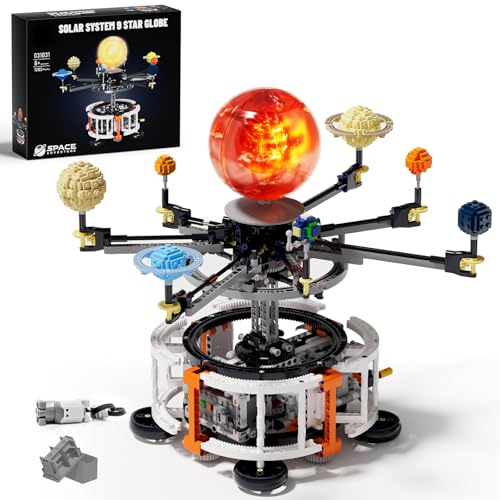
- 1,282-piece construction kit
- Hand-crank and auto modes
- Light-up Sun and eight planets
Best For: Larger space-themed building projects and gifts
Hands-On Builder – Smartivity DIY Solar System Kit
The Smartivity DIY Solar System Kit is a practical choice among interactive solar system models for children who learn best by building. Designed for ages 8–14, it combines assembly, rotation, and introductory astronomy concepts in one compact MDF project.
Best For: Kids ages 8–14 who enjoy hands-on STEM construction and learning about planets, orbits, day, and night.
Pros:
- Gear-driven design lets children build and rotate the model.
- Connects construction and creativity with basic astronomy.
- Uses child-safe, eco-friendly materials and comes gift-ready.
Cons:
- It is recommended for ages 8 and up, so it may not suit younger children.
- The kit is a single project and includes only the box as a listed component.
This model is a good fit when you want an accessible, build-first space activity rather than a highly detailed display. Its rotating mechanism adds interaction while keeping the focus on core solar system ideas.
Advanced Building Pick – 964-Piece Spinning Solar System
With 964 pieces and a hand-powered gear system, this set stands out among interactive solar system models for children who want a more involved building challenge. It creates a rotating display with eight planets, the moon, a rocket, satellites, and a space-themed base.
Best For: Space-loving builders ages 6–14 and adults who want a detailed construction project with moving parts.
Pros:
- 964-piece format offers an extended building experience.
- Rotating handle and gear transmission simulate orbital movement.
- Includes detailed planets, a rocket, satellites, and a decorative base.
- Instructions are designed for precise assembly.
Cons:
- The large number of pieces may make assembly more demanding.
- As a plastic construction set, it may be less suitable for shoppers seeking primarily classroom-grade materials.
This is the strongest option here for a substantial building challenge and display piece. Choose it when moving mechanics and part count matter more than quick setup.
Projector STEM Kit – Playz Solar System Model
The Playz Solar System Model adds motorized motion and projection to the interactive solar system models category. It includes 75-plus parts, a four-speed orbit motor, paintable planets, and a sun that projects eight planets onto a surface for viewing or use as a nightlight.
Best For: Kids ages 8–12 working on astronomy activities, school projects, or a large interactive model with visual effects.
Pros:
- Four-speed motor provides adjustable orbit movement.
- Sun projector displays eight planets on a surface.
- 75-plus parts and a color instruction manual support DIY assembly.
- Children can paint foam planets or use the laser-painted versions.
Cons:
- Four AA batteries are required but not included.
- The large 26-by-18-by-11-inch model needs substantial display space.
- Recommended age begins at 8 years.
This kit is especially appealing if projection and customization are priorities. It offers more visual variety than a basic rotating model, though its size and battery requirement are worth planning for.
Classroom Demonstrator – EISCO 13-Inch Solar System Model
The EISCO Solar System Model is a straightforward educational option among interactive solar system models, using manually movable planets to demonstrate relative position and motion. Its labeled base and included experiment guide make it useful for structured lessons and observation activities.
Best For: Classrooms, homeschool lessons, and learners who need a physical model for studying planetary positions and movement.
Pros:
- Shows the sun and all eight planets in a three-dimensional format.
- Metal rods allow the planets to be manually moved around the sun.
- Base is labeled with the months of the year for position activities.
- Experiment guide includes activities, exploration topics, rubric, and planet location table.
Cons:
- Planet movement is manual rather than motorized or gear-driven.
- Its 8.5-by-18.25-by-13-inch footprint requires dedicated space.
- The model is designed for demonstration and study rather than a build-your-own project.
This is the most lesson-oriented choice in the group. Its sturdy metal construction, month-labeled base, and experiment materials make it a sensible pick for guided solar system demonstrations.
Hands-On Starter – Wookidel 64-Piece Solar System Kit
For younger learners who enjoy making things, the Wookidel kit is one of the more hands-on interactive solar system models. Children paint foam planets, assemble the pieces, and use the included guide to connect the craft activity with basic astronomy.
Best For: Children ages 6–12 working on a classroom or at-home solar system project, especially when painting and creative assembly are part of the activity.
Pros:
- Includes foam balls, a sun, stars, bamboo sticks, flags, paints, brushes, palette, and instructions.
- Coloring and assembly encourage hand-eye coordination, focus, artistic expression, and science learning.
- Durable foam has a smooth surface designed for coloring, while the acrylic paints are described as safe and odorless.
- Suitable for family activities as well as classroom solar system themes.
Cons:
- The foam-based design is primarily a craft project rather than a finished, moving planetarium.
- Adult guidance may be useful for younger children during assembly.
This is a practical choice when the goal is learning through making. Its large component count and included art supplies make it a self-contained project, though shoppers seeking illumination or mechanical interaction should consider a different model.
Wall-Display Pick – Pllieay Solar System Model Kit
The Pllieay kit is a space-conscious option among interactive solar system models, combining a felt backdrop with painted foam pieces. The included instructions cover orbital positions and planet names, while hooks let the completed project hang on a wall.
Best For: Learners ages 8–17 who need a school science project, compact display, or decorative space-themed craft for a classroom or bedroom.
Pros:
- Includes a felt background plate and self-adhesive hooks for wall display.
- Provides foam hemispheres, stars, paints, brushes, palette, labels, adhesive dots, and instructions.
- Supports learning orbital positions and planet names while developing hands-on and color-discrimination skills.
- Works for science projects, DIY decoration, and outer-space room decor.
Cons:
- The foam-and-felt construction is a static display once completed.
- Its recommended age begins at 8, so it may be less suitable for preschool learners.
Choose this model if display space matters as much as the activity itself. It offers a guided craft with a clear educational purpose and a wall-mounting solution, but it does not provide glow effects or moving orbital parts.
Glow-In-The-Dark Favorite – 4M Solar System Planetarium
The 4M Solar System Planetarium adds a glow-in-the-dark element to interactive solar system models. Children assemble and paint the planets, then use rods, string, a fact-filled wall chart, and quiz questions to extend the astronomy activity beyond the build.
Best For: Children ages 8 and up who want a reusable-looking astronomy craft with glow paint, guided facts, and quiz-based learning.
Pros:
- Includes planets, stencils, rods, string, a glow paint pen, assembly instructions, and a wall chart.
- Ten sets of Kidz Quiz questions add an educational activity after construction.
- No batteries are required, and the glow feature offers a visual nighttime element.
- Suitable for STEM, astronomy, earth science, and science-fair themes.
Cons:
- Pluto is not included; the set represents eight planets.
- Recommended for ages 8 and up, so it is not intended for very young children.
- Painting and assembly are required before the model can be displayed.
This is the strongest fit for families prioritizing glow-in-the-dark appeal alongside science content. Its wall chart and quizzes add structure, while the no-battery design keeps the experience focused on building, painting, and learning.
Best Wind-Up STEM Build – Orbiting Solar System Kit
For shoppers comparing interactive solar system models, this Thames & Kosmos kit offers a hands-on mechanical build with planets that move using a wind-up motor. It introduces gear ratios and planetary gears without requiring batteries, making it a practical choice for STEM activities and science-fair projects.
Best For: Kids ages 6–14+ who enjoy building, mechanical motion, and astronomy projects.
Pros:
- Wind-up motor powers the rotating planets without batteries.
- Introduces gear mechanics and planetary gears.
- Includes a built-in expansion slot for a possible Planet Nine.
- Suitable for science-fair projects and STEM learning.
Cons:
- Intermediate difficulty may require guidance for younger builders.
- The compact model is listed as approximately 10 x 2.5 x 11 inches.
This is a strong pick when the learning goal is understanding motion and gears rather than adding lights or electronic controls. Its battery-free design also keeps the activity focused on construction and mechanics.
Best for Earth-Moon Demonstrations – Sun Earth Moon Orbital Model
Among interactive solar system models, this orbital model focuses on the Sun, Earth, and Moon rather than the full planetary system. Its moving components can demonstrate seasons, moon phases, and solar and lunar eclipses, making it especially useful for classroom lessons and guided projects.
Best For: Children over 6, geography and Earth-science teaching, and school demonstrations.
Pros:
- Demonstrates Earth’s orbit and the Moon’s orbit around Earth.
- Supports lessons on seasons, moon phases, and eclipses.
- Includes a seasonal plate with four seasons and twenty-four solar terms.
- Large listed dimensions provide a substantial demonstration model.
Cons:
- Assembly involves multiple screws, gears, alignment steps, and a wrench.
- It models the Sun, Earth, and Moon rather than all eight planets.
- The instructions require careful alignment for seasonal demonstrations.
This model is better suited to explaining Earth-Moon relationships than to showcasing the complete solar system. Buyers should allow time for assembly and alignment so the demonstrations work as intended.
Best for Motorized Building Fun – Dual-Mode Spinning Solar System
This 1,282-piece kit stands out among interactive solar system models for combining a substantial building project with motorized planetary movement. Children can use the hand crank or switch to auto mode, while the light-up Sun and detailed planet designs add visual interest to the finished display.
Best For: Kids ages 6 and up who enjoy larger construction sets, moving models, and space-themed gifts.
Pros:
- Includes 1,282 pieces for an extended building activity.
- Offers manual hand-crank and automatic rotation modes.
- Models the Sun and eight planets with size and color relationships.
- Features a light-up Sun and recognizable details such as Mars and Saturn’s rings.
Cons:
- The large piece count may require substantial assembly time.
- Battery-powered operation adds an electronic component to the model.
- The listed finished size is approximately 16 x 16 x 14 inches, so it needs display space.
Choose this kit if you want a more involved construction experience with both manual and continuous motion. Its size, piece count, and lighting make it a display-oriented option, but they also call for more assembly time and room than compact models.
How We Picked the Best Interactive Solar System Models
We focused on models that make the solar system easier to explore through building, movement, projection, lighting, or guided experiments. The selection includes options for younger children, independent STEM projects, classroom demonstrations, and advanced hands-on building. We also considered age guidance, assembly demands, durability, educational materials, display value, and whether the finished model offers meaningful interaction rather than serving only as a static decoration.
Because product designs vary widely, check the current package contents, dimensions, battery or motor requirements, and recommended age before buying. Small parts and tools may make some kits unsuitable for younger children without adult supervision.
Quick Comparison
| Best for | Look for | Most suitable model types |
|---|---|---|
| Young learners | Large pieces, simple assembly, clear instructions | Basic project kits and light-up models |
| Building enthusiasts | Many pieces, gears, and extended construction | STEM building kits and gear-driven models |
| Classrooms | Visible motion, accurate layout, experiment guides | Orbital and three-dimensional teaching models |
| Nighttime or display use | Glow, projection, or illumination | Planetariums and light-up designs |
Key Buying Factors for Interactive Solar System Models
Age, Supervision, and Assembly
Match the construction difficulty to the child’s patience and fine-motor skills. A simple paint-and-assemble project may suit younger children, while gear systems and hundreds of interlocking pieces are better for older kids or family projects. Review warnings about small parts, batteries, glue, and required tools.
Type of Interaction
Decide what you want the model to demonstrate. Rotating planets can illustrate motion, gear mechanisms show how movement is transferred, and projection or glow features can support visual learning. Some models prioritize building, while others are better for repeated demonstrations after assembly.
Educational Accuracy and Guidance
Look for clear labels, an experiment guide, teaching booklet, or explanations of rotation, revolution, scale, and planetary order. No tabletop model can reproduce true distances and sizes perfectly, so prioritize products that explain those limitations when accuracy is important.
Power, Space, and Durability
Check whether the unit uses batteries, a windup motor, manual spinning, or no power at all. Confirm the assembled footprint and storage needs, especially for desks and classrooms. Reinforced connectors and securely mounted planets matter if the model will be handled frequently.
Who Should Buy Which Interactive Solar System Models?
Choose a straightforward project kit for a first-time builder or younger child who benefits from a shorter activity. Pick a gear-driven or high-piece-count building set for an older learner who enjoys construction and mechanical problem-solving. A rotating orbital model with an experiment guide is the stronger choice for teachers, homeschool lessons, and demonstrations about planetary motion.
For bedrooms or evening science activities, a glow-in-the-dark or projection-focused planetarium adds visual appeal. If the main goal is a science fair or school project, prioritize clear instructions, a stable finished display, and enough information to explain the model. Families buying for multiple ages may get the best value from a durable rotating kit that can be rebuilt, demonstrated, and revisited rather than a model designed only for one-time assembly.