Moving Windows to a new drive does not have to mean reinstalling the operating system, applications, and settings from scratch. A dedicated hard drive duplicator can clone a SATA or NVMe drive directly, often without requiring separate cloning software.
This roundup compares 10 options for home upgrades, IT departments, technicians, and backup workflows. The right choice depends on drive type, cloning speed, capacity, and whether you need a simple dock or a purpose-built standalone duplicator.
Best 10 Hard Drive Duplicators for Windows Picks for 2026
Best Overall
StarTech Dual-Bay SATA Duplicator Dock

- Standalone sector-by-sector cloning
- Supports 2.5/3.5-inch SATA HDDs and SSDs
- USB 3.0 and eSATA drive access
Best For: Versatile Windows drive cloning and docking
Best for Secure Erasing
StarTech SATA Duplicator and Eraser

- Duplicates and erases SATA drives
- Includes three duplication modes
- Offers up to three-pass overwrite
Best For: Drive sanitation, deployment, and recovery tasks
Best Budget Dock

- One-button offline cloning
- Supports up to 44TB total capacity
- USB 3.0 with UASP and TRIM support
Best For: Simple home backups and cross-platform drive access
Best for Speed
StarTech 28GB/min SATA Duplicator
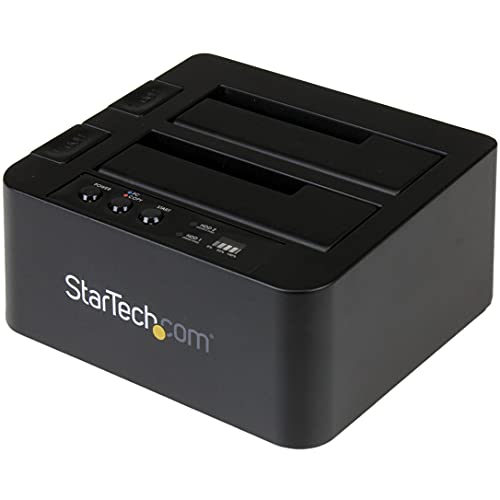
- Up to 28 GB/min cloning speed
- Standalone sector-by-sector copying
- USB 3.2 Gen 2 host connectivity
Best For: Frequent, faster SATA drive cloning
Best Standalone Pick
Systor SYS101HS-DP 1:1 Duplicator

- Standalone copying and erasing
- Supports 2.5- and 3.5-inch SATA drives
- Up to 90MB/s with sanitization support
Best For: Dedicated 1:1 SATA drive copying and erasure
Best Windows-Compatible Dock

- Offline cloning plus USB 3.0 transfers
- Supports Windows XP through Windows 10
- Dual bay for 2.5- and 3.5-inch SATA drives
Best For: Flexible home and small-office drive workflows
Best Multi-Drive Copier
Systor SYS105HS-DP 1:5 Duplicator

- Duplicates up to five drives simultaneously
- Standalone operation with no PC required
- Up to 90MB/s and DoD erasure support
Best For: Batch SATA drive deployment and sanitization
Best NVMe Pick

- One-click offline cloning without a computer
- Supports M.2 NVMe drives up to 8TB
- Aluminum design helps manage heat
Best For: Windows users duplicating compatible M.2 NVMe SSDs
Best SATA Value

- Handles 2.5-inch and 3.5-inch SATA drives
- One-click offline cloning without a PC
- UASP-enabled USB 3.0 connectivity
Best For: Windows users working with mixed-size SATA HDDs and SSDs
Best Hub Features

- Supports SATA HDDs and SSDs up to 24TB per bay
- Includes three USB 3.0 hub ports
- Offline cloning needs no computer or drivers
Best For: Windows users needing SATA cloning and USB-A expansion
Best Overall – StarTech Dual-Bay SATA Duplicator Dock
For shoppers comparing hard drive duplicators for windows, the StarTech SDOCK2U33RE is a versatile dual-bay option for standalone cloning and everyday drive access. It supports 2.5- and 3.5-inch SATA HDDs and SSDs, works without a PC for duplication, and can connect to a computer through USB 3.0 or eSATA.
Best For: Windows users who want one dock for drive cloning, recovery, and routine SATA drive access.
Pros:
- Standalone sector-by-sector cloning supports any file format.
- Works with 2.5/3.5-inch SATA drives, including 4Kn devices.
- Dual-bay design also functions as a USB or eSATA drive dock.
- Includes USB-A and eSATA cables plus a universal power adapter.
Cons:
- The target drive must be equal to or larger than the source.
- IDE support requires a separately sold adapter.
With a stated cloning rate of up to 22 GB/min and a tool-free top-loading design, this is a practical all-around choice. Its OS-independent operation is useful when cloning drives for Windows systems without relying on cloning software.
Best for Secure Erasing – StarTech SATA Duplicator and Eraser
The StarTech SATDUP11 stands out among hard drive duplicators for windows because it combines drive copying with dedicated erasing and sanitizing modes. Its standalone operation supports 2.5- and 3.5-inch SATA HDDs and SSDs for backups, recovery, system deployment, and drive disposal.
Best For: IT technicians and Windows users who need both disk duplication and documented-style erase options.
Pros:
- Offers sector-by-sector, system-and-file, and all-partitions copy modes.
- Includes quick, secure, single-overwrite, and three-pass erase modes.
- Copy & Compare can verify the cloned drive against the source.
- LCD controls display drive information and errors without requiring a computer.
Cons:
- Maximum stated duplication speed is 14 GB/min.
- eSATA, mSATA, IDE, and M.2 SATA support requires separately sold adapters where applicable.
This is less of a general-purpose docking station and more of a focused duplication and sanitation tool. The erase modes and verification feature make it especially useful for deployments, recovery workflows, and preparing drives for reuse.
Best Budget Dock – ORICO Dual-Bay Offline Cloner
The ORICO DD28U3-C is a straightforward choice for shoppers seeking hard drive duplicators for windows with broad device compatibility. It supports offline cloning between 2.5- and 3.5-inch SATA drives, while its USB 3.0 connection provides up to 5 Gbps access for backups and file transfers.
Best For: Home users who want an easy offline cloner and a flexible SATA dock for Windows and other platforms.
Pros:
- Offline cloning starts with a dedicated CLONE button.
- Supports up to 44TB total capacity across two bays.
- Works with Windows, Mac, Linux, iPad OS, and Android devices.
- UASP and TRIM support help with compatible USB storage workflows.
Cons:
- The target disk must be larger than the source disk.
- The dock requires its included external power adapter.
- It has a one-year warranty, shorter than the two-year coverage on the StarTech options.
Its tool-free design, automatic sleep mode, and dust-resistant cover make the ORICO convenient for occasional cloning and drive swapping. It is a good fit when broad compatibility and simple controls matter more than advanced erase functions.
Best for Speed – StarTech 28GB/min SATA Duplicator
For users prioritizing speed in hard drive duplicators for windows, the StarTech SDOCK2U313R offers standalone sector-by-sector cloning at up to 28 GB/min. It handles 2.5- and 3.5-inch SATA HDDs and SSDs, and it can also serve as a USB-to-SATA dock when you need computer-based drive access.
Best For: Windows professionals who frequently clone SATA drives and want faster stated duplication performance.
Pros:
- Rated for cloning speeds up to 28 GB/min.
- Supports SATA I, SATA II, SATA III, and 4Kn drives.
- Works independently of an operating system and supports any file format.
- Includes USB-C-to-B and USB-A-to-B cables.
Cons:
- The target disk must be equal to or larger than the source.
- IDE drive support requires a separately sold adapter.
The SDOCK2U313R is a strong choice for repeat cloning work where throughput is important. Its dual-bay, trayless design and eject buttons keep handling simple, while USB 3.2 Gen 2 connectivity adds flexible host access.
Best Standalone Pick – Systor SYS101HS-DP 1:1 Duplicator
For shoppers comparing hard drive duplicators for windows, the Systor SYS101HS-DP is a straightforward standalone option for copying or sanitizing one SATA source drive to one target. It works with both 2.5-inch and 3.5-inch SATA HDDs and SSDs without an adapter, and does not require a computer or software.
Best For: Personal or business users who need a dedicated 1:1 SATA drive copier and eraser.
Pros:
- Standalone operation requires no computer or software.
- Supports 2.5-inch and 3.5-inch SATA HDDs and SSDs without an adapter.
- Copies at up to 90MB per second and supports DoD 5220.22-M-compliant sanitization.
- Includes a 1-year parts, 3-year labor warranty and lifetime technical support.
Cons:
- Designed for 1:1 duplication rather than making several copies at once.
- Supports SATA drives rather than a broad range of drive interfaces.
The SYS101HS-DP is a practical choice when repeatable one-source-to-one-target copying and drive erasure matter more than computer-based management or higher duplication volume.
Best Windows-Compatible Dock – SSK DK103 PRO Dual-Bay Cloner
Among hard drive duplicators for windows, the SSK DK103 PRO combines offline cloning with USB 3.0 computer connectivity. Its dual bay accepts two 2.5-inch or 3.5-inch SATA HDDs or SSDs, while a manual mode switch helps separate cloning from PC data-transfer operation.
Best For: Windows users who want a dual-bay dock for occasional offline cloning and computer-based transfers.
Pros:
- Works with Windows XP through Windows 10, as well as Mac and Linux systems listed by the manufacturer.
- Supports offline cloning without connecting to a computer.
- Accepts two 2.5-inch or 3.5-inch SATA drives and supports capacities up to 20TB per drive according to the supplied notes.
- Includes UASP support, LED status indicators and aluminum heat dissipation.
Cons:
- Does not support hot-plugging.
- Manual switching is required between cloning and PC transfer modes.
- No warranty is listed in the supplied product details.
The DK103 PRO is more flexible than a dedicated copier when you also need a USB-connected drive dock, but its manual mode switch and lack of hot-plugging are worth considering for frequent workflows.
Best Multi-Drive Copier – Systor SYS105HS-DP 1:5 Duplicator
If you need hard drive duplicators for windows in a higher-volume setting, the Systor SYS105HS-DP is built to copy one SATA source to as many as five target drives simultaneously. It is a standalone unit, so duplication and sanitization do not depend on a Windows computer or specialized software.
Best For: Businesses, technicians and deployment tasks requiring multiple SATA copies at once.
Pros:
- Creates up to five drive copies simultaneously.
- Standalone operation needs no computer or software.
- Supports 2.5-inch and 3.5-inch SATA HDDs and SSDs without an adapter.
- Copies at up to 90MB per second and offers DoD 5220.22-M-compliant erasure.
Cons:
- Limited to SATA HDDs and SSDs.
- Its 1:5 capacity may be unnecessary for occasional single-drive copying.
- The supplied details list a 26-pound item weight, making it less portable than a small dock.
The SYS105HS-DP is the strongest fit here for repeatable batch duplication. Choose it when the ability to produce several copies in one pass justifies a larger, dedicated duplicator.
Best NVMe Pick – ACASIS M.2 NVMe SSD Cloner
For Windows users comparing hard drive duplicators, the ACASIS is a specialized choice for cloning M.2 NVMe SSDs without a computer. Its one-click offline cloning, tool-free installation, and aluminum cooling design make it practical for SSD upgrades and maintenance.
Best For: Windows users upgrading or duplicating compatible M.2 NVMe SSDs.
Pros:
- Offline cloning requires no computer, software, drivers, or system reinstallation.
- Supports M.2 NVMe sizes 2230, 2242, 2260, and 2280, with drives up to 8TB.
- Aluminum construction and expanded surface area help dissipate heat.
- Supports USB 3.2 Gen 2×2 speeds up to 20Gbps on compatible devices.
Cons:
- Supports NVMe SSDs only; SATA drives are not compatible.
- The target SSD must have greater capacity than the source for offline cloning.
- S.M.A.R.T. monitoring and TRIM are unavailable during offline cloning.
The ACASIS is a focused duplicator rather than a general-purpose SATA dock. Choose it when your Windows system uses M.2 NVMe storage and you want a fast, tool-free cloning workflow.
Best SATA Value – GODO Dual-Bay SATA Drive Dock
The GODO dual-bay dock is a straightforward option among hard drive duplicators for Windows, supporting both 2.5-inch and 3.5-inch SATA HDDs and SSDs. It combines computer-connected storage access with one-click offline cloning and tool-free drive insertion.
Best For: Windows users cloning or accessing standard 2.5-inch and 3.5-inch SATA drives.
Pros:
- Supports SATA I, II, and III HDDs and SSDs in both 2.5-inch and 3.5-inch formats.
- Offline cloning works without connecting the dock to a computer.
- UASP support can improve transfer performance with compatible systems.
- Tool-free, hot-swappable design includes LED status indicators.
Cons:
- USB 3.0 is slower than newer USB 3.2 interfaces.
- Each drive bay supports up to 18TB, according to the supplied specifications.
- Offline cloning erases data on the target drive, so drive selection requires care.
With broad SATA compatibility and a simple offline cloning mode, the GODO is a sensible everyday dock for Windows desktops and laptops. It is especially useful if you work with both 2.5-inch laptop drives and larger 3.5-inch desktop drives.
Best Hub Features – MAIWO SATA Drive Cloner
The MAIWO adds extra connectivity to the usual cloning functions, making it a versatile choice among hard drive duplicators for Windows. Its dual SATA bays support large-capacity drives, while three USB 3.0 hub ports expand access to peripherals and flash storage.
Best For: Windows users who want SATA cloning plus additional USB hub connectivity.
Pros:
- Supports 2.5-inch and 3.5-inch SATA HDDs and SSDs.
- Provides offline cloning without a computer or drivers.
- Supports up to 24TB per bay, with 48TB total capacity listed by the manufacturer.
- Includes three USB 3.0 Type-A hub ports, including one with 2.4A charging support.
Cons:
- USB 3.0 offers up to 5Gbps bandwidth rather than a newer USB standard.
- The larger ABS enclosure takes more desk space than compact drive readers.
- It is designed for SATA drives and does not support M.2 NVMe cloning.
The MAIWO stands out when a basic duplicator is not enough and you also need convenient USB-A expansion. Its high per-bay capacity makes it suitable for backup workflows involving large SATA disks.
How We Picked the Best Hard Drive Duplicators for Windows
We focused on devices that can clone drives used with Windows PCs, emphasizing compatibility, connection standards, ease of use, and practical workflow features. The selection includes SATA HDD and SSD docks, standalone 1:1 duplicators, multi-drive systems, and an M.2 NVMe model for newer storage hardware.
We also considered whether a unit can operate offline, its advertised transfer rate, support for 2.5-inch and 3.5-inch drives, host connectivity, capacity limits, and useful extras such as drive erasing or USB hubs. Advertised speeds are maximum figures; actual results vary with the source drive, destination drive, interface, and data type.
Quick Comparison
| Type | Best For | What to Check |
|---|---|---|
| Dual-bay SATA dock | Occasional cloning and drive access | Offline clone support, USB speed, capacity |
| Standalone 1:1 duplicator | Technicians and repeat jobs | Drive compatibility, erase modes, copying speed |
| Multi-drive duplicator | Batch production or IT deployment | Number of targets, sustained speed, controls |
| M.2 NVMe duplicator | Modern PCIe-based SSDs | Supported M.2 sizes, PCIe generation, thermal limits |
Key Buying Factors for Hard Drive Duplicators for Windows
Drive Format and Interface
First identify the source and destination drive. Most models here support 2.5-inch and 3.5-inch SATA drives, while an NVMe duplicator is required for M.2 PCIe SSDs. SATA and NVMe drives are not interchangeable, even if they look similar.
Offline Cloning Versus Windows Software
Offline cloning copies one drive to another using the duplicator’s own controls, which is useful when replacing a system drive or working on several computers. Docking stations may also function as USB storage devices, but confirm whether the clone feature works independently of Windows.
Speed, Capacity, and Destination Size
Higher advertised rates can reduce waiting time, but drive performance often becomes the bottleneck. Check the maximum supported capacity and ensure the target drive is at least as large as the source—or verify whether the device supports intelligent cloning to a smaller drive.
Erasing and Security Considerations
Some duplicators include secure erase or disk-wiping modes. These features can be valuable for IT recycling and maintenance, but they are destructive. Confirm the selected drive and review the operating instructions before starting any erase process.
Who Should Buy Which Hard Drive Duplicators for Windows?
Choose a basic dual-bay SATA dock if you occasionally upgrade a Windows desktop or laptop and want a device that can also read bare drives. A standalone 1:1 duplicator is better for technicians who need repeatable, computer-free cloning and erasing. For deployment work, a multi-target duplicator can save substantial time by copying one master drive to several destinations at once.
If your newer system uses an M.2 NVMe SSD, select a model designed specifically for NVMe rather than assuming a SATA dock will work. Buyers who need both cloning and everyday external-drive access should prioritize USB-C or USB 3.x connectivity, while users handling large 3.5-inch hard drives should check the included power supply and supported capacity before purchasing.