A reliable wired connection can make a major difference for video calls, large downloads, cloud work, and network storage. The best docking station with Ethernet port also turns a laptop’s limited USB-C connectivity into a more capable desktop setup.
We compared 10 options across port selection, display support, charging, data speeds, portability, and everyday usability to help you find the right fit for your desk or travel bag.
Best 10 Docking Station with Ethernet Port Picks for 2026
Best Overall
BENFEI 10-in-1 USB-C Ethernet Dock
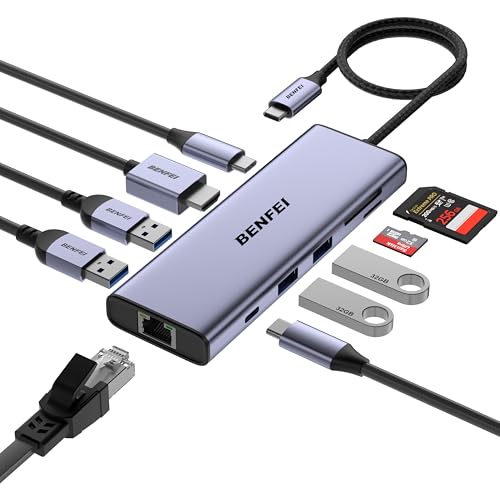
- 4K@60Hz HDMI and Gigabit Ethernet
- Five USB data ports plus SD/TF readers
- Up to 85W laptop charging; 18-month warranty
Best For: Mobile professionals and photographers needing maximum connectivity
Best Compact Pick
Anker PowerExpand 6-in-1 Ethernet Hub

- Small aluminum 6-in-1 design
- Gigabit Ethernet and 4K@30Hz HDMI
- Supports pass-through charging with a 65W charger
Best For: Compact home-office and laptop setups
Best for Dual Displays

- Dual 4K@60Hz or single 8K@30Hz HDMI
- 1Gbps Ethernet and SD/TF card readers
- Up to 85W charging with 24-month warranty
Best For: Compatible Windows laptops with dual-monitor workstations
Best Value Essentials
Acer 6-in-1 USB-C Ethernet Hub

- 4K@60Hz HDMI and Gigabit Ethernet
- Three 5Gbps USB data ports
- Up to 85W charging in a compact aluminum body
Best For: Students and office users needing essential connectivity
Best Compact Ethernet Hub
UGREEN Revodok 6-in-1 USB-C Hub

- Gigabit Ethernet with a portable six-port design
- 4K HDMI output at 30Hz for one external display
- Three 5Gbps USB-A ports and up to 85W charging
Best For: Portable laptop connectivity and wired networking
Best for Media Cards and Dual HDMI

- 1Gbps Ethernet, dual HDMI, and SD/microSD readers
- One 4K display at 60Hz or two at 4K 30Hz
- Up to 85W charging with a compatible 100W charger
Best For: Windows users handling displays and memory cards
Compact Ethernet Essentials

- Adds 100Mbps Ethernet, 4K HDMI, and card readers
- Supports up to 100W PD pass-through charging
- Compact aluminum, plug-and-play design
Best For: USB-C laptop users needing everyday ports and wired networking
Multi-Display Powerhouse

- Gigabit Ethernet with dual HDMI and DisplayPort
- Supports up to three displays on compatible Windows systems
- Adds 10Gbps USB, audio, and 100W PD charging
Best For: Windows multi-monitor workstations with many peripherals
Best Overall – BENFEI 10-in-1 USB-C Ethernet Dock
The BENFEI 10-in-1 is a versatile docking station with ethernet port for users who want wired networking, external display support, storage-card readers, and multiple USB connections in one portable hub. It supports 4K at 60Hz, up to 85W laptop charging through its 100W PD input, and Gigabit Ethernet.
Best For: Mobile professionals, photographers, and multitaskers who need broad connectivity in a compact adapter.
Pros:
- Includes Gigabit Ethernet, 4K@60Hz HDMI, 100W PD input, and five USB data ports.
- SD and TF readers can read two cards simultaneously at speeds up to 170MB/s.
- Soft woven cable, compact design, and 18-month warranty improve portability and durability.
Cons:
- The host USB-C port must support DisplayPort Alt Mode for video output.
- The PD port is for charging only and provides up to 85W to the laptop.
- Some USB 3.1 Gen 1 and older Galaxy devices may transfer data more slowly.
Choose this model if you want the most complete single-cable setup among these options. Its combination of Ethernet, display, card-reader, and USB expansion is especially useful for travel and content workflows.
Best Compact Pick – Anker PowerExpand 6-in-1 Ethernet Hub
Anker’s 6-in-1 hub is a straightforward docking station with ethernet port for laptops and tablets that need wired internet, display output, and everyday USB expansion. Its aluminum body includes Gigabit Ethernet, HDMI, USB-C data, two USB data ports, and a dedicated PD input.
Best For: Home-office users who prefer a compact, well-equipped hub from an established accessory brand.
Pros:
- Combines Ethernet, HDMI, USB-C data, and two USB data ports in a small 82-gram design.
- Supports up to 4K@30Hz external display output.
- Pass-through charging supports a 65W wall charger, with an 18-month warranty included.
Cons:
- HDMI output is limited to 4K@30Hz rather than 60Hz.
- It has fewer total ports and no SD or microSD card reader.
- Pass-through charging requires a separate 65W wall charger.
This is a sensible choice when you want core connectivity without the extra size or port count of a larger dock. It suits office setups particularly well, provided 4K at 30Hz meets your display needs.
Best for Dual Displays – UGREEN 10-in-1 Dual-HDMI Dock
The UGREEN 10-in-1 is a docking station with ethernet port designed for expanded desktop setups. It provides two HDMI outputs, Gigabit Ethernet, 100W PD input, USB data ports, and SD/TF card readers, supporting dual 4K@60Hz displays or one 8K@30Hz display under compatible conditions.
Best For: Windows laptop users building a dual-monitor workstation with wired networking and card-reader access.
Pros:
- Offers two HDMI outputs for dual 4K@60Hz displays or single 8K@30Hz output.
- Includes 1Gbps Ethernet, SD/TF readers, USB-C data, and USB-A ports.
- 100W PD input can provide up to 85W laptop charging, and the dock has a 24-month warranty.
Cons:
- On macOS, connected external displays show identical content because of the stated limitation.
- The PD port supports charging only, not data or video.
- USB-A and USB-C data ports do not provide charging or video output.
For compatible Windows laptops, this is the strongest option here for a multi-monitor desk. Mac users should consider it only if mirrored displays meet their workflow requirements.
Best Value Essentials – Acer 6-in-1 USB-C Ethernet Hub
The Acer 6-in-1 is a practical docking station with ethernet port for adding wired networking, 4K display output, USB data connections, and laptop charging through one USB-C port. It includes Gigabit RJ45 Ethernet, HDMI at up to 4K@60Hz, two USB-A ports, USB-C data, and 100W PD input.
Best For: Students, office users, and laptop owners who need essential ports without a larger 10-in-1 dock.
Pros:
- Supports 4K@60Hz HDMI and 10/100/1000Mbps wired Ethernet.
- Provides two USB-A and one USB-C data port with up to 5Gbps transfer speeds.
- Compact aluminum housing supports up to 85W laptop charging and includes a one-year manufacturer warranty.
Cons:
- It has no SD or microSD card reader.
- The PD port is charging-only and requires a 100W-or-higher charger and compatible cable.
- 4K@60Hz requires a compatible DP 1.4 Alt Mode device and HDMI 2.0-or-higher setup.
This Acer hub covers the most common desk and travel needs while keeping the port layout simple. It is a good fit when Ethernet and 4K display support matter more than card readers or extra USB ports.
Best for Multi-Monitor Windows Setups – Selore 10-in-1 USB-C Dock
If you need a docking station with ethernet port for a demanding desktop setup, the Selore USB-C dock combines Gigabit Ethernet with multiple display outputs, fast USB ports, and laptop charging. Windows users can connect up to three independent 4K displays, while macOS users should expect mirrored external screens.
Best For: Windows users building multi-monitor workstations for coding, trading, design, or video conferencing.
Pros:
- Includes 1Gbps Gigabit Ethernet for stable wired networking.
- Supports up to three independent 4K displays on Windows, plus an 8K DisplayPort output.
- Offers two USB-A 3.0 ports, one USB-C 3.0 port, VGA, and up to 100W PD input with 85W laptop output.
- Dedicated monitor-control button and aluminum chassis add convenience for extended use.
Cons:
- macOS supports mirrored display output rather than independent extended screens.
- Requires a full-featured USB-C port with DisplayPort Alt Mode or Thunderbolt support.
This is the most display-focused option in the group. Its Ethernet port and broad video selection make it a strong Windows workstation hub, but Mac users should choose it only if mirrored displays meet their needs.
Best Compact Ethernet Hub – UGREEN Revodok 6-in-1 USB-C Hub
The UGREEN Revodok is a straightforward docking station with ethernet port for laptops that need wired networking, one external display, and extra USB-A connections. Its compact six-port design adds Gigabit Ethernet, 4K HDMI, charging pass-through, and 5Gbps data transfer without taking up much space.
Best For: Laptop users who want a portable hub for reliable Ethernet, a single 4K display, and everyday peripherals.
Pros:
- Gigabit RJ45 Ethernet supports up to 1000Mbps for more consistent connectivity.
- 4K HDMI output supports 4K at 30Hz for meetings, media, and presentations.
- Three USB-A 3.0 ports provide up to 5Gbps transfer speeds for accessories and storage.
- Supports up to 85W laptop charging through 100W USB-C pass-through input.
Cons:
- The USB-C port is for charging only and does not support data or video output.
- HDMI does not support HDR or 3D.
- Video output is limited to one HDMI display.
Choose the Revodok when portability and essential connectivity matter more than multi-monitor expansion. It delivers the core benefits of a docking station with ethernet port in a simple, travel-friendly format.
Best for Media Cards and Dual HDMI – Anker 8-in-1 USB-C Hub
Anker’s 8-in-1 hub is a versatile docking station with ethernet port for USB-C laptops, combining wired networking with dual HDMI, SD and microSD card readers, USB data ports, and power delivery. It can run one 4K display at 60Hz or two at 4K 30Hz, making it useful for work and media workflows.
Best For: Windows laptop users who need Ethernet, dual HDMI, and convenient SD or microSD card access.
Pros:
- Combines a 1Gbps Ethernet port with dual HDMI, SD, and microSD card readers.
- Supports one 4K display at 60Hz or two displays at 4K 30Hz.
- Provides up to 85W USB-C pass-through charging with a suitable 100W charger and cable.
- Works with USB-C, USB4, and Thunderbolt connections on supported systems.
Cons:
- macOS mirrors identical content across both connected external monitors.
- Not compatible with Linux.
- Charger and USB-C cable are not included.
This Anker hub is a well-rounded choice when Ethernet and memory-card access are equally important. Its display flexibility is strongest on Windows, while Mac users should account for mirrored dual-monitor output.
Compact Ethernet Essentials – 8-in-1 USB-C Hub
If you need a docking station with ethernet port for everyday laptop connectivity, this 8-in-1 USB-C hub provides a compact way to add wired networking, HDMI, card readers, USB ports, and pass-through charging. Its RJ45 port supports speeds up to 100Mbps, while the HDMI output supports 4K at 30Hz.
Best For: MacBook, Dell, HP, and other USB-C laptop or tablet users who want a lightweight hub for office work, media access, and basic wired networking.
Pros:
- Eight useful connections, including HDMI, Ethernet, USB, SD, and TF card slots
- 100W PD pass-through charging for compatible USB-C devices
- Plug-and-play aluminum design with support for multiple operating systems
Cons:
- Ethernet is limited to 100Mbps rather than Gigabit speeds
- HDMI output is limited to 4K at 30Hz
- PD charging port does not support data transfer
This is a practical, travel-friendly choice when port expansion matters more than maximum network speed. Confirm that your device supports USB-C DisplayPort Alt Mode before relying on the HDMI output.
Multi-Display Powerhouse – 13-in-1 USB-C Dock
For users seeking a docking station with ethernet port and extensive desktop connectivity, this 13-in-1 USB-C dock combines Gigabit Ethernet with dual HDMI, DisplayPort, multiple USB connections, audio, and 100W PD charging. It can support up to three displays on compatible Windows systems.
Best For: Windows laptop users building a multi-monitor workstation with fast wired networking, high-speed USB transfers, and several connected peripherals.
Pros:
- Gigabit Ethernet helps support faster downloads and reduced network lag
- Dual HDMI and DisplayPort support high-resolution multi-display setups
- Includes 10Gbps USB-C and USB 3.1 connectivity plus 100W PD input
- 18-month technical support and product warranty
Cons:
- Mac systems can extend only one monitor according to the supplied notes
- The dock uses 13W, leaving up to 87W for laptop charging
- Advanced display modes depend on the host system and source capabilities
This is the strongest option here for a feature-rich desk setup, particularly on Windows. Its display flexibility and Gigabit Ethernet make it more workstation-oriented than a basic portable hub.
Photo-Ready Wired Hub – 8-in-1 USB-C Ethernet Adapter
This docking station with ethernet port is designed for users who want a small USB-C accessory with wired networking, 4K HDMI, and convenient camera-card access. The RJ45 connection supports 10/100Mbps, while the SD and MicroSD readers support cards up to 2TB.
Best For: MacBook, iPad Pro, XPS, Chromebook, and other USB-C users who regularly transfer photos or video and need a simple wired network connection.
Pros:
- Combines 100Mbps Ethernet, 4K HDMI, USB ports, and SD/MicroSD readers
- Card readers support capacities up to 2TB and speeds up to 104MB/s
- 100W PD charging and 5Gbps USB data ports add useful everyday flexibility
- Plug-and-play aluminum design supports Windows, macOS, ChromeOS, Linux, and more
Cons:
- Ethernet is limited to 10/100Mbps
- HDMI output supports 4K at 30Hz rather than 60Hz
- PD charging port does not provide data transfer
Its card-reader support makes this a particularly useful choice for photographers, creators, and travelers. As with similar USB-C hubs, the host device must support DisplayPort Alt Mode or Thunderbolt for video output.
How We Picked the Best Docking Station with Ethernet Port
We focused on practical features that affect daily use rather than simply counting ports. Each selected model offers wired Ethernet connectivity and adds useful expansion for laptops, including USB peripherals, external displays, memory cards, or USB-C power delivery. We also considered whether the design suits travel, a permanent workstation, or a multi-monitor setup.
Because compatibility can vary by computer, we paid particular attention to USB-C requirements, display standards, supported resolutions, and operating-system limitations. A hub may advertise multiple monitors, for example, but the laptop’s USB-C port must support the required video mode, and some systems handle external displays differently from others.
Quick Comparison: What to Look for
- Compact hubs: Six-in-one models are convenient for travel and typically cover Ethernet, HDMI, USB, and charging.
- Balanced everyday docks: Eight- and 10-in-one designs add card readers, extra USB ports, or greater workspace flexibility.
- Multi-monitor docks: Dual- and triple-display models are best for productivity setups, but require careful compatibility checks.
- Permanent desk solutions: Larger 13-in-one docks can reduce cable clutter when you need several accessories connected at once.
Key Buying Factors for a Docking Station with Ethernet Port
Ethernet Speed and Reliability
Look for Gigabit Ethernet if you want fast local-network transfers, stable video conferencing, or dependable wired internet. Confirm that your router, switch, and network service can take advantage of that speed.
Display Support
Check HDMI resolution and refresh-rate claims against your laptop and monitor. A 4K-at-60Hz output is useful for a smooth single-display workstation, while dual- or triple-monitor support may depend on the computer’s graphics hardware, USB-C video support, or DisplayLink technology.
Power Delivery
Pass-through charging can keep a compatible laptop powered through one cable. A 100W PD rating is helpful, but the dock itself uses some power, so the actual charge delivered to the laptop may be lower. Use a sufficiently powerful USB-C charger.
USB and Card-Reader Performance
USB 3.x ports are preferable for external drives and high-speed accessories. SD and TF readers are useful for photographers and creators, while additional USB 2.0 ports are generally better reserved for keyboards, mice, and other low-bandwidth devices.
Compatibility and Design
Verify your laptop’s port type, operating system, charging requirements, and display needs before buying. A short attached cable favors portability; a larger dock with more ports may be better for a fixed desk.
Who Should Buy Which Docking Station with Ethernet Port?
Frequent travelers should prioritize a compact six-in-one hub with Gigabit Ethernet, HDMI, USB, and pass-through charging. Remote workers will usually benefit from an eight- or 10-in-one model with several USB ports and a stable wired connection. Photographers and content creators should choose a dock with both SD and TF readers, fast USB data ports, and enough charging capacity for their laptop.
Multi-monitor users should select one of the dedicated dual- or triple-display docks, but confirm operating-system and laptop support first. Desk-based power users who connect displays, storage, peripherals, cards, and networking simultaneously may prefer a 13-in-one design. If you only need Ethernet and a few extra connections, a smaller dock will save space, cost, and cable clutter.