Choosing the right digital earth resistance tester can save time in the field and reduce guesswork on grounding jobs. The best models balance accuracy, ease of use, and the right measurement method for your application.
Whether you need a traditional 3-pole tester for detailed ground rod testing or a clamp-on unit for fast non-intrusive checks, this roundup focuses on practical options that fit real-world electrical work.
Best 10 Digital Earth Resistance Tester Picks for 2026
Precision IEC-Compliant Pick
KYORITSU 4105A Digital Earth Tester

- Measures earth voltage as well as resistance.
- 2 mA measuring current helps avoid breaker trips.
- IP54 dust- and drip-proof with hard case included.
Best For: Electricians needing a compact, safety-oriented tester
Data-Saving Field Choice
MS2302 Ground Resistance Tester

- Large LCD and gear selection simplify use.
- Supports 2-pole and 3-pole measurement modes.
- Stores up to 100 measurement groups.
Best For: Technicians who want easy reading and data storage
Classic Range Tester
UNI-T UT522 Digital Earth Tester

- Manual range control with data hold.
- Supports both 2-wire and 3-wire testing.
- LCD backlight and status indicators aid reading.
Best For: Users who prefer manual control and standard test modes
Clamp-On Rapid Tester
EITAI2000A-S Clamp Earth Resistance Meter
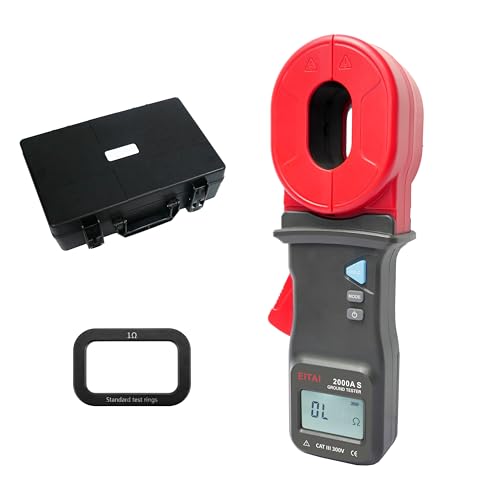
- Contactless clamp-on testing with no auxiliary electrodes.
- Returns results in about 0.5 seconds per test.
- Stores 99 data sets and includes sound/light alarms.
Best For: Teams needing fast clamp-on ground resistance checks
Field-Tested 3-Pole Pick
Ideal 3-Pole Ground Resistance Tester
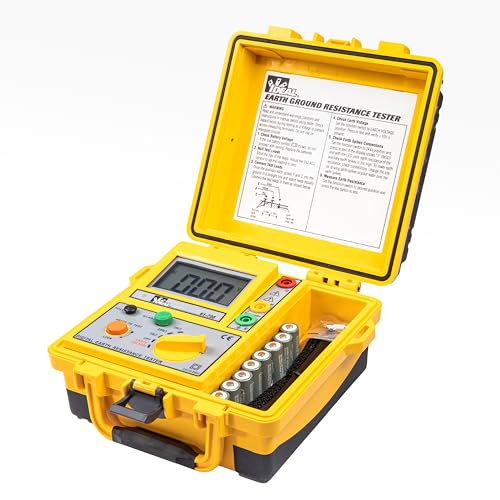
- 3-pole FOP method for precise ground rod readings
- Auto-ranging, zero-ohm adjust, and data hold
- Includes electrodes, leads, and hard case
Best For: Technicians who need accurate ground rod testing with a full accessory kit
Compact Clamp Utility
0.01–200Ω Clamp Ground Resistance Meter

- Measures ground, loop resistance, and leakage current
- Stores up to 300 readings with alarm support
- Automatically identifies interference signals
Best For: Field users who want a clamp meter with storage and interference detection
Fast Clamp Loop Tester
ETCR2100+ Digital Clamp Ground Earth Resistance Meter

- Clamp-on loop resistance measurement without disconnecting wires
- 0.010Ω to 1200Ω range with 0.001Ω resolution
- 32 mm jaw for flexible field testing
Best For: Professionals needing quick non-contact loop resistance testing
Clamp-On Loop Tester

- Non-contact clamp-on loop measurement
- 0.010Ω to 200Ω range, 0.001Ω resolution
- 32mm jaw for flexible field use
Best For: quick loop resistance checks on grounded systems
Field Clamp Meter

- Clamp-on loop resistance testing
- 65mm × 32mm jaw for broader fit
- 0.01Ω to 200Ω with 0.001Ω resolution
Best For: portable loop testing in industrial and field environments
Industrial Clamp Tester

- Non-contact loop resistance testing
- Includes carrying case and accessory bundle
- 0.010Ω to 200Ω measurement range
Best For: buyers wanting an industrial kit with accessories
Precision IEC-Compliant Pick – KYORITSU 4105A Digital Earth Tester
If you need a digital earth resistance tester for everyday fieldwork, the KYORITSU 4105A focuses on safety, portability, and practical measurements. It can measure earth voltage, includes warning output when auxiliary earth spike resistance exceeds tolerance, and uses a 2 mA measuring current to help avoid tripping earth leakage breakers during testing.
Best For: Electricians and technicians who want a lightweight tester with simple two-wire and precision measurement options.
Pros:
- Measures earth voltage in addition to resistance.
- 2 mA measuring current helps prevent breaker trips in the test circuit.
- Supplied with test leads for simplified two-wire measurement.
- Dust- and drip-proof design built to IEC 529 IP54.
Cons:
- Battery-powered, so runtime depends on battery condition.
- Primarily a field tester rather than a feature-heavy data logger.
- Best suited to users who need practical measurement, not advanced connectivity.
Overall, the 4105A is a solid choice if you value a compact build, safety-focused design, and straightforward earth testing. The included accessories and hang-from-neck setup make it especially convenient for on-site work.
Data-Saving Field Choice – MS2302 Ground Resistance Tester
The MS2302 is a digital earth resistance tester built for straightforward ground testing with a large LCD, selectable ranges, and both 2-pole and 3-pole modes. It is designed for professional detection of ground resistance on electrical equipment, and its relative measurement function can be used when measuring earth resistance.
Best For: Users who want an easy-to-read tester with onboard data storage and standard field measurement modes.
Pros:
- Large LCD display makes readings easier to read correctly.
- Supports 2-pole and 3-pole measurement modes.
- Stores up to 100 groups of measurement data.
- Double insulation protection adds safety for measurement work.
Cons:
- Battery powered, so battery management is part of regular use.
- Feature set is focused on core resistance testing rather than extras.
- Best for ground resistance work rather than broader electrical diagnostics.
For buyers who want a practical digital earth resistance tester with clear readings and basic record keeping, the MS2302 is well aligned. It covers the main job without adding unnecessary complexity.
Classic Range Tester – UNI-T UT522 Digital Earth Tester
UNI-T UT522 UT520 Series Digital Earth Tester, 0O-4000O Earth Resistance Tester
Check Price On AmazonThe UNI-T UT522 is a digital earth resistance tester designed around core field features like manual range selection, data hold, low-battery indication, and clear status displays. It supports both simple 2-wire testing and precise 3-wire testing, making it a practical option for routine ground resistance checks.
Best For: Buyers who want a straightforward earth tester with manual control and both basic and precise test modes.
Pros:
- Manual range selection gives the user direct control.
- Supports simple 2-wire and precise 3-wire testing.
- Includes data hold and LCD backlight for easier reading.
- Double insulation protection and poor-contact/over-range displays improve usability.
Cons:
- Heavier than some handheld testers at 2 kilograms.
- Battery powered, so it depends on charge level during field use.
- More focused on essential testing than advanced digital features.
The UT522 is a dependable, no-frills digital earth resistance tester for users who prefer manual range control and familiar test modes. It is especially useful when you want clear feedback during standard site checks.
Clamp-On Rapid Tester – EITAI2000A-S Clamp Earth Resistance Meter
EITAI2000A-S Gen2 Clamp Ground Earth Resistance Meter Tester, 0.01Ω-500Ω, Manufacturer Direct Sales
Check Price On AmazonThe EITAI2000A-S is a clamp-style digital earth resistance tester built for contactless measurements, fast on-site checks, and work on grounding rods or busbars. It measures from 0.01Ω to 500Ω, does not require auxiliary electrodes, and is designed to deliver results quickly during maintenance routines.
Best For: Field teams that need a clamp-on tester for fast, one-handed ground resistance measurements.
Pros:
- Contactless clamp-on measurement avoids grounding lead breakage and auxiliary electrodes.
- Fast one-handed testing with results in 0.5 seconds per test.
- Works with grounding rods and flat steel busbars without disassembly.
- Stores up to 99 sets of data and includes sound/light alarms.
Cons:
- Clamp jaw size may limit use on some larger conductors.
- More specialized than traditional lead-based earth testers.
- Best suited to loop resistance and clamp-on workflows rather than every testing scenario.
For speed and convenience, this clamp-on digital earth resistance tester stands out. Its lightweight build, rapid readout, and contactless operation make it a strong fit for busy maintenance and inspection work.
Field-Tested 3-Pole Pick – Ideal 3-Pole Ground Resistance Tester
If you need a digital earth resistance tester for accurate ground rod and earth voltage checks, this Ideal model is built around the 3-pole Fall of Potential method. It’s a practical pick when you want precise readings, auto-ranging convenience, and a kit that includes the essentials for field use.
Best For: Electricians and technicians who need a dependable 3-pole tester for ground rod measurements and energized-circuit testing.
Pros:
- Uses 3-pole Fall of Potential testing for precise ground rod and earth voltage readings
- Designed not to trip ground fault breakers and can operate on energized circuits
- Auto-ranging, zero-ohm adjustment, and data hold improve day-to-day usability
- Includes electrodes, test leads, and a hard case for organized transport
Cons:
- Battery-powered design means you’ll need to monitor charge and battery status
- 3-pole testing can take more setup than clamp-style options
This is a strong choice if your priority is measured, repeatable grounding work rather than speed. The included accessories and useful hold/adjust functions make it easier to use in the field.
Compact Clamp Utility – 0.01–200Ω Clamp Ground Resistance Meter
This digital earth resistance tester is aimed at fast, handheld clamping work, with ground resistance, loop resistance, and leakage current testing in one device. Its 55 mm jaw, data storage, and interference detection make it useful when you need flexible measurements without digging into a larger test setup.
Best For: Users who want a clamp-style tester with storage, alarm, and interference detection for general ground testing.
Pros:
- Measures ground resistance, loop resistance, and leakage current
- 0.001Ω resistance resolution and 4-digit LCD display
- Stores up to 300 groups of readings with MEM indication
- Automatically identifies interference signals and includes an alarm function
Cons:
- Powered by four AA batteries, so runtime depends on battery condition
- Clamp size and measurement style may not suit every grounding scenario
For users who want compact clamping convenience, this meter offers a lot of useful controls and feedback. The storage and noise detection features add value when you’re collecting readings in the field.
Fast Clamp Loop Tester – ETCR2100+ Digital Clamp Ground Earth Resistance Meter
If you need a digital earth resistance tester for fast clamp-on work, this ETCR2100+ focuses on loop resistance measurement without disconnecting ground wires. It’s designed for situations where you want a non-contact approach and a wide range that reaches up to 1200Ω.
Best For: Professionals who need quick loop resistance measurements without breaking down grounding leads.
Pros:
- Clamp-on design measures loop resistance without disconnecting ground wires
- Wide 0.010Ω to 1200Ω range with 0.001Ω resolution
- Suitable for applications in power, industrial, construction, and related environments
- 32 mm jaw size supports versatile clamp testing
Cons:
- Measures loop resistance only, not single-point grounding
- Users may need to create an artificial loop for some tests
This model is best when speed and minimal disruption matter more than traditional single-point grounding checks. Its loop-measurement focus makes it a specialized tool, so it works best when that matches your testing method.
Clamp-On Loop Tester – ETCR2100A+ 200Ω, φ32mm Jaw
The ETCR2100A+ is a digital earth resistance tester built for fast, non-contact loop resistance checks without disconnecting grounding wires. Its clamp-on design and 32mm jaw make it practical for field work where you want quick readings and minimal setup, especially when auxiliary electrodes are not convenient.
Best For: Technicians who need quick loop resistance measurements on grounded systems in industrial and site maintenance settings.
Pros:
- Measures loop resistance without breaking down grounding leads or using auxiliary electrodes.
- Wide range from 0.010Ω to 200Ω with 0.001Ω resolution.
- Can help detect ground faults that traditional methods may miss.
- 32mm jaw size adds flexibility for different test scenarios.
Cons:
- Designed for loop resistance only, not single-point grounding measurements.
- Requires an artificial loop near the grounding electrode for some testing.
- User manual is important for correct setup and use.
As a digital earth resistance tester, this model is strongest when speed and non-contact testing matter more than conventional single-point measurement. It suits users who regularly work on grounded systems and need a practical clamp meter for loop checks.
Field Clamp Meter – ETCR2000A+ 200Ω, 65×32mm Jaw
This digital earth resistance tester is designed for fast loop resistance measurements with a non-contact clamp-on approach. The ETCR2000A+ lets you test grounding systems without disconnecting wires or using auxiliary electrodes, which is useful when you need efficient checks in industrial or outdoor environments.
Best For: Users who want a clamp-on tester for practical loop resistance measurement across power, construction, and industrial applications.
Pros:
- Measures loop resistance without breaking down grounding leads.
- Wide application in power, meteorology, oilfields, construction, and industrial electrical equipment.
- Range from 0.01Ω to 200Ω with 0.001Ω resolution.
- 65mm × 32mm jaw offers a larger clamping size.
Cons:
- Limited to loop resistance, not single-point grounding.
- May require an artificial loop near the grounding electrode for testing.
- Heavier than some alternatives at 2.5 pounds.
For buyers comparing digital earth resistance tester options, this model stands out for its broad use cases and larger jaw size. It is a sensible choice when you need a portable clamp tester that can handle common grounding checks with minimal setup.
Industrial Clamp Tester – ETCR2100A+ 200Ω, CE/FCC Model
The ETCR2100A+ version in this listing is a digital earth resistance tester made for non-contact loop resistance measurement in industrial settings. It uses the same clamp-on approach to avoid disconnecting grounding leads, and its included carrying case and accessories make it geared toward field use and transport.
Best For: Buyers who want an industrial-style clamp tester with included carrying case and accessory bundle.
Pros:
- Measures loop resistance without disconnecting grounding wires.
- Wide measuring range from 0.010Ω to 200Ω with 0.001Ω resolution.
- Includes test ring, manual, warranty card/qualification card, and carrying case.
- Designed for applications in power, construction, meteorology, oilfields, and industrial equipment.
Cons:
- Only measures loop resistance, not single-point grounding.
- May require an artificial loop near the grounding electrode.
- Jaw size is not stated in the supplied details.
If you want a digital earth resistance tester built around quick clamp-on loop checks, this package is attractive because of its included accessories and transport case. It is best suited to users who value a more complete industrial kit for routine grounding inspections.
How We Picked These Digital Earth Resistance Tester Options
We looked for models that cover the main use cases professionals and maintenance teams actually need: clamp-on testing for speed, 2-pole and 3-pole testing for broader compatibility, and units with useful measurement ranges for common grounding tasks. We also favored options with clear displays, durable build quality, and features that make fieldwork easier.
Because grounding jobs vary widely, the list includes both contact-based and non-contact designs. That makes it easier to choose a Digital Earth Resistance Tester based on your site conditions, testing frequency, and the type of electrical system you maintain.
Quick Comparison: Clamp-On Vs 3-Pole
Clamp-on testers are best when you want fast measurements without disconnecting the ground system. They are convenient for routine checks and large facilities, but they may not suit every installation. Traditional 3-pole testers are still the better fit when you need a more direct earth resistance measurement or must verify ground rod performance in the field.
If you work across different environments, it helps to think first about access, speed, and required test method rather than just price.
Key Buying Factors for a Digital Earth Resistance Tester
Test Method
Choose clamp-on if you need non-intrusive testing. Choose 2-pole or 3-pole if you need broader test flexibility or more conventional ground rod measurement.
Measurement Range and Resolution
Look for a range that matches your typical work. Lower-resistance ranges matter for modern grounding systems, while wider ranges help when conditions are uncertain or installations vary.
Display and Ease of Use
A readable screen, straightforward controls, and auto-ranging features can reduce setup time and user error, especially in poor lighting or harsh jobsite conditions.
Safety and Site Compatibility
Make sure the tester fits your environment. Some designs are better for energized systems, while others are ideal for de-energized verification and planned maintenance. Consider whether the unit avoids nuisance tripping and whether it can be used in tight or hard-to-access locations.
Who Should Buy Which Digital Earth Resistance Tester?
If you want quick routine checks, a clamp-on model is usually the easiest choice. If you need dependable traditional grounding measurements, a 3-pole Digital Earth Resistance Tester is the safer bet. For teams that handle mixed jobs, a versatile model with multiple test modes offers the best balance.
In short, match the tester to your workflow. The right choice is the one that gives you reliable results with the least disruption to the system you are evaluating.