Choosing a digital lux meter for laboratory work is about more than reading brightness. You need repeatable measurements, a sensor that matches your setup, and the right features for documentation and quality control.
Below, we compare ten strong options for labs, clean rooms, photography-adjacent testing, and general illuminance checks so you can match the meter to your workflow.
Best 10 Digital Lux Meter for Laboratory Picks for 2026
Bench-Ready Lux Meter

- 0-200,000 lux range with FC/LUX switching
- Fast 2 readings per second
- Peak hold plus low battery alert
Best For: quick general light checks and plant lighting
Data-Logging Lab Meter

- NIST traceable calibration
- Logs up to 87,000 readings via PC
- 0.01 resolution with multiple lux ranges
Best For: laboratory logging and documented measurements
Rotating-Sensor Lux Meter
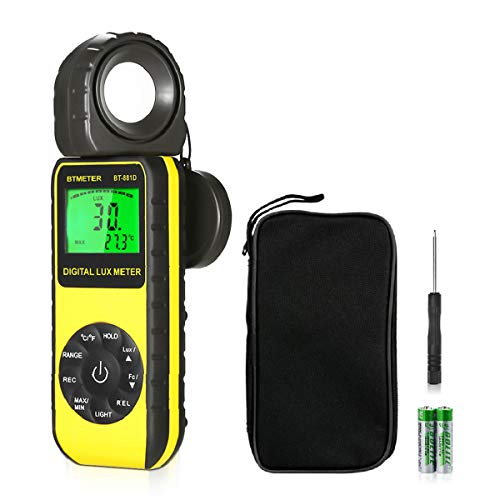
- 0.01 to 400,000 lux range
- 270-degree rotating sensor
- Stores 33 readings with relative mode
Best For: flexible measurements at awkward angles
LCD Lab Light Meter

- 0-200,000 lux with FC/Lux switching
- 4-digit color LCD with min/max
- Data hold plus auto power off
Best For: easy light checks in labs and photography
Lab-Ready Lux Meter
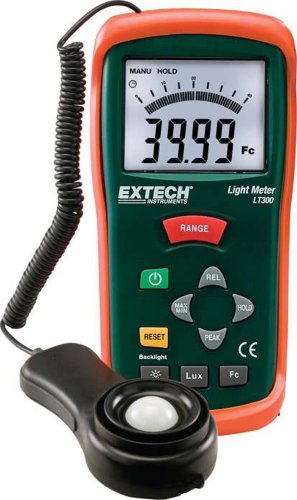
- Up to 40,000 lux with Lux/FC readout
- Remote sensor on 12-inch coiled cable
- Backlit LCD plus min/max and data hold
Best For: Lab and facility lighting checks with a portable remote-sensor meter
High-Range Calibration Meter

- Measures from 0 to 200,000 lux
- Comes with a calibration certificate
- Low battery display and 9V power
Best For: Clean room and lab brightness checks that need a wide range
Compact Lab Photometer

- Measures up to 199,900 lux and 18,500 FC
- 0.5-second sampling with backlit LCD
- Compact 5-ounce body with data hold
Best For: Portable lab and studio illuminance checks with quick readings
Spectral Lab Meter
SK-8301A Multi-Function Illuminance & CCT Meter

- Up to 200,000 lux range
- CCT and color coordinates included
- 999 data records with USB export
Best For: Lab checks needing lux, CCT, and color data
Bluetooth Lab Lux Meter
UT383BT Compact Illuminance Meter

- Bluetooth app support for logging
- 0 to 199,900 lux and FC readings
- 0.5 s sampling with Max/Min
Best For: Portable lab logging and app-based analysis
Basic Lab Lux Meter
200,000 Lux Handheld Illuminance Meter
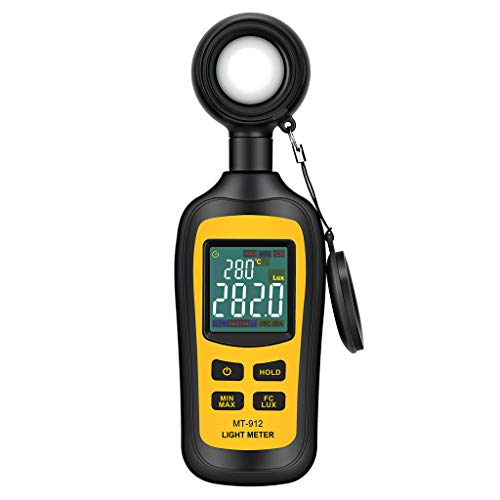
- Measures up to 200,000 lux
- Also reads ambient temperature
- MIN/Max and data hold included
Best For: Routine lab and office light checks
Bench-Ready Lux Meter – Dr.meter LX1330B
If you need a practical digital lux meter for laboratory-style light checks, the Dr.meter LX1330B gives you a simple way to measure illuminance indoors or outdoors. It offers a 0-200,000 lux range, fast 2-times-per-second response, and easy FC/LUX switching, making it useful for general brightness testing, plant lighting, and quick spot measurements.
Best For: General-purpose light measurements where fast readings, FC/LUX switching, and basic portability matter.
Pros:
- Measures up to 200,000 lux with FC/LUX conversion.
- Fast response at 2 readings per second.
- Peak data recording captures brief high-intensity light pulses.
- Runs on an included 9V battery and has a low battery alert.
Cons:
- Designed for broad use rather than advanced logging or calibration features.
- Single-reading style workflow may not suit formal lab documentation needs.
For buyers who want a straightforward digital lux meter for laboratory-adjacent or field lighting checks, this model covers the basics well. Its speed, peak capture, and wide range make it a solid entry-level option when you need quick, repeatable light readings without extra complexity.
Data-Logging Lab Meter – Digi-Sense NIST Traceable
For a digital lux meter for laboratory workflows that need recording as well as measurement, the Digi-Sense Data Logging Light Meter stands out. It offers NIST traceable calibration, a 0 to 40,000 foot-candle range, multiple lux ranges up to 400,000, and data logging support for manual or automatic readings when connected to a PC.
Best For: Lab users who need traceable calibration and PC-connected data logging.
Pros:
- NIST traceable calibration supports more formal measurement use.
- Logs up to 87,000 manual or automatic readings with a PC connection.
- Multiple lux ranges cover a wide span of light levels.
- Fine 0.01 resolution helps with detailed readings.
Cons:
- Data logging depends on connecting to a PC.
- Foot-candle range is limited to 40,000 compared with some broader-range meters.
If your priority is documentation rather than just quick spot checks, this model is the most lab-oriented choice in the group. The combination of traceable calibration and large logging capacity makes it better suited to controlled environments where repeatable records matter.
Rotating-Sensor Lux Meter – BTMETER BT-881D
The BTMETER BT-881D is a strong digital lux meter for laboratory or workspace use when you want a wide measurement range and an easy-to-read setup. It measures from 0.01 to 400,000 lux, offers 2 to 3 samples per second, and includes a 270-degree rotated sensor that makes angled measurements easier without repositioning the whole meter.
Best For: Users who want a wide-range meter with a rotating sensor for flexible readings.
Pros:
- Very wide 0.01 to 400,000 lux range.
- 270-degree rotatable sensor simplifies awkward measurement angles.
- 2 to 3 samples per second provides quick feedback.
- Stores 33 readings and includes a relative measuring mode.
Cons:
- Not calibrated or logging-focused like a dedicated lab model.
- Reading memory is limited compared with PC-based data logging systems.
This is a good pick if you need flexibility more than formal record-keeping. Its rotating sensor and broad range make it easy to use in different positions, which is helpful when measuring LEDs, plant lights, or general illumination in a lab setting.
LCD Lab Light Meter – Digital Light Meter LUX Meter
If you want a digital lux meter for laboratory, photography, or office checks, this model focuses on simple measurement and useful display features. It covers 0 to 200,000 lux, switches between lux and FC, and adds a 4-digit color LCD with min/max readings, data hold, auto power off, and low battery indication.
Best For: General lab, photography, and illumination-control checks with easy display features.
Pros:
- Measures up to 200,000 lux with FC/Lux unit selection.
- 4-digit color LCD makes readings easy to view.
- Min/max, data hold, and auto power off add convenience.
- Includes 2 AAA batteries and follows CIE photo visual function standard.
Cons:
- Not designed with data logging or traceable calibration.
- Best suited to straightforward spot checks rather than advanced lab documentation.
As a practical everyday meter, this is a balanced choice for users who need readable output and basic measurement tools. It is less specialized than a logging meter, but its display features and broad use cases make it a sensible option for light-level checks across lab and applied settings.
Lab-Ready Lux Meter – Extech LT300 Light Meter
If you’re shopping for a digital lux meter for laboratory use, the Extech LT300 is a practical option for routine illuminance checks. It measures lux and foot-candles with a remote sensor, which can make positioning easier when you need to assess lighting in work areas, studios, or lab spaces.
Best For: Lab and facility users who want a portable lux meter with a remote sensor and straightforward readout.
Pros:
- Measures up to 40,000 lux with lux and foot-candle readings.
- Remote sensor on a 12-inch coiled cable helps with flexible placement.
- Backlit LCD and bargraph improve visibility in dim environments.
- Includes min/max, data hold, and zero adjustment functions.
Cons:
- Maximum range is lower than some higher-range lab-focused models.
- Uses a single product-specific battery.
Overall, the LT300 is a solid general-purpose light meter for laboratory-style lighting checks where ease of use matters. Its sensor design and display features make it convenient for quick readings and comparisons.
High-Range Calibration Meter – HTC LX-102A Digital Lux Meter
The HTC LX-102A is a digital lux meter for laboratory and clean room light monitoring when you need a very wide measurement range. It reads up to 200,000 lux and comes with a calibration certificate, making it a strong fit for brightness checks where documentation is useful.
Best For: Users who need a high-range lux meter for lab, clean room, or exposure measurements with calibration documentation.
Pros:
- Wide range up to 200,000 lux and 20,000 FC.
- Accuracy listed at +5% of reading.
- Includes a calibration certificate.
- Low battery display helps with basic power awareness.
Cons:
- No extra operating features are listed beyond basic measurement and battery warning.
- Requires a 9V battery.
For buyers prioritizing range and calibration paperwork, the LX-102A stands out as a straightforward laboratory light monitoring tool. It is best suited to users who want documented readings rather than advanced meter functions.
Compact Lab Photometer – UNI-T UT383 Light Meter
The UNI-T UT383 is a compact digital lux meter for laboratory work, photography, and other brightness checks where portability matters. It measures up to 199,900 lux and 18,500 foot-candles, with a backlit screen and fast 0.5-second sampling for quick readings.
Best For: Buyers who want a small, easy-to-use light meter for lab, studio, or general illuminance testing.
Pros:
- High range up to 199,900 lux and 18,500 FC.
- Large 4-digit backlit LCD is easy to read.
- Includes max/min, data hold, overload indication, and auto shutdown.
- Compact 5-ounce design makes it highly portable.
Cons:
- No calibration certificate is mentioned.
- Best suited to quick spot measurements rather than advanced logging.
As a portable illuminance meter, the UT383 offers a strong mix of range, speed, and convenience. It is a smart pick for users who need fast light checks in labs or similar environments without extra bulk.
Spectral Lab Meter – SK-8301A Multi-Function Illuminance & CCT Meter
If you need a digital lux meter for laboratory-style lighting checks, the SK-8301A is built for more than basic brightness readings. It measures illuminance up to 200,000 lux, adds CCT from 2500K to 15000K, and also reports color coordinates, making it useful when your workflow needs both light level and spectral context.
Best For: Lab environments and lighting checks that benefit from lux, color temperature, and color coordinate data in one handheld meter.
Pros:
- Measures illuminance up to 200,000 lux for high-output lighting
- Includes CCT and color coordinate readings for more detailed analysis
- Stores 999 groups of data and supports USB communication
- Upper computer software can handle max, min, average, alarms, and report output
Cons:
- Requires a USB-connected workflow for full data export and processing
- Uses a single A battery, so it is not rechargeable from the listing details
This is the most feature-rich option in the group, especially if you need to document and export measurements instead of just taking quick spot checks. The silicone protective case and included carry case also make it easier to use and store in a busy lab setting.
Bluetooth Lab Lux Meter – UT383BT Compact Illuminance Meter
The UT383BT is a practical digital lux meter for laboratory use when you want fast readings and easy data handling. It measures from 0 to 199,900 lux or 0 to 18,500 FC, and its Bluetooth link to the iENV app lets you record, export, store, and analyze results without a complicated setup.
Best For: Users who want a compact lab lux meter with Bluetooth app support for logging and analysis.
Pros:
- Bluetooth transfer to the iENV app for recording and analysis
- Measures both Lux and FC with a wide 0 to 199,900 lux range
- 0.5 s sampling time for quick readings
- Includes Max/Min, data hold, overload indication, and backlit LCD
Cons:
- Accuracy is listed as +/- (4%+8), so it is not the highest-precision choice here
- Best features depend on using the app and Bluetooth connection
For a lab, office, or field setup where you value portability and simple digital recordkeeping, this model is easy to justify. It is especially appealing if you want app-based storage and analysis without moving to a more complex instrument.
Basic Lab Lux Meter – 200,000 Lux Handheld Illuminance Meter
If your priority is straightforward light measurement, this digital lux meter for laboratory and general workspace use keeps the feature set simple. It covers 0 to 200,000 lux, adds ambient temperature measurement, and uses a 4-digit color LCD to make readings easy to check at a glance.
Best For: Buyers who want a compact, no-frills lux meter for everyday lab, office, or setup checks.
Pros:
- Measures up to 200,000 lux with ambient temperature detection
- Compact and lightweight handheld design
- Includes MIN/Max, data hold, auto power off, and low battery indication
- Backed by a 2-year warranty
Cons:
- No Bluetooth or data export features listed
- Batteries are required but not included
This model fits well when you just need dependable spot measurements without extra software or advanced data management. The temperature readout and simple controls make it a solid utility choice for routine checks.
How We Picked the Best Digital Lux Meter for Laboratory
We focused on measurement range, resolution, display clarity, sensor design, calibration support, and practical features like data logging, peak/relative modes, and unit switching. For lab environments, consistency and usable documentation matter as much as raw range.
Quick Comparison
Some models are better suited to routine spot checks, while others are stronger for compliance work, trend tracking, or broader environmental monitoring. If you need simple verification, a basic handheld meter may be enough. If you need records, a data-logging or NIST-traceable model is a better fit.
Key Buying Factors for a Digital Lux Meter for Laboratory
Measurement Range and Resolution
Make sure the meter covers the light levels you actually test. Low-light lab spaces, clean rooms, and display testing may need good sensitivity at the bottom end, while general illumination work benefits from a wider upper range. Higher resolution helps when you need to detect small changes.
Calibration and Traceability
If your lab follows documentation or QA requirements, calibration matters. NIST-traceable calibration or a clear calibration process can make a big difference when results need to be audited or compared over time.
Sensor Layout and Ease of Positioning
A remote sensor, angled head, or rotating sensor can improve measurement accuracy by making it easier to place the detector exactly where it belongs. This is especially useful when fixtures, benches, or equipment block direct access.
Data Handling and Display
For a Digital Lux Meter for Laboratory use, a readable display and useful logging functions reduce mistakes. Look for hold, max/min, peak, relative mode, or USB export if you need to record trends or share results.
Units and Measurement Extras
Lux is the core unit, but some users also want foot-candles or related environmental data. Extra functions are helpful only if they support your workflow; otherwise, a simpler meter is often easier to use and faster to trust.
Who Should Buy Which Digital Lux Meter for Laboratory?
If you need routine lighting checks, choose a straightforward handheld meter with a wide range and an easy-to-read screen. If you need traceable records, choose a calibrated or data-logging model. If your work involves color or spectral conditions, a meter with CCT or storage features may be worth the upgrade. For most labs, the best choice is the one that balances accuracy, documentation, and speed without adding unnecessary complexity.