Finding a capable bench supply does not require a large laboratory budget. The best benchtop power supplies under $100 offer adjustable voltage and current, clear digital readings, and practical protections for hobby electronics, repairs, and prototyping.
This roundup compares 10 budget-friendly models, including compact switching supplies with encoder controls, memory functions, output switches, and USB or USB-C charging ports. Use the guide below to match specifications and features to your work.
Best 10 Benchtop Power Supplies Under 100 Picks for 2026
Best Compact High-Current Pick
Jesverty SPS-3010V 32V/10A Bench Supply

- 0–32V and 0–10A adjustable output
- 20W USB-A and USB-C quick charging
- Compact design with encoder controls
Best For: Crowded workbenches and general electronics projects
Best Feature-Rich Option
YITRANIC 3010MS 32V/10.1A Supply

- 300W output with 100–240V auto-detect input
- Memory recall and key-lock functions
- Five protection systems and CV/CC switching
Best For: Repetitive testing and internationally compatible bench setups
Best Simple Precision Controls
NANKADF 30V/10A Variable Supply

- Digit-selecting encoder for precise adjustments
- 0.01V and 0.001A display resolution
- Output button and short-circuit alarm
Best For: 115V repair benches and precision-focused electronics work
Best Higher-Voltage Choice

- Adjustable output up to 50V and 6A
- Three memory presets for repeat settings
- Four-digit display with encoder adjustment
Best For: Higher-voltage electronics, repair, and battery projects
DIAIARY Precision Pick

- Digit-by-digit encoder adjustment
- 0–32V, 0–10A output range
- Output switch and selectable OCP
Best For: Precise electronics experiments and bench work
NICE-POWER Practical Choice

- Bright four-digit V/A/W display
- 5V/2A USB charging port
- Compact design with cooling fan
Best For: Portable electronics repair and general bench use
Jesverty Charging Choice

- Coarse and fine encoder controls
- 20W USB-A and USB-C charging
- Automatic intelligent battery charging
Best For: Maker projects, repairs, and battery charging
Best with Extra Features
Jesverty SPS-3010 30V/10A Bench Supply

- Real-time V/A/W display
- Compact 2.5-pound design
- Automatic CV/CC switching
Best For: Portable DIY and repair benches
Best Control-Focused Option
HANGELL HPS3010 Encoder Bench Supply

- Precision encoder adjustment
- Dedicated output switch
- Short-circuit alarm and protections
Best For: Repeat testing and controlled setup changes
Best USB-Monitoring Pick
WANPTEK GA3010 30V/10A Power Supply
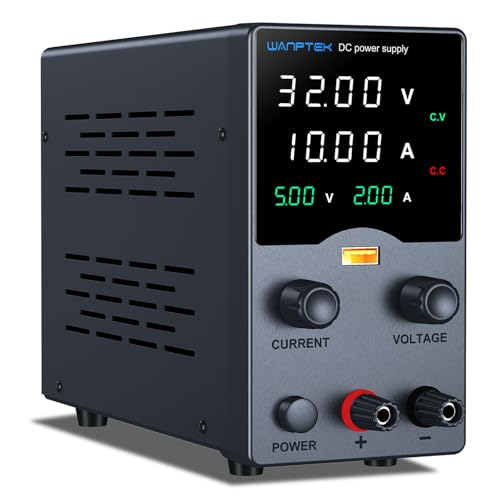
- Shows USB output current
- Precision encoder controls
- Compact 2.53-pound design
Best For: Repair and DIY benches using USB devices
Best Compact High-Current Pick – Jesverty SPS-3010V 32V/10A Bench Supply
For shoppers comparing benchtop power supplies under 100, the Jesverty SPS-3010V combines a 0–32V, 0–10A output with convenient controls and a compact enclosure. Its encoder knobs, output switch, and USB charging ports make it a practical choice for electronics work, repair, and DIY projects.
Best For: Crowded workbenches, Arduino and Raspberry Pi projects, repairs, and general high-current DC testing.
Pros:
- Coarse and fine encoder adjustment supports 0.01V and 0.001A setting resolution.
- USB-A and USB-C ports provide 20W quick charging.
- Output ON/OFF control lets you adjust settings without disconnecting the load.
- Compact 7.1 × 3.6 × 6.2-inch design weighs about 2.5 pounds.
Cons:
- Included test leads are described as giveaway leads and may not suit sustained high-current use.
- AC input selection is 115V/230V rather than automatic.
The SPS-3010V stands out when you want substantial current capacity without taking up much bench space. OCP and a temperature-regulated fan add useful protection, while the output switch improves day-to-day usability.
Best Feature-Rich Option – YITRANIC 3010MS 32V/10.1A Supply
Among benchtop power supplies under 100, the YITRANIC 3010MS is appealing for users who want broad input compatibility and extra workflow features. It delivers up to 32V and 10.1A, with memory recall, key lock, dual-switch output control, and multiple protection systems.
Best For: Repetitive testing, training environments, repair benches, and users who need automatic 100–240V input.
Pros:
- Provides continuously adjustable 0–32V and 0–10.1A output with up to 300W power.
- 100–240V auto-detect input supports use with 120V and 230V mains.
- Memory function recalls the last settings, while the output switch helps prevent hot-plugging.
- Five listed protections include overvoltage, overcurrent, overload, reverse polarity, and overtemperature protection.
Cons:
- Cooling uses a fan, which may be less appealing for noise-sensitive workspaces.
- The listed built-in media description appears inconsistent, so verify included accessories before purchase.
This model offers an unusually complete feature set for a compact 300W supply. Its encoder control, key lock, USB charging, and automatic CV/CC switching make it well suited to repeated bench work rather than occasional basic testing alone.
Best Simple Precision Controls – NANKADF 30V/10A Variable Supply
The NANKADF 30V/10A is a strong candidate among benchtop power supplies under 100 for users who prioritize straightforward, precise adjustment. Its push-and-turn encoder, output enable button, four-digit display, and short-circuit alarm provide useful control for electronics repair and testing.
Best For: Users who want precise digit-by-digit adjustment for repair work, prototyping, and general DC load testing.
Pros:
- Encoder knob allows individual digit selection and adjustment.
- Four-digit display provides 0.01V and 0.001A resolution.
- Output enable/disable button helps prevent accidental powered connections.
- OCP can stop output and sound an alarm during a short circuit.
Cons:
- Input specifications list 115V only, limiting international flexibility.
- The supplied details contain inconsistent wattage and dimension information.
- Its USB charging port is rated at 18W rather than 20W.
For a 115V workbench, the NANKADF focuses on the controls that matter most: clear readings, fine adjustment, and quick output shutdown. The automatic CV/CC modes further simplify routine testing, though buyers should confirm the listing specifications before ordering.
Best Higher-Voltage Choice – HYELEC HY50-06A 50V/6A Supply
For buyers searching benchtop power supplies under 100 with more voltage headroom, the HYELEC HY50-06A reaches 50V while supplying up to 6A and 150W. It adds three memory presets, coarse/fine encoder adjustment, a USB port, and output protection for versatile bench use.
Best For: Projects requiring up to 50V, mobile-device repair, battery charging, maintenance, and DIY electronics.
Pros:
- 0–50V output provides more voltage range than the other listed models.
- Three M1/M2/M3 memory groups make recurring settings easy to recall.
- Encoder adjustment and a four-digit display support 0.01V and 0.001A resolution.
- Includes output switching, short-circuit protection, overvoltage protection, and overcurrent protection.
Cons:
- Maximum current is 6A, lower than the 10A-class alternatives.
- Input is 110V only and does not provide a 220V option.
- The USB interface is rated at 5V/2A rather than quick-charge levels.
The HY50-06A is the best fit when voltage range matters more than maximum current. Its memory presets and protection features add convenience, but the 110V-only input should be checked carefully before purchase.
DIAIARY Precision Pick – 32V 10A Encoder Bench Supply
For shoppers comparing benchtop power supplies under 100, the DIAIARY BPS3010 stands out for its encoder-based adjustment and practical output controls. It provides adjustable 0–32V and 0–10A output, with readings for voltage, current, and calculated power.
Best For: Electronics work, experiments, and users who want precise digit-by-digit adjustment.
Pros:
- High-precision encoder knob allows individual-digit voltage and current adjustment.
- Four-digit display shows voltage, current, and power with 0.01V and 0.001A resolution.
- Output switch and selectable overcurrent protection help protect connected loads.
- Includes a 1-year warranty and online technical support.
Cons:
- No USB-C charging port is listed; the unit has an 18W USB interface.
- The supplied specifications list a maximum output of 300W, below the theoretical 32V × 10A combination.
This model is a practical choice when adjustment precision and straightforward protection controls matter more than extra charging features. Its clear display and compact box-like benchtop form suit routine electronics tasks.
NICE-POWER Practical Choice – 30V 10A USB Bench Supply
The NICE-POWER 30V 10A unit is worth considering among benchtop power supplies under 100 if you want a clear readout, a dedicated output switch, and a built-in USB charging port. Its four-digit LED display reports voltage, current, and power in real time.
Best For: General electronics servicing, portable bench setups, and users who value broad protection features.
Pros:
- Displays voltage, current, and power with 0.01V and 0.001A resolution.
- Output key lets you adjust settings without applying power to the load.
- Includes 5V/2A USB charging and an intelligent temperature-controlled fan.
- Compact vertical design weighs approximately 2.6 pounds and has shock-absorbing feet.
Cons:
- Designed for 110V input only; 220V input is not available.
- The supplied notes do not specify the complete application list or included accessories.
Choose this model for a compact, readable supply with convenient USB charging and extensive stated protection circuitry. Confirm the input-voltage requirement before buying, especially for use outside standard US 110V setups.
Jesverty Charging Choice – 32V 10A USB-C Bench Supply
For benchtop power supplies under 100 with extra charging flexibility, the Jesverty SPS-3010C combines adjustable 0–32V, 0–10A output with USB-A and USB-C ports. Its coarse and fine encoder controls are designed for quick, precise setting changes.
Best For: Makers, educators, repair work, and battery-charging projects that benefit from USB-C and intelligent charging features.
Pros:
- Separate coarse and fine encoder knobs provide 0.01V and 0.001A setting resolution.
- USB-A and USB-C ports support up to 20W quick charging.
- Intelligent battery charging can stop automatically when the battery is full.
- Offers output control, overcurrent protection, temperature-regulated cooling, and selectable 115V/230V input.
Cons:
- The enclosure is listed as plastic/polycarbonate rather than metal.
- The supplied details list output wattage as 20W, so buyers should verify the intended load requirements.
This is the most feature-rich option of the three for charging-oriented workflows and compact workbenches. Its selectable input and USB-C support add flexibility, while the encoder controls make frequent adjustments easier.
Best with Extra Features – Jesverty SPS-3010 30V/10A Bench Supply
For shoppers comparing benchtop power supplies under 100, the Jesverty SPS-3010 combines a 0–30V, 0–10A output with a compact enclosure and clear real-time readings. Its 4-digit display shows voltage, current, and wattage, while coarse and fine controls help with everyday adjustment.
Best For: DIY electronics, repair work, and workbenches where space and portability matter.
Pros:
- Displays V, A, and W in real time with up to 0.01V and 0.001A resolution.
- Automatically switches between constant-voltage and constant-current modes.
- Compact 2.5-pound design with a 5V/2A USB port.
- Includes short-circuit, overload, and temperature-regulated fan protections.
Cons:
- The included test leads are described as giveaway leads and may not suit sustained high-current use.
- The display uses red LEDs, which may be less versatile than a larger graphical screen.
The SPS-3010 is a practical choice when you want high-current capability, useful output monitoring, and a lightweight body without giving up basic safety features.
Best Control-Focused Option – HANGELL HPS3010 Encoder Bench Supply
Among benchtop power supplies under 100, the HANGELL HPS3010 stands out for its encoder-based controls and dedicated output switch. The 0–30V, 0–10A supply supports coarse and fine adjustment, while its 4-digit display provides detailed voltage and current readings.
Best For: Users who want precise digital adjustment and the ability to configure settings before enabling output.
Pros:
- Encoder knob lets you select digits and switch between coarse and fine adjustment.
- Output switch allows settings to be changed while output is off.
- Short-circuit alarm and optional OCP help protect the supply and connected load.
- Includes overvoltage, overcurrent, overtemperature, and overload protection.
Cons:
- The unit weighs about 1.2 kg, making it less lightweight than some compact alternatives.
- Its USB and Type-C quick-charge features are noted as 18W charging, rather than an additional regulated bench output.
With its configurable encoder interface and output control, the HPS3010 is well suited to repeated testing where quick, deliberate parameter changes are more important than the smallest footprint.
Best USB-Monitoring Pick – WANPTEK GA3010 30V/10A Power Supply
The WANPTEK GA3010 is a strong contender among benchtop power supplies under 100 for users who want digital adjustment and USB charging in one compact unit. Its encoder knobs set voltage and current precisely, while the display reports output readings with 0.01V and 0.001A resolution.
Best For: Repair benches and DIY work that benefit from USB charging with visible USB current monitoring.
Pros:
- Precision encoder knobs support digit selection and quick 0–9 adjustments.
- Displays voltage, current, and USB-port output current in real time.
- Offers a 0–32V/0–10A operating range according to the product description.
- Includes overvoltage, overcurrent, and overtemperature protection.
Cons:
- The enclosure is plastic, which may feel less rugged than a metal-bodied design.
- The supplied notes identify the USB feature as fast charging, not as a separately adjustable laboratory output.
The GA3010’s combination of encoder controls, compact dimensions, and USB-current visibility makes it especially convenient for electronics repair and mixed bench tasks.
How We Picked the Best Benchtop Power Supplies Under 100
We focused on the specifications that matter most at a workbench: adjustable voltage and current ranges, display readability, control precision, output switching, protection features, and everyday usability. Most models in this selection provide approximately 30–32V and up to 10A, while one offers a higher 50V range at a lower maximum current.
We also considered useful extras such as encoder-based coarse and fine adjustment, preset memory, intelligent charging modes, USB outputs, and USB-C quick charging. These features can improve convenience, but they should not outweigh accurate control, stable output, and appropriate safety protections.
Quick Comparison
| Feature | What to expect | Best for |
|---|---|---|
| Voltage range | About 0–30V, 0–32V, or up to 50V | General electronics and testing |
| Maximum current | Typically 6A to 10A | Small devices, motors, and projects |
| Display | Four-digit LED readouts on many models | Monitoring voltage and current |
| Controls | Encoder knobs, coarse/fine adjustment, and output switches | Faster, more precise setup |
| Extra ports | USB-A or USB-C charging outputs | Charging and powering compatible devices |
Key Buying Factors for Benchtop Power Supplies Under 100
Voltage and Current Capacity
Choose a supply based on the highest voltage and current your projects require, not simply the largest advertised number. A 30V, 10A unit suits most low-voltage electronics, while a 50V model is useful when voltage headroom matters more than maximum current. Check whether the listed current is continuous and confirm the total power rating.
Regulation and Adjustment
Switching supplies are compact and efficient, but stable regulation and low ripple remain important for sensitive circuits. Encoder controls with separate coarse and fine adjustment make it easier to reach an exact setting than a single basic potentiometer. A clearly labeled output-enable button is also helpful when changing connections.
Readout and Protection
A four-digit LED display can make small changes easier to monitor. Look for independent voltage and current readings, plus short-circuit, over-voltage, over-current, and over-temperature protection. These safeguards reduce the chance of damaging a circuit or the supply during testing.
USB and Charging Features
USB-A and USB-C ports are convenient for charging devices, but they may not provide the same regulated output behavior as the main terminals. Check the port’s voltage, current, and charging specifications before relying on it for a project.
Who Should Buy Which Benchtop Power Supplies Under 100?
For general hobby work, repairs, Arduino projects, and breadboard testing, a 30–32V, 10A model offers the most flexible balance. Choose an encoder-equipped supply if you frequently change settings or need repeatable adjustments. A model with memory presets is useful for recurring tests, while USB-C quick charging adds convenience for device work.
Choose the 50V option when your projects genuinely need higher voltage and can operate within its lower current limit. If you work with sensitive circuits, prioritize precise readouts, stable regulation, and comprehensive protection over charging extras. Finally, confirm the outlet, included leads, cooling approach, and warranty before ordering.