Choosing a benchtop digital multimeter for laboratory work is about more than just voltage and resistance. Accuracy, stability, logging, and connectivity can matter just as much as raw measurement range.
Below, we’ve narrowed the field to ten standout options for labs, benches, and electronics test setups, with picks for budget buyers, advanced users, and precision-focused workflows.
Best 10 Benchtop Digital Multimeter for Laboratory Picks for 2026
Laboratory-Grade Accuracy
Siglent SDM3045X 4-1/2 Digit DMM

- 4-1/2 digit bench multimeter with 0.01% basic DC accuracy
- True RMS and dual display for practical lab measurements
- USB host, USB device, and LAN for connected testing
Best For: Laboratory benches needing accuracy and measurement flexibility
Desktop Troubleshooting Value
ADM1041 Bench Multimeter Tester

- 55,000-count display helps reveal small measurement changes
- True RMS with common lab functions and temperature support
- Stores 1,000 readings and supports SCPI communication
Best For: Repeated circuit testing and simple bench data workflows
High-Resolution Bench Standard

- 5.5-digit bench meter with True RMS support
- Dual display plus USB and LAN connectivity
- Up to 150 readings per second with statistics and graphs
Best For: Laboratories wanting higher resolution and networked bench integration
Fast-Read Bench Integration Pick

- 5.5-digit resolution with up to 123 readings per second
- USB/RS232 connectivity plus LXI Criterion support
- Saves or recalls 10 preset configurations
Best For: Laboratory setups that need fast, connected bench measurements
Precision Benchtop Pick

- Real 6½-digit readings with 2,200,000 counts
- True-RMS AC/DC voltage and current measurement
- USB Device, USB Host, and optional LAN support
Best For: Labs that need a high-resolution bench DMM with flexible connectivity
Portable Lab Choice
OWON XDM1241 Desktop Multimeter

- AC/DC voltage, current, resistance, capacitance, and more
- True RMS with dual display and 3.5-inch LCD
- Manual and auto record functions with internal memory
Best For: Compact lab benches that need multi-function measurement and data logging
Reference-Grade Bench Meter

- Real 6½-digit resolution for detailed lab readings
- Double display for easier AC signal measurement
- Any-sensor function with multiple temperature sensor support
Best For: Stationary lab work that needs precision and temperature-sensor support
Lab-Ready True RMS Desktop Meter
Crenova 30000 Counts Bench Multimeter
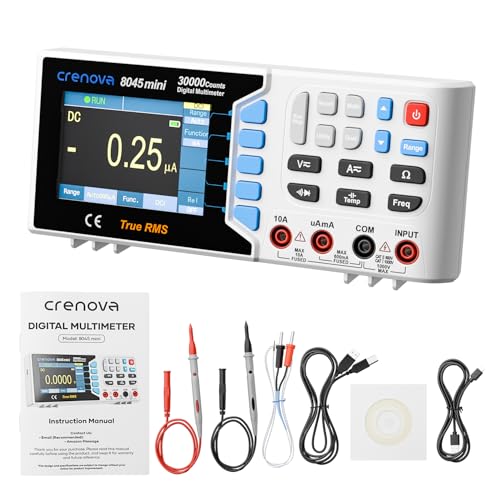
- 11 measurement functions including temperature and frequency
- USB data logging with PC remote control support
- 30,000-count True RMS display with dual readout
Best For: Lab users who want a feature-rich desktop multimeter with USB data management
High-Count Data-Logging Bench Meter
LB1041 Desktop Digital Multimeter

- 55,000 counts with 0.05% DC voltage accuracy
- Manual/auto recording with up to 1,000 points
- SCPI support and chart-mode trend analysis
Best For: Users who need a desktop meter with internal recording and SCPI support
Portable High-Precision Lab Meter
OWON XDM1041 Bench Desktop DMM

- 55,000-count True RMS meter with 0.05% DC accuracy
- USB software support with SCPI and trend analysis
- Measures voltage, current, resistance, capacitance, frequency, and temperature
Best For: Lab and maintenance users who want a compact bench meter with high precision
Laboratory-Grade Accuracy – Siglent SDM3045X 4-1/2 Digit DMM
If you need a benchtop digital multimeter for laboratory use, the Siglent SDM3045X is built around practical measurement depth rather than basic handheld convenience. Its dual display, True RMS capability, and support for DCV/DCI, ACV/ACI, resistance, capacitance, continuity, diode, frequency, period, and temperature make it a strong fit for routine bench testing and component checks.
Best For: Lab benches that need solid accuracy, dual-display workflow, and measurement flexibility.
Pros:
- 4-1/2 digit resolution with basic DC accuracy of 0.01% for detailed bench work
- True RMS plus dual display for easier comparison during measurements
- Measures resistance, capacitance, continuity, diode, frequency, period, and temperature
- USB host, USB device, and LAN interfaces for connected workflows
Cons:
- Requires more bench space than a handheld meter
- Listed with battery-powered input details, which may be less straightforward than corded bench units
Overall, the SDM3045X is a capable bench instrument for users who want accuracy, dual-display convenience, and broad test coverage in a laboratory setting. It also adds data features like statistics, graphs, and up to 150 readings per second, which helps when tracking trends over time.
Desktop Troubleshooting Value – ADM1041 Bench Multimeter Tester
The ADM1041 is a practical benchtop digital multimeter for laboratory-style troubleshooting, especially when you want a readable desktop meter that stays ready for repeated measurements. Its 55,000-count display, True RMS support, and 1000V DC capability make it useful for comparing values, checking circuits, and watching signals during longer test sessions.
Best For: Bench users who want an easy-to-read meter for repeated circuit tests and logging.
Pros:
- 55,000-count display makes small changes easier to spot
- True RMS plus DC/AC voltage, current, resistance, capacitance, frequency, diode, continuity, and temperature
- Stores up to 1,000 readings for review
- SCPI communication supports computer-connected workflows
Cons:
- Lower update rate than some bench meters at up to 65 readings per second
- Desktop format is less portable than a handheld meter
For a lab bench that prioritizes clear readings and repeatable testing, the ADM1041 covers the essentials well. It is a good choice when you want a straightforward desktop meter with data storage and remote communication support.
High-Resolution Bench Standard – Siglent SDM3055 5.5 Digit DMM
For buyers comparing a benchtop digital multimeter for laboratory work, the Siglent SDM3055 stands out with 5.5-digit resolution and a bench-focused design. It supports True RMS measurements, dual display operation, and a broad set of functions including resistance, capacitance, continuity, diode, frequency, period, and temperature.
Best For: Labs that want a higher-resolution bench meter with connected interface options.
Pros:
- 5.5-digit resolution for more detailed readings
- True RMS and dual display for practical lab measurement work
- USB host, USB device, and LAN interfaces for integration
- Up to 150 readings per second with statistics and graphs
Cons:
- Heavier bench-style unit at 7.2 pounds
- More instrument than needed for basic occasional testing
The SDM3055 is a strong fit when resolution and bench workflow matter more than portability. Its combination of display flexibility, connected interfaces, and data tools makes it well suited to a laboratory setup.
Fast-Read Bench Integration Pick – Rigol DM3058E 5.5 Digit DMM
The Rigol DM3058E is a benchtop digital multimeter for laboratory users who value speed, resolution, and system integration. With 5.5-digit readings, up to 123 readings per second, True-RMS AC measurement, and USB/RS232 connectivity, it fits well into bench setups where measurements need to be captured and reviewed efficiently.
Best For: Lab benches that need fast readings and easy integration with control software.
Pros:
- Real 5.5-digit resolution for detailed measurement work
- Up to 123 readings per second for responsive bench testing
- USB/RS232 connectivity and LXI support for integration
- Save or recall 10 preset configurations
Cons:
- Interface and software features may be more than needed for simple checks
- Bench-focused design is less convenient to move around than a handheld meter
For laboratory environments that connect instruments into broader test systems, the DM3058E offers a strong mix of speed and control options. Its built-in help system and software compatibility make it especially practical for repeatable bench workflows.
Precision Benchtop Pick – Siglent SDM3065X 6½ Digit DMM
If you need a benchtop digital multimeter for laboratory work with high-resolution readings and flexible connectivity, the Siglent SDM3065X is built for that kind of bench use. Its real 6½-digit display, 2,200,000-count resolution, and support for DC/AC voltage and current make it a strong fit for detailed electrical measurement tasks.
Best For: Lab users who want a high-resolution bench DMM with USB and LAN support.
Pros:
- Real 6½-digit readings with 2,200,000 counts for fine measurement detail
- Measures DC and true-RMS AC voltage and current across broad ranges
- 4.3-inch TFT-LCD makes readings easy to view on the bench
- EasyDMM software plus USB Device, USB Host, and optional LAN expand workflow options
Cons:
- At 4.47 kg, it is not a lightweight portable meter
- LAN requires optional accessories for use
For laboratories that value resolution and PC-friendly control, this Siglent model is geared more toward stationary measurement than casual field use. The feature set is practical for bench testing, but the size and accessory needs suggest a more serious lab setup.
Portable Lab Choice – OWON XDM1241 Desktop Multimeter
The OWON XDM1241 is a useful benchtop digital multimeter for laboratory users who want a compact meter with broad everyday test functions. It combines AC/DC voltage and current, resistance, capacitance, continuity, diode, frequency, and temperature measurements with True RMS capability and a clear 3.5-inch LCD.
Best For: Labs and instrument benches that need a compact, multi-function meter with data logging.
Pros:
- Measures AC/DC current and voltage, plus resistance, capacitance, frequency, temperature, and more
- True RMS capability and dual display support more flexible readings
- Manual and auto record functions store data in internal memory
- Compact body with built-in lithium battery and DC 5V 2A support
Cons:
- 3.5-inch display is smaller than larger bench meters
- Designed to be portable, so it is less of a traditional full-size benchtop unit
This OWON model makes sense when you want lab-friendly functionality without committing to a large bench instrument. The recording features and broad measurement list add practical value, while the compact form factor helps in shared workspaces.
Reference-Grade Bench Meter – Rigol DM3068 6½ Digit
For buyers comparing a benchtop digital multimeter for laboratory settings, the Rigol DM3068 stands out as a true bench instrument with 6½-digit resolution and lab-oriented measurement features. It supports AC signal measurement with double display, an any-sensor function, multiple temperature sensors, and standard capacitance measurement.
Best For: Bench users who want a lab meter with high-resolution readings and temperature-sensor support.
Pros:
- Real 6½-digit resolution for detailed measurements
- Double display helps when measuring AC signals
- Any-sensor function supports multiple temperature sensors
- Includes standard capacitance measurement function
Cons:
- AC-powered design is meant for stationary bench use
- More specialized than simple everyday multimeters
The DM3068 is a strong fit when precision and lab-oriented features matter more than portability. Its support for sensor measurements and temperature probes makes it especially useful in test environments that go beyond basic voltage checks.
Lab-Ready True RMS Desktop Meter – Crenova 30000 Counts Bench Multimeter
If you want a benchtop digital multimeter for laboratory use that handles a wide mix of measurements, the Crenova 30000 Counts model is built for practical testing and data collection. It combines True RMS accuracy, dual display, USB logging, and a 3.5-inch backlit screen, making it a flexible choice for lab work, workshops, and diagnostics.
Best For: Lab users who want a feature-rich desktop multimeter with USB data management and broad measurement coverage.
Pros:
- 11 measurement functions cover voltage, current, resistance, capacitance, temperature, frequency, duty cycle, continuity, and diode tests.
- 30,000-count display with dual display support, adjustable backlight, and Max/Min/Average/Relative readings.
- USB connectivity supports PC data management, remote control, firmware updates, and data logging.
- Rechargeable 5000mAh battery and CAT II 600V / CAT I 1000V ratings add convenience and protection.
Cons:
- Battery-powered design may be less ideal than a permanently powered bench setup for long sessions.
- Its CAT II 600V rating may not suit users looking for higher-category protection.
Overall, this Crenova meter is a strong pick if you need a desktop multimeter with broad functionality and software-assisted workflow. It is especially practical for users who value logging and analysis alongside everyday electrical measurements.
High-Count Data-Logging Bench Meter – LB1041 Desktop Digital Multimeter
The LB1041 is a practical benchtop digital multimeter for laboratory work when you want high-resolution readings and built-in recording features. With 55,000 counts, True RMS measurement, SCPI support, and chart-based trend analysis, it is designed for users who want a lab meter that can also export and process data on a computer.
Best For: Users who need a desktop meter with internal recording, SCPI support, and accurate readouts for lab or test bench work.
Pros:
- 55,000-count TFT display with up to 0.05% DC voltage accuracy and dual-line display support.
- Manual and auto recording with internal memory for up to 1,000 data points.
- Computer export support plus chart mode trend analysis and SCPI compatibility.
- True RMS AC measurement and a fuse design with a spare fuse included for easier replacement.
Cons:
- The notes emphasize data logging and bench use more than advanced specialized lab automation.
- It is battery powered, so it may not appeal to users who prefer mains-powered bench instruments.
In short, the LB1041 is a solid fit for labs and electronics work where data recording matters as much as measurement accuracy. Its mix of high counts, SCPI support, and export tools makes it useful for repeat testing and analysis.
Portable High-Precision Lab Meter – OWON XDM1041 Bench Desktop DMM
The OWON XDM1041 is a compact benchtop digital multimeter for laboratory and maintenance use, built around a 55,000-count True RMS platform. Its 3.5-inch color LCD, USB data management, and wide test coverage make it a versatile option when you need accurate readings and straightforward workflow on the bench.
Best For: Lab and maintenance users who want a compact bench meter with high precision, USB data tools, and broad measurement support.
Pros:
- 55,000 counts with up to 0.05% DC voltage accuracy and True RMS AC voltage/current measurement.
- Manual and auto data recording with internal memory for up to 1,000 points.
- USB software support, SCPI compatibility, and trend analysis in chart mode.
- Measures AC/DC current and voltage, resistance, capacitance, frequency, diode, continuity, and temperature.
Cons:
- The battery-powered design may not be ideal for users seeking a fixed mains-only bench instrument.
- Its compact, lightweight build favors portability over a larger traditional desktop footprint.
For buyers comparing a benchtop digital multimeter for laboratory use, the XDM1041 stands out for precision, recording, and software support. It offers a balanced feature set for labs, factories, and instrument maintenance without adding unnecessary complexity.
How We Picked the Best Benchtop Digital Multimeter for Laboratory
To build this roundup, we focused on measurement accuracy, display readability, input range, true RMS performance, speed, and practical bench features such as USB or RS-232 connectivity. We also weighed overall value, since the best Benchtop Digital Multimeter for Laboratory use is not always the most expensive one.
Quick Comparison
If you need a simple starting point, think in tiers: entry-level bench meters for general electronics testing, midrange models for everyday lab work, and high-resolution instruments for calibration, validation, and precision measurement tasks. Higher digit count usually means finer resolution, but it does not automatically guarantee better real-world performance.
Key Buying Factors for a Benchtop Digital Multimeter for Laboratory Use
Resolution and Accuracy
Digit count affects how finely a meter can display readings, but accuracy specs tell you how close those readings are to the true value. For lab work, prioritize accuracy and stability over display count alone.
Measurement Range and True RMS
Make sure the meter covers the voltages and currents you test most often. True RMS is important if you measure non-sinusoidal AC signals, variable-speed drives, power supplies, or other distorted waveforms.
Connectivity and Data Logging
USB and RS-232 support can make a big difference when you need to capture trends, automate testing, or export results into lab records. If your workflow involves repeated measurements, logging features are worth paying for.
Bench Ergonomics
A clear screen, stable stand, intuitive controls, and fast reading updates improve day-to-day use. For a Benchtop Digital Multimeter for Laboratory environments, usability matters almost as much as spec sheets.
Who Should Buy Which Benchtop Digital Multimeter for Laboratory?
Choose a budget-friendly desktop meter if you need dependable everyday measurements for electronics repair, education, or basic lab checks. Pick a midrange model if you want better resolution, faster readings, and computer connectivity for general R&D or QA work.
If your workflow demands tight resolution, calibration-friendly measurements, or frequent documentation, move up to a higher-digit bench meter with stronger accuracy and logging support. In short: buy for the precision level and workflow you actually use, not just the highest digit count on the box.