The best benchtop conductivity meters make routine water-quality and laboratory testing faster, more repeatable, and easier to document. The right model depends on your required measurement range, accuracy, calibration workflow, and whether you also need pH, TDS, salinity, or resistivity readings.
We compared 10 options ranging from straightforward conductivity and temperature meters to research-grade multiparameter systems, highlighting practical differences that matter at the bench.
Best 10 Benchtop Conductivity Meters Picks for 2026
Best All-Around Benchtop Meter

- 0-200.0 mS/cm conductivity range
- One- to four-point auto calibration
- 50 groups of data storage
Best For: Routine lab conductivity and temperature testing
Calibration-Friendly Pick

- Benchtop conductivity meter kit
- Automatically recognizes calibration solutions
- Simple calibration-focused feature set
Best For: Users seeking easier calibration setup
Education and Research Pick

- 0-200 mS/cm measurement range
- Automatic recognition of five standards
- Conductivity, TDS, and salinity workflows
Best For: Research, teaching, and routine lab measurements
Best Dual-Channel Upgrade

- Simultaneous pH and conductivity display
- 200-set data logger with USB output
- Large TFT HD screen with tutorials
Best For: Labs needing combined pH and conductivity testing
Precision Data Companion

- Measures conductivity, TDS, and salinity
- Five conductivity/TDS calibration points
- Stores up to 99 data points
Best For: Labs and industrial users needing flexible conductivity measurements
Research-Grade Multiparameter Hub

- Simultaneously measures pH/ORP and conductivity
- Stores 1,000 data sets with USB export
- Includes holder, organizers, and stirrer
Best For: Research labs needing multiparameter testing and GLP records
Protected Everyday Workstation
Benchtop Lab Conductivity Meter
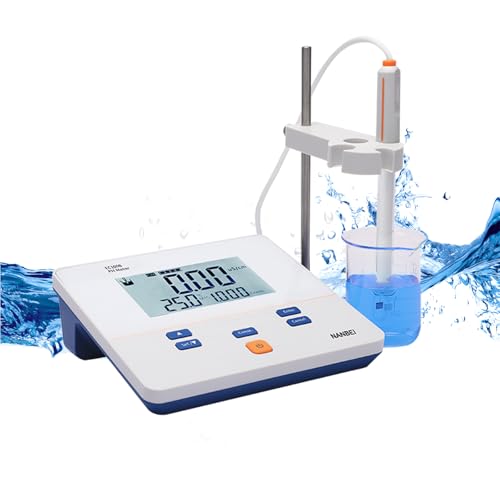
- 6-inch LCD for easy reading
- IP54 spill- and dust-resistant protection
- 0.00 S/cm to 100.0 mS/cm range
Best For: Routine laboratory conductivity testing with a durable enclosure
Best High-Accuracy Pick
Apera EC820 Conductivity Meter

- ±0.5% F.S. conductivity accuracy
- 1–4 point automatic calibration
- 500 data groups with USB export
Best For: Users prioritizing accurate conductivity testing and data management
Best Multiparameter Control
Bante 902 pH Conductivity Meter

- Measures five water parameters
- 1–5 point calibration support
- 500 data sets with USB interface
Best For: Labs needing configurable pH and water-quality measurements
Best Complete Water-Testing Kit
Apera PC800 Multiparameter Meter

- Measures six water parameters
- Automatic 1–4 point calibration
- 500 GLP data groups with USB output
Best For: Research and QC users testing multiple water properties
Best All-Around Benchtop Meter – Apera EC700
The Apera EC700 is a practical choice among benchtop conductivity meters for labs that need conductivity and temperature readings in a single setup. Its 0-200.0 mS/cm range, automatic calibration guidance, and data storage make it suited to routine measurement work.
Best For: Routine laboratory conductivity and temperature testing where guided calibration and stored readings are useful.
Pros:
- Measures conductivity and temperature simultaneously with the included platinum black ATC electrode.
- Supports one- to four-point automatic calibration with calibration guidance and self-diagnosis.
- Offers quick, stable readings, 50 groups of data storage, and an IP54 spill- and dust-proof design.
- Includes a detachable electrode holder and pre-mixed calibration solutions.
Cons:
- Specified accuracy is 1% full scale.
- Its benchtop design is less suited to portable testing.
Overall, the EC700 balances a broad measurement range with useful calibration and storage features, making it a well-rounded option for everyday benchtop work.
Calibration-Friendly Pick – Oakton CON 550
The Oakton CON 550 is a straightforward option among benchtop conductivity meters for users who want calibration to be easier to manage. Its supplied feature highlight is automatic recognition of calibration solutions.
Best For: Users who prioritize convenient calibration-solution recognition during conductivity meter setup.
Pros:
- Automatically recognizes calibration solutions.
- Designed as a dedicated benchtop conductivity meter kit.
Cons:
- The supplied notes provide limited information about its measurement range and accuracy.
- Additional included features and accessories are not specified in the supplied details.
The CON 550 is worth considering when automatic calibration-solution recognition is more important than comparing a long list of published specifications.
Education and Research Pick – Bante 510
The Bante 510 is a capable choice among benchtop conductivity meters for research and education applications. It combines a 0-200 mS/cm range with platinum electrodes, automatic temperature compensation, and an endpoint-locking Auto-Read function.
Best For: Research, teaching, and routine lab measurements requiring flexible calibration and conductivity, TDS, or salinity workflows.
Pros:
- Measures across a 0-200 mS/cm range with stated accuracy of ±1% full scale.
- Supports one- to three-point calibration and automatically recognizes five conductivity standards.
- Automatic temperature compensation corrects readings to the default reference temperature.
- Auto-Read locks the measurement endpoint, while the setup and reset functions simplify operation.
Cons:
- Its stated accuracy is ±1% full scale rather than a higher-precision specification.
- The supplied notes do not specify data storage or connectivity features.
With broad range coverage and practical automation, the Bante 510 is a strong fit for instructional and general-purpose laboratory conductivity work.
Best Dual-Channel Upgrade – Apera PC910
The Apera PC910 stands apart from simpler benchtop conductivity meters by combining pH and conductivity testing in a dual-channel system. Its large TFT HD screen, included electrodes, and USB-capable data logging suit users who need broader lab measurement capabilities.
Best For: Laboratories that need simultaneous pH and conductivity, TDS, or salinity measurement with guided calibration and data export.
Pros:
- Displays pH and conductivity/TDS/salinity simultaneously through dual channels.
- Includes a refillable LabSen 211 glass pH electrode, separate temperature probe, and ATC conductivity electrode.
- Large TFT HD screen provides multilingual prompts and graphic tutorials.
- Stores 200 data sets, supports manual or automatic logging, and offers USB data output.
Cons:
- Its expanded functionality comes in a larger, heavier package weighing 6.82 pounds.
- It is more equipment than needed for conductivity-only testing.
The PC910 is the most comprehensive option in this group for labs that want conductivity measurement alongside pH and convenient digital recordkeeping.
Precision Data Companion – Sper Scientific 860032
For buyers comparing benchtop conductivity meters for laboratory or industrial work, the Sper Scientific 860032 stands out for broad measurement support and flexible calibration. It measures conductivity, TDS, and salinity while offering automatic or manual temperature compensation.
Best For: Labs and industrial users who need multiple measurement modes, calibration options, and basic data tracking.
Pros:
- Measures conductivity, TDS, salinity, and temperature-related readings in multiple units.
- Offers five conductivity/TDS calibration points and two salinity calibration points.
- Stores up to 99 data points and includes data hold plus Min/Max tracking.
- Large LCD displays conductivity, temperature, time, and date.
Cons:
- Its 99-point storage capacity is smaller than the 1,000-set capacity of the Apera multiparameter model.
- The supplied notes do not specify a waterproof or dustproof rating.
The 860032 is a practical choice when measurement flexibility and straightforward record review matter more than advanced multiparameter testing or extensive onboard storage.
Research-Grade Multiparameter Hub – Apera PC9500
The Apera PC9500 is a research-grade option among benchtop conductivity meters, combining conductivity testing with pH and ORP measurement. Its dual-channel design, GLP data management, and USB output make it suited to workflows that require organized records and broader analysis.
Best For: Research and laboratory users who need simultaneous multiparameter measurement, extensive data storage, and PC or printer export.
Pros:
- Measures pH/mV (ORP) and conductivity/TDS/salinity/resistivity through dual channels.
- Stores up to 1,000 data sets with manual or automatic logging and USB export.
- Includes an integrated electrode holder, buffer organizers, and intelligent magnetic stirrer.
- Provides multilingual screen prompts and includes a Swiss LabSen 211 pH electrode.
Cons:
- Its multiparameter feature set and 7.83-pound weight may be more than needed for conductivity-only testing.
- The supplied notes do not specify a waterproof or dustproof rating.
Choose the PC9500 when conductivity testing is part of a larger measurement and documentation process; it is the most comprehensive and data-oriented option in this group.
Protected Everyday Workstation – Benchtop Lab Conductivity Meter
For straightforward laboratory testing, this benchtop conductivity meter focuses on readable measurements, a wide stated range, and durable enclosure protection. Its 6-inch display and configurable cell constant support routine monitoring in a stable benchtop setup.
Best For: Laboratory users who want a simple conductivity-focused meter with a large screen and IP54 protection.
Pros:
- Provides a 0.00 S/cm to 100.0 mS/cm conductivity range.
- Uses a large 6.0-inch LCD screen for easier reading.
- IP54 construction is described as waterproof, spill-proof, and dust-proof.
- Supports a settable cell constant and manual temperature compensation.
Cons:
- Specified accuracy is 1.5% FS, which may not suit users seeking the tightest measurement precision.
- The supplied notes do not mention data logging, USB export, or included accessories.
This model is a sensible fit for routine conductivity work where a large display and environmental protection are more important than extensive data management or multiparameter capability.
Best High-Accuracy Pick – Apera EC820 Conductivity Meter
For buyers seeking benchtop conductivity meters with strong accuracy across a broad testing range, the Apera EC820 is a focused option. It offers ±0.5% full-scale accuracy, a glass-body platinum electrode, simultaneous conductivity and temperature readings, and USB data export.
Best For: Scientific research and quality-control users who prioritize conductivity accuracy, guided calibration, and stored measurement records.
Pros:
- ±0.5% F.S. accuracy with an ultra-wide measurement range.
- One- to four-point automatic calibration with guidance and reminders.
- Stores 500 data groups and supports USB export to a PC.
- Backlit LCD shows conductivity, temperature, stability, and calibration status.
Cons:
- Focused on conductivity rather than the broader multiparameter testing offered by some alternatives.
- The electrode has a six-month limited warranty, shorter than the instrument warranty.
The EC820 stands out when conductivity performance is the main requirement. Its calibration assistance, data management, and clear display make it a practical choice for repeatable bench measurements.
Best Multiparameter Control – Bante 902 pH Conductivity Meter
The Bante 902 is a versatile choice among benchtop conductivity meters, combining conductivity with pH, TDS, salinity, and resistivity modes. Its configurable setup, automatic temperature compensation, and USB interface suit users who need more than a single measurement type.
Best For: Laboratories and quality-control workflows requiring flexible pH and water-parameter testing with calibration tracking.
Pros:
- Measures pH, conductivity, TDS, salinity, and resistivity.
- Supports one- to five-point calibration with automatic standard recognition.
- Stores up to 500 data sets and provides USB transfer and timed interval readings.
- Includes calibration logs, due alarms, automatic temperature compensation, and auto-read.
Cons:
- Its many configuration options may be more than needed for conductivity-only testing.
- The supplied notes do not specify included electrodes or standards.
Choose the Bante 902 when measurement flexibility and recordkeeping matter as much as conductivity readings. The calibration logs and adjustable parameters are especially useful for structured laboratory routines.
Best Complete Water-Testing Kit – Apera PC800 Multiparameter Meter
The Apera PC800 is a broad-testing option for buyers comparing benchtop conductivity meters with multiparameter capability. It measures pH, conductivity, TDS, salinity, resistivity, and temperature, while its combination electrodes are designed for stable measurements in regular water solutions.
Best For: Research and quality-control users who need a single benchtop system for routine water testing across several parameters.
Pros:
- Combines pH, conductivity, TDS, salinity, resistivity, and temperature measurement.
- Supports quick one- to four-point automatic calibration with guidance and reminders.
- Stores 500 groups of GLP data and provides USB output.
- Electrode slope display helps assess pH electrode condition between calibrations.
Cons:
- Its 5.5-pound weight and larger footprint may be less convenient for limited bench space.
- The listed conductivity accuracy is 1% F.S., lower than the EC820’s stated 0.5% F.S.
The PC800 makes sense for users who want one instrument to cover a broad set of water measurements. It trades specialized conductivity accuracy for multiparameter coverage, electrode-status information, and GLP data handling.
How We Picked the Best Benchtop Conductivity Meters
We evaluated these Benchtop Conductivity Meters by comparing measurement range, stated accuracy, calibration options, temperature compensation, included probes, display and controls, data-management features, and overall versatility. We also considered whether each meter is better suited to routine water testing, education, quality control, or research workflows.
Because specifications and included accessories can vary by kit, confirm the current listing before purchase. Pay particular attention to the probe type, calibration standards, connectivity, and whether a stand, temperature sensor, or replacement electrode is included.
Quick Comparison
| Best for | What to prioritize |
|---|---|
| Routine conductivity testing | Simple operation, automatic temperature compensation, and a reliable included cell |
| Broad-range samples | Low-to-high conductivity coverage and suitable cell constants |
| pH and conductivity workflows | Dual-channel or multiparameter measurement with compatible probes |
| Research and documentation | GLP records, data storage, calibration history, and export options |
| Budget-conscious labs | Essential conductivity functions without paying for unused parameters |
Key Buying Factors for Benchtop Conductivity Meters
Range and Accuracy
Choose a range that comfortably covers your samples rather than relying on the meter’s maximum figure alone. Accuracy is especially important when testing low-conductivity water or comparing results across batches. A wider range may require different probes or cell constants for best performance.
Calibration and Temperature Compensation
Automatic multi-point calibration can simplify work across different conductivity ranges, while automatic temperature compensation improves consistency when sample temperatures change. Check the supported calibration points and whether standards are supplied.
Probe Design and Maintenance
Probe material, cell constant, cable length, and cleaning requirements affect long-term usability. Platinum electrodes can be useful for broad applications, but every cell must be rinsed between samples and stored according to the manufacturer’s instructions.
Extra Measurement Modes and Records
If you only measure conductivity, a dedicated meter may be quicker and less expensive. For broader lab workflows, pH, TDS, salinity, resistivity, and temperature modes can reduce the need for separate instruments. GLP data, memory, timestamps, and connectivity are valuable when results must be traceable.
Who Should Buy Which Benchtop Conductivity Meters?
Choose a dedicated conductivity model for routine water-quality checks, teaching labs, and applications where straightforward operation matters most. A model with stronger accuracy and more calibration points is a better fit for quality-control work or samples spanning several conductivity levels.
Choose a pH/conductivity multiparameter meter when one workstation handles several measurements every day. For regulated, research, or heavily documented environments, prioritize a research-grade system with GLP management, stored results, and convenient data transfer. Before ordering, match the meter’s probe and range to your samples; those details usually matter more than having the longest feature list.