Beginner robotics sets make it easier for children and first-time makers to explore coding, electronics, engineering, and problem-solving through hands-on projects.
This roundup includes approachable robot cars, solar-powered builds, screen-free coding tools, and Arduino-compatible kits for different ages, interests, and skill levels.
Best 10 Beginner Robotics Sets Picks for 2026
Best Entry-Level Pick

- Builds in about 15 minutes
- Teaches Scratch and Arduino coding
- Includes line-following and obstacle avoidance
Best For: Kids ages 8-12 beginning with coding and robotics
Best Electronics Learning Kit
ELEGOO UNO R3 Super Starter Kit

- Includes 22-plus guided projects
- Offers sensors, motors, displays, and controls
- Uses a solderless breadboard for setup
Best For: Arduino beginners building a broad electronics foundation
Best 3-in-1 Building Set
Kyanio 3-in-1 STEM Robotics Kit

- Includes 560 building pieces
- Creates three robot or vehicle models
- Combines app, remote, and programming play
Best For: Kids ages 8-14 who prefer building and interactive robot play
Best Robot Car Project
ELEGOO UNO R3 Smart Robot Car V4

- Adds FPV video to a programmable robot car
- Tracks lines and avoids obstacles
- Includes app, IR, and Arduino control
Best For: Ages 12+ ready for a more advanced robot-car project
Best All-Around Starter
BeAndge 6-in-1 Robotics STEM Kit

- Six beginner-friendly projects in one set
- Includes instructions and mini screwdriver
- Batteries and bubble solution sold separately
Best For: Kids ages 8–12 who want varied hands-on electronics activities
Best Solar Option
Sillbird 12-in-1 Solar Robot Kit

- Builds 12 models from 190 parts
- Explores solar power and renewable energy
- No batteries required, but light is needed
Best For: Kids 10+ interested in solar-powered building challenges
Best Family Project Set

- Includes six motor-based projects
- Covers construction and problem-solving skills
- Comes with a screwdriver and instructions
Best For: Families seeking collaborative STEM activities for ages 8–12
Best Screen-Free Starter

- 27 guided activities for progressive learning
- Starts screen-free and advances to Blockly
- Recommended for ages 5 and up
Best For: Young beginners, homeschoolers, and families new to coding
Best Build-and-Rebuild Value

- Builds 14 different robot models
- Runs on sunlight or one AAA battery
- Includes illustrated beginner instructions
Best For: Ages 8+, hands-on builders, and STEM project work
Best Mechanical Coding Challenge
TEACH TECH Mech-5 Coding Robot
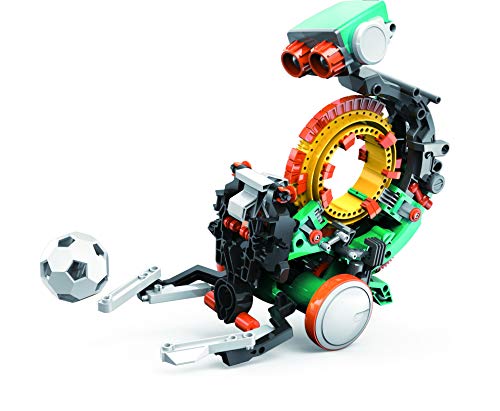
- Programs actions with a mechanical coding wheel
- Requires a detailed, multi-hour build
- Recommended for ages 10 and up
Best For: Older beginners interested in engineering and physical coding
Best Entry-Level Pick – Makeblock mBot Coding Robot
The Makeblock mBot is a practical starting point for families seeking beginner robotics sets that introduce coding, electronics, and mechanical assembly without an overly complicated build. Its guided construction takes about 15 minutes, and children can progress from Scratch-based activities toward Arduino programming.
Best For: Kids ages 8-12 who want a quick-build robot with guided coding lessons, remote control, line following, and obstacle avoidance.
Pros:
- Designed for step-by-step learning with Scratch and Arduino support.
- Clear instructions allow the robot to be assembled in about 15 minutes.
- Supports remote control, line following, and obstacle avoidance.
- Open-source design is compatible with many Makeblock modules and LEGO parts.
Cons:
- Four AA batteries for the robot are not included.
- The remote controller requires a CR2025 battery, also not included.
mBot is a strong choice when ease of assembly and a gradual coding path matter most. Its metal-and-plastic construction and expandable platform also give children room to continue experimenting beyond the starter activities.
Best Electronics Learning Kit – ELEGOO UNO R3 Super Starter Kit
The ELEGOO UNO R3 Super Starter Kit is one of the more versatile beginner robotics sets for learning how individual electronic components work together. Its 22-plus guided projects cover LEDs, sensors, displays, motors, and input devices, while the solderless breadboard keeps early experiments approachable.
Best For: Beginners, homeschoolers, coding clubs, and STEM classrooms that want a broad Arduino-based electronics foundation.
Pros:
- Includes more than 22 guided hands-on projects.
- Provides a wide selection of sensors, motors, displays, and control components.
- Solderless breadboard and pre-soldered LCD help beginners get started without soldering.
- Example code can be modified for custom alarms, monitors, games, and motion projects.
Cons:
- Requires careful wiring and correct component polarity.
- The power module should not be used with voltage higher than 9V.
- Younger learners may need experienced adult guidance.
This kit is better suited to learners who want to understand circuits and Arduino programming rather than simply operate a finished robot. The large component selection supports a wide progression of small projects, although it rewards patient, organized experimentation.
Best 3-in-1 Building Set – Kyanio 3-in-1 STEM Robotics Kit
The Kyanio 3-in-1 kit combines block construction, remote play, app control, and programming in a format designed for children ages 8-14. Among beginner robotics sets, it stands out for offering three build options and 560 pieces, giving young builders a creative way to explore gears, mechanics, and basic robotics concepts.
Best For: Kids who enjoy hands-on block building and want multiple robot or vehicle configurations with remote and app control.
Pros:
- Includes 560 building pieces and three different model configurations.
- Color-coded blocks and step-by-step instructions support assembly.
- Combines construction, mechanical engineering concepts, remote control, and app programming.
- Rechargeable Type-C design and included lithium-polymer battery add convenience.
Cons:
- The plastic building format may offer less electronics depth than an Arduino kit.
- Programming capabilities are described broadly rather than through a detailed lesson count.
This is a good fit for children who are motivated by building and imaginative play first, with coding introduced as an added layer. Its three-in-one format can keep the experience fresh, while the remote-control focus makes it immediately engaging before deeper programming practice.
Best Robot Car Project – ELEGOO UNO R3 Smart Robot Car V4
The ELEGOO UNO R3 Smart Robot Car V4 is a strong choice for learners ready to move from simple circuits into a complete programmable vehicle. It combines guided assembly with Arduino coding, app and IR control, FPV video, line tracking, and obstacle avoidance, making it one of the more feature-rich beginner robotics sets in this group.
Best For: Beginners ages 12 and up who want to build, program, and drive a robot car while experimenting with sensors and camera-based control.
Pros:
- Includes FPV video through an onboard camera and Wi-Fi module.
- Supports line tracking, obstacle avoidance, auto-follow, app control, and IR control.
- Keyed connectors and an illustrated tutorial help reduce wiring errors.
- Rechargeable 2000 mAh lithium-ion battery is included.
Cons:
- Recommended for ages 12 and up, so younger beginners may need more support.
- Its multiple modules and programming features create a more involved setup than a basic robot kit.
- The manufacturer warranty is listed as six months.
This robot car offers a satisfying next step for learners who have outgrown very simple coding toys. It has enough sensors and driving modes for repeated experimentation, though first-time builders should plan for a careful assembly and programming session.
Best All-Around Starter – BeAndge 6-in-1 Robotics STEM Kit
For families comparing beginner robotics sets, the BeAndge kit offers six hands-on projects rather than a single robot. Children ages 8–12 can build models such as a reptile robot, balance car, bubble machine, fiber lamp, and buzzer wire game while practicing basic circuits and assembly.
Best For: Kids ages 8–12 who want several introductory electronics projects and families looking for a screen-free activity to complete together.
Pros:
- Includes six different STEM building projects.
- Step-by-step instructions and a mini screwdriver support assembly.
- Encourages problem-solving, motor skills, and interest in circuits.
- Packaged as a gift-ready set with a stated lifetime warranty against manufacturer defects.
Cons:
- AA batteries and bubble solution are required but not included.
- The projects are geared toward younger beginners rather than advanced robotics programming.
This is a practical entry point for children who enjoy variety and hands-on construction. Adult guidance may make the building process more enjoyable, especially for first-time makers.
Best Solar Option – Sillbird 12-in-1 Solar Robot Kit
Among beginner robotics sets, the Sillbird 12-in-1 kit stands out for its solar-powered focus and growing difficulty. Its 190 parts can be used to build 12 models, including robots and cars, giving children a way to explore engineering and renewable energy without batteries.
Best For: Kids and teens ages 8 and up who are interested in solar power, outdoor building, and a kit that offers increasingly challenging models.
Pros:
- Offers 12 buildable models from 190 parts.
- Uses sunlight or a strong artificial light source such as a flashlight.
- Introduces renewable energy and engineering concepts through play.
- Clear, step-by-step instructions can support independent or shared assembly.
Cons:
- Performance depends on sufficient sunlight or a strong artificial light source.
- The recommended age is listed as 10 years and up, despite some broader age positioning.
The solar mechanism makes this a distinctive choice for curious builders, while the range of models lets the kit remain useful as skills develop. It is best suited to children comfortable following detailed building instructions.
Best Family Project Set – 6-in-1 Robotics STEM Kit
This six-piece kit is one of the more approachable beginner robotics sets for children who like building several small electronic projects. The activities include a reptile robot, balance car, bubble machine, fiber lamp, and sliding plane, with instructions intended to make the assembly process easier to follow.
Best For: Boys and girls ages 8–12 who need a collaborative STEM activity for home, classroom projects, birthdays, or holiday gifting.
Pros:
- Provides six separate robot and motor-based activities.
- Supports construction, logical thinking, coordination, and problem-solving skills.
- Includes a screwdriver and step-by-step instruction manuals.
- Designed for family bonding and hands-on learning without screens.
Cons:
- The supplied notes do not specify included batteries, so power requirements should be confirmed before purchase.
- It focuses on building and motor crafts rather than programmable robotics.
With multiple compact projects, this set can keep a beginner engaged beyond a single build. Its emphasis on guided construction makes it a sensible choice when an adult or sibling can participate.
Best Screen-Free Starter – Ozobot Ozo at Home
For families seeking beginner robotics sets with a gentle introduction to coding, Ozobot Ozo at Home combines screen-free activities with an optional path to Blockly programming. Its guided progression helps children learn through drawing, magnetic tiles, color codes, and hands-on challenges.
Best For: Children ages 5 and up, homeschool lessons, and families wanting an approachable first coding robot.
Pros:
- No prior coding experience is required, and guided activity cards provide step-by-step support.
- Includes 27 activities spanning color coding, magnetic-board play, Blockly, and engineering challenges.
- Screen-free play can progress to computer- or tablet-based block programming.
Cons:
- Blockly programming requires a computer or tablet.
- The activities are structured for progression, so it may be less appealing for children seeking entirely open-ended play.
Ozo at Home is a strong entry point for younger learners because it starts with tactile play and gradually introduces coding concepts such as sequencing, direction, loops, and problem-solving.
Best Build-and-Rebuild Value – 14-in-1 Solar Robot Kit
This 14-in-1 kit is one of the more hands-on beginner robotics sets for children who enjoy assembling and rebuilding machines. It introduces basic engineering and solar power through multiple robot designs, with instructions that move from simpler models toward more challenging builds.
Best For: Kids ages 8 and up who enjoy construction projects, screen-free STEM activities, and experimenting with different robot designs.
Pros:
- One kit supports 14 robot configurations, encouraging repeated building and experimentation.
- Solar and AAA battery power allow indoor or outdoor use; the AAA battery is not included.
- Illustrated, step-by-step instructions support beginners and family or classroom projects.
Cons:
- Indoor battery operation requires one AAA battery, which must be supplied separately.
- Assembly is more appropriate for ages 8 and up than for very young children.
With its variety of models and dual-power design, this kit offers a practical way to connect building skills with lessons about gears, motion, and renewable energy.
Best Mechanical Coding Challenge – TEACH TECH Mech-5 Coding Robot
For older children ready for a deeper project, TEACH TECH Mech-5 is a mechanical coding robot that uses snap-on buttons and a coding wheel to control physical actions. Among beginner robotics sets, it stands out for combining a substantial build with mission-based programming.
Best For: Future engineers ages 10 and up who want to spend multiple hours assembling and programming a hands-on robot.
Pros:
- The mechanical coding wheel programs actions such as throwing, lifting, kicking, and drawing.
- Provides a genuine build-first STEM experience rather than a pre-assembled toy.
- Encourages mechanical engineering, coding basics, problem-solving, and learning by doing.
Cons:
- Assembly can take multiple hours and requires careful adherence to detailed instructions.
- Two AAA batteries are required.
- Its recommended age of 10 and up makes it less suitable for younger beginners.
Mech-5 is best viewed as an entry-level engineering project for older kids, especially those who value building and physical cause-and-effect more than instant play.
How We Picked These Beginner Robotics Sets
We focused on kits that offer an accessible entry point into robotics while still providing meaningful opportunities to build, program, test, and modify a working project. The selection spans simple color-code robots, guided Arduino starter kits, remote- and app-controlled vehicles, multi-build construction sets, and more advanced programmable robots.
We also considered stated age ranges, included components, learning support, control methods, project variety, and the likelihood that a beginner can make progress without extensive outside help. Because these kits target different learners, the best choice depends as much on patience and interests as on the advertised age.
Quick Comparison
- Best for first-time coding: Ozobot Ozo at Home uses color codes and Blockly for a gentle introduction.
- Best for structured electronics learning: The ELEGOO UNO R3 Super Starter Kit provides a broad Arduino-compatible component base and tutorials.
- Best for guided robot building: Makeblock mBot combines assembly with block-based and text-based coding options.
- Best for variety: The 12-in-1 and 14-in-1 solar kits offer multiple construction projects.
- Best for more advanced builders: The ELEGOO Smart Robot Car V4 and TEACH TECH Mech-5 add more complex controls or mechanisms.
Key Buying Factors for Beginner Robotics Sets
Age, Supervision, and Difficulty
Check the recommended age, but also consider the child’s experience with small parts, instructions, and troubleshooting. Younger beginners often benefit from visual coding and close adult guidance, while older children may prefer open-ended Arduino programming.
Coding and Control Options
Color coding and block programming reduce the initial learning curve. Remote controls are enjoyable for immediate play, while app control and Arduino compatibility provide a path toward more deliberate programming and customization.
Build Type and Project Variety
Robot cars provide quick, motivating results, whereas construction kits encourage mechanical experimentation. Solar and multi-model sets can deliver more variety, but they may require more rebuilding and patience than a single-purpose robot.
Instructions and Included Hardware
Look for clear tutorials, labeled parts, compatible software, and all essential electronics. Some kits assume access to batteries, a USB cable, a smartphone, or a computer, so verify requirements before buying.
Who Should Buy Which Beginner Robotics Sets?
Choose a screen-free color-coding robot for a young learner who needs an especially simple start. Select a Makeblock or guided STEM building kit for children who want a balance of assembly and coding. Arduino-based ELEGOO kits suit curious learners ready to study circuits, sensors, and programming in greater depth.
Solar multi-build kits are a good fit for children who enjoy constructing different models and learning basic mechanisms. For families seeking app control, cameras, or more ambitious programming projects, the Kyanio and ELEGOO robot-car options offer more interactive features. Older beginners who enjoy mechanical challenges may get the most from the TEACH TECH Mech-5.