The best barometers for classrooms turn changing air pressure into a hands-on lesson about weather forecasting. The right model should be easy to read, durable enough for daily use, and useful for recording observations over time.
This roundup includes dedicated teaching barometers, classroom weather centers, and combination instruments that add temperature or humidity readings. Use the guide below to match your grade level, lesson goals, available space, and budget.
Best 10 Barometers for Classrooms Picks for 2026
Best Classroom Weather Kit
Learning Resources Weather Center

- Measures pressure, humidity, and temperature
- Includes a weather-instrument activity guide
- Recommended for ages 5–10
Best For: Elementary weather lessons and science activities
Best Dedicated Teaching Instrument
Eisco Labs Aneroid Teaching Barometer

- 13 cm dial for classroom viewing
- Reads inches and millibars
- Exposed mechanism shows pressure changes
Best For: Demonstrating atmospheric pressure
Best Temperature Companion
Learning Resources Classroom Thermometer

- Large analog Celsius/Fahrenheit display
- Indoor and outdoor use
- Recessed tube helps prevent breakage
Best For: Adding temperature readings to weather lessons
Best 3-in-1 Wall Station
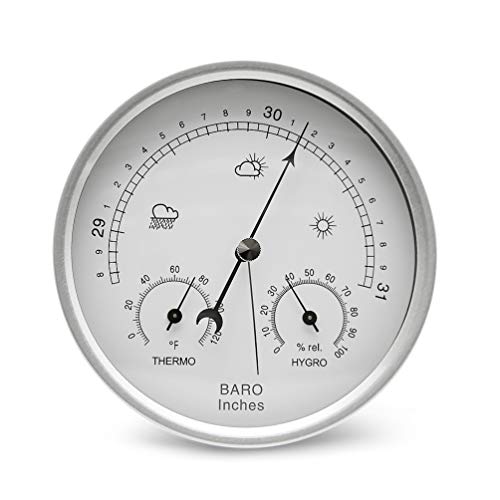
- Combines pressure, temperature, and humidity
- Mechanical 5.2-inch dial design
- Mounts horizontally or vertically
Best For: Classroom weather displays covering multiple variables
Connected Forecasting
La Crosse Atomic Weather Station

- 12-hour barometric pressure graph
- Indoor/outdoor temperature and humidity
- Wireless sensor with atomic time
Best For: Weather-trend lessons and multi-measurement classroom displays
Hands-On Basics

- Measures pressure, temperature, and humidity
- Battery-free analog operation
- Wall-mountable and lightweight
Best For: Simple weather-reading exercises and budget classroom setups
Large Analog Learning

- Large 6.9-inch analog dial
- Barometer, thermometer, and hygrometer
- Battery-free mechanical movement
Best For: Group demonstrations and visible classroom weather journals
Classic Classroom Display
Traditional Analog Weather Station

- Three analog readings: pressure, temperature, and humidity
- Easy-to-read wall-mounted dials
- No power supply required
Best For: Science classrooms wanting a decorative, hands-on weather display
Precision Learning Gauge

- Pressure range of 950–1070 hPa
- Temperature and humidity measurement included
- Readable silver dial with mechanical operation
Best For: Environmental monitoring lessons and compact classroom demonstrations
Vintage Lab Accent

- Barometer, hygrometer, and thermometer in one unit
- Desk or wall display options
- Classic walnut-and-gold analog design
Best For: Classrooms wanting a flexible weather display with vintage decor
Best Classroom Weather Kit – Learning Resources Weather Center
For teachers seeking barometers for classrooms, the Learning Resources Weather Center provides a hands-on way to introduce meteorology. It combines barometric pressure, relative humidity, and air-temperature measurement with an activity guide, making it suited to guided science lessons for children ages 5 to 10.
Best For: Elementary classrooms and at-home science activities that cover several basic weather measurements.
Pros:
- Measures barometric pressure, humidity, and air temperature.
- Includes an activity guide explaining how to use the instruments.
- Designed to inspire curiosity about meteorology.
- Manual operation requires no stated battery power.
Cons:
- Its plastic construction may be less substantial than metal teaching instruments.
- The recommended age range is limited to children ages 5 to 10.
This is a strong choice when the goal is broad, introductory weather instruction rather than a standalone precision barometer. The included guide and multiple instruments make it especially practical for structured classroom exploration.
Best Dedicated Teaching Instrument – Eisco Labs Aneroid Teaching Barometer
The Eisco Labs Aneroid Teaching Barometer is a focused option for classrooms that need a dedicated instrument for demonstrating atmospheric pressure. Its 13 cm dial is marked in both inches and millibars, while the exposed aneroid mechanism makes pressure changes visible to students.
Best For: Classroom demonstrations centered specifically on pressure readings and how an aneroid barometer responds to changing conditions.
Pros:
- Large 13 cm dial supports classroom visibility.
- Uses both inches and millibars.
- Exposed aneroid shows changes in pressure directly.
- Covers 28 to 31 inches of mercury and 960 to 1060 millibars.
Cons:
- It measures atmospheric pressure only, rather than temperature or humidity.
- The supplied notes do not specify an activity guide or mounting hardware.
Choose this model when visualizing the mechanics of pressure measurement matters more than having a complete weather station. Its dual-scale dial and exposed mechanism give lessons a clear, demonstration-friendly focus.
Best Temperature Companion – Learning Resources Classroom Thermometer
Although it is not a barometer, the Learning Resources Classroom Thermometer can complement barometers for classrooms by adding temperature readings to a weather unit. Its large analog display shows Celsius and Fahrenheit, and the recessed tube is designed to help prevent breakage.
Best For: Classrooms that already have a pressure instrument and want a simple, reusable temperature-reading aid.
Pros:
- Large analog display is designed for student viewing.
- Teaches Celsius and Fahrenheit readings.
- Suitable for indoor and outdoor use.
- Recessed tube helps prevent breakage.
Cons:
- It measures temperature, not barometric pressure.
- The supplied notes list battery power but do not provide battery details.
This is best treated as a supporting weather instrument rather than a standalone barometer. It offers a straightforward way to expand classroom observations with a reusable, dual-scale temperature display.
Best 3-in-1 Wall Station – Imperial Weather Station
The 3-in-1 Imperial Weather Station combines a mechanical barometer, thermometer, and hygrometer in a 5.2-inch wall-mounted unit. For barometers for classrooms, it offers a compact display of pressure, temperature, and humidity, with an imperial Fahrenheit scale and horizontal or vertical installation.
Best For: Weather displays that let students compare pressure, temperature, and humidity in one location.
Pros:
- Combines barometer, thermometer, and hygrometer functions.
- Measures 28.75–31 inHg, -10–130°F, and 0–100% relative humidity.
- Metal housing is described as sturdy and durable.
- Supports horizontal or vertical wall mounting.
Cons:
- Uses imperial Fahrenheit and pressure scales, which may not suit every curriculum.
- The supplied notes do not identify a Celsius scale or a digital display.
- Its broad weather-prediction claims are based on observing trends rather than stated electronic forecasting.
This station is a useful all-in-one visual aid for lessons connecting several weather variables. Its mechanical design and flexible mounting make it suitable for a classroom wall, provided the imperial scale matches the teaching objectives.
Connected Forecasting – La Crosse Atomic Weather Station
For classrooms seeking barometers for classrooms with more than a pressure reading, this wireless weather station combines barometric information with temperature, humidity, and time displays. Its 12-hour pressure graph can support simple weather-trend observations, while the indoor and outdoor readings offer useful comparison points.
Best For: Classrooms teaching weather trends, temperature, humidity, and changes in barometric pressure.
Pros:
- Shows a 12-hour barometric pressure history graph in inHg or hPa.
- Includes indoor and outdoor temperature and humidity readings with recorded MIN/MAX values.
- Wireless sensor, atomic time setting, automatic DST updates, and LED backlight add convenience.
- Fisherman icon with tendency arrow reacts to temperature changes for an easy visual cue.
Cons:
- Requires five AA batteries.
- Its many features may be more than needed for a class focused only on barometric pressure.
This is the most feature-rich option in the group for ongoing classroom observation. Choose it when students can benefit from viewing pressure history alongside other weather measurements.
Hands-On Basics – Aowutus 3-in-1 Dial Barometer
This compact 3-in-1 dial is a straightforward choice among barometers for classrooms. It measures air pressure, temperature, and humidity without batteries, giving students an easy-to-read analog instrument for recording conditions and comparing pressure over time.
Best For: Budget-conscious classrooms, demonstrations, and basic indoor or outdoor weather observations.
Pros:
- Combines a barometer, thermometer, and hygrometer in one dial.
- Battery-free operation uses air pressure and requires no listed power supply.
- Measures a broad stated range of 970–1060 hPa, -20 to 120°F, and 0–100% relative humidity.
- Lightweight, round, and suitable for wall mounting or portable observation.
Cons:
- Does not provide digital readings or an electronic history graph.
- Temperature accuracy is listed as plus or minus 1°C.
- The plastic construction may be less robust than an aluminum-framed instrument.
Its analog display encourages students to read and record measurements manually, making it a practical fit for introductory weather activities. It is best when simplicity and battery-free use matter more than advanced data logging.
Large Analog Learning – FER3345 Wall Weather Station
For classrooms that prefer a prominent analog display, this wall-hanging weather station combines a barometer, thermometer, and hygrometer. Its 6.9-inch diameter, Fahrenheit scale, clear markings, and mechanical movement make it suitable for group demonstrations and routine weather-trend checks.
Best For: Whole-class demonstrations where students need to read a large, wall-mounted pressure dial.
Pros:
- Three-in-one design measures barometric pressure, temperature, and humidity.
- Large round dial uses black markings on a yellow face for visibility.
- Mechanical, battery-free movement requires no special long-term maintenance.
- Can be hung horizontally or vertically and is described as suitable for indoor or outdoor use.
Cons:
- Provides analog readings rather than digital history or automated logging.
- The listed temperature accuracy is 1°C.
- Its Fahrenheit scale may be less convenient for lessons requiring Celsius readings.
This model offers the clearest shared viewing experience of the three, especially when mounted where an entire class can see it. Select it for visual demonstrations and manual weather journals rather than precise electronic tracking.
Classic Classroom Display – Traditional Analog Weather Station
For classrooms seeking hands-on barometers for classrooms, this analog weather station combines a barometer, thermometer, and hygrometer in one wall-mountable display. Its large, traditional dials can support lessons on atmospheric pressure, temperature, and relative humidity without requiring a power supply.
Best For: Science classrooms, libraries, and offices that want a decorative teaching aid for observing pressure, temperature, and humidity.
Pros:
- Combines barometric pressure, temperature, and humidity readings.
- Easy-to-read analog dials encourage visual observation.
- Wall-mountable cherry wood and gold-tone design adds classroom display appeal.
- Does not require a power supply.
Cons:
- Temperature accuracy is listed as plus or minus 1°C.
- Designed for indoor use according to the supplied details.
This is a practical choice when you want an analog instrument students can check at a glance while also complementing a classroom or laboratory setting.
Precision Learning Gauge – 3-in-1 Analog Weather Station
This 3-in-1 gauge is a useful option for classrooms comparing environmental measurements. Among barometers for classrooms, it stands out with stated ranges for air pressure, temperature, and humidity, plus a clear silver dial designed for quick reading during demonstrations or daily observation.
Best For: Classrooms that need a compact analog instrument for structured weather and environmental monitoring activities.
Pros:
- Measures air pressure from 950 to 1070 hPa.
- Measures temperatures from -30 to 50°C and humidity from 0 to 100% RH.
- Clear dial with easy-to-read fonts.
- Mechanical design requires no batteries.
Cons:
- The supplied details do not list included mounting hardware or other components.
- Its minimalist gray design may offer less decorative character than vintage-style alternatives.
Choose this model when measurement ranges and a straightforward, readable layout matter more than ornamental styling. Its stated temperature accuracy is plus or minus 0.5°C.
Vintage Lab Accent – Wooden Analog Weather Station
For educators who want barometers for classrooms that also enhance the room, this vintage wooden weather station offers analog readings for pressure, temperature, and humidity. It can be used on a desk or mounted on a wall, giving students a visible reference point for weather observations.
Best For: Science rooms, libraries, and classrooms that value a flexible desk-or-wall display with classic educational styling.
Pros:
- Combines a barometer, hygrometer, and thermometer.
- Can be displayed on a desk or mounted on a wall.
- Measures humidity from 0 to 100% with stated accuracy of plus or minus 5%.
- Mechanical analog design does not need batteries.
Cons:
- Temperature reading accuracy is listed as plus or minus 1°C.
- The supplied details identify it for indoor use.
- Its dark walnut and gold finish may be less utilitarian for some lab environments.
This model is a strong fit when presentation matters alongside basic weather instruction, especially in classrooms that need a display students can inspect without electronic connectivity.
How We Picked the Best Barometers for Classrooms
We focused on products that support observation-based learning rather than display alone. The selection includes dedicated aneroid teaching barometers, weather centers, and combination gauges that let students compare air pressure with temperature and humidity. We also considered dial readability, measurement range, mounting or placement flexibility, durability, and how easily each option can fit into a classroom activity.
For younger learners, a weather center or large, clearly labeled display may be more approachable. Older students may benefit from a traditional analog instrument that encourages calibrated readings, trend tracking, and comparison with official weather data.
Quick Comparison
| Best For | Recommended Type | Why It Helps |
|---|---|---|
| Elementary weather units | Classroom weather center | Combines multiple observations in an accessible format |
| Pressure-focused lessons | Dedicated aneroid barometer | Makes air-pressure changes the primary learning objective |
| Data collection projects | 3-in-1 weather station | Supports comparisons among pressure, temperature, and humidity |
| Small classrooms or desks | Compact analog station | Uses less wall space and remains easy to reposition |
| Forecasting and daily routines | Digital forecast station | Adds automated readings and extra weather information |
Key Buying Factors for Barometers for Classrooms
Readability and Scale
Choose a dial with large numerals, strong contrast, and clearly marked pressure units. Students should be able to read it from their seats without crowding around the instrument. If the class uses different measurement systems, check whether the scale includes both common units.
Accuracy and Adjustment
An aneroid barometer measures pressure mechanically, but local elevation and calibration affect its readings. Look for an adjustable reference marker or explain that students should focus on changes and trends unless the instrument has been calibrated against a trusted source.
Durability and Placement
Wall-mounted models keep instruments visible and reduce the risk of being knocked over. Desk models are easier to use in small groups. For active classrooms, favor sturdy cases, secure mounting hardware, and simple controls.
Extra Measurements
Temperature and humidity readings can make experiments more engaging, but additional gauges are not essential for a lesson focused only on pressure. Combination stations are most useful when students will maintain weather logs or investigate relationships among conditions.
Who Should Buy Which Barometers for Classrooms?
Buy a dedicated teaching barometer when air pressure, weather fronts, and forecasting are central to the curriculum. Choose a classroom weather center for younger students or lessons that introduce several weather variables at once. A 3-in-1 analog station is a strong choice for recurring observation journals and science-fair projects.
Choose a digital forecast station when convenience, automated readings, and broader daily weather information matter more than teaching the mechanics of an analog dial. For a traditional science-room display or home-school setup, a vintage-style analog weather station can provide useful readings while taking up modest space. Before purchasing, confirm the product’s dimensions, units, mounting method, and whether batteries or calibration are required.