Accurate labels keep inventory moving, reduce shipping mistakes, and make daily fulfillment easier. The right thermal printer can also eliminate ink costs while fitting your existing workflow.
We compared 10 shipping label printers for inventory across connectivity, print quality, speed, size, compatibility, and ease of use to help you choose a practical match for your operation.
Best 10 Shipping Label Printers for Inventory Picks for 2026
Best Touchscreen Model
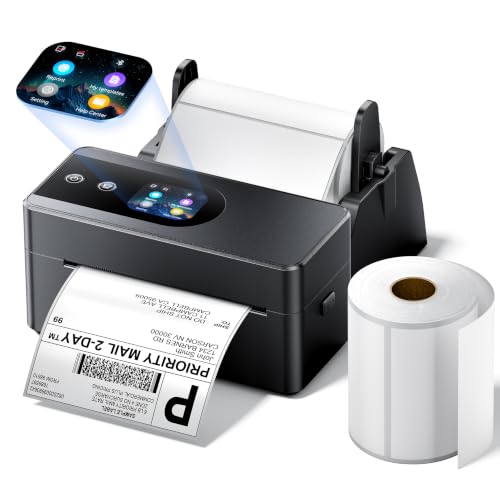
- Built-in touchscreen controls
- Includes 500 4x6 labels
- Bluetooth and USB connectivity
Best For: Small businesses wanting a ready-to-use, flexible label printer
Best Budget-Friendly Wireless Option

- Bluetooth and USB printing
- Supports roll and fanfold labels
- Works with major shipping platforms
Best For: Online sellers needing simple wireless shipping and warehouse labeling
Compact Wireless Pick
Gloryang Bluetooth Thermal Shipping Label Printer

- Wireless printing across phones, tablets, and computers
- Supports 4x6 and smaller labels from 1.57 to 4.1 inches
- Compact inkless design for space-conscious work areas
Best For: Small businesses needing flexible wireless label printing
High-Volume Workhorse
iDPRT iD880 Industrial Thermal Label Printer
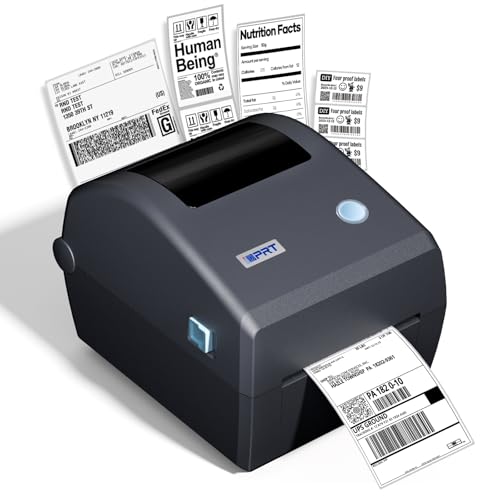
- USB and Ethernet connectivity for business workflows
- Prints up to 6 inches per second at 203 dpi
- Supports shipping, barcode, warehouse, and retail labels
Best For: Warehouses and commercial inventory operations
Template-Rich Portable Option
KNAON Bluetooth Thermal Shipping Label Printer
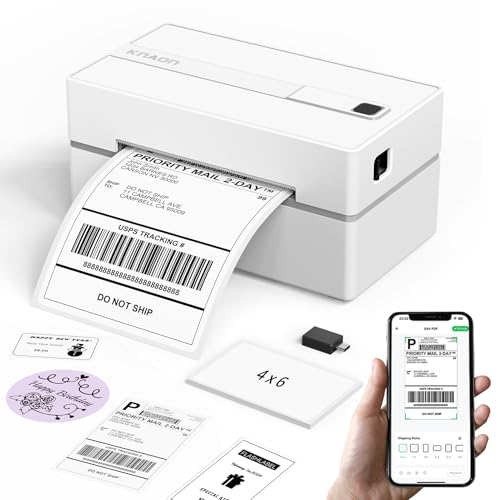
- App provides 3,000+ templates, 5,000+ icons, and 100+ fonts
- Supports Bluetooth app printing and USB computer connections
- Handles labels from 1.5 to 4.2 inches at up to 180 mm/s
Best For: Sellers needing custom inventory and shipping labels
Flexible Inventory Labeling
Labeer Bluetooth Thermal Printer

- Supports 4x6 and smaller inventory label sizes
- Prints from computers and mobile devices
- Automatic calibration and label-gap detection
Best For: Mixed shipping, barcode, and inventory labeling
Fast Wireless Workflow
Rongta RP425 Bluetooth Label Printer
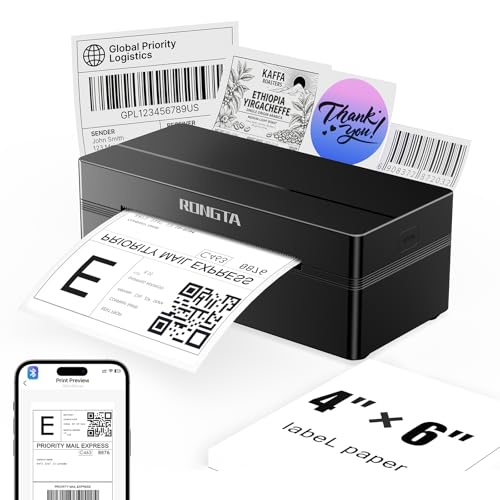
- Prints 4x6 and smaller labels
- Supports phone, Windows, Mac, and Chrome OS workflows
- Automatic label detection and feeding
Best For: Busy small-business and warehouse labeling
Simple Compact Printing
Rongta RP425 White Label Printer

- Wireless phone and USB computer printing
- Inkless 203 DPI thermal output
- Supports labels up to 4x6 inches
Best For: Basic home-office and small-business shipping labels
Best Overall – MUNBYN RealWriter 941
The MUNBYN RealWriter 941 is a practical choice for shipping label printers for inventory, especially if you want straightforward computer setup and broad platform compatibility. Its automatic label identification and support for multiple label widths make it useful for shipping, warehouse, and product labeling.
Best For: Small businesses that primarily print from Windows or macOS computers.
Pros:
- Supports Windows and macOS with a quick setup process.
- Automatically identifies and feeds labels after loading.
- Prints without ink or toner at speeds up to 150mm/s.
- Works with major selling and shipping platforms.
Cons:
- Supplied specifications list USB connectivity rather than wireless printing.
- Uses 203dpi resolution, which is lower than some higher-resolution options.
Choose the RealWriter 941 if dependable desktop printing and broad marketplace support matter more than wireless flexibility. Its automatic feeding and ink-free operation can simplify recurring inventory and shipping tasks.
Best Touchscreen Model – Phomemo PM64D
The Phomemo PM64D stands out among shipping label printers for inventory because it combines on-device touchscreen controls with Bluetooth and USB connectivity. It also includes 500 4×6 labels, making it convenient for businesses that want to begin printing inventory or shipping labels immediately.
Best For: Home offices and small businesses that value touchscreen controls and included supplies.
Pros:
- Touchscreen provides direct access to status, settings, and printing functions.
- Includes 500 4×6 labels and a label holder.
- Supports Bluetooth 5.0 for Android and iOS plus USB for Windows and macOS.
- Prints shipping, barcode, warehouse, and inventory labels without ink or toner.
Cons:
- Its 203dpi resolution may be less detailed than 300dpi alternatives.
- The included labels are 4×6, while other label sizes require separate media.
The PM64D is a convenient starter package for sellers who want flexible device connections and simple controls. The included labels reduce initial setup friction, while the compact design helps conserve desk space.
Best Budget-Friendly Wireless Option – JADENS JD268BT
The JADENS JD268BT is a straightforward option for shipping label printers for inventory, with support for both Bluetooth and USB printing. It handles roll and fanfold labels from 1.57 to 4.1 inches wide and is designed for common marketplaces and shipping services.
Best For: Online small businesses seeking a simple wireless label printer for shipping and warehouse tasks.
Pros:
- Uses thermal printing with no ink or toner.
- Supports roll and fanfold labels in several widths.
- Works with Windows and Mac through USB and supports Bluetooth printing.
- Compatible with platforms including ShipStation, Shopify, eBay, and Amazon.
Cons:
- Label calibration is required when changing label types.
- Phone printing requires the JADENS app; iOS and Android cannot print directly through Bluetooth.
- Includes a one-year warranty, shorter than some listed alternatives.
The JD268BT makes sense when wireless printing and broad platform support are priorities without requiring advanced controls. Be prepared to calibrate the printer when switching media and to use the companion app for phone printing.
Best High-Resolution Model – Phomemo D530Pro
The Phomemo D530Pro is a strong fit for shipping label printers for inventory when sharper output and flexible connectivity are important. Its 300dpi resolution, built-in paper bin, and support for Ethernet, Bluetooth, and USB suit businesses printing shipping, barcode, product, and warehouse labels.
Best For: Small businesses and workspaces that need clearer labels and built-in media storage.
Pros:
- 300dpi printing provides higher resolution than 203dpi models.
- Built-in paper bin and holder can accommodate up to 500 4×6 labels.
- Supports Ethernet, Bluetooth, and USB connections.
- Works with Android, iOS, Windows, macOS, Linux, and ChromeOS.
Cons:
- Its larger desktop footprint may require more workspace.
- It has a limited warranty according to the supplied specifications.
- Higher-resolution features may be more than needed for basic shipping labels.
The D530Pro is the most feature-rich choice here for businesses that need sharper prints, multiple connection options, and integrated label storage. It is especially useful when inventory labels, barcodes, and product labels are printed alongside standard 4×6 shipping labels.
Compact Wireless Pick – Gloryang Bluetooth Thermal Shipping Label Printer
For home offices and small businesses seeking shipping label printers for inventory, the Gloryang stands out for its compact footprint and flexible Bluetooth connectivity. It prints 4×6 shipping labels plus smaller labels from 1.57 to 4.1 inches without ink or toner.
Best For: Small businesses and shared workspaces that need wireless, space-saving label printing from phones, tablets, or computers.
Pros:
- Bluetooth support works with iOS, Android, macOS, Windows, laptops, tablets, and Chromebooks.
- Prints 4×6 labels and smaller formats from 1.57 to 4.1 inches.
- Inkless thermal operation helps reduce supply and maintenance needs.
- Compact, lightweight design fits home offices and limited desk space.
Cons:
- Bluetooth connectivity may be less suitable than wired Ethernet for high-volume operations.
- Its 203 dpi resolution is designed for standard monochrome labels rather than higher-detail printing.
The Gloryang is a practical choice when inventory and shipping labels need to be printed from several device types without taking over the workspace. Its strongest advantages are portability, wireless flexibility, and support for multiple label widths.
High-Volume Workhorse – iDPRT iD880 Industrial Thermal Label Printer
The iDPRT iD880 is built for warehouses, logistics centers, retail stores, and other operations comparing shipping label printers for inventory. Its USB and Ethernet connectivity, automatic paper alignment, and batch-printing capabilities make it suited to more demanding workflows.
Best For: Commercial workgroups and inventory operations that need reliable wired connectivity and continuous label printing.
Pros:
- USB and Ethernet connectivity support flexible workstation or network setups.
- Prints at speeds up to 6 inches per second with 203 dpi resolution.
- Works with Windows, macOS, Linux, Android, and iOS systems.
- Supports labels up to 4.64 inches wide and multiple media types.
Cons:
- It is larger than compact portable-style models, measuring 10 by 7.2 by 3.2 inches.
- Setup requires installing drivers and ensuring the power plug is firmly connected.
Choose the iD880 when inventory labeling volume and connectivity matter more than the smallest footprint. It also supports major shipping and e-commerce platforms, making it a versatile option for shipping, barcode, warehouse, and retail labels.
Template-Rich Portable Option – KNAON Bluetooth Thermal Shipping Label Printer
The KNAON is a useful option for shoppers comparing shipping label printers for inventory who want wireless printing and built-in design tools. It connects through the FlashLabel Pro app, supports USB on several operating systems, and handles label widths from 1.5 to 4.2 inches.
Best For: Small businesses and sellers creating shipping, barcode, price, and other custom labels from mobile or desktop devices.
Pros:
- Bluetooth printing is supported through the FlashLabel Pro app, with USB connectivity for computers.
- The app includes more than 3,000 templates, 5,000 icons, and 100 fonts.
- Works with platforms including Amazon, eBay, Shopify, USPS, UPS, Etsy, and PayPal.
- Prints at speeds up to 180 mm/s and includes 10 test papers.
Cons:
- Mobile and direct Bluetooth printing require use of the FlashLabel Pro app.
- Shipping-platform labels must be saved as PDFs and imported into the app.
- Its 200 x 200 resolution is slightly lower than the 203 dpi rating of some alternatives.
The KNAON offers more customization than a basic shipping-only printer, especially for sellers who also need inventory, barcode, price, or thank-you labels. Be prepared to use the companion app for the wireless workflow.
Flexible Inventory Labeling – Labeer Bluetooth Thermal Printer
For sellers and warehouse teams comparing shipping label printers for inventory, the Labeer Bluetooth Thermal Shipping Label Printer stands out for supporting both standard 4×6 shipping labels and smaller inventory formats. Its 203 DPI direct-thermal printing avoids ink, toner, and ribbons, while the FlashLabel Pro app can prepare PDF labels from iPhone or Android devices.
Best For: Small businesses, inventory teams, and shipping stations that need one printer for shipping, barcode, product, and storage labels.
Pros:
- Supports label widths from 1.57 to 4.41 inches, including 4×6, 4×4, 4×2, and 2×1 formats.
- Prints from Windows, macOS, ChromeOS, Linux, iPhone, and Android devices through the listed connection methods.
- App automatically identifies label areas and offers crop and rotate tools for PDF labels.
- Automatic gap detection, calibration, paper-out detection, and jam detection help with repeated printing.
Cons:
- Phone printing requires the FlashLabel Pro app and Bluetooth.
- Print resolution is 203 DPI, rather than a higher-resolution format.
- It is a print-only device without scanning or copying functions.
The Labeer is a versatile choice when inventory labeling and shipping use the same workstation. Its broad media support and mobile PDF workflow are useful for mixed labeling tasks, while 203 DPI is suited to routine barcode and package labels.
Fast Wireless Workflow – Rongta RP425 Bluetooth Label Printer
The Rongta RP425 is a practical option for buyers seeking shipping label printers for inventory with wireless phone support and quick label handling. It prints 203 DPI direct-thermal labels at speeds up to 150 mm/s and automatically detects and feeds labels, helping reduce manual adjustments during busy packing or labeling sessions.
Best For: Small businesses, warehouses, offices, and mobile work areas that need 4×6 shipping labels plus smaller barcode, QR code, or circular labels.
Pros:
- Supports iOS and Android printing through the RONGTA app, plus Windows, Mac, and Chrome OS compatibility.
- Handles direct-thermal media from 0.98 to 4.37 inches wide, including 4×6, 2×2, 2×1, and 1×1 labels.
- Automatic label identification and feeding simplify setup and repeated printing.
- Offers a compact design and a stated print speed of up to 150 mm/s.
Cons:
- Computer printing uses USB, while Bluetooth phone printing requires the RONGTA app.
- Labels and media are not included beyond the listed built-in media reference.
- The printer uses 203 DPI resolution and monochrome output only.
The RP425 balances wireless convenience, broad label-size support, and automatic feeding. It is especially appealing for inventory workflows that alternate between standard shipping labels and smaller product or barcode labels.
Simple Compact Printing – Rongta RP425 White Label Printer
For shoppers comparing shipping label printers for inventory, this white Rongta RP425 offers a straightforward wireless and USB setup for shipping and small-business labels. Its inkless 203 DPI thermal printing is designed for sharp monochrome labels, while the RONGTA app supports phone printing and the computer driver supports USB printing.
Best For: Home offices and small businesses that want a basic 4×6 shipping-label printer with support for multiple label sizes.
Pros:
- Supports wireless Bluetooth printing from phones through the RONGTA app.
- Supports USB printing from a PC or laptop with the provided computer driver workflow.
- Uses inkless thermal printing for shipping and small-business labels.
- Supports multiple-size labels up to the stated 4×6-inch maximum.
Cons:
- The supplied notes do not specify the full range of supported smaller label sizes.
- It provides 203 DPI monochrome, simplex printing only.
- The listing describes a print-only device with one USB connection.
The white RP425 is a simple fit for users who primarily need 4×6 shipping labels and occasional smaller business labels. Its Bluetooth-and-USB combination keeps the setup flexible, though buyers needing detailed inventory media specifications may prefer a model with a clearly listed label-width range.
How We Picked the Best Shipping Label Printers for Inventory
We focused on features that affect real fulfillment work rather than appearance alone. Each printer was evaluated for 4×6 label support, connection options, setup requirements, print resolution, operating-system compatibility, portability, and suitability for different inventory volumes. We also considered useful extras such as touchscreen controls, built-in label storage, Ethernet connectivity, bundled labels, and industrial construction.
Because inventory workflows vary, no single model is best for every seller. A home-based shop may value compact Bluetooth operation, while a warehouse may need a more durable USB or Ethernet printer that can run throughout the day.
Quick Comparison
- Best for flexible everyday use: MUNBYN RealWriter 941 offers Bluetooth and USB connectivity for common shipping setups.
- Best for guided operation: Phomemo PM64D adds a touchscreen and bundled labels.
- Best for wired network workflows: Phomemo’s 300DPI Ethernet model suits shared workstations and detailed labels.
- Best for demanding environments: The iDPRT iD880 Industrial model is designed with heavier-duty use in mind.
- Best for mobile fulfillment: Compact Bluetooth options from JADENS, KNAON, Labeer, Gloryang, and Rongta can work well with phones or laptops.
Key Buying Factors for Shipping Label Printers for Inventory
Connectivity and Software Compatibility
Bluetooth is convenient for mobile devices and uncluttered desks, but USB is often simpler and more dependable for a dedicated packing station. Ethernet can be a better choice when multiple employees need access over a local network. Before buying, confirm support for your operating system, marketplace, shipping platform, and preferred phone or tablet.
Print Resolution and Label Accuracy
Most shipping labels only require standard thermal output, but 300DPI models can produce sharper small text, barcodes, and product identifiers. Whichever resolution you choose, look for consistent alignment and reliable barcode readability.
Volume, Speed, and Durability
Estimate your busiest shipping days, not your average week. A compact printer may be sufficient for occasional orders, while a high-volume operation benefits from faster printing, stronger construction, and easy roll access. Check whether the printer supports fanfold labels or requires a particular roll size.
Footprint and Label Handling
Built-in bins reduce desk clutter, while portable designs are useful for pop-up fulfillment or storage-room inventory checks. Also consider how easily labels can be loaded, removed, and recalibrated when changing sizes.
Who Should Buy Which Shipping Label Printers for Inventory?
Choose a Bluetooth model if you pack from a phone, tablet, or flexible workstation. Choose USB for a straightforward single-computer setup. Choose Ethernet if several users or stations need access to one printer. Choose an industrial model for frequent daily printing, shared warehouse use, or a more demanding environment. If you are starting out, a bundled-label option can lower initial costs, but verify the ongoing price and availability of replacement labels before committing.