Moisture-sensitive filament can cause stringing, bubbling, weak layers, and inconsistent extrusion. The right filament dryer helps restore damp spools and keeps materials ready for more reliable prints.
We selected 10 filament dryers ranging from compact single-spool units to high-capacity systems with multiple heating chambers. Use the guide below to match drying capacity, temperature control, and everyday convenience to your printer setup.
Best 10 Filament Dryers Picks for 2026
Best High-Capacity Pick

- Dries up to four 1 kg spools
- Three fans and 350W PTC heating
- Eight outlets for multi-printer feeding
Best For: High-volume printing and multi-printer setups
Best Dual-Chamber Pick

- Fits four 1 kg or two 2 kg spools
- Dual 200W heating chambers
- Up to 85°C with sealed storage
Best For: High-volume filament drying and moisture-controlled storage
Best Compact Everyday Pick

- Adjustable 35–70°C drying
- Built-in spindle rotates the spool
- Touch controls and translucent lid
Best For: Single-spool home printing and easy operation
Best Simple Precision Pick

- Heats to 65°C in about 15 minutes
- Real-time humidity and timer display
- Fits most 1 kg spools
Best For: Single-spool users wanting quick, monitored drying
Best Smart Filament Dryer

- Dries four 1kg spools
- Automatic humidity control
- Three circulation fans
Best For: Multi-printer workflows needing automated humidity management
Best Compact Filament Dryer

- Single-spool drying while printing
- LCD temperature, time, and humidity display
- Supports common filament diameters
Best For: Single-printer users and straightforward moisture control
Best Dual-Spool Value
Comgrow SH01 Filament Dryer Box

- Holds two 1kg spools
- Supports 1.75mm and 2.85mm filament
- 40°C–50°C drying with LCD monitoring
Best For: Makers seeking enclosed dual-spool storage for standard filaments
Best High-Capacity Performance
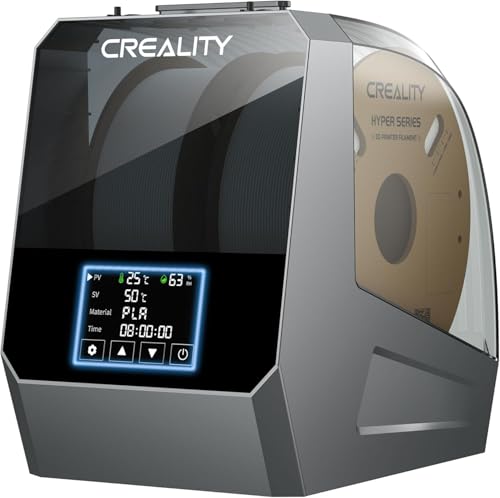
- Dries two 1kg spools
- 160W 360° PTC hot-air heating
- Presets for up to 12 filament types
Best For: Multi-printer users and broad-material filament workflows
Best Single-Spool Control
Creality Space Pi Filament Dryer

- 360° PTC hot-air heating
- 0–48-hour timer with power-off memory
- 45°C–70°C range and 12 material presets
Best For: Users wanting extended drying cycles and flexible controls
Best High-Capacity Pick – SUNLU S4 Filament Dryer
The SUNLU S4 is a high-capacity option for users who need filament dryers that can handle several spools at once. Its four-spool chamber, three circulation fans, adjustable heat, and multiple filament outlets make it well suited to multi-printer setups.
Best For: High-volume printing, multiple printers, and users drying up to four 1 kg spools simultaneously.
Pros:
- Holds up to four 1 kg spools and supports several filament diameters.
- Three fans and 360-degree circulation promote more even drying.
- Offers 35–70°C temperature control and a 0–99-hour timer.
- Eight filament exit holes support different loading angles and multiple printers.
Cons:
- Its large 460 × 220 × 310 mm footprint requires substantial workspace.
- At 4 kg, it is less convenient to move than smaller filament dryers.
The S4 is a practical choice when capacity and simultaneous printing matter more than compact size. Its broad material compatibility and customizable settings add flexibility for demanding setups.
Best Dual-Chamber Pick – Creality Space Pi X4 Dryer
The Creality Space Pi X4 is one of the more spacious filament dryers for users managing multiple spools. Dual 200W heating chambers, an 85°C maximum temperature, and sealed storage help support both active drying and moisture control during printing pauses.
Best For: High-volume users who need space for four 1 kg spools or two 2 kg spools.
Pros:
- Accommodates four standard 1 kg spools or two large 2 kg spools.
- Dual independent heating chambers provide separate drying areas.
- Reaches up to 85°C for materials including ABS, PET, PC, ASA, and nylon.
- Silicone-sealed storage helps limit moisture re-absorption.
Cons:
- The larger capacity may be unnecessary for users with a single printer and spool.
- Its advanced multi-chamber design may require more setup space than compact dryers.
The X4 stands out when both capacity and storage are priorities. Its illuminated viewing window and sealed enclosure are useful for keeping filament enclosed while monitoring the spools.
Best Compact Everyday Pick – SUNLU S2 Filament Dryer
The SUNLU S2 is a straightforward choice for users who want filament dryers that can dry and feed a spool during printing. Its touch controls, translucent lid, adjustable temperature, and continuous spool rotation keep operation simple while helping address moisture-related printing issues.
Best For: Individual makers who typically dry one spool at a time and want an easy-to-use filament holder and dryer.
Pros:
- Supports 35–70°C temperatures and drying times from 0–99 hours.
- Built-in spindle rotates the spool for more even drying.
- Works with 1.75 mm, 2.85 mm, and 3.00 mm filament.
- Translucent lid allows filament viewing without opening the chamber.
Cons:
- Its stated capacity and dimensions are oriented toward smaller, single-spool use.
- Its 70°C maximum may be less suitable than higher-temperature models for some advanced materials.
The S2 offers a balanced feature set for routine home printing. It is especially appealing when you want simple controls and in-use drying without the size of a multi-spool unit.
Best Simple Precision Pick – Creality Space Pi SE Dryer
The Creality Space Pi SE is a compact filament dryer for users who want controlled heating and straightforward monitoring. It reaches 65°C in about 15 minutes, circulates air through the chamber, and displays humidity and drying time while the spool is in use.
Best For: Users drying one 1 kg spool at a time who value quick warm-up, simple controls, and real-time monitoring.
Pros:
- Heats to 65°C within 15 minutes according to the supplied specifications.
- Fan-assisted 360-degree circulation helps heat the chamber evenly.
- Temperature adjusts from 45–65°C, with drying times up to 24 hours.
- Display and knob provide humidity and countdown-timer information.
Cons:
- It is designed for most 1 kg spools rather than multi-spool drying.
- Its 65°C maximum offers less temperature range than higher-capacity alternatives.
The Space Pi SE is a sensible option for everyday PLA, PETG, TPU, ABS, and similar materials. Its insulated chamber and accessible controls make it convenient for users who prefer a focused, uncomplicated dryer.
Best Multi-Spool Filament Dryer – Sovol SH03
The Sovol SH03 is a high-capacity choice for filament dryers, holding four 1kg spools while offering two independently controlled heating chambers. Its 85°C maximum temperature, automatic moisture vent, and preset material settings make it practical for multi-color or multi-printer workflows.
Best For: Makers who need to dry or store several spools and work with different filament types at once.
Pros:
- Dries up to four 1kg spools simultaneously.
- Dual independent chambers support different temperatures or storage.
- Reaches up to 85°C with 360° hot-air circulation.
- Preset settings cover 10 common filament types.
Cons:
- The large four-spool design may be more capacity than a single-printer user needs.
- Its 3.6 kg weight makes it less portable than smaller dryers.
Choose the SH03 when capacity and flexibility matter most. Independent chamber control is particularly useful if you regularly switch between materials with different drying needs.
Best Smart Filament Dryer – SUNLU S4
The SUNLU S4 is one of the more automation-focused filament dryers, combining four-spool capacity with humidity control and three circulation fans. It heats to 70°C and is designed to dry filament for up to four 3D printers concurrently.
Best For: Multi-printer users who want humidity monitoring and automated environmental control.
Pros:
- Holds four 1kg spools for simultaneous drying.
- Supports 1.75mm, 2.85mm, and 3.0mm filament diameters.
- Humidity control starts at 30–50% RH and stops below 25% RH.
- Three fans provide 360° air circulation.
Cons:
- Its 350W heater and large four-spool format may be excessive for occasional users.
- The listed dimensions require dedicated workspace.
The S4 stands out among filament dryers for users who want capacity without constantly managing humidity settings. Its safety monitoring and multi-fan circulation add convenience for sustained, busy printing sessions.
Best Compact Filament Dryer – SUNLU S1 Plus
The SUNLU S1 Plus is a simpler single-spool option for users who want filament dryers that can operate while printing. Its built-in fan helps discharge moisture, while the LCD shows temperature, time, and humidity and supports adjustable settings from 35°C to 55°C.
Best For: Single-spool printing setups and beginners seeking a straightforward dryer with live readings.
Pros:
- Supports drying while printing.
- LCD displays temperature, time, and humidity.
- Works with 1.75mm, 2.85mm, and 3.0mm filament.
- Fan-assisted drying helps address moisture-related stringing and clogging.
Cons:
- Its 35–55°C temperature range is lower than the other dryers in this roundup.
- Capacity is limited to a single spool.
The S1 Plus is a practical pick when you do not need multi-spool capacity or high-temperature drying. Its display and manual adjustments make it easy to tailor drying time and temperature to the filament and environment.
Best Dual-Spool Value – Comgrow SH01 Filament Dryer Box
For shoppers comparing filament dryers, the Comgrow SH01 focuses on straightforward moisture control and enclosed storage. It holds two 1-kilogram spools, supports 1.75mm and 2.85mm filament, and can dry filament while printing.
Best For: Makers who want a roomy, sealed dryer for standard PLA, ABS, and similar filaments.
Pros:
- Stores up to two 1-kilogram spools.
- Supports common 1.75mm and 2.85mm filament diameters.
- Provides adjustable 40°C–50°C temperatures and 6–12-hour drying times.
- Includes temperature and humidity monitoring on a 2-inch LCD screen.
Cons:
- The maximum temperature is 50°C, which is lower than some competing dryers.
- Operation requires selecting a work state; otherwise, the motherboard shuts down after three minutes.
- The vent must be opened while drying and closed for storage.
The SH01 is a practical choice if capacity and sealed storage matter more than high-temperature drying. Its controls require a little attention, but the dual-spool design and printing-through-dryer setup add useful flexibility.
Best High-Capacity Performance – Creality Space Pi Dryer Plus
The Creality Space Pi Filament Dryer Plus is a strong option among filament dryers for users who want two-spool capacity and more powerful circulation. Its 160W PTC system uses 360° hot-air heating, while the touchscreen provides quick access to material presets and manual settings.
Best For: Multi-printer users and makers drying two spools or working with a broad range of filament materials.
Pros:
- Holds two 1-kilogram spools and includes four filament holes with two PTFE pipes.
- Uses double 360° hot-air PTC heating for more uniform circulation.
- Offers one-key presets for up to 12 filament types.
- Supports adjustable temperatures from 45°C to 70°C with a 4-inch touchscreen.
Cons:
- Its larger feature set may be more than needed for users drying one spool at a time.
- The supplied notes do not specify a timer range.
- At 5.5 pounds, it is less lightweight than simpler dryer boxes.
With dual-spool drying, a higher 70°C ceiling, and broad material support, the Space Pi Plus is designed for more demanding workflows. It is especially appealing when two printers or multiple filament types are part of the setup.
Best Single-Spool Control – Creality Space Pi Filament Dryer
The Creality Space Pi is one of the more control-focused filament dryers, pairing 360° PTC hot-air heating with a 48-hour timer. Its 3.7-inch touchscreen offers material presets and adjustable temperatures, while power-off memory can retain settings after an outage.
Best For: Users who want extended drying cycles, broad material compatibility, and simple touchscreen controls.
Pros:
- Circulates 360° hot air with a 110W PTC heater.
- Provides one-key settings for up to 12 filament types.
- Offers adjustable temperatures from 45°C to 70°C.
- Includes a 0–48-hour timer and power-off memory function.
Cons:
- The supplied notes list one dryer and do not state a two-spool capacity.
- The 3.7-inch screen is smaller than the Plus model’s 4-inch display.
- It uses a 110W heater rather than the Plus model’s 160W system.
This Space Pi makes sense for users who value timer flexibility and remembered settings over dual-spool capacity. Its support for common and composite filaments also makes it a versatile fit for varied printing materials.
How We Picked the Best Filament Dryers
We compared these Filament Dryers by looking at practical features that affect print quality and ease of use: spool capacity, maximum temperature, heating design, temperature control, drying-cycle convenience, filament compatibility, and storage functionality. We also considered whether each model suits common materials such as PLA, PETG, ABS, TPU, and moisture-sensitive nylon.
Capacity matters, but bigger is not automatically better. A compact dryer may be easier to place beside a desktop printer, while a four-spool model can save time for users who regularly print with multiple colors or materials. Models with active heating and enclosed storage are especially useful in humid environments.
Quick Comparison
- Best for multiple spools: SUNLU S4, Creality Space Pi X4, and Sovol SH03.
- Best for compact setups: SUNLU S2, SUNLU S1 Plus, and Comgrow SH01.
- Best for controlled everyday drying: Creality Space Pi SE and Space Pi Plus models.
- Best for higher-temperature materials: Units reaching up to 85°C, provided the recommended temperature matches the filament manufacturer’s guidance.
Key Buying Factors for Filament Dryers
Capacity and Spool Fit
Check how many spools the dryer holds and whether it supports your spool width and weight. Single-spool dryers are convenient for occasional use; two- and four-spool models make more sense for color changes, production work, or shared workspaces.
Temperature Range and Accuracy
Different materials require different drying temperatures. PLA and PETG generally need gentler settings, while nylon and some engineering filaments require more heat and longer cycles. A broad range is helpful, but dependable sensing and stable heating are just as important as the maximum temperature.
Heating and Airflow
PTC heating elements, circulating airflow, and even heat distribution can reduce cold spots and improve drying consistency. A sealed design also helps limit reabsorption after drying.
Use During Printing
If you want to print directly from the dryer, confirm that the outlet path fits your filament diameter and that the spool rotates smoothly. Clear covers, LCD controls, presets, and timers can make long drying cycles easier to manage.
Who Should Buy Which Filament Dryers?
Choose a compact SUNLU S2, S1 Plus, or Comgrow SH01 if you print occasionally or have limited desk space. Choose a multi-spool SUNLU S4, Creality X4, or Sovol SH03 if you use several materials or want to prepare multiple spools at once. For balanced capacity and more targeted temperature control, consider a Creality Space Pi SE or Space Pi Plus model. Users printing nylon, TPU, or other moisture-sensitive materials should prioritize a dryer with a suitable high-temperature range, reliable circulation, and enough capacity for the spool sizes they use.