Reliable dissolved oxygen readings help you assess whether ponds, aquariums, tanks, and aquaculture systems have enough oxygen for healthy aquatic life. The right tester can also make routine water-quality checks faster and more consistent.
These 10 options range from simple chemical test kits to portable digital meters with temperature compensation, salt compensation, calibration controls, and data memory. Use the guide below to narrow the list by accuracy, convenience, measurement range, and intended application.
Best 10 Dissolved Oxygen Meters for Water Picks for 2026
Budget Test Kit
Monitor Dissolved Oxygen Test Kit

- 60-test capacity
- 0–15 ppm measurement range
- For freshwater and marine applications
Best For: Economical aquarium, pond, and aquaculture testing
Connected Field Meter
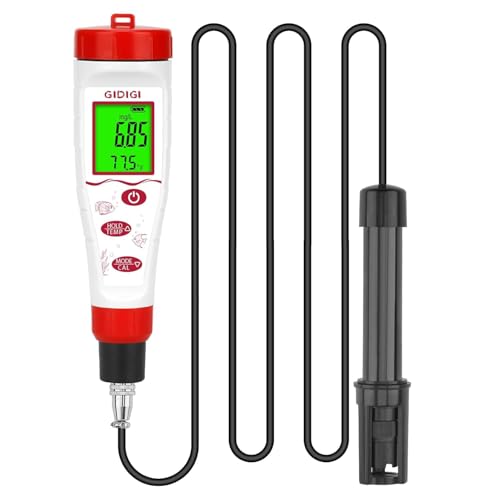
- mg/L and saturation modes
- 3-meter electrode cable
- Bluetooth app data management
Best For: Portable, multi-application water monitoring
Proven Economy Meter
Milwaukee MW600 Portable DO Meter

- 0.0–19.0 mg/L range
- 0.1 mg/L resolution
- Two-point manual calibration
Best For: Educational, aquaculture, and environmental analysis
Long-Reach Data Meter
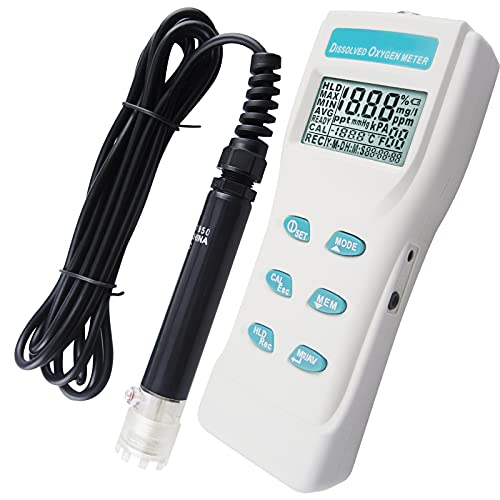
- 11.48-foot probe cable
- 99-reading memory
- Measures DO, temperature, salinity, and pressure
Best For: Aquaculture and field testing requiring reach and data storage
Best All-Around Field Kit
Extech DO210 Portable Dissolved Oxygen Meter

- Measures DO, saturation, and temperature
- Automatic temperature, altitude, and salinity compensation
- Complete kit with spare membranes and carrying case
Best For: Field testing and comprehensive water-quality monitoring
Best Compact Waterproof Pen
Sper Scientific 850045 DO Meter

- IP65-rated waterproof housing
- Simultaneous DO and temperature display
- Includes spare probe heads and carrying case
Best For: Portable aquarium, lab, environmental, and wastewater testing
Best Wide-Range Value
Yewhick DO9100S Wide-Range DO Meter

- Measures up to 40 mg/L or 300.0%
- Automatic temperature compensation and two-point calibration
- Includes six spare membrane caps and extra batteries
Best For: Aquariums, aquaculture, brewing, and wastewater testing
Most Versatile
GIDIGI 6-in-1 Dissolved Oxygen Meter
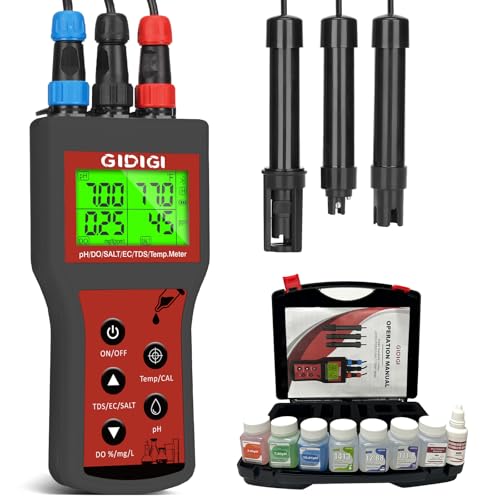
- Measures DO, pH, salinity, TDS, EC, and temperature
- Bluetooth logging with salinity and altitude compensation
- Includes replacement membranes, solutions, batteries, and case
Best For: Multi-parameter testing across ponds, aquariums, and hydroponic systems
Best for Data Logging
YINMIK Smart Portable DO Meter

- Measures 0–30 mg/L and 0–300% dissolved oxygen
- Stores 1,000 readings through Bluetooth app connectivity
- Includes a protective case and calibration accessories
Best For: Recurring pond, aquaculture, and environmental monitoring
Simple Everyday Pick

- Measures dissolved oxygen from 0.0–40.00 mg/L
- Automatic temperature compensation from 0–50°C
- Backlit display with auto shutoff and low-battery alert
Best For: Routine aquarium, pond, pool, and fish-tank spot checks
Budget Test Kit – Monitor Dissolved Oxygen Test Kit
Monitor DISSOLVED Oxygen Test KIT (60 Tests) - Monitor Aquarium and aquaculture Water Quality
Check Price On AmazonFor straightforward dissolved oxygen meters for water testing, this kit uses a simple chemical test format rather than a digital probe. It covers freshwater and marine aquariums, aquaculture, ponds, groundwater, and drinking water, with enough materials for 60 tests.
Best For: Aquarium, pond, and aquaculture owners who want an economical supply of basic dissolved oxygen tests.
Pros:
- Provides up to 60 tests.
- Measures dissolved oxygen from 0 to 15 ppm.
- Works with freshwater and marine water applications.
- Designed for easy, fast testing.
Cons:
- Resolution is limited to 0.5 ppm.
- Does not provide digital readings or data storage.
This is a practical choice when testing frequency and low operating cost matter more than fine measurement resolution or electronic features.
Connected Field Meter – GIDIGI Digital DO Tester
This digital option is among the more versatile dissolved oxygen meters for water, offering mg/L and saturation modes plus a long 3-meter electrode cable. Automatic temperature compensation and app-based salinity and altitude adjustments make it suited to varied water-monitoring tasks.
Best For: Users testing ponds, aquaculture systems, hydroponics, wastewater, or deeper outdoor water who want digital readings and Bluetooth data management.
Pros:
- Displays dissolved oxygen in mg/L and percentage saturation modes.
- Includes automatic temperature compensation.
- 3-meter cable helps reach deeper water.
- App support enables compensation settings and data storage, management, and sharing.
Cons:
- Requires app use for salinity and barometric-pressure compensation.
- Bulkier and more involved than a basic test kit.
With calibration accessories, a backlit display, and a stated 365-day warranty, this meter is a feature-rich fit for users who need portable testing across several water environments.
Proven Economy Meter – Milwaukee MW600 Portable DO Meter
The Milwaukee MW600 is a compact choice among dissolved oxygen meters for water, using a polarographic probe, a 3-meter cable, and two-point manual calibration. Its 0.1 mg/L resolution and automatic temperature compensation support routine educational, aquaculture, and environmental measurements.
Best For: Schools, aquaculture operators, and water-analysis users seeking a dedicated portable meter with manual calibration.
Pros:
- Measures from 0.0 to 19.0 mg/L.
- Offers 0.1 mg/L resolution and ±1.5% accuracy.
- Includes two-point manual calibration.
- Automatic temperature compensation operates from 0 to 30°C.
Cons:
- Manual calibration requires more user involvement.
- Temperature compensation range is limited to 0–30°C.
- Does not list memory or app connectivity features.
This model keeps the feature set focused on core DO measurement, making it a sensible fit when probe-based testing and established manual calibration are preferred over connected functions.
Long-Reach Data Meter – Multi-Parameter DO Tester
This multi-parameter tester is a strong option among dissolved oxygen meters for water when reach, storage, and broader readings matter. It measures DO in percentage or ppm/mg/L, along with temperature, salinity, and barometric pressure, using an 11.48-foot cable.
Best For: Aquaculture, aquarium, industrial, environmental, and educational users who need long-reach testing and onboard data memory.
Pros:
- Measures dissolved oxygen, temperature, salinity, and barometric pressure.
- Stores up to 99 readings and includes a data-hold function.
- 11.48-foot cable supports testing at a distance.
- Includes batteries, membranes, electrolyte, manual, and carrying case.
Cons:
- Manual salinity adjustment adds setup work.
- The Clark-type electrode requires maintenance.
- Its broad feature set may be more than needed for simple aquarium checks.
Its long cable, 0.01 ppm resolution, memory, and included maintenance supplies make it particularly useful for repeated or less accessible water measurements.
Best All-Around Field Kit – Extech DO210 Portable Dissolved Oxygen Meter
The Extech DO210 is a versatile choice among dissolved oxygen meters for water, combining DO, oxygen saturation, and temperature readings in a portable kit. Automatic temperature compensation, adjustable altitude settings, and salinity compensation help adapt measurements to different water conditions.
Best For: Field testing, water-quality monitoring, and users who need compensation controls and a complete carrying kit.
Pros:
- Measures dissolved oxygen from 0–20.0 mg/L, oxygen saturation from 0–100%, and water temperature.
- Automatic temperature compensation uses the probe’s built-in temperature sensor.
- Adjustable altitude and salinity compensation support varied testing environments.
- Includes spare membranes, electrolyte, battery, probe, and carrying case.
Cons:
- Its 0–20.0 mg/L DO range is narrower than some alternatives.
- The probe cable is relatively long at 13 feet, which may be more than needed for compact setups.
Choose the DO210 if you want a capable portable meter with useful environmental adjustments and accessories ready for field work.
Best Compact Waterproof Pen – Sper Scientific 850045 DO Meter
The Sper Scientific 850045 is a compact option among dissolved oxygen meters for water, designed for quick readings in wet environments. Its IP65-rated housing, automatic temperature compensation, and one-hand format suit aquarium, laboratory, environmental, and wastewater testing.
Best For: Portable testing where waterproof construction, simple operation, and easy-to-read DO and temperature readings matter.
Pros:
- Measures dissolved oxygen from 0–20 mg/L and oxygen percentage from 0–100%.
- IP65-rated waterproof design is suited to wet field and aquarium environments.
- Displays dissolved oxygen and temperature together with automatic temperature compensation.
- Includes spare probe heads, electrolyte solution, batteries, and a carrying case.
Cons:
- It does not list altitude or salinity compensation in the supplied specifications.
- The DO measurement range stops at 20 mg/L.
This pen-style meter is a practical pick for users who prioritize portability and wet-environment durability over advanced compensation controls.
Best Wide-Range Value – Yewhick DO9100S Wide-Range DO Meter
The Yewhick DO9100S stands out among dissolved oxygen meters for water with a 0–40 mg/L measurement range and readings available in mg/L or percentage. Automatic temperature compensation, two-point calibration, and included maintenance supplies make it adaptable for tanks, aquaculture, brewing, and wastewater applications.
Best For: Users who need a wider DO range, multiple application options, and a generous supply of replacement membranes and batteries.
Pros:
- Measures dissolved oxygen from 0–40 mg/L or 0–300.0%.
- Built-in temperature sensor provides automatic temperature compensation from 0–50°C.
- Offers automatic two-point calibration at 0% and 100%.
- Includes electrolyte, calibration supplies, six spare membrane caps, and extra batteries.
Cons:
- The meter uses three LR44 batteries, which may be less convenient to replace than common larger cells.
- The supplied notes do not mention altitude or salinity compensation.
Consider the DO9100S when its 40 mg/L upper range and included consumables are more important than advanced environmental compensation settings.
Most Versatile – GIDIGI 6-in-1 Dissolved Oxygen Meter
For shoppers comparing dissolved oxygen meters for water, the GIDIGI stands out as a multifunction tester for ponds, aquariums, hydroponics, pools, and other water-quality checks. It displays dissolved oxygen, pH, salinity, TDS, EC, and temperature simultaneously, with Bluetooth data logging and compensation settings.
Best For: Users who want one portable instrument for dissolved oxygen and broader water-quality monitoring.
Pros:
- Measures six parameters, including DO from 0–20 mg/L or 0–200%.
- Supports Bluetooth logging, printing, and sharing through the app.
- Includes calibration solutions, six replacement membranes, batteries, and a rugged case.
- Offers salinity, altitude, and temperature compensation.
Cons:
- Its many functions and app-based settings may be more than basic users need.
- Salinity, TDS, and EC ranges use different units and settings, requiring careful setup.
The GIDIGI is a strong choice when versatility matters more than a simple single-purpose meter. Its included accessories and durable case also make it practical for field testing.
Best for Data Logging – YINMIK Smart Portable DO Meter
The YINMIK is one of the more data-focused dissolved oxygen meters for water, offering Bluetooth connectivity, app-based compensation, and storage for up to 1,000 readings. Its carrying case and two display modes suit recurring checks in ponds, aquariums, aquaculture, and outdoor water environments.
Best For: Aquaculture, environmental monitoring, and users who want to save and review repeated DO measurements.
Pros:
- Measures dissolved oxygen in both mg/L and percentage modes.
- Provides a 0–30 mg/L range with 0.01 mg/L resolution.
- Stores up to 1,000 readings and displays changes through Excel via the app.
- Includes a portable case, electrode cable, electrolyte, caps, and calibration supplies.
Cons:
- Bluetooth features require use of the YINMIK app.
- Zero-point calibration is needed for solutions below 2 mg/L.
- At 1.76 pounds, it is heavier than a compact handheld meter.
Choose the YINMIK if measurement history and field portability are priorities. Its two calibration approaches provide flexibility, while the case protects the kit during transport.
Simple Everyday Pick – ATC Dissolved Oxygen Test Kit
This straightforward option is designed for shoppers who need dissolved oxygen meters for water without extra connectivity or multi-parameter features. It measures dissolved oxygen and temperature, includes automatic temperature compensation, and uses a backlit LCD for quick readings.
Best For: Basic dissolved oxygen checks in aquariums, ponds, pools, fish tanks, and aquaculture setups.
Pros:
- Measures dissolved oxygen across a 0.0–40.00 mg/L range.
- Automatic temperature compensation works from 0–50°C.
- Backlit display, low-battery indicator, and eight-minute auto shutoff simplify operation.
- Comes with electrode filling fluid and batteries.
Cons:
- It does not offer Bluetooth logging or additional water-quality parameters.
- The supplied notes do not specify a dissolved oxygen percentage mode.
The compact feature set makes this meter suitable for routine spot checks rather than detailed water-quality analysis. Its wide mg/L range and ATC function cover many common aquarium and pond tasks.
How We Picked These Dissolved Oxygen Meters for Water
We selected products across the main testing categories: reagent-based kits, compact pen meters, portable digital instruments, and larger-range meters for ponds or aquaculture. We prioritized useful measurement ranges, temperature compensation, calibration options, probe design, portability, and features that support repeatable readings.
Because specifications and included accessories can vary by seller, confirm the current package contents before buying. Pay particular attention to whether the product includes a probe, calibration solution, filling fluid, batteries, carrying case, or replacement membranes.
Quick Comparison
| Type | Best suited to | Main advantage | Typical trade-off |
|---|---|---|---|
| Reagent test kit | Basic aquarium or pond checks | Simple and low-cost | Manual color comparison and limited precision |
| Pen meter | Fast spot checks | Compact and convenient | Often fewer advanced controls |
| Portable digital meter | Routine field or aquaculture testing | More control and readable results | Requires calibration and probe care |
| Extended-range digital meter | Ponds, tanks, and variable conditions | Broad measurement capability | Usually costs more and needs maintenance |
Key Buying Factors for Dissolved Oxygen Meters for Water
Measurement Range and Resolution
Choose a range that covers your expected conditions. Aquarium users may only need ordinary freshwater readings, while ponds, aquaculture systems, and saltwater applications can benefit from a broader range and finer resolution. Do not confuse resolution with accuracy: a display showing more decimal places does not automatically mean a more precise instrument.
Temperature and Salinity Compensation
Dissolved oxygen depends on temperature, and salinity also affects readings. Automatic temperature compensation is helpful for changing water conditions. If you test saltwater or brackish water, look for salt compensation or a manual salinity adjustment rather than assuming a freshwater meter will compensate correctly.
Calibration and Probe Maintenance
Digital meters generally require calibration, commonly in air or with a suitable calibration solution. Review how often calibration is recommended and whether the electrode uses replaceable membranes or filling fluid. Rinse the probe after use, store it as directed, and avoid letting sensing components dry out when the manufacturer advises otherwise.
Portability and Data Features
For field work, a waterproof or water-resistant housing, long cable, clear display, and durable probe can matter more than extra menu functions. Data hold and memory are useful when recording multiple locations, while a compact pen design is convenient for quick checks around an aquarium.
Who Should Buy Which Dissolved Oxygen Meters for Water?
- Aquarium owners: Choose a straightforward pen meter or chemical kit if you need occasional checks and want minimal setup.
- Pond keepers: A portable digital meter with temperature compensation and a longer probe cable is more practical for sampling from the bank or different depths.
- Saltwater and brackish-water users: Prioritize salinity compensation and confirm that the stated range and calibration procedure support marine testing.
- Aquaculture operators: Select a durable digital meter with dependable calibration, a replaceable or serviceable probe, strong temperature handling, and memory or data-hold functions.
- Lab-style or frequent users: Spend more on an instrument with better documented accuracy, stable calibration, replacement parts, and readily available consumables.
The best Dissolved Oxygen Meters for Water are not necessarily the most feature-heavy. Match the meter to your water type, testing frequency, required accuracy, and willingness to maintain the probe. That approach usually produces more dependable results and a lower total cost over time.