Accurate dissolved oxygen readings are essential for aquaculture, environmental sampling, wastewater checks, aquariums, and laboratory work. The right meter should deliver dependable measurements while making temperature, salinity, and pressure compensation easy to manage.
We selected 10 dissolved oxygen meters with data logging and related portable models, focusing on measurement range, calibration controls, recording features, probe design, portability, and practical value.
Best 10 Dissolved Oxygen Meters with Data Logging Picks for 2026
Best Overall
APERA AI485 DO8500 Optical Meter
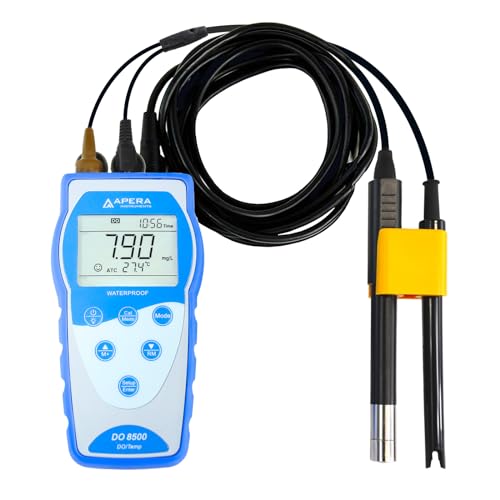
- Optical sensor with minimal maintenance
- 500 data groups with USB output
- Automatic salinity, temperature, and air-pressure compensation
Best For: Professional field testing and data-rich water monitoring
Heavy-Duty Pick
Extech 407510 Dissolved Oxygen Meter

- Heavy-duty kit with 13-foot cable
- Portable, battery-powered design
- Warranty covers meter and probe for different terms
Best For: Extended-reach portable DO testing
Best Memory Value
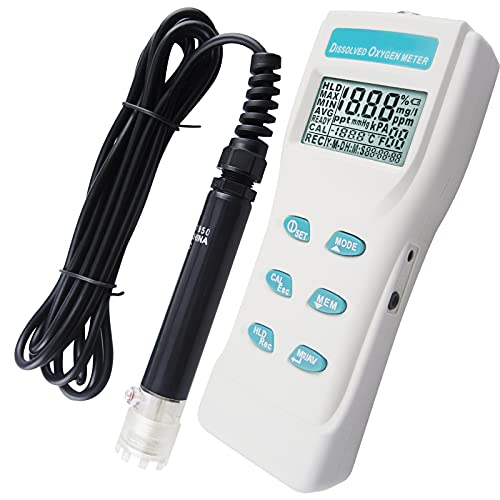
- 99-data memory with data hold
- Measures DO, temperature, salinity, and pressure
- Includes membranes, electrolyte, batteries, and case
Best For: Routine aquarium, aquaculture, and educational testing
Best Simple Option
Milwaukee MW600 Economy DO Meter

- Two-point manual calibration
- Automatic temperature compensation from 0–30°C
- 0.1 mg/L resolution with ±1.5% accuracy
Best For: Basic educational and routine portable DO measurements
App-Connected Field Choice
GIDIGI Digital Dissolved Oxygen Meter
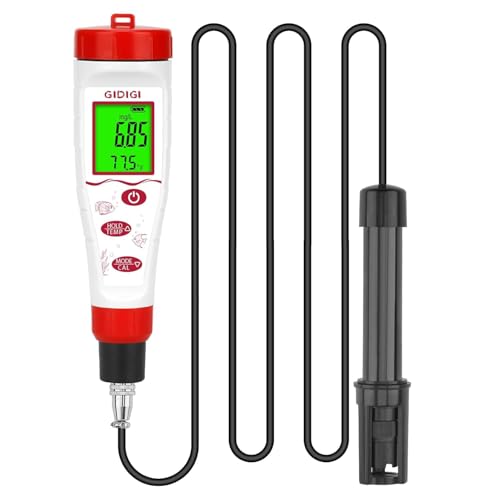
- Bluetooth app stores, manages, and shares test data
- Measures mg/L and saturation percentage
- 3 m cable suits deeper water and outdoor testing
Best For: Aquaculture and field users who want app-based data logging
Proven Portable Kit
Extech DO210 Dissolved Oxygen Meter

- Measures DO, saturation, and temperature
- Includes Min/Max and Data Hold functions
- 4 m cable and field accessories included
Best For: Routine field water-quality checks with simple onboard data capture
High-Resolution Workhorse

- 0.01 mg/L resolution across a 0–20 mg/L range
- One-click operation saves readings
- IP65 protection and 9.84 ft cable
Best For: Aquaculture and treatment monitoring requiring high-resolution onboard logging
Best Data Logger

- Records and recalls up to 99 readings
- Measures DO and temperature in multiple units
- Includes ATC, pressure compensation, and calibration solution
Best For: Aquarium, hydroponic, pond, and home water monitoring
Best for Versatile Testing

- Measures up to 40 mg/L with percent and mg/L units
- Provides ATC across 0–50°C
- Includes spare membrane caps, electrolyte, and batteries
Best For: Aquariums, aquaculture, brewing, wastewater, and education
Best Simple Extended-Range Option

- Measures dissolved oxygen from 0–40.0 mg/L
- Supports probe-in-cover testing and 0–50°C ATC
- Includes protective covers, calibration powder, and batteries
Best For: Routine aquarium, pond, pool, and aquaculture testing
Best Overall – APERA AI485 DO8500 Optical Meter
For buyers seeking dissolved oxygen meters with data logging, the APERA AI485 DO8500 stands out with optical sensing, automatic compensation, and GLP data management. It stores up to 500 data groups and includes USB data output, making it well suited to repeat testing and recordkeeping.
Best For: Field professionals, aquaculture operators, and environmental users who need portable testing with substantial onboard storage.
Pros:
- Optical DO sensor requires minimal maintenance.
- Automatically compensates for salinity, temperature, and air pressure.
- Stores 500 groups of data and supports USB output.
- Complete kit includes a 10-foot probe, salinity probe, calibration cap, and rugged case.
Cons:
- Heavier and more involved than basic handheld meters.
- Requires three AA batteries.
Its combination of optical measurement, compensation features, and GLP storage makes this the strongest choice here for organized, repeatable dissolved oxygen data collection.
Heavy-Duty Pick – Extech 407510 Dissolved Oxygen Meter
The Extech 407510 is presented as a heavy-duty dissolved oxygen meter kit with a 13-foot cable. It is a practical option for users who value a longer reach and a compact, battery-powered design, though the supplied specifications do not list onboard data logging.
Best For: Users who need a portable, heavy-duty DO meter with an extended probe cable.
Pros:
- Includes a 13-foot cable for flexible testing access.
- Battery powered and portable at approximately 0.5 kg.
- Includes a one-year meter warranty and six-month probe warranty.
Cons:
- Supplied notes do not specify data storage or data-export functions.
- The product details are less specific about compensation and measurement ranges than the other listed meters.
Choose the Extech when cable reach and a rugged kit matter most; buyers specifically prioritizing dissolved oxygen meters with data logging should verify the recording capabilities before purchase.
Best Memory Value – Portable DO Tester with IRDA
This portable DO tester offers useful data-management features at a practical scale, including 99-data memory, data hold, and an IRDA port. It also measures temperature, salinity, and barometric pressure, making it a versatile choice among dissolved oxygen meters with data logging for aquarium, aquaculture, and general water-testing tasks.
Best For: Aquarium owners, aquaculture users, educators, and field testers who need basic stored readings and multiple water parameters.
Pros:
- Stores up to 99 readings and includes data hold.
- Measures DO, temperature, salinity, and barometric pressure.
- Large LCD offers readings in percent or ppm/mg/L.
- Complete kit includes batteries, membranes, electrolyte, and carrying case.
Cons:
- Memory capacity is lower than the APERA meter’s 500 groups.
- Clark-type electrode requires membrane and electrolyte maintenance.
Its broad measurement range and included maintenance supplies make it a balanced option for routine monitoring, especially when 99 stored readings are sufficient.
Best Simple Option – Milwaukee MW600 Economy DO Meter
The Milwaukee MW600 is a straightforward portable dissolved oxygen meter for education, aquaculture, water analysis, and environmental work. Its two-point manual calibration and automatic temperature compensation support routine measurements, but the supplied notes do not mention data storage or logging.
Best For: Students, educators, and users who want a simple portable meter for basic DO measurements.
Pros:
- Two-point manual calibration supports routine setup.
- Provides automatic temperature compensation from 0 to 30°C.
- Portable design with an LCD screen and three-meter probe cable.
- Offers 0.1 mg/L resolution and ±1.5% accuracy.
Cons:
- Supplied notes do not list data logging or memory.
- Manual calibration requires more user involvement than automatic calibration.
- Temperature compensation range is specified only from 0 to 30°C.
This is a sensible low-complexity choice for immediate readings, but buyers specifically searching for dissolved oxygen meters with data logging should consider a model with documented memory or data output.
App-Connected Field Choice – GIDIGI Digital Dissolved Oxygen Meter
For shoppers comparing dissolved oxygen meters with data logging, the GIDIGI GX-D01C2 stands out for Bluetooth-connected data storage, management, and sharing through its phone app. It measures dissolved oxygen in mg/L or saturation percentage and adds automatic temperature compensation, with app-based salinity and barometric-pressure adjustments.
Best For: Aquaculture, ponds, fish tanks, hydroponics, brewing, wastewater work, and outdoor monitoring where stored or shareable readings are useful.
Pros:
- Bluetooth app supports storing, managing, and sharing test data.
- Offers mg/L and percentage saturation modes with automatic temperature compensation.
- Includes a 3 m electrode cable for deeper water and outdoor measurements.
- Includes replacement membrane parts, electrolyte, and zero-oxygen water for calibration.
Cons:
- Salinity and altitude compensation require adjustment through the app rather than fully automatic operation.
- The supplied notes do not specify the app platform or detailed logging export options.
The GIDIGI is a practical fit when data logging and mobile sharing matter as much as basic DO measurement. Its long cable and included calibration supplies make it especially flexible for field and aquatic-system testing.
Proven Portable Kit – Extech DO210 Dissolved Oxygen Meter
Among dissolved oxygen meters with data logging features, the Extech DO210 offers straightforward onboard data handling through Min/Max and Data Hold functions. It measures dissolved oxygen, oxygen saturation, and temperature, while automatic temperature compensation and adjustable altitude and salinity settings support varied water-quality applications.
Best For: Field technicians and water-quality users who want a compact, established meter with basic reading capture and a complete carrying kit.
Pros:
- Measures 0–20.0 mg/L DO, 0–100% saturation, and water temperature.
- Automatic temperature compensation helps account for changing water temperatures.
- Adjustable altitude and salinity compensation support diverse environments.
- Includes a 4 m cable, spare membranes, electrolyte, battery, and soft case.
Cons:
- Data handling is limited to Min/Max and Data Hold functions in the supplied notes.
- Does not list app connectivity or downloadable data logging.
- Its temperature range is limited to 32–122°F (0–50°C).
The DO210 is best viewed as a field-ready meter with simple onboard capture rather than a connected logging platform. Its long cable and included consumables make it convenient for routine water-quality checks.
High-Resolution Workhorse – LOHAND LH-D701 DO Meter
The LOHAND LH-D701 is a strong option for buyers seeking dissolved oxygen meters with data logging and detailed readings. It provides 0.01 mg/L resolution, stores readings with one-button operation, and simultaneously displays dissolved oxygen concentration, saturation, and temperature. Manual atmospheric-pressure and salinity compensation complement automatic temperature compensation.
Best For: Aquaculture, sewage treatment, environmental monitoring, and lab or field users who value high-resolution readings and simple onboard saving.
Pros:
- Provides a 0.00–20.00 mg/L range with 0.01 mg/L resolution.
- One-click operation supports data switching and saving.
- Combines automatic temperature compensation with manual pressure and salinity compensation.
- IP65 protection, backlight, and a 9.84 ft electrode cable support demanding field use.
Cons:
- Pressure and salinity compensation are manual rather than automatic.
- The supplied notes do not mention app connectivity or computer-based data export.
- At 2.76 pounds, it is heavier than the Extech model listed here.
The LH-D701 suits users who prioritize resolution, visible operating prompts, and straightforward onboard logging. Its IP65 construction and long cable add practical value for wet or dusty monitoring environments.
Best Data Logger – 99-Sample DO Meter
For shoppers comparing dissolved oxygen meters with data logging, this portable model stands out for its ability to record and recall up to 99 readings. It measures dissolved oxygen and temperature, supports multiple units, and includes compensation features for more adaptable testing.
Best For: Aquarium, hydroponics, pond, and home water monitoring where stored readings are useful.
Pros:
- Stores and recalls up to 99 data samples.
- Displays dissolved oxygen in percent, ppm, or mg/L.
- Includes automatic temperature compensation, barometric pressure compensation, and data hold.
- Includes electrolyte solution and one-key calibration.
Cons:
- Its stated accuracy is -1.5%/+1.5% of readings, so it may not suit applications requiring tighter specifications.
- At 2.46 pounds, it is heavier than the compact alternatives in this roundup.
This is the strongest match for buyers who specifically want onboard data logging rather than a meter focused only on live readings. Its flexible units and compensation controls add convenience for routine water testing.
Best for Versatile Testing – Yewhick 40 mg/L DO Meter
For dissolved oxygen meters with data logging alternatives, this Yewhick model emphasizes broad measurement capability, stable readings, and included maintenance supplies. It measures up to 40 mg/L, uses automatic temperature compensation, and offers two-point automatic calibration.
Best For: Aquariums, aquaculture, brewing, wastewater testing, education, and general water-quality checks.
Pros:
- Measures dissolved oxygen from 0 to 40 mg/L or 0.0 to 300.0%.
- Built-in temperature sensor and automatic temperature compensation cover 0–50°C.
- Includes two-point automatic calibration, six spare membrane caps, electrolyte, and calibration supplies.
- Uses three included LR44 batteries and is rated for up to 2,000 hours of continuous use.
Cons:
- The supplied notes do not specify a data-recording or memory function.
- Calibration and probe maintenance require consumable supplies such as electrolyte and membrane caps.
This model is a practical choice when measurement range, automatic compensation, and included accessories matter more than stored readings. Its cable-mounted probe and wide application list support repeated testing across different water environments.
Best Simple Extended-Range Option – ATC DO Meter, No Backlight
This dissolved oxygen meter is designed for straightforward field and routine water testing, with an expanded 0–40.0 mg/L range and automatic temperature compensation. Unlike the other compact option here, this version is specifically identified as having no backlight.
Best For: Aquariums, pools, ponds, aquaculture, research, and general water testing in normal lighting.
Pros:
- Offers an expanded 0–40.0 mg/L dissolved oxygen range.
- Measures without removing the electrode’s protective cover.
- Automatic temperature compensation operates across 0–50°C.
- Includes six probe protective covers, calibration powder, batteries, auto power-off, and a low-battery indicator.
Cons:
- This version has no backlight, which may make readings harder to see in dim conditions.
- The supplied notes do not mention data logging or stored-memory readings.
- Membrane sleeves may need replacement if accuracy and calibration performance decline.
Choose this version for its extended range and simple probe handling, especially if you usually test in well-lit settings. It is less suitable for shoppers specifically seeking dissolved oxygen meters with data logging or illuminated displays.
How We Picked These Dissolved Oxygen Meters with Data Logging
We compared the selected meters by looking at the features that most affect real-world water testing: dissolved oxygen range and resolution, temperature compensation, salinity and atmospheric-pressure adjustment, calibration methods, memory capacity, probe and cable design, display usability, and portability. Models with explicit recording or memory functions received particular attention for users who need to document readings rather than check them only once.
We also considered whether each meter is better suited to routine field checks, aquaculture, aquarium maintenance, wastewater work, or more controlled testing. Product specifications can vary by seller and configuration, so verify included probes, calibration solution, batteries, case, and warranty before ordering.
Quick Comparison
| Feature | What to look for | Why it matters |
|---|---|---|
| Measurement range | Commonly 0–20 mg/L; some meters reach 40 mg/L | Higher ranges help with specialized or highly oxygenated samples |
| Data storage | Internal memory, data logging, or downloadable records | Supports trend tracking and compliance documentation |
| Compensation | Automatic temperature plus manual or automatic salinity and pressure settings | Improves accuracy when water conditions change |
| Probe setup | Replaceable membrane, filling solution, cable length, and connector | Affects maintenance and access to tanks, ponds, and sampling points |
Key Buying Factors for Dissolved Oxygen Meters with Data Logging
Accuracy, Range, and Resolution
Choose a range that covers your application with room to spare. A 0.1 mg/L resolution is often adequate for routine aquaculture and aquarium checks, while laboratory or regulatory work may require tighter accuracy and documented calibration procedures.
Compensation and Calibration
Temperature compensation is important because oxygen solubility changes with temperature. If you test saltwater, brackish water, or samples at varying elevations, prioritize salinity and atmospheric-pressure compensation. Two-point calibration can provide more flexibility than a basic single-point procedure, but only when you are willing to maintain the probe correctly.
Logging and Workflow
For Dissolved Oxygen Meters with Data Logging, check the number of stored readings, whether records include temperature and time, and how data are retrieved. Internal memory is convenient for fieldwork; USB or software export is preferable when results must be archived, analyzed, or shared.
Probe Maintenance and Durability
Polarographic probes may require membrane and electrolyte maintenance, while optical systems can reduce routine servicing but may cost more. Confirm replacement-part availability, cable length, waterproofing, and the meter’s resistance to moisture before buying.
Who Should Buy Which Dissolved Oxygen Meters with Data Logging?
For aquaculture and ponds: Choose a portable meter with automatic temperature compensation, a durable cable, and enough memory for repeated readings across multiple sites.
For aquariums and home testing: A straightforward model with clear controls, manageable calibration, and a moderate measurement range is usually the best value.
For saltwater or brackish applications: Prioritize salinity compensation and a probe designed for frequent cleaning and recalibration.
For field surveys and wastewater work: Look for robust construction, long probe cables, broad compensation controls, and dependable data logging or export.
For laboratory or process monitoring: Favor the strongest accuracy specifications, repeatable calibration, traceable records, and readily available replacement probes and consumables.