The best physics experiment sets for homeschool turn abstract concepts into hands-on lessons. With the right kit, students can build circuits, test forces, explore magnetism, and connect classroom theory to visible results.
This roundup compares 10 options across electricity, mechanics, engineering, and general STEM learning. Use the guide below to match each set with your learner’s age, curriculum, and preferred project style.
Best 10 Physics Experiment Sets for Homeschool Picks for 2026
Best for Electromagnetism
EUDAX Electricity & Magnetism Lab Kit
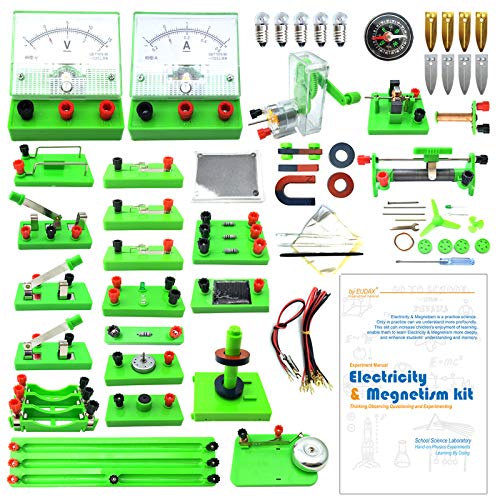
- 79-piece kit with color manual
- Covers circuits, magnets, and Ohm’s law
- Batteries required but not included
Best For: Hands-on electricity and magnetism lessons
Best Broad Science Variety
Doctor Jupiter Ultimate Science Kit

- Includes 135+ guided experiments
- Comes with basic lab tools and materials
- Designed for ages 8 and up
Best For: Broad, family-friendly STEM exploration
Best for Force and Mechanics
T&K Simple Machines Physics Set

- Builds 26 simple-machine models
- Includes a force-measuring spring scale
- No batteries required
Best For: Mechanics and engineering lessons for ages 8+
Best for Mixed STEM Activities
UNGLINGA 150-Experiment Science Kit

- Advertises 150 science experiments
- Includes tools, materials, and goggles
- Covers physics, chemistry, and earth science
Best For: Varied hands-on science practice for ages 8+
Best Hands-On Mechanics Kit
Physics Laws: Inertia, Friction & Circular Motion

- Build six working physics models
- Includes theory, experiments, and quizzes
- Recommended for ages 9 and up
Best For: Hands-on homeschool lessons about motion and mechanics
Best Magnetism Starter Set

- Includes 14 magnets and accessories
- Features a compass, magnetic cars, and iron filings
- Recommended for ages 8 and up
Best For: Beginner magnetism activities at home or in class
Best Introductory Electricity Kit

- Builds series and parallel circuits
- Includes English assembly instructions
- Stores in a plastic case
Best For: Grades 7–9 homeschool electricity lessons
Best Simple Circuit Starter

- Designed for beginning circuit lessons
- Builds simple, series, and parallel circuits
- Includes bulbs, wires, holders, and a switch
Best For: Ages 8–12 and early STEM activities
Best Expanded Electricity and Magnetism Set

- Includes over 50 hands-on experiments
- Covers electricity and magnetism
- Comes with 55 items and a storage case
Best For: Ages 13–18 and extended physics units
Best for Electromagnetism – EUDAX Electricity & Magnetism Lab Kit
For homeschoolers seeking physics experiment sets for homeschool, this EUDAX kit focuses specifically on introductory electricity and magnetism. It includes 79 items, a color-page manual, and projects such as series and parallel circuits, fruit batteries, electromagnets, electric bells, and a hand-crank generator. Three AA batteries are required but not included.
Best For: Students in grades 9–11 or learners ages 8–18 exploring basic electricity, magnetism, and electromagnetism through hands-on models.
Pros:
- Offers dedicated electricity and magnetism activities.
- Includes 56 electricity items, 21 magnetism items, repair tools, and a manual.
- Supports projects involving circuits, Ohm’s law, electromagnets, and generators.
Cons:
- Requires three AA batteries, which are not included.
- The subject focus is narrower than an all-purpose science kit.
This is a strong choice when your homeschool curriculum needs a focused, reusable introduction to electrical and magnetic principles rather than broad coverage of multiple science fields.
Best Broad Science Variety – Doctor Jupiter Ultimate Science Kit
The Doctor Jupiter Ultimate Science Kit is a broad option for families comparing physics experiment sets for homeschool with more general science activities. It includes materials and instructions for more than 135 experiments, covering topics such as color changes, glowing water, underwater volcanoes, chemistry, and other STEM concepts.
Best For: Children ages 8 and up who benefit from varied, guided experiments and parent-child science activities.
Pros:
- Provides more than 135 experiments when the included bonus booklet is counted.
- Includes tools such as a measuring cylinder, conical flask, funnel, tray, cups, and test-tube stand.
- Step-by-step instructions and illustrations support independent or supervised use.
Cons:
- It is a general science kit, not a physics-focused set.
- Some experiments use everyday household items beyond the included components.
Choose this kit if variety and repeated science sessions matter more than a structured study of one physics topic. Its broad experiment list can add flexibility to a hands-on homeschool schedule.
Best for Force and Mechanics – T&K Simple Machines Physics Set
For a mechanics-centered homeschool lesson, the T&K Simple Machines set offers 26 model-building exercises involving all six classic simple machines. The included spring scale lets students measure how levers, pulleys, gears, inclined planes, screws, wedges, and wheel-and-axle systems affect the direction and magnitude of forces.
Best For: Learners ages 8 and up studying force, mechanical advantage, and everyday engineering through construction and measurement.
Pros:
- Covers all six classic simple machines through 26 models.
- Includes a spring scale for hands-on force measurement.
- Uses a 32-page, full-color manual with step-by-step instructions.
Cons:
- Focuses primarily on simple machines and mechanics rather than broad physics.
- The set contains plastic building pieces, so projects depend on assembling models.
This is one of the more targeted physics experiment sets for homeschool, especially when you want students to connect textbook force concepts with measurable, working models.
Best for Mixed STEM Activities – UNGLINGA 150-Experiment Science Kit
The UNGLINGA kit is a flexible choice for families looking at physics experiment sets for homeschool alongside chemistry, earth science, and surface-tension activities. It advertises 150 experiments, includes science tools and kid-friendly materials, and uses an illustrated manual to guide projects, with additional activities relying on common household items.
Best For: Children ages 8 and up who want a broad collection of short, hands-on science activities with an emphasis on exploration.
Pros:
- Offers 150 experiments across physics and several other science topics.
- Includes laboratory-style tools, materials, and goggles for selected activities.
- Step-by-step illustrations make the projects easier to follow.
Cons:
- Physics is only one part of the kit’s broader subject coverage.
- Some projects require regular household items in addition to the included materials.
Consider UNGLINGA when you want a high-volume activity kit for school breaks, weekends, or supplementary lessons. It favors breadth and experimentation over a sequential physics curriculum.
Best Hands-On Mechanics Kit – Physics Laws: Inertia, Friction & Circular Motion
For families looking for physics experiment sets for homeschool, the Engino Physics Laws kit offers a structured way to explore inertia, friction, and circular motion through building. Children ages 9 and up can construct six working models, then use the included theory, experiments, facts, and quiz materials to reinforce what they discover.
Best For: Homeschool learners who enjoy building models while studying introductory laws of motion.
Pros:
- Includes six working models, including a rocket launcher, crash test rig, and sharpening wheel.
- Provides 12 pages of theory, experiments, and a four-page quiz section.
- Includes an interactive 3D app for virtual building and complements hands-on construction.
- Supports construction, critical thinking, logic, and other STEM skills.
Cons:
- Recommended for children ages 9 and up, so it may be too advanced for younger learners.
- Focuses on a specific group of mechanics topics rather than broad physics coverage.
This is a strong choice when you want physics instruction to include both physical construction and guided review. Its model-based format may be especially engaging for children who learn best by making and testing things.
Best Magnetism Starter Set – Junior Science Magnetism Set
The Sntieecr Labs Junior Science Magnetism Set is a compact option among physics experiment sets for homeschool. Designed for learners ages 8 and up, it provides magnets, a compass, magnetic cars, and iron filings for simple investigations into magnetism and the Earth’s magnetic field.
Best For: Beginners who need an accessible magnetism kit for home or classroom exploration.
Pros:
- Includes 14 magnets and accessories, including bar, U-shaped, and ring magnets.
- Features a compass, three magnetic cars, and an iron filings box for varied demonstrations.
- Can be paired with common household items such as pens, rulers, and paper.
- Encourages observation, questioning, and connections between lessons and everyday life.
Cons:
- Concentrates primarily on magnetism rather than covering multiple areas of physics.
- Some experiments require additional household tools or materials.
- The included compass is made from plastic.
This set works well as a focused introduction to magnetic forces without requiring a large collection of equipment. Its small size and open-ended activities make it practical for short homeschool investigations.
Best Circuit-Building Set – Electronics Exploration Kit
For homeschool families moving from basic physics into electricity and circuits, this electronics exploration kit offers 66 color-coded parts and a project guide. The snap-together design requires no soldering or extra tools, allowing children ages 6 and up to begin building circuit projects quickly.
Best For: Young learners who want an approachable introduction to circuitry and electrical engineering concepts.
Pros:
- Includes 66 parts mounted on a numbered, color-coded plastic grid.
- Offers a guide featuring more than 1,200 project possibilities.
- Requires no soldering, batteries, or additional tools for setup.
- Supports creativity, problem-solving, and practical circuit-building skills.
Cons:
- The product is centered on electronics and circuits rather than general physics topics.
- The broad age claims in the listing vary, although the stated manufacturer recommendation is ages 6 and up.
- Projects depend on the included components and guide rather than open-ended individual parts selection.
This kit is a convenient bridge into electrical concepts for children who benefit from visual, modular construction. It is particularly useful when you want screen-free project variety without introducing soldering or complicated tools.
Best Introductory Electricity Kit – EUDAX Basic Circuit Lab
For families comparing physics experiment sets for homeschool, the EUDAX Basic Circuit Lab offers a focused introduction to electricity. Students can use the English instructions to assemble simple series and parallel circuits while reinforcing concepts from their science lessons.
Best For: Homeschool students in approximately grades 7–9 working on introductory electricity, circuit-building, or a STEM unit study.
Pros:
- Supports series and parallel circuit experiments.
- Includes English instructions for guided assembly.
- Encourages hands-on learning, problem-solving, and creativity.
- Components come in a plastic storage box for organization.
Cons:
- AA batteries are not included.
- The basic kit focuses primarily on introductory electricity rather than a broad range of physics topics.
This is a practical choice when your homeschool curriculum needs a straightforward, reusable circuit activity. Its narrow focus makes it especially suitable for learning foundational current and circuit rules without adding unrelated experiments.
Best Simple Circuit Starter – Kids Basic Circuit Board Kit
Among physics experiment sets for homeschool, this basic circuit board kit is designed for younger learners who are beginning to explore current and electrical connections. Its included bulbs, wires, holders, and switch let children construct simple, series, and parallel circuits.
Best For: Children approximately ages 8–12, including primary and junior students beginning hands-on STEM and electricity activities.
Pros:
- Introduces basic current and circuit concepts in a hands-on format.
- Supports simple, series, and parallel circuit projects.
- Includes a switch, bulb bases, battery holders, wires, and bulbs.
- Components are made from plastic described as nontoxic and odorless.
Cons:
- Batteries are not included.
- Its basic design may be limited for students seeking advanced electricity or magnetism experiments.
This kit works well as an accessible first circuit set for family experiments or a homeschool science lesson. It emphasizes construction and exploration, making abstract electrical ideas easier to connect with practical activity.
Best Expanded Electricity and Magnetism Set – Mysterystone Physics Lab
For homeschoolers wanting more variety than a basic circuit activity, the Mysterystone kit combines electricity and magnetism in a larger physics lab set. It includes 55 items and a manual covering more than 50 hands-on experiments, including circuit, electromagnet, magnetic switch, and light-control projects.
Best For: Older students, approximately ages 13–18, who want an exploratory electricity and magnetism unit with multiple experiment options.
Pros:
- Offers more than 50 electricity and magnetism experiments.
- Includes distinctive projects such as a magnetic switch, light-control LED, and Joule’s first law experiment module.
- Provides a clearly illustrated manual explaining both procedures and concepts.
- Comes with 55 items in a portable storage case.
Cons:
- The larger set weighs about 1.89 kg, so it is less lightweight than basic kits.
- Its recommended age range may make it less suitable for younger beginners.
- The notes do not specify whether batteries are included.
This is the strongest option here for a broader homeschool physics sequence rather than a single introductory lesson. The experiment variety and explanatory manual can support extended exploration, while the storage case helps keep the many parts organized.
How We Picked These Physics Experiment Sets for Homeschool
We focused on kits that support practical investigation rather than passive demonstration. The selection covers electrical circuits, electromagnetism, magnetism, simple machines, motion, friction, inertia, and broader STEM activities. We also considered age guidance, project variety, the likelihood of repeated use, and whether the components appear suited to guided lessons or independent exploration.
Because kit contents and instructions vary, check the current listing for exact parts, experiment counts, recommended ages, and supervision requirements before buying.
Quick Comparison
| Best For | Look For | Typical Learning Focus |
|---|---|---|
| Beginner learners | Clearly labeled parts and simple instructions | Basic circuits, magnets, and observation |
| Older students | Modular components and repeatable experiments | Voltage, current, electromagnetism, and measurement |
| Engineering-minded kids | Buildable mechanisms and open-ended challenges | Forces, motion, machines, and design thinking |
| Mixed-age homeschool families | Multiple difficulty levels and many activities | General STEM exploration and project-based learning |
Key Buying Factors for Physics Experiment Sets for Homeschool
Age and Lesson Difficulty
Choose a kit that matches the learner’s reading ability, patience, and prior experience. Younger children generally benefit from guided builds and visible cause-and-effect results, while older students may need components that support testing, troubleshooting, and more precise explanations.
Subject Coverage
Decide whether you need a focused electricity kit or a broader set. Circuit-focused products are useful for a structured physics unit, while mechanics and general science kits can provide variety when several children share the materials.
Instructions and Component Quality
Good diagrams, labeled parts, and progressive experiments reduce frustration. Look for reusable components, secure connections, and a storage solution. Confirm whether batteries or other consumables are included.
Safety and Supervision
Even low-voltage kits require sensible supervision. Review warnings, inspect wires and connectors, and explain safe battery use. Avoid modifying circuits beyond the instructions unless an adult is guiding the activity.
Who Should Buy Which Physics Experiment Sets for Homeschool?
Choose a dedicated electricity or electromagnetism set for a learner studying circuits and wanting repeated practice. A magnetism kit is a focused option for short lessons and simple demonstrations. Simple-machines and motion sets suit children who learn best by building and manipulating mechanisms.
For families wanting broad coverage, a large multi-experiment science kit offers more variety, though it may provide less depth in any one physics topic. An electronics exploration kit can be a strong fit for project-oriented learners who enjoy assembling and troubleshooting. If you are teaching a formal high-school unit, prioritize clear documentation, reusable parts, and experiments that support measurement and written conclusions over sheer project count.