Electronic loads with USB make it easier to test chargers, power banks, batteries, and development hardware under controlled conditions. The models in this roundup range from compact USB modules to programmable bench loads with higher voltage, current, and power limits.
Use the buying guide below to match test capacity, control options, display features, and connectivity to your projects—whether you need quick USB checks or repeatable laboratory-style measurements.
Best 10 Electronic Loads with USB Picks for 2026
Best Compact USB Load
DROK 25W Adjustable USB Load Tester
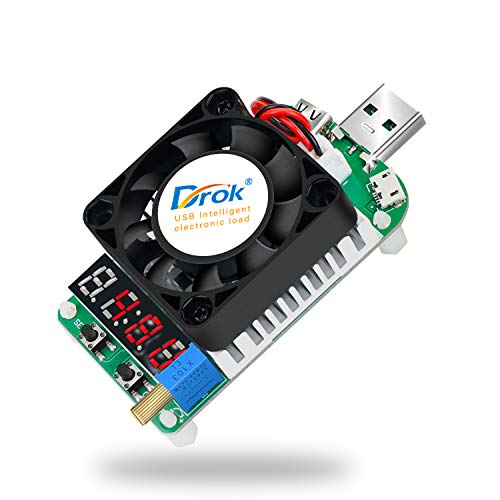
- 0.25A–4A adjustable constant current
- LED voltage, current, and power display
- USB and Type-C testing with cooling fan
Best For: Charger, cable, and small USB power-output tests
Best Programmable Bench Load
OWON OEL1530 300W Electronic Load

- USB, RS232, and RS485 with SCPI
- 0–150V, 0–30A, and 300W operation
- CV, CC, CR, and CP modes with 5kHz dynamic testing
Best For: Automated laboratory and production testing
Best Battery Capacity Tester
MakerHawk 180W Four-Wire USB Load

- 180W, 200V, and 20A maximum ratings
- Four discharge modes and four-wire measurement
- App, Bluetooth, and wired PC connectivity
Best For: Battery, power-bank, and long-duration discharge testing
Best Fast-Charge Protocol Tester

- Tests QC2.0, QC3.0, AFC, and FCP
- Triggers 5V, 9V, 12V, and 20V outputs
- USB, Micro USB, Type-C, and external ports
Best For: Fast-charge, charger, cable, and power-bank testing
Best Versatile Pick
180W USB Electronic Load Tester

- Four modes: CC, CV, CW, and CR
- 180W, 200V, and 20A capability
- Color display with temperature and fan control
Best For: DIY charger, cable, battery, and DC adapter testing
Best Programmable Option
ET5410A+ 400W USB-Controlled Load

- 400W load with 0–150V and 0–40A range
- 12 test modes for lab and production work
- USB PC control plus safety protections
Best For: Programmable charger, power supply, and battery testing
Best Compact USB Meter
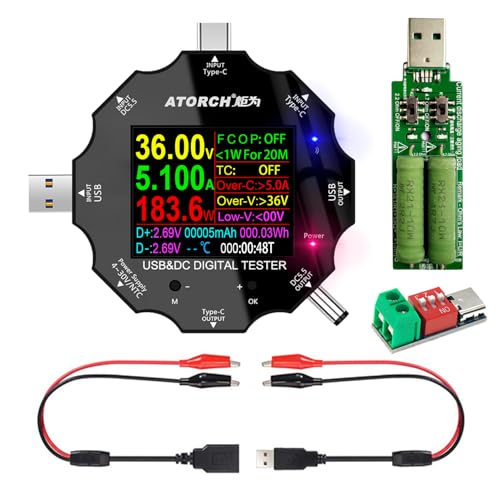
- Supports USB, Type-C, DC5.5, and micro USB
- Measures charging and capacity data
- Recognizes PD and QC fast-charge standards
Best For: Portable USB, Type-C, cable, and charger diagnostics
USB Cable Specialist
35W Adjustable USB Load Tester

- OLED readings for key USB test values
- 0–3A coarse and fine current control
- Includes QC2.0/QC3.0 trigger
Best For: USB chargers, cables, and power banks
Advanced Mode Tester
180W Multi-Mode Electronic Load

- Four constant-load operating modes
- 2.4-inch display with data reports
- Includes external temperature probe
Best For: DIY bench testing and detailed discharge analysis
Best Compact USB Load – DROK 25W Adjustable USB Load Tester
The DROK LD25 is a practical choice for testing electronic loads with USB and Type-C connections. Its adjustable constant-current range, digital readout, and temperature-controlled fan make it useful for checking charger, cable, and power-output performance.
Best For: Charger output checks, USB and Type-C cable testing, and modest 25W discharge or aging tasks.
Pros:
- Adjustable 0.25A–4A constant-current testing.
- Displays voltage, current, and power on a four-digit LED screen.
- Includes temperature-controlled cooling and over-voltage, over-power, and over-temperature protection.
Cons:
- Limited to 25V, 4A, and 25W; these ratings should not be exceeded.
- Has no reverse-connection protection, so incorrect polarity can permanently damage the unit.
Choose this model when you want a compact, straightforward USB load tester rather than a high-power laboratory instrument. Its safeguards and fan support routine testing, but careful connection and rating checks are essential.
Best Programmable Bench Load – OWON OEL1530 300W Electronic Load
The OWON OEL1530 is a full benchtop option for users who need electronic loads with USB connectivity and computer control. It combines programmable operation, dynamic testing, multiple load modes, and a color display for more demanding development and production work.
Best For: Automated lab testing, production-line validation, transient testing, and battery charge/discharge analysis.
Pros:
- Supports USB, RS232, and RS485 connectivity with SCPI protocol.
- Handles up to 150V, 30A, and 300W, with CV, CC, CR, and CP modes.
- Offers dynamic testing up to 5kHz and integrated battery charge/discharge testing.
- Includes OCP, OVP, OPP, OTP, and reverse-polarity protection.
Cons:
- Its 2.5 kg benchtop design is less portable than compact USB modules.
- More capability than needed for simple charger or cable checks.
This is the strongest fit for structured, repeatable testing where PC integration and programmable profiles matter. Its broad operating range and protection features make it considerably more versatile than basic USB-only load modules.
Best Battery Capacity Tester – MakerHawk 180W Four-Wire USB Load
The MakerHawk battery tester suits users looking for electronic loads with USB support and more detailed discharge analysis. Its four-wire measurement system, color display, multiple discharge modes, and app or PC connectivity support testing across batteries, power banks, chargers, and adapters.
Best For: Battery capacity testing, long-duration discharge or aging tests, and accurate evaluation of power banks and adapters.
Pros:
- Supports up to 200V, 20A, and 180W.
- Provides constant-current, constant-power, constant-resistance, and constant-voltage modes.
- Four-wire measurement helps reduce the effect of wire resistance on voltage readings.
- Offers Android, iOS, PC Bluetooth, and wired connection compatibility.
Cons:
- Larger than a basic USB discharge module.
- Its extensive battery-testing features may be unnecessary for occasional USB checks.
For capacity and endurance work, the MakerHawk offers a useful mix of measurement detail and operating flexibility. The temperature-controlled fan and safety monitoring are particularly helpful during extended discharge or aging sessions.
Best Fast-Charge Protocol Tester – UCTRONICS 35W USB Load Tester
The UCTRONICS RS2818 stands out among electronic loads with USB interfaces because it also tests and triggers several fast-charge protocols. Multiple connection ports and adjustable discharge operation make it useful for checking chargers, cables, and power banks across common voltage levels.
Best For: Fast-charge protocol checks, USB charger and cable testing, and power-bank aging tasks.
Pros:
- Tests QC2.0, QC3.0, AFC, and FCP fast-charge protocols.
- Can trigger 5V, 9V, 12V, and 20V outputs.
- Provides USB, Micro USB, Type-C, and external wiring ports.
- Includes reverse, over-voltage, over-current, over-power, low-voltage, and over-temperature protection.
Cons:
- Maximum discharge power is 35W, with a rated operating range of 4–25V and 0.03–5A.
- Designed for protocol and device testing rather than high-power bench-load work.
This model is a strong pick when identifying fast-charge behavior is as important as applying a load. Its broad protocol support and connection options add flexibility, while the 35W ceiling keeps it focused on USB-scale applications.
Best Versatile Pick – 180W USB Electronic Load Tester
For shoppers comparing electronic loads with USB support, this 180W tester offers a practical balance of load control, battery testing, and charger diagnostics. Its color display and four operating modes make it useful for checking voltage, current, power, capacity, and related data from USB and other DC sources.
Best For: DIY users and repair benches testing USB chargers, Type-C cables, lithium batteries, and DC adapters.
Pros:
- Supports constant current, voltage, power, and resistance modes.
- Handles up to 180W, 200V, and 20A according to the supplied specifications.
- Includes a 2.4-inch color screen, temperature monitoring, and intelligent fan control.
- Supports Android, Type-C, Mini, and other cable testing applications.
Cons:
- Its 180W and 20A limits may not suit higher-power testing.
- The external NTC thermometer is an added accessory rather than an integrated measurement feature.
This is a flexible choice when you want one compact instrument for USB charger checks, cable testing, and controlled DC discharge work. It is less appropriate for applications requiring more than 180W or 20A.
Best Programmable Option – ET5410A+ 400W USB-Controlled Load
If you need electronic loads with USB control for more structured testing, the ET5410A+ is the most advanced option in this group. It combines 400W capacity, PC control, detailed measurements, and multiple test modes for chargers, power supplies, adapters, and batteries.
Best For: Electronics labs, repair benches, R&D work, and production-line evaluation of DC power devices.
Pros:
- Provides 400W, 0–150V, and 0–40A operating capability.
- Offers 12 modes, including CC, CV, CR, CP, battery, LED, dynamic, scan, list, and short-circuit tests.
- USB interface supports PC remote operation and automated testing.
- Includes fine voltage and current resolution, a 2.8-inch TFT display, and multiple safety protections.
Cons:
- Its corded, 8-pound design is less portable than compact USB meters.
- The stated upper temperature rating is 40°C, so operating conditions require attention.
- Its professional feature set may be more than casual users need.
This is the strongest pick for repeatable, programmable testing and higher-power DC loads. Choose it over a simpler tester when PC control, automation, and broader test coverage matter more than portability.
Best Compact USB Meter – UD18 Type-C Load Tester
For lightweight USB and Type-C diagnostics, the UD18 combines a meter with a small load in a highly portable format. It monitors voltage, current, power, resistance, capacity, and charging behavior across USB, Type-C, DC5.5, and micro USB connections.
Best For: Mobile troubleshooting, fast-charge checks, cable testing, and quick measurements of small DC devices.
Pros:
- Supports USB, Type-C, DC5.5, and micro USB interfaces.
- Measures voltage, current, power, resistance, capacity, and temperature-related data.
- Recognizes PD2.0/3.0 and QC2.0/3.0 fast-charging standards.
- Compact 34g design includes a clip cable and load configuration.
Cons:
- It is designed for compact USB/DC diagnostics rather than high-power electronic-load work.
- The temperature probe is not included.
- Its battery-powered design and 3.6V minimum operating voltage may limit some setups.
This is the convenient choice for everyday USB testing and fast-charge verification. Its small size makes it easy to carry, while its interface coverage suits phones, notebooks, routers, and similar DC devices.
High-Power Bench Tester – 150W Electronic Load
If you need electronic loads with usb support for battery and power-source testing, this MakerHawk module offers a high-capacity option with adjustable constant-current discharge. It measures up to 200V and 20A, with a 150W maximum body discharge rating.
Best For: Users testing batteries and higher-voltage sources who need adjustable current, voltage, capacity, power, and time readings.
Pros:
- Measures 0.00–200V and 0.00–20A.
- Supports capacity, power, and timed discharge settings.
- Can be powered through DC 6–12V input or Micro USB.
- Compact 83-gram design.
Cons:
- Requires careful current adjustment before connecting a high-power source.
- Discharge power must not exceed 150W.
- Its operating temperature rating is limited to 60°C.
This is the strongest choice here for higher-power battery discharge work, but it demands disciplined setup. Turn both current controls fully down before connection and increase the load gradually to reduce the risk of damage.
USB Cable Specialist – 35W Adjustable USB Load Tester
For everyday electronic loads with usb testing, the Eversame combines a USB load, multimeter, OLED display, and QC2.0/QC3.0 trigger. Its 0–35W continuous discharge capability is suited to chargers, cables, smartphones, tablets, and power banks.
Best For: Checking USB charger output, cable quality, fast-charging modes, and power-bank capacity.
Pros:
- Displays voltage, current, resistance, capacity, temperature, and time.
- Offers coarse and fine current adjustment from 0–3A.
- Includes a QC2.0/QC3.0 trigger for supported fast chargers.
- Fan-assisted cooling starts above 55°C and stops below 45°C.
Cons:
- Limited to 35W and 3A, so it is not intended for high-power loads.
- The QC trigger works with QC2.0/QC3.0 chargers, not ordinary chargers.
- Both current knobs should be fully counterclockwise before testing.
This is the most purpose-built option for USB-focused troubleshooting. The included trigger and multiple USB-A interfaces make it practical for comparing cables and checking supported fast-charging behavior.
Advanced Mode Tester – 180W Multi-Mode Electronic Load
The Eyes.sys tester is a versatile pick among electronic loads with usb capability, combining 180W testing with constant-current, constant-voltage, constant-power, and constant-resistance modes. Its color display, reporting functions, and temperature probe make it suitable for more detailed bench work.
Best For: DIY users who want multiple load modes, live discharge monitoring, temperature measurement, and generated test reports.
Pros:
- Provides four operating modes: constant current, voltage, power, and resistance.
- Includes a 2.4-inch HD color screen and automatic data reports.
- Offers internal and external temperature measurement with a wired NTC probe.
- Supports flexible input wiring for DIY connections.
Cons:
- The supplied notes do not specify the maximum current for each operating mode.
- Its broader feature set may be more than needed for simple USB checks.
- Temperature monitoring requires using the included external probe for the external reading.
Choose this model when flexibility matters more than simplicity. Its four modes and dual temperature monitoring give it a broader testing role than a basic USB load, while the included cables and probe help support varied setups.
How We Picked the Best Electronic Loads with USB
We compared these 10 Electronic Loads with USB by focusing on the specifications that most affect real-world testing: maximum voltage, current, and wattage; adjustable operating modes; USB and Type-C compatibility; measurement visibility; control interfaces; and suitability for batteries, chargers, and power supplies. We also considered whether each unit is better suited to quick bench checks, capacity testing, or programmable development work.
Because a compact USB load and a 400W programmable DC load serve different purposes, the list includes several performance tiers rather than treating one specification as universally best. Always confirm the manufacturer’s limits and cooling requirements before connecting a device under test.
Quick Comparison
- Compact USB testing: DROK, UCTRONICS, and Eversame models are convenient for basic discharge and trigger tests.
- Higher-power battery testing: The 150W and 180W MakerHawk, Eyes.sys, and color-screen units offer more headroom for capacity checks.
- Programmable bench work: OWON and ET5410A+ provide broader voltage and current ranges, multiple load modes, and computer-control options.
- Measurement-focused use: The USB-C tester combines load functionality with meter-style readings for voltage, current, power, resistance, and capacity.
Key Buying Factors for Electronic Loads with USB
Power, Voltage, and Current Limits
Choose a load with substantial margin above your intended test. A 35W module may be adequate for a phone charger, while laptop supplies, battery packs, and DC power supplies can require 150W, 180W, 300W, or more. Check both continuous and peak ratings, since maximum figures may depend on cooling.
Load Modes and Adjustment
Constant current is useful for repeatable discharge tests. Constant voltage, constant resistance, and constant power modes add flexibility for power-supply characterization and battery work. Fine adjustment and stable regulation matter more than a high headline rating when you need comparable results.
USB Interfaces and Trigger Support
USB-A and USB-C connections are not interchangeable in every test. If you work with modern chargers, look for Type-C support and protocol triggering such as QC, AFC, or FCP where relevant. USB or RS232 computer control is valuable for logging and automated test sequences.
Display, Protection, and Cooling
A clear color or digital display helps monitor voltage, current, power, and accumulated capacity. Look for over-temperature, over-voltage, over-current, and over-power protection. Higher-wattage loads generally need an effective fan or heatsink and adequate airflow.
Who Should Buy Which Electronic Loads with USB?
Choose a compact USB module if you mainly test phone chargers, small adapters, power banks, or USB cables and want an inexpensive, portable tool.
Choose a mid-power load if you need battery capacity testing or regular evaluation of higher-output USB and DC supplies. Prioritize cooling, four-wire measurement, and a readable display.
Choose a programmable bench load if you develop electronics, validate power supplies, or need repeatable CC, CV, CR, and CP testing with computer connectivity. The added cost and size are justified by wider operating ranges and better automation.