Halogen moisture balances speed up moisture testing by combining precision weighing with controlled heating. The right model can reduce drying time while delivering repeatable results for food, grain, wood, chemicals, and other materials.
This roundup compares 10 halogen moisture analyzers across capacities, readability levels, heating ranges, controls, and connectivity so you can choose a practical fit for your workflow and budget.
Best 10 Halogen Moisture Balances Picks for 2026
Practical High-Capacity Pick
120g Halogen Moisture Analyzer
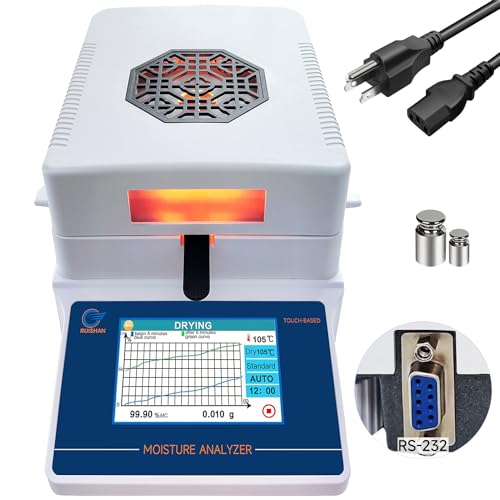
- 120 g capacity with 0.001 g resolution
- Three drying modes and 32 stored methods
- RS232 connectivity and included accessories
Best For: Versatile laboratory moisture testing across food, grain, wood, and other materials
Established Laboratory Choice
A&D MX-50 Moisture Balance

- 51 g capacity with 0.001 g resolution
- Four heating modes and five programs
- VFD display with progress window
Best For: Controlled bench testing of smaller laboratory samples
Compact Touchscreen Value
100g Halogen Moisture Analyzer
- 100 g capacity with 0.01% readability
- Three drying modes and touchscreen controls
- Stores 32 methods and supports RS232
Best For: Space-conscious labs running repeat food, grain, or wood tests
Durable Routine Tester

- 110 g capacity with 1 mg/0.01% accuracy
- Backlit LCD shows weight and moisture
- Cleanable chamber and bidirectional RS-232
Best For: Frequent laboratory moisture testing with PC or printer data output
Precision Lab Pick
FLB 110g Halogen Moisture Analyzer

- 0.001g readout accuracy and 110g capacity
- 34 programmable methods with three operation modes
- RS232 connectivity and 40°C–180°C heating
Best For: Precision-focused laboratory and production testing
Easy-Use Lab Option
JOANLAB MBA1102A Moisture Analyzer
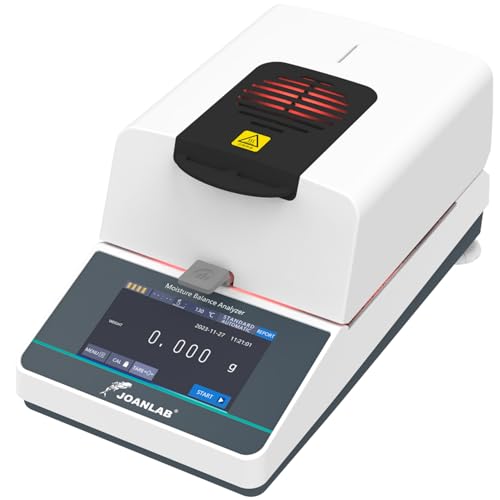
- 110g capacity with halogen heating
- Three drying modes and touchscreen operation
- Stores 20 methods and supports RS232 output
Best For: Routine testing across varied sample types
Data-Tracking Choice
120g Halogen Moisture Analyzer with Database
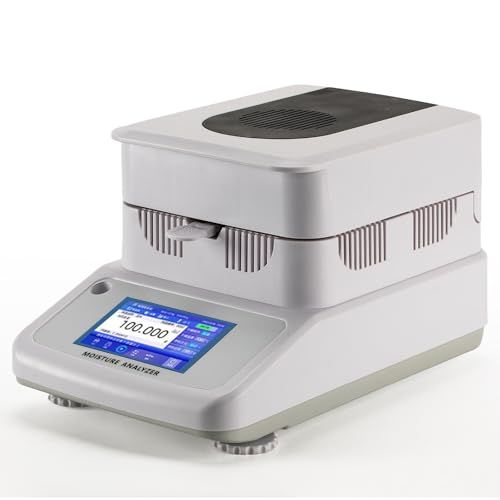
- Stores up to 100 test records internally
- Four drying programs and three operating modes
- 120g capacity with 0.002g readability
Best For: Lab and industrial users managing repeat test records
Precision Touchscreen Pick
U.S. Solid 0.005 g Moisture Analyzer

- 0.005 g readability and 0.05% moisture measurement
- 250 W halogen heating up to 160°C
- 5-inch touchscreen with 20-method storage
Best For: Labs seeking fine readability and touchscreen controls
High-Heat Routine Tester
U.S. Solid 5 mg Halogen Moisture Analyzer
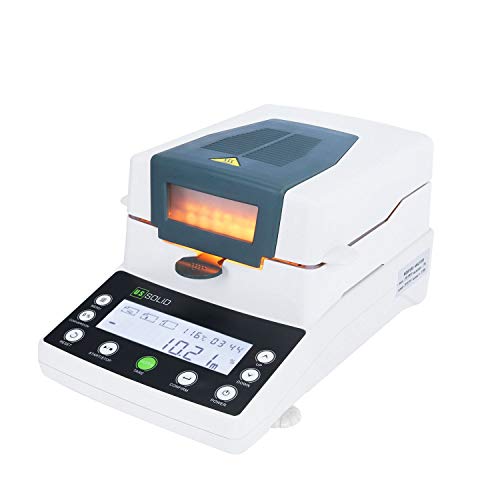
- 5 mg readability with 110 g capacity
- 450 W heating up to 199°C
- 15 preset method groups and RS-232 output
Best For: Routine food, grain, chemical, and lab testing
Maximum Readability Choice
U.S. Solid 1 mg Moisture Analyzer

- 1 mg readability and 0.01% moisture accuracy
- 450 W heating up to 199°C
- 15 methods, three drying modes, and RS-232
Best For: Precision-focused lab, research, food, and industrial testing
Practical High-Capacity Pick – 120g Halogen Moisture Analyzer
For buyers comparing halogen moisture balances, this model combines a 120 g capacity with 0.001 g weighing resolution and 0.01% readability. Its touchscreen controls, selectable drying modes, and broad application list make it a flexible choice for routine laboratory moisture testing.
Best For: Laboratories testing food, grain, wood, soil, paper, textiles, and other materials that benefit from rapid halogen drying.
Pros:
- Offers standard, fast, and soft drying modes plus automatic or timed endpoints.
- Stores up to 32 research methods and supports RS232 data output to a printer or computer.
- Includes calibration weights, sample-handling tools, and 10 disposable aluminum pans.
- Uses a 50–180°C halogen lamp and supports 0–100% moisture measurements.
Cons:
- Its 3.3 kg body is less convenient to move than a compact portable instrument.
- The many settings may be more than needed for occasional, single-method testing.
Choose this analyzer when capacity, method storage, and sample versatility matter more than a minimal setup. The included accessories also make it a practical starting point for a new testing workflow.
Established Laboratory Choice – A&D MX-50 Moisture Balance
The A&D MX-50 is a laboratory-focused option among halogen moisture balances, with a 51 g capacity and 0.001 g resolution. Its four heating modes, measurement programs, self-check functions, and VFD display are suited to repeatable bench testing.
Best For: Laboratory users who want selectable heating control, guided measurements, and a clear display for smaller samples.
Pros:
- Provides four selectable heating modes for greater temperature-control flexibility.
- Includes five selectable measurement programs and self-check functions.
- Uses a vacuum fluorescent display with a progress window for easy monitoring.
- Features a design described as safe and reliable for laboratory use.
Cons:
- The 51 g maximum capacity is lower than several higher-capacity alternatives.
- The supplied details list jewellery as the recommended use, so broader applications are less clearly specified.
- Its 15-pound weight may make relocation inconvenient.
This is a sensible fit for established laboratory routines where display visibility, heating control, and programmed measurements are priorities. It is less compelling if you regularly process larger sample loads.
Compact Touchscreen Value – 100g Halogen Moisture Analyzer
This mini-format analyzer offers a useful balance of capacity and control for buyers shopping halogen moisture balances. It handles up to 100 g, provides 0.01% readability, and pairs a touchscreen with three drying modes and RS232 connectivity.
Best For: Compact laboratory setups testing food, grain, wood, and similar materials with repeatable preset methods.
Pros:
- Three drying modes—standard, fast, and soft—support different sample requirements.
- Stores up to 32 methods for faster repeat testing.
- Offers automatic and timed endpoints through a 5-inch touchscreen.
- Includes calibration weights, sample tools, and 10 aluminum sample pans.
Cons:
- Its 100 g capacity is lower than the 120 g model in this roundup.
- The unit weighs 3.3 kg, so “mini” does not mean highly portable.
- RS232 is provided, but the supplied details do not specify newer wireless connectivity.
Consider this model when a touchscreen workflow and stored methods are more important than maximum capacity. Its broad stated applications and included setup accessories add practical value for routine testing.
Durable Routine Tester – Ohaus MB27 Moisture Analyzer
The Ohaus MB27 is designed for quick, precise moisture measurements and is a strong routine-testing candidate among halogen moisture balances. A backlit LCD, cleanable heating chamber, and durable die-cast metal and ABS housing support frequent laboratory use.
Best For: Laboratories that need repeat moisture testing, easy-to-read results, and straightforward computer or printer connectivity.
Pros:
- Supports measurements up to 110 g with 1 mg/0.01% readout accuracy.
- Backlit LCD displays both weight and moisture readings.
- Its easily cleaned heating chamber can improve productivity during frequent testing.
- Provides a bidirectional RS-232 interface for a PC or printer.
Cons:
- The supplied details do not list multiple drying modes or stored research methods.
- It has a fixed-installation form factor rather than a handheld or mini design.
- No sample pans or calibration weights are specified among the listed details.
The MB27 is a practical choice when durability and repeatable day-to-day operation take priority. Its combination of a cleanable chamber, dual-result display, and RS-232 output suits a structured lab workflow.
Precision Lab Pick – FLB 110g Halogen Moisture Analyzer
For buyers comparing halogen moisture balances, the FLB stands out with 0.001g readout accuracy, a 110g capacity, and a broad 40°C–180°C heating range. Its touchscreen, programmable methods, and RS232 connectivity make it suitable for repeatable lab or production testing.
Best For: Food, agriculture, chemical, and pharmaceutical testing where high weighing precision and flexible drying control matter.
Pros:
- 0.001g readout accuracy with a 110g maximum capacity.
- 34 programmable memory settings reduce repeated setup.
- Manual, automatic, and timed modes, plus gentle and rapid drying options.
- RS232 connectivity and English, Spanish, and German menu support.
Cons:
- Its 11-pound desktop form may be less convenient for mobile use.
- Designed for 110V power, which may limit compatibility in some locations.
The FLB is a strong choice when precise mass readings, stored test programs, and broad sample flexibility take priority. Pre-calibration, CE certification, and the included calibration weights add practical value for routine testing.
Easy-Use Lab Option – JOANLAB MBA1102A Moisture Analyzer
Among halogen moisture balances, the JOANLAB MBA1102A emphasizes straightforward operation and rapid testing. It combines halogen heating, a 5-inch color touchscreen, three drying modes, and stored methods for recurring measurements.
Best For: Laboratories testing granular, powdered, sheet-like, or non-volatile liquid samples across food, agriculture, chemical, and pharmaceutical applications.
Pros:
- 110g capacity with 0.001g weight readability and 0.001% moisture readability.
- Automatic and timing modes with standard, fast, and soft drying.
- Stores up to 20 testing methods for quicker repeat measurements.
- RS232 output supports printers and computers, with two calibration modes.
Cons:
- Its listed heating range tops out at 160°C, narrower than some alternatives.
- The product details contain differing readability figures, so buyers should confirm the intended specification.
The MBA1102A is appealing for teams that value an accessible interface and repeatable workflows. Its one-touch preheating, method storage, and manufacturer-backed one-year warranty support routine laboratory use.
Data-Tracking Choice – 120g Halogen Moisture Analyzer with Database
This halogen moisture balance is a practical fit for laboratories and industrial users who need more than a single test result. It offers 120g capacity, 0.002g weight readability, multiple heating programs, and a built-in database for storing up to 100 records.
Best For: Users who need flexible drying methods and convenient on-device moisture data management.
Pros:
- Built-in database stores up to 100 moisture records.
- Standard, mild, fast, and slow heating programs cover different sample needs.
- 40°C–180°C temperature range with auto-stop, timed, and manual modes.
- Includes calibration weight, sample tray, windproof cover, and touchscreen stylus.
Cons:
- Its 0.002g weight readability is less fine than 0.001g models.
- The supplied notes do not specify a moisture-capacity measurement range.
The HC-152 prioritizes workflow flexibility and record retention over the finest available weighing resolution. Its RS232 interface, selectable drying profiles, and stainless-steel construction make it well suited to organized lab or industrial testing.
Precision Touchscreen Pick – U.S. Solid 0.005 g Moisture Analyzer
For buyers comparing halogen moisture balances, this model combines 0.005 g readability with a touchscreen interface and a 160°C maximum temperature. Its 250 W halogen heater and selectable drying modes make it a practical choice for routine laboratory moisture testing.
Best For: Labs that value fine readability, touchscreen operation, and flexible test-method storage.
Pros:
- Measures up to 110 g with 0.005 g readability and 0.05% moisture measurement.
- Offers standard, fast, and soft drying modes with temperatures up to 160°C.
- Stores up to 20 methods and provides automatic, manual, and timed ending modes.
- Includes RS-232 connectivity and 50 sample pans.
Cons:
- Its 160°C maximum and 250 W heater are lower than those of the higher-temperature models in this roundup.
- Manual calibration requires a 100 g weight.
The color touchscreen and larger method memory are useful workflow advantages, while the lower maximum temperature may matter for applications requiring more aggressive drying.
High-Heat Routine Tester – U.S. Solid 5 mg Halogen Moisture Analyzer
This halogen moisture balance is designed for repeatable testing where higher heat and straightforward controls matter. It handles samples up to 110 g, uses a 450 W halogen heater, and reaches 199°C for food, grain, chemical, and laboratory applications.
Best For: Routine testing that benefits from high-temperature drying, simple method storage, and broad sample compatibility.
Pros:
- Provides 5 mg readability with a 110 g capacity and 0.1% moisture measurement.
- 450 W heating reaches up to 199°C and includes standard, fast, and soft modes.
- Stores up to 15 preset method groups and displays moisture, dry weight, or dry-weight percentage.
- Includes RS-232 output and 50 sample dishes.
Cons:
- Its 5 mg readability is less precise than the 1 mg model in this roundup.
- The LCD display does not offer the touchscreen interface found on the newer touchscreen model.
With strong heating and useful reporting options, this is a balanced choice for general-purpose workflows where 0.1% moisture readability is sufficient.
Maximum Readability Choice – U.S. Solid 1 mg Moisture Analyzer
Among these halogen moisture balances, this model offers the finest stated readability: 1 mg for weight and 0.01% for moisture. Its 450 W heater reaches 199°C, while three drying modes and stored test methods support repeatable lab, research, food, and industrial testing.
Best For: Users who prioritize the finest listed readability for general-purpose moisture analysis.
Pros:
- Offers 1 mg readability and 0.01% moisture accuracy with a 110 g capacity.
- Uses 450 W halogen heating with temperatures up to 199°C.
- Provides standard, fast, and soft drying modes plus automatic, manual, and timed ending modes.
- Stores up to 15 methods and includes RS-232 connectivity with 50 sample pans.
Cons:
- The LCD display is less direct to operate than a touchscreen.
- Method storage is limited to 15 presets, fewer than the touchscreen model’s 20.
This is the strongest fit when measurement granularity is the deciding factor, while its 110 g capacity, high-temperature range, and connectivity keep it practical for varied testing workflows.
How We Picked These Halogen Moisture Balances
We focused on the specifications that most directly affect day-to-day moisture testing: weighing capacity, readability, drying temperature range, heating control, display and menu design, data connectivity, and included accessories. The selection covers compact entry-level units, touchscreen analyzers, and established laboratory models from brands such as A&D and Ohaus.
We also considered whether each balance suits a particular application. A unit with 0.001 g readability may be preferable for demanding laboratory work, while a simpler 0.005 g or 0.01 g instrument can be sufficient for routine production checks. Included sample pans, databases, and RS232 interfaces can also affect total value.
Quick Comparison
Capacity across these models generally falls near 100 to 120 g, which is adequate for many routine samples. Readability varies considerably, from approximately 0.001 g on higher-resolution instruments to 0.005 g or more on simpler options. Moisture readability and accuracy should be evaluated separately from weight readability, since the final percentage result depends on sample consistency, heating behavior, and endpoint settings.
Temperature ranges also differ. Models reaching about 180–199°C offer flexibility for materials needing higher drying temperatures, while lower-temperature operation may be preferable for heat-sensitive samples. Touchscreens and built-in databases can simplify repeated testing, whereas RS232 connectivity is useful when results must be transferred to a computer, printer, or laboratory information system.
Key Buying Factors for Halogen Moisture Balances
Readability and Repeatability
Choose readability based on the smallest moisture difference that matters to your process. More decimal places do not automatically guarantee better results; calibration, sample preparation, and stable operating conditions are equally important.
Capacity and Sample Size
A larger capacity provides flexibility, but the sample must still be spread evenly across the pan for consistent heating. Check the recommended sample mass and pan diameter before buying, especially for bulky materials such as wood or grain.
Heating Control and Methods
Look for adjustable temperature settings, multiple drying modes, and clear endpoint criteria. Step, ramp, timed, and automatic programs can help accommodate different materials and prevent overheating or premature measurement.
Workflow and Data Handling
A touchscreen may make setup faster, while physical controls can be easier to operate with gloves. Built-in method storage, result memory, calibration options, and RS232 connectivity matter most in shared labs or repeat-testing environments.
Accessories and Support
Included dishes and sample-handling tools reduce startup costs. Also verify replacement-pan availability, calibration support, power requirements, warranty coverage, and whether the instrument’s software or documentation fits your facility.
Who Should Buy Which Halogen Moisture Balances?
Choose a high-resolution 0.001 g model when you need fine weight changes and tighter laboratory control. A 0.002 g or 0.005 g analyzer is a sensible middle ground for routine quality assurance. For basic production screening, a 0.01 g readability unit may offer the best value if its temperature control and repeatability meet your requirements.
Touchscreen models with databases are especially useful for teams running multiple standardized methods. Units with RS232 are better suited to connected workflows, while compact, simpler analyzers can be preferable for occasional testing or smaller workspaces. Before ordering, match the balance’s voltage, capacity, temperature range, and reporting features to your actual samples and documentation needs.