The right benchtop power supply gives you stable, adjustable DC power without taking over your workbench. This roundup compares 10 options ranging from compact single-output models to high-current supplies and versatile multi-output units.
Use the buying guide below to match voltage, current, control features, protection, and output style to your projects—whether you are troubleshooting circuits, charging batteries, or building prototypes.
Best 10 Benchtop Power Supplies Picks for 2026
Best Multi-Output Pick
Siglent SPD3303X-E Triple Output
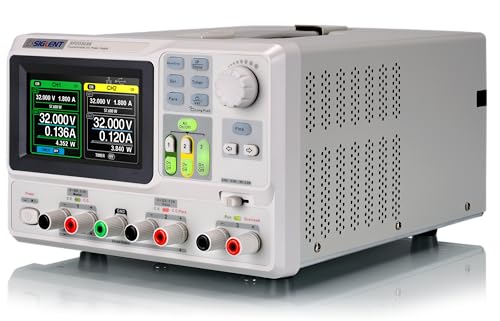
- Three isolated, independently controlled outputs
- Series and parallel modes
- 220W total output with trending graphs
Best For: Labs needing multiple flexible power channels
Best Compact Linear Value

- Adjustable 0–30V and 0–5A output
- Dual four-digit LED displays
- 110/220V input and circuit protection
Best For: General-purpose hobby and small-lab bench work
Best High-Voltage Compact Pick

- 0–60V and 0–8A output range
- 180W single-channel switching design
- Compact body with TFT LCD display
Best For: Portable bench testing requiring higher voltage
Best Feature-Rich Linear Pick

- 0–30V and 0–5A adjustable output
- 0.001V/0.001A display resolution
- Memory presets and safety controls
Best For: Repeatable testing with precise manual control
Compact Charging Station

- 0–32V, 0–10A adjustable output
- 20W USB-A and USB-C charging
- Automatic intelligent battery charging
Best For: Compact electronics benches and battery-charging projects
High-Power Repair Bench

- 0–30V and 0–20A, up to 600W
- Automatic constant-voltage/current modes
- Rear connector required above 5A
Best For: High-current testing, repair, and laboratory applications
Everyday Electronics Workhorse

- 0–32V, 0–10A adjustable output
- Output switch and precise encoder controls
- 20W USB-A and USB-C quick charging
Best For: General electronics projects, repairs, and bench testing
Best Compact 30V/10A Pick
NICE-POWER 30V 10A Variable DC Supply

- 4-digit display shows voltage, current, and power
- Output switch supports safer adjustments
- 5V/2A USB port and compact vertical design
Best For: Compact electronics benches and repair work
Best Versatile Range
Jesverty SPS-6005V 60V 5A Bench Supply

- 0–60V, 0–5A output with 300W maximum power
- Coarse and fine encoder adjustment
- 20W USB-A and USB-C quick charging
Best For: Higher-voltage projects and compact multi-use benches
Best for Repetitive Testing
WANPTEK TPS-C3010 30V 10A Supply

- Three memory presets speed up repeat testing
- 0–30V and 0–10A regulated output
- Output switch, OCP, and key lock add control
Best For: Repair benches and repeatable lab workflows
Best Multi-Output Pick – Siglent SPD3303X-E Triple Output
For benchtop power supplies that can handle several circuits at once, the Siglent SPD3303X-E combines three independent, controlled, and isolated outputs with up to 220W total power. Series and parallel modes add flexibility for more demanding bench setups.
Best For: Labs and workbenches that need multiple isolated outputs and series or parallel operation.
Pros:
- Three independent, controlled, isolated outputs
- Supports independent, series, and parallel output modes
- 220W total output with timing and trending graph functions
- Three-year warranty
Cons:
- Heavier and larger than the compact alternatives, at 17.6 pounds
- Maximum listed output is 32V and 3.2A on two channels
The SPD3303X-E is a strong choice when output flexibility matters more than portability. Its multi-channel design and graphing functions make it particularly useful for organized lab testing and development work.
Best Compact Linear Value – KORAD KD3005D 30V/5A
The KORAD KD3005D is a straightforward option among benchtop power supplies, offering adjustable output up to 30V and 5A. Its dual four-digit LED displays and digital controls make everyday voltage and current adjustments easy to monitor.
Best For: Hobbyists, small labs, and general-purpose bench work needing a 30V/5A linear supply.
Pros:
- Adjustable 0–30V output and up to 5A
- Dual four-digit LED displays
- Switchable 110/220V input
- Overload, short-circuit, and over-temperature protection
Cons:
- Single-output design
- At 9 pounds, it is less portable than the smallest switching models
With its metal enclosure, digital readouts, and built-in protection features, the KD3005D focuses on practical bench functionality. It is a sensible fit for users who want a conventional linear supply without a more complex interface.
Best High-Voltage Compact Pick – UNI-T UDP6721 60V/8A
For benchtop power supplies that prioritize higher voltage and easy portability, the UNI-T UDP6721 provides 0–60V and 0–8A output with 180W of power. Its 2.8-inch TFT LCD keeps voltage and current monitoring clear in a compact package.
Best For: Bench testing and lab work that require up to 60V and 8A in a compact single-channel supply.
Pros:
- Wide 0–60V and 0–8A adjustable output range
- 180W maximum power
- Compact 2.7 kg design
- 2.8-inch TFT LCD display and five-year warranty
Cons:
- Only one output channel
- Switching design may not suit users specifically seeking a linear supply
The UDP6721 stands out for combining a 60V ceiling with a relatively lightweight form factor. It is well suited to users who need more voltage headroom without dedicating much bench space.
Best Feature-Rich Linear Pick – KORAD KA3005D 30V/5A
The KORAD KA3005D adds fine control and convenience features to the familiar 30V/5A linear benchtop power supplies format. Its back-lit four-digit display, memory recall buttons, lock button, and load on/off control support repeatable everyday bench work.
Best For: Hobbyists, small labs, and technicians who value precise adjustments and saved settings.
Pros:
- 0–30V and up to 5A adjustable output
- 0.001V and 0.001A display resolution
- Four memory recall buttons with course and fine adjustment
- Thermal, overload, and short-circuit protection
Cons:
- Single-output design
- Maximum listed power is 150W
- Heavier than the compact UNI-T model at 10 pounds
The KA3005D is a practical upgrade for users who want more control than a basic adjustable supply provides. Memory presets and the load switch are especially useful when repeating tests or changing connections frequently.
Compact Charging Station – Jesverty SPS-3010C
The Jesverty SPS-3010C is a compact option for shoppers comparing benchtop power supplies for electronics work, battery charging, and educational projects. It provides adjustable 0–32V and 0–10A output, encoder-based voltage and current adjustment, and a useful intelligent charging mode.
Best For: Compact workbenches, electronics projects, battery charging, and users who want USB-C quick charging alongside adjustable DC output.
Pros:
- Coarse and fine encoder controls provide 0.01V and 0.001A setting resolution.
- USB-A and USB-C ports support 20W quick charging.
- Intelligent battery charging can stop automatically when the battery is full.
- Compact 2.5-pound design with output switching and multiple protection features.
Cons:
- The included test leads are intended as a giveaway, so higher-current projects may require better leads.
- The 10A output is limited to 320W maximum power.
This model stands out when bench space and charging convenience matter as much as adjustable output. Its charging mode and dual USB ports add versatility for small electronics setups.
High-Power Repair Bench – NICE-POWER 30V 20A
For demanding electronics repair and testing, the NICE-POWER unit offers substantially more current than many benchtop power supplies. Its 0–30V, 0–20A range and 600W rating are paired with an output switch, encoder controls, automatic constant-voltage/constant-current operation, and a four-digit display.
Best For: High-current repair, battery charging, laboratory work, electroplating, lamp testing, and other applications requiring up to 20A.
Pros:
- High-power 0–30V, 0–20A output with a 600W rating.
- Encoder control and 0.01V/0.001A display resolution support precise adjustments.
- Output on/off control lets you change settings without disconnecting the load.
- Includes overvoltage, overcurrent, overheating, and termination protection.
Cons:
- The front panel is suitable only for output currents up to 5A; higher-current output requires the rear high-current connector.
- It uses a 115V ±10%, 60Hz AC input, so input compatibility should be checked before purchase.
This is the strongest choice of the three for current-hungry work, but its rear-terminal requirement above 5A is important. Buyers should plan their wiring around that limitation and verify the input specification.
Everyday Electronics Workhorse – Jesverty SPS-3010V
The Jesverty SPS-3010V is a practical all-around pick among benchtop power supplies, combining 0–32V, 0–10A adjustable output with a compact enclosure and convenient output control. Its encoder coarse and fine knobs make routine voltage and current adjustments easier, while USB-A and USB-C ports can power or charge small devices.
Best For: DIY electronics, Arduino and Raspberry Pi projects, maintenance repairs, teaching labs, and general-purpose bench testing.
Pros:
- Coarse and fine encoder controls offer 0.01V and 0.001A setting resolution.
- Output ON/OFF button allows adjustments without removing the load.
- USB-A and USB-C ports provide 20W quick charging.
- Compact 2.5-pound design includes over-current protection and temperature-regulated cooling.
Cons:
- The included test leads may not be suitable for long-term high-current use.
- The unit is limited to 10A and 320W output.
- AC input and power-cord configurations vary by destination, so buyers should verify the setup.
The SPS-3010V balances useful controls, modest size, and broad project compatibility. It is a sensible everyday choice when 10A is sufficient and you want quick access to both adjustable DC output and USB charging.
Best Compact 30V/10A Pick – NICE-POWER 30V 10A Variable DC Supply
For shoppers comparing benchtop power supplies for electronics work, the NICE-POWER 30V/10A model combines a clear 4-digit readout with a convenient output switch. Its compact vertical design and 5V/2A USB port make it a practical choice when bench space and everyday convenience matter.
Best For: Compact electronics benches, repair work, and projects needing 30V/10A output with USB charging.
Pros:
- Displays voltage, current, and power in real time with 0.01V and 0.001A resolution.
- Output switch allows adjustments without applying power to the connected load.
- Includes 5V/2A USB charging, protection features, and temperature-controlled cooling.
- Lightweight 2.6-pound design with stable rubber feet.
Cons:
- Accepts 110V input only; 220V input is not available.
- Its 30V maximum may be limiting for higher-voltage applications.
The NICE-POWER is a well-rounded option for users who value readable measurements, straightforward controls, and a portable footprint. Confirm that its 110V-only input and 30V ceiling match your setup before buying.
Best Versatile Range – Jesverty SPS-6005V 60V 5A Bench Supply
The Jesverty SPS-6005V stands out among benchtop power supplies for its broad 0–60V range, encoder-based coarse and fine adjustment, and dual fast-charging ports. It is designed to save space while offering useful controls for lab, repair, and DIY electronics work.
Best For: Users who need higher voltage range, precise encoder adjustment, and USB-A/USB-C charging in a compact supply.
Pros:
- Provides adjustable 0–60V and 0–5A output, up to 300W.
- Separate coarse and fine encoder controls simplify precise setting changes.
- USB-A and USB-C ports support 20W quick charging.
- Offers selectable 115V/230V input, output control, over-current protection, and temperature-regulated cooling.
Cons:
- Included test leads are described as giveaways and may not suit extended high-current use.
- It supplies up to 5A, less than some 10A alternatives.
Choose this Jesverty model if voltage flexibility and modern charging ports are more important than maximum current. Its selectable input and compact 2.5-pound form factor also make it adaptable across workspaces.
Best for Repetitive Testing – WANPTEK TPS-C3010 30V 10A Supply
For technicians seeking benchtop power supplies for repeatable repair and testing routines, the WANPTEK TPS-C3010 combines 30V/10A output with three memory presets. Its encoder adjustment, output switch, key lock, and clear display focus on controlled day-to-day bench work.
Best For: Electronics repair, circuit diagnostics, and lab workflows that reuse standard voltage and current settings.
Pros:
- Delivers regulated 0–30V and 0–10A output with up to 300W.
- Three memory presets recall frequently used settings quickly.
- Digit-by-digit encoder adjustment supports precise voltage and current changes.
- Output switch, over-current protection, and key lock help reduce operating mistakes.
Cons:
- The included test leads are not intended for heavy, extended high-current use.
- U.S. users must set the rear 115V/230V switch to 115V before operation.
- The built-in USB port is described for powering small devices, without a specified fast-charge rating.
The WANPTEK is particularly useful when consistent workflows matter: save common settings, lock the controls, and switch output as needed. It is a strong repair-bench choice, provided you use appropriately rated leads for demanding loads.
How We Picked These Benchtop Power Supplies
We selected models across the specifications most important to electronics users: adjustable voltage and current ranges, maximum output power, regulation type, display readability, control layout, protection features, and overall usefulness on a bench. The selection includes linear and switching designs, single- and triple-output supplies, and options for low-current precision work as well as higher-power applications.
Because advertised specifications can vary by operating mode, always confirm the manufacturer’s voltage, current, ripple, accuracy, and thermal limits before purchase. A supply’s maximum rating is not necessarily its ideal continuous operating point.
Quick Comparison
| Best For | What to Prioritize |
|---|---|
| General electronics work | 0–30V output, 3–5A capacity, adjustable current limiting, and clear displays |
| Higher-power projects | At least 10A, adequate cooling, output switching, and over-temperature protection |
| Precision circuits | Low ripple, fine adjustment, stable regulation, and accurate metering |
| Multiple rails | Independent outputs, series/parallel operation, and tracking controls |
| Portable or crowded benches | Compact switching design, front-panel controls, and a readable LCD |
Key Buying Factors for Benchtop Power Supplies
Voltage and Current Range
Choose a voltage range that covers your projects with room to spare. A 30V, 5A supply suits many microcontroller, sensor, audio, and repair tasks. Higher-current 10A or 20A models are better for motors, lighting, battery work, and power electronics, but they may be larger and noisier.
Linear Versus Switching Design
Linear supplies are often favored for low-noise testing and sensitive analog circuits, although they can be heavier and less efficient. Switching supplies generally provide more power in a smaller enclosure and may include convenient USB or USB-C charging outputs. For demanding measurements, check ripple and noise specifications rather than relying on the design label alone.
Controls, Displays, and Presets
Encoder knobs, coarse and fine adjustment, four-digit displays, memory presets, and a separate output switch can make repeated testing faster and safer. A supply with intuitive controls is especially valuable when you frequently change voltage or current limits.
Protection and Usability
Look for over-voltage, over-current, short-circuit, and over-temperature protection. Constant-voltage and constant-current indicators help you understand how the supply is operating. Also consider fan noise, terminal quality, ventilation, warranty support, and whether the unit has enough clearance around its vents.
Who Should Buy Which Benchtop Power Supplies?
For a general-purpose electronics bench, choose a regulated 30V, 5A-class model with fine adjustment and dependable current limiting. Beginners and repair technicians will usually get the best balance of capability and simplicity from this category.
For sensitive analog or measurement work, prioritize a low-ripple linear supply or a model with clearly documented noise performance. If you regularly power several independent rails, a triple-output supply is more useful than buying multiple basic units.
For motors, LEDs, battery charging, and other power-hungry loads, select a higher-current model with robust protection and an output switch. Compact switching units are convenient when bench space matters, while 60V models are the better choice for projects that exceed the usual 30V ceiling.
Finally, USB-equipped supplies are practical for mixed workspaces where you also charge development boards, phones, or accessories. Treat those ports as a convenience feature, however, and verify their output limits separately from the main adjustable supply.