Finding the right moisture analyzer means balancing accuracy, drying speed, sample capacity, temperature control, and ease of use. The best choice depends on whether your laboratory prioritizes high-throughput testing, repeatable research measurements, or straightforward quality control.
We compare 10 moisture balances for laboratories across established brands and value-focused alternatives, highlighting the specifications and features that matter most before you buy.
Best 10 Moisture Balances for Laboratories Picks for 2026
Best Value Rapid Tester
120 g Halogen Moisture Analyzer
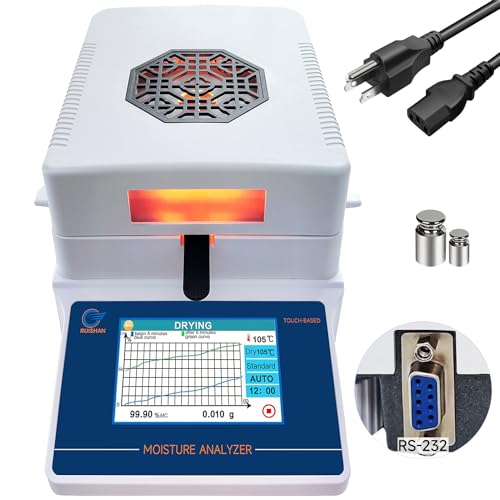
- 0.01% readability with 50–180°C halogen heating
- 32 stored methods and RS232 data output
- Includes pans, calibration weights, and accessories
Best For: Versatile routine testing across food, grain, soil, wood, and textiles
Best Premium Precision

- 1 mg/0.01% measurement capability
- Carbon fiber heating for rapid, consistent drying
- Touchscreen, customizable profiles, and password protection
Best For: Quality-control and production labs emphasizing precision and secure workflows
Best Compact PC-Connected

- 120 g capacity with 0.01% readability
- Four drying profiles and 20 memory locations
- USB interface for PC data analysis
Best For: Space-conscious labs testing powders with computer-based workflows
Best Simple Scientific Option
Sartorius MA35 Moisture Analyzer
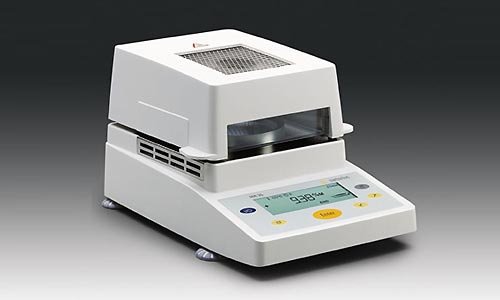
- Designed for laboratory and scientific applications
- Concise digital display with percentage measurement
- Balance-scale format from Sartorius
Best For: Labs wanting a straightforward moisture analyzer for scientific work
Fast-Drying Lab Workhorse
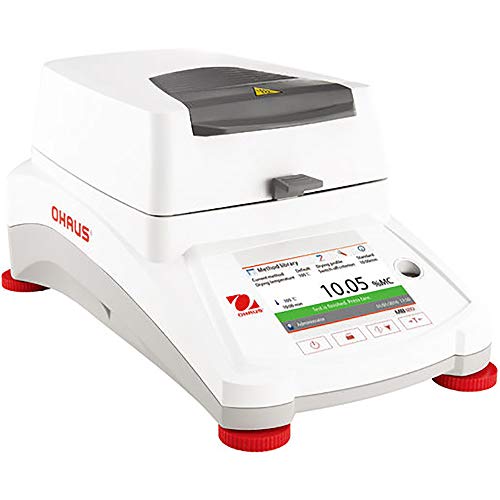
- 120 g maximum capacity
- Halogen heating for quick drying
- LCD touchscreen with SmartGuide™
Best For: Routine food, produce, package, herb, and small-part testing
Versatile Temperature-Controlled Analyzer
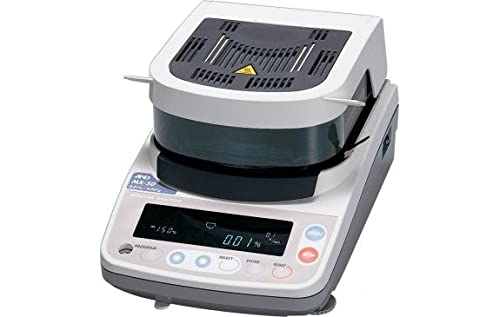
- Process-temperature functionality
- Readout accuracy from 0.1% to 0.001%
- Stainless steel construction
Best For: Multi-application testing across food, herbs, powders, and pharmaceuticals
Compact Precision Tester

- 90 g capacity
- 1 mg readability
- Compact 5 x 4 x 3-inch listing
Best For: Space-limited labs prioritizing fine readability
Fast-Drying Workhorse
GS110 Halogen Moisture Analyzer

- Rapid halogen heating with automatic weight monitoring
- 40–160°C range and broad sample compatibility
- Stores 20 results and supports printer output
Best For: Routine food, plant, chemical, soil, and materials testing
Precision Laboratory Pick
Fristaden Lab Moisture Analyzer

- 0.001g readability and 0.01% moisture resolution
- HBM load cell designed for stable measurements
- RS-232 connectivity and programmable method storage
Best For: Research and regulated-style loss-on-drying workflows
Versatile Method Tester
U.S. Solid Halogen Moisture Analyzer
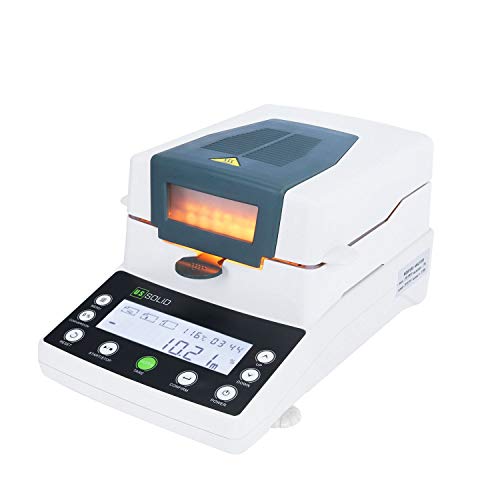
- 40–199°C range with three drying modes
- Stores 15 methods and offers three result displays
- Includes RS-232 and 50 sample pans
Best For: Mixed-material labs running repeated food, grain, and chemical tests
Best Value Rapid Tester – 120 g Halogen Moisture Analyzer
For laboratories needing practical moisture balances for laboratories, this analyzer combines a 120 g capacity with 0.01% readability, halogen drying from 50–180°C, and a touchscreen interface. Its stored methods, multiple drying modes, and RS232 connectivity make it a flexible option for routine testing across materials such as food, grain, soil, wood, and textiles.
Best For: Labs seeking an accessible, versatile moisture analyzer for varied sample types and rapid routine measurements.
Pros:
- Offers standard, fast, and soft drying modes plus automatic or timed shutoff.
- Stores up to 32 research methods for repeatable workflows.
- Includes RS232 connectivity, calibration weights, and disposable sample pans.
- Uses a halogen lamp and supports moisture measurement from 0–100%.
Cons:
- The supplied specifications list readability and readout accuracy differently, so buyers should confirm the exact display resolution.
- Its 3.3 kg form may be less convenient for frequent relocation than a smaller compact unit.
This is a feature-rich choice for general-purpose laboratory work, especially when method storage and broad application coverage matter more than premium-brand positioning.
Best Premium Precision – Ohaus MB92 Moisture Analyzer
The Ohaus MB92 is designed for laboratories that prioritize precision, efficient drying, and controlled workflows. Its 90 g capacity, 1 mg/0.01% measurement capability, carbon fiber heating, and full-color capacitive touchscreen make it a strong candidate for quality-control and production environments.
Best For: Professional labs needing high-precision moisture results, configurable test profiles, and protected data handling.
Pros:
- Delivers measurements up to 1 mg or 0.01% according to the supplied specifications.
- Carbon fiber heating is intended to provide rapid, consistent drying.
- Full-color capacitive touchscreen supports easier navigation and data entry.
- Allows customizable drying profiles, shutoff criteria, and password protection.
Cons:
- Its 90 g capacity is lower than some 120 g alternatives.
- The supplied notes do not specify connectivity options or included accessories.
Choose the MB92 when precision, repeatable setup, and data security are central requirements. It is less compelling if you need the largest sample capacity or clearly documented PC connectivity.
Best Compact PC-Connected – ATS120 Moisture Analyzer
The ATS120 is a practical pick among moisture balances for laboratories where bench space and computer-based analysis are important. It provides 0.01% readability, a 120 g capacity, drying up to 160°C, four drying profiles, and a USB interface for collecting and analyzing data on a PC.
Best For: Compact laboratory setups that need repeatable custom methods and USB-based data review.
Pros:
- Offers four profiles: Standard, Slow, Step, and Fast.
- Stores 20 custom parameter sets to reduce reconfiguration.
- Compact design suits space-conscious workbenches.
- USB connectivity supports PC data collection, plotting, and analysis.
Cons:
- Its maximum drying temperature is 160°C, lower than some 180°C models.
- The supplied notes specifically recommend it for powder, so broader material suitability is less documented.
This model stands out for streamlined data handling and a small footprint. It is a sensible choice for powder-focused applications and laboratories that want to move results into PC workflows.
Best Simple Scientific Option – Sartorius MA35 Moisture Analyzer
The Sartorius MA35 is a straightforward option for laboratories looking for established scientific equipment with a concise digital display. The supplied information identifies it as a moisture analyzer for laboratory and scientific applications, with percentage measurement and a balance-scale format.
Best For: Laboratory users who prefer a simple, focused moisture analyzer from Sartorius for scientific applications.
Pros:
- Designed for laboratory and scientific applications.
- Uses a concise digital display for a focused interface.
- Measures moisture as a percentage.
- Sartorius branding may appeal to users seeking established laboratory equipment.
Cons:
- The supplied notes do not provide capacity, heating temperature, drying modes, or connectivity details.
- Its listed 20-pound weight may make it less convenient to move between work areas.
- Performance specifications are described only generally as “high” readout accuracy.
The MA35 is worth considering when a simple Sartorius laboratory instrument fits your workflow. However, buyers needing detailed method control or clearly stated performance specifications should compare the available documentation carefully.
Fast-Drying Lab Workhorse – Ohaus MB120
For laboratories looking for moisture balances that can handle routine sample testing, the Ohaus MB120 combines a 120 g capacity with efficient halogen heating. Its touchscreen operation and compact design make it practical when throughput and straightforward operation matter.
Best For: Labs testing food, herbs, produce, packages, or small hardware samples that need quick, repeatable moisture measurements.
Pros:
- 120 g maximum capacity
- Halogen heating technology is designed to dry samples quickly
- LCD touchscreen with SmartGuide™ support
- Compact construction with a 12-pound item weight
Cons:
- No warranty is listed in the supplied details
- Its stated readout accuracy is 0.01%, which may not suit applications requiring finer resolution
The MB120 is a sensible choice when a lab values efficient drying, broad sample flexibility, and simple controls in a durable, compact balance.
Versatile Temperature-Controlled Analyzer – A&D MX50 Moisture Analyzer
The A&D MX50 is a practical option for laboratories comparing moisture balances for food, herbs, powders, and pharmaceutical-related samples. It includes process-temperature functionality and supports readout accuracy from 0.1% to 0.001%, helping users match the instrument to different testing needs.
Best For: Labs needing a versatile analyzer for food, herbs, baby powder, animal-related samples, or pharmaceutical applications.
Pros:
- Supports process-temperature settings
- Listed readout accuracy ranges from 0.1% to 0.001%
- Stainless steel construction
- Designed for multiple sample categories
Cons:
- The supplied details do not state the sample capacity
- The listing describes it as handheld but also identifies it as a counter scale
- International buyers are responsible for customs clearance, duties, and taxes
The MX50 stands out for its temperature-related features and broad stated application range, though buyers should confirm capacity and configuration before purchasing.
Compact Precision Tester – OHAUS MB27 Moisture Analyzer
When comparing moisture balances for laboratories with limited bench space, the OHAUS MB27 offers a compact 90 g-capacity design with 1 mg readability. Its small listed dimensions make it worth considering for focused testing where precise readability is a priority.
Best For: Compact laboratory setups that need 1 mg readability for samples within a 90 g capacity.
Pros:
- 90 g sample capacity
- 1 mg readability
- Compact listed dimensions of 5 x 4 x 3 inches
Cons:
- Lower capacity than the 120 g MB120
- The supplied details do not specify heating technology, display type, or application range
- The listed item weight is only 0.3 ounces, so buyers may want to verify the shipping or product specification
The MB27 is best evaluated as a space-conscious precision option, particularly when its 90 g capacity covers the laboratory’s typical samples.
Fast-Drying Workhorse – GS110 Halogen Moisture Analyzer
For laboratories seeking practical moisture balances for laboratories, the GS110 combines halogen heating with real-time weight monitoring to shorten testing compared with traditional oven drying. Its adjustable 40–160°C range and broad sample compatibility make it a flexible option for routine moisture determination.
Best For: Labs and production environments testing food, plants, grains, minerals, chemicals, soil, wood, paper, and textiles.
Pros:
- Rapid halogen heating and automatic measurement can deliver results in minutes.
- Temperature is adjustable from 40–160°C in 1°C increments, with 1–99 minute heating settings.
- Stores up to 20 historical results and includes a printer interface for recordkeeping.
- Includes 20 aluminum weighing pans and a 100g calibration weight.
Cons:
- Its 5mg readout is less fine than the 0.001g readability offered by some laboratory analyzers.
- The drying range tops out at 160°C, below some competing models.
The GS110 is a sensible choice when faster results, straightforward operation, and basic data storage matter more than the finest available readability or the highest drying temperature.
Precision Laboratory Pick – Fristaden Lab Moisture Analyzer
The Fristaden Lab analyzer is designed for buyers comparing moisture balances for laboratories that need fine readability and repeatable loss-on-drying results. Its 0.001g readability, 0.01% moisture resolution, HBM load cell, and programmable methods support more controlled routine testing.
Best For: Food, pharmaceutical, agricultural, and research laboratories requiring precise, repeatable moisture analysis and documented workflows.
Pros:
- Provides 0.001g readability and 0.01% moisture resolution for detailed measurements.
- Uses a German-engineered HBM load cell for stability and long-term durability.
- Halogen drying supports efficient testing across several laboratory applications.
- RS-232 connectivity and method storage support PC or printer records and repeat testing.
Cons:
- Its 110g capacity may be limiting for larger sample loads.
- The supplied notes do not specify the analyzer’s drying-temperature range or included sample pans.
Choose this model when measurement resolution, sensor stability, and connectivity for laboratory records are higher priorities than a larger capacity or more fully specified accessory package.
Versatile Method Tester – U.S. Solid Halogen Moisture Analyzer
For labs comparing moisture balances for laboratories across different materials, this U.S. Solid model offers a 110g capacity, 40–199°C drying range, and three heating modes. Its method storage, multiple result displays, RS-232 port, and 50 included sample pans make it well suited to repeated testing.
Best For: Food, grain, pharmaceutical, chemical, plastic, and textile testing where flexible drying methods and convenient sample handling are useful.
Pros:
- Measures to 5mg and offers 0.1% moisture readability while drying and weighing simultaneously.
- 450W halogen heating reaches up to 199°C and includes standard, fast, and soft modes.
- Stores up to 15 preset method groups for repeatable testing.
- Displays moisture percentage, dry weight, or dry-weight percentage and includes RS-232 output.
Cons:
- Its 0.1% moisture readability is less precise than the Fristaden model’s 0.01% resolution.
- Calibration is manual rather than described as automatic.
This is a strong practical option for mixed-material labs that value a high drying ceiling, selectable heating modes, method recall, and a generous supply of sample pans.
How We Picked the Best Moisture Balances for Laboratories
We evaluated these moisture analyzers using the specifications most relevant to laboratory and quality-control work: weighing capacity, readability, heating range, drying control, display design, connectivity, operating simplicity, and overall suitability for repeated measurements. We also considered whether each unit is better suited to basic screening, routine production testing, or more demanding analytical workflows.
Because sample types vary widely, no single analyzer is ideal for every laboratory. A system with 0.001 g readability may be preferable for precision-focused testing, while a simpler 0.005 g or 0.01% system can be more practical for quick moisture checks.
Quick Comparison
| What to Compare | Why It Matters |
|---|---|
| Capacity | Determines the maximum sample mass the balance can accommodate; common options in this roundup range from about 90 g to 120 g. |
| Readability | Indicates the smallest weight increment the instrument displays. Higher resolution can improve repeatability but may require better sample handling. |
| Heating range | A wider range supports more materials and drying methods, provided the sample can tolerate the selected temperature. |
| Drying modes | Automatic, timed, stepped, or rapid programs can make results more consistent across operators and materials. |
| Connectivity | USB or other data-output options simplify recordkeeping, result transfer, and integration with laboratory workflows. |
Key Buying Factors for Moisture Balances for Laboratories
Accuracy, Readability, and Repeatability
Readability is not the same as total measurement accuracy. Look for a balance whose resolution matches your method, then check calibration options, repeatability data, and recommended sample size. A very fine display is useful only when the test environment and sample preparation support it.
Heating Performance and Method Control
Halogen heating can shorten drying cycles, but speed should not replace method validation. Choose adjustable temperature control and drying profiles that suit your materials. Automatic endpoint detection is useful for routine work, while timed or stepped programs can provide better control for complex samples.
Capacity and Sample Handling
Consider typical sample mass, container size, and how easily operators can load and remove samples. A larger capacity provides flexibility, but the balance should still offer stable readings with the smaller samples used in your standard method.
Workflow and Documentation
Backlit displays, intuitive menus, stored methods, and USB connectivity can reduce training time and transcription errors. If results must be audited or transferred to a LIMS, confirm the analyzer’s data-export and reporting capabilities before purchase.
Who Should Buy Which Moisture Balances for Laboratories?
Choose a high-resolution 0.001 g model when your laboratory needs finer weight tracking, method development, or more demanding repeatability. Established systems from Ohaus, Sartorius, and A&D are strong candidates for laboratories that value brand support, documented workflows, and long-term serviceability.
Compact 90 g analyzers are a practical fit for routine quality control and laboratories with moderate sample sizes. Value-oriented 110 g to 120 g halogen analyzers can suit schools, small production facilities, and general screening when budget and straightforward operation matter most.
Before ordering, verify calibration requirements, pan and disposable-dish availability, service support, electrical compatibility, and whether the stated temperature and readability specifications match your validated testing method.