A 4.3\” LCD Digital Coin Microscope review makes sense if you need a small-screen inspection tool for dates, mint marks, and error checks.
This model is built for close-up coin work, not full-coin display.
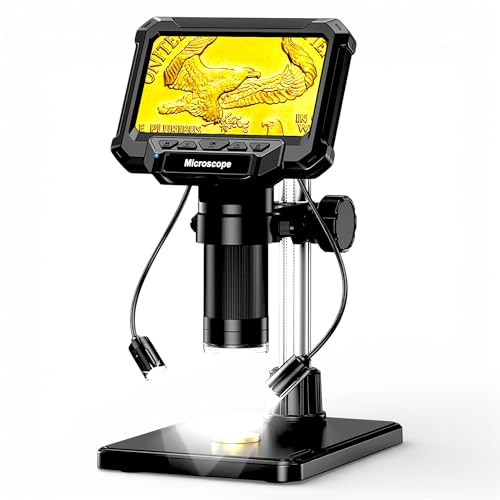
Coin Microscope Review Summary
The 4.3\” LCD Digital Coin Microscope is a specialized inspection device for collectors who care more about microscopic detail than broad, pretty viewing.
If your goal is to study doubled dies, repunched mint marks, scratches, relief, and other small features, this design is aligned with that job.
Its strongest case is simple: the combination of a compact 4.3-inch display, focus adjustment, side lighting, and PC live view makes it a practical bench tool for targeted coin analysis.
It is less compelling if you want an all-purpose microscope that can frame an entire large coin in one view, because the listing explicitly says that is not what it is optimized to do.
Review Scorecard
| Category | Score | Buyer-focused rationale |
|---|---|---|
| Detail inspection | 9/10 | The listing is explicitly aimed at tiny coin features like DDO, RPM, scratches, and error checks. |
| Lighting control | 8/10 | Eight LEDs plus two side lamps should help reveal relief and shadows that ring lights can flatten. |
| Ease of use | 7/10 | The focus wheel and bracket adjustments are straightforward, but proper setup still matters. |
| Documentation | 8/10 | Built-in 1080P video and 10M photos support saving inspection evidence. |
| Computer workflow | 8/10 | USB-C PC live view is useful for larger-screen analysis and cataloging. |
| Versatility | 5/10 | It is clearly tuned to close-up coin sections, not full views of larger coins. |
| Collector fit | 9/10 | Best for hobbyists who inspect specific details more than casual viewers who want a general microscope. |
Key Features and Specifications of Coin Microscope
The 4.3\” LCD Digital Coin Microscope is built around one core use case: examining coin details at close range.
The listing repeatedly emphasizes error attribution, mint mark work, and high-magnification inspection rather than general macro viewing.
Key evidence from the product record:
| Feature | What the listing says | Why it matters |
|---|---|---|
| Display | 4.3-inch screen | Small but direct viewing for bench-top inspection. |
| Lighting | 8 built-in LEDs + 2 detachable auxiliary side lamps | Side light helps expose relief and reduce flat-looking shadows. |
| Capture | 1080P video and 10M photo support | Useful for recording finds and sharing images. |
| Storage | Micro SD/TF card required, not included, up to 32GB | You need your own card before saving media. |
| Connectivity | USB Type-C, PC Camera mode | Lets you use a computer as a larger analysis station. |
| Focus workflow | Height adjustment plus large focus wheel | Gives you two-stage control over sharpness. |
| Intended use | DDO, RPM, scratches, coin sections, and close-ups | Strong signal that this is a detail tool, not a full-display microscope. |
Two practical notes stand out.
First, the listing says it cannot capture the entire view of larger coins like Morgan Dollars or Silver Eagles, so buyers should not expect a full-frame hero shot of every coin.
Second, the Micro SD/TF card is not included, so this is one of those purchases where the core device is only part of the setup.
That is not a flaw if you already know what you are buying.
It is simply a reminder that the value here comes from focused inspection, not from out-of-the-box completeness.
Pros and Cons of Coin Microscope
Pros
- Purpose-built for coin detail work. The listing is unusually specific about doubled dies, repunched mint marks, scratches, and relief features.
- Side lighting is a real advantage. Standard ring light setups can flatten raised detail; the auxiliary lamps are meant to solve that.
- Useful documentation features. Built-in photo and video capture make it easier to preserve evidence of a find.
- Computer integration adds workflow value. PC live view is handy if you want a larger analysis screen or a digital archive.
- Simple enough for bench use. The focus wheel and height adjustments are familiar controls for this type of device.
Cons
- Not for full-coin viewing of large pieces. The listing directly warns that large coins will not fit as a complete view.
- Requires extra storage. The Micro SD/TF card is not included.
- More specialized than casual buyers may need. If you only want an occasional look at coins, this may be more tool than you need.
- Set-up still matters. The product text suggests users may need to adjust height and focus carefully to get a clear image.
For most buyers, the biggest trade-off is not quality versus price.
It is specialization versus flexibility.
This model seems to spend its strengths on the exact kind of inspection coin collectors do when they are looking for tiny evidence on a surface, not on broad all-purpose viewing.
Who Should Buy Coin Microscope?
Buy the 4.3\” LCD Digital Coin Microscope if you regularly inspect coins for mint marks, date detail, scratches, or suspected varieties.
The product description is most convincing for collectors who already know what they want to examine and need a dedicated close-up station to do it.
It also makes sense for people who want a straightforward way to document discoveries.
The combination of photo capture, video capture, and PC live view supports both hobby use and more organized cataloging.
Skip it if you mostly want to admire the full face of larger coins, or if you want a microscope that serves many unrelated tasks.
The listing itself signals that this is optimized for a narrower job, and that narrowness is part of the appeal.
In short, this is a strong fit for detail-oriented coin collectors and a weaker fit for general-purpose casual users.
How Coin Microscope Handles Coin Inspection
Close-Up Detail Checks
For coin attribution, the important question is not whether the device looks impressive.
It is whether it makes tiny surface differences visible enough to study.
The listing points directly at DDO, RPM, scratches, and similar microscopic details, which suggests this microscope is aimed at real inspection work rather than novelty use.
Lighting and Shadow Control
The side lamps are one of the most important features here.
A ring light can be useful, but it often washes out relief and hides the angle of a surface.
Directional side light is better suited to showing raised edges, lines, and other subtle differences that matter when you are deciding whether a coin is ordinary or worth a second look.
Focus, Framing, and Workflow
The focus wheel and bracket height adjustment matter because close-up coin imaging is often about patience, not one-click convenience.
The listing implies that a clear image comes from dialing in the setup rather than expecting instant perfection.
That is normal for this category and actually a good sign for serious use.
PC Live View and Record Keeping
USB-C PC connection adds value if you like a bigger screen for analysis or want to keep organized digital records.
If you are comparing multiple coins, documenting a possible error, or building a collection archive, the larger-screen workflow is more useful than the built-in display alone.
Alternatives to Coin Microscope
If you want a different approach, these Amazon search options are the most sensible comparisons:
- JIusion digital microscope
- Plugable USB microscope
- Celestron digital microscope
- Andonstar microscope
These alternatives are worth comparing if you want a different balance of display size, USB workflow, and accessory ecosystem.
The JIusion and Plugable options are common baseline comparisons for budget-friendly inspection setups, while Celestron and Andonstar are often considered when buyers want more established microscope lines or broader accessory support.
The key question is whether you want a coin-first tool with side lighting emphasis, or a more general digital microscope that can be adapted to several hobbies.
If the latter is your priority, one of the alternatives may fit better.
Is Coin Microscope Worth It?
The 4.3\” LCD Digital Coin Microscope is worth it if you want a focused coin inspection device and you understand its limits.
Its design choices make sense for error hunting, mint mark checks, and detailed documentation, especially because the side lighting and PC view support serious analysis.
It is not the best choice if you want one microscope to do everything, or if you expect a full-frame view of larger coins.
For collectors who value detail over versatility, though, this looks like a practical and well-aimed tool.
If your buying goal is coin attribution and evidence capture, this is a reasonable pick.
If your goal is casual viewing, keep looking.