Pocket Kids Microscope review is about one thing: giving young children an easy way to look closely at real specimens without turning the experience into a complicated lab project.
If you want a kids microscope that is simple, portable, and built around guided curiosity, this one has a clear case.
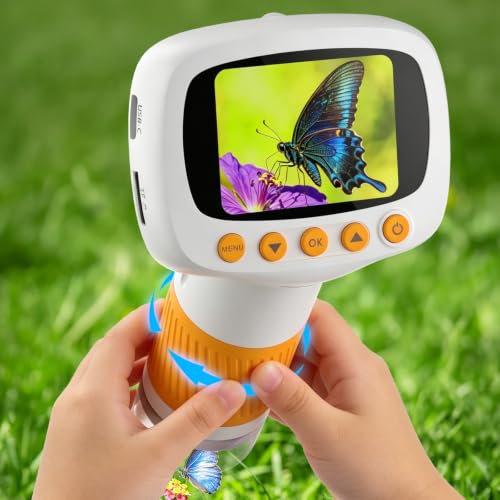
Pocket Kids Microscope Review Summary
The Pocket Kids Microscope is best understood as a beginner-friendly digital microscope for children over 3 years old, with the convenience of a handheld form factor and a built-in screen.
That combination makes it a strong fit for parents who want a first microscope that feels approachable, travel-friendly, and more interactive than a basic optical toy.
What stands out most is how the listing leans into independence and repeated discovery: long-press power, knob focus, screen viewing, photo/video capture, adjustable LEDs, and computer connection.
Those are all practical features for a child who wants to observe insects, leaves, fabric, or other everyday objects without needing constant setup help.
It is more educational tool than novelty gift.
Review Scorecard
| Category | Score | Why it scores this way |
|---|---|---|
| Ease of use | 9/10 | Long-press power, knob focus, and a simple handheld body make it approachable for young kids. |
| Learning value | 8/10 | The screen, capture functions, and computer connection support real observation and sharing. |
| Portability | 9/10 | Palm-sized design and lanyard support make it easy to move between rooms or take outside. |
| Viewing versatility | 8/10 | 50x-1000x range, adjustable LEDs, and real-time display broaden what kids can inspect. |
| Storage and recording | 8/10 | Built-in storage plus TF card support help children save discoveries. |
| Parent-friendly design | 8/10 | USB computer viewing and straightforward controls make supervised use easier. |
| Value for beginner buyers | 8/10 | It bundles several useful learning features into one child-oriented package. |
Key Features and Specifications of Pocket Kids Microscope
The listing positions this as a microscope for kids over 3 years old, with a small handheld body, an anti-lost lanyard, and a 2-inch IPS digital screen.
The intended use case is simple: let children view specimens directly on the device instead of trying to line up their eyes with a traditional eyepiece.
Here are the main evidence-backed details:
| Feature | What it means for buyers |
|---|---|
| Age focus: over 3 years old | Designed for very young beginners, though supervision is still the sensible approach. |
| Magnification: 50x-1000x | Covers a wide range for insects, plant parts, textures, and other everyday samples. |
| Display: 2-inch IPS screen | Makes live viewing easier than squinting through a small eyepiece. |
| Focus controls | Fine and coarse focusing should help kids bring samples into view more quickly. |
| Lighting: 8 LED lights, 6 brightness levels | Useful for indoor samples and dimmer conditions. |
| Photo and video capture | Lets children save discoveries instead of losing them after the moment passes. |
| Storage support | Built-in storage plus TF card expansion are helpful for recording sessions. |
| USB computer connection | Windows and Mac viewing can turn it into a shared learning tool. |
The strongest part of the feature set is not any single specification, but the way the features work together.
A child can hold the device, focus it, adjust lighting, capture an image, and then review it later with a parent.
That workflow is what makes the product more substantial than a toy microscope with one gimmick.
Pros and Cons of Pocket Kids Microscope
Pros
- Very approachable for kids. The screen-based design lowers the barrier to entry compared with a traditional microscope.
- Portable enough for real use. The palm-sized body and lanyard make it easier to carry outside, to school projects, or around the house.
- Useful for observation and sharing. Photo, video, and computer connection features expand the educational value.
- Flexible lighting. The 8 LED lights and 6 brightness levels are practical for changing environments.
- Good range for beginner exploration. The 50x-1000x range should be enough for common kid-friendly discoveries.
Cons
- Small screen limits detail compared with larger displays. A 2-inch screen is portable, but not ideal for extended group viewing.
- Best for supervised beginner use. Children under 3 are not the real audience, despite the broad age wording.
- Not a replacement for a higher-end lab microscope. Serious older students will likely want more optical depth and a larger viewing system.
- Recording features add complexity. Some families may simply want observation, not photo and video management.
The biggest tradeoff is clear: this product is optimized for accessibility, not advanced microscopy.
That is a good trade for the target age group, but it matters if you are buying for an older child who already has stronger science skills.
Who Should Buy Pocket Kids Microscope?
This microscope makes the most sense for parents, grandparents, and gift buyers looking for an easy STEM starter tool.
It fits children who are curious about bugs, leaves, rocks, fabric, or other ordinary objects and need a device that feels immediate rather than technical.
It also suits families who want a shared learning activity.
The USB computer connection and capture features make it easier for an adult to sit beside a child, review specimens together, and talk through what they are seeing.
That parent-child interaction is one of the stronger reasons to buy it.
You should consider skipping it if:
- You want a serious lab microscope for an older student.
- You prefer a larger screen or a more immersive desktop setup.
- You do not need photo/video capture or computer output.
- You are shopping for a child who already understands more advanced microscopy and may outgrow a beginner model quickly.
In short, this is a better fit for first-time young explorers than for hobbyists or science students who need precision and expandability.
How the Pocket Kids Microscope Works for Young Explorers
Screen-First Viewing
The 2-inch IPS screen is the defining part of the experience.
For small children, that matters because the device can be used like a mini portable viewer rather than a traditional microscope with a strict eye position.
The result should be less frustration and more immediate discovery.
Lighting and Focus Control
The adjustable LED ring and the fine/coarse focus setup are the practical strengths behind the learning experience.
Lighting is often what makes or breaks a beginner microscope session, and the ability to dial in brightness should help with both indoor experiments and outdoor finds.
Capture and Storage
Photo, video, built-in storage, and TF card expansion give the microscope a simple documentation layer.
That is useful when a child wants to compare specimens later or show a parent what they found.
It also reinforces the educational side by turning observations into something saved, revisited, and discussed.
Shared Learning on a Computer
The Windows and Mac connection support makes this more than a solo toy.
If a parent wants to sit with a child and view the image on a larger screen, the product can become part of a guided science session instead of just a handheld gadget.
Alternatives to Pocket Kids Microscope
If you want to compare this against other kid-friendly microscopes, these are sensible Amazon search starting points:
- National Geographic Kids Microscope
- AmScope Kids Microscope
- Bresser Junior Microscope
- LeapFrog Magic Adventures Microscope
National Geographic and AmScope are common comparison points if you want a more established educational brand or a different balance of toy-like simplicity and actual learning utility.
Bresser Junior is worth checking if you want another child-focused starter option, while LeapFrog is a logical alternative if you want a more playful, interactive format.
The Pocket Kids Microscope is competitive when your priority is portability, screen viewing, and easy recording.
Some alternatives may offer a different learning style, but this one keeps the interface straightforward enough for younger children to use with less friction.
Is Pocket Kids Microscope Worth It?
For the right buyer, yes.
The Pocket Kids Microscope is worth considering if you want a beginner digital microscope that is easy for children to handle, simple to operate, and useful for real-world observation.
It is especially appealing for families who value screen-based viewing, shared parent-child science time, and a portable design that can move from the backyard to the kitchen table.
The feature set is well matched to young beginners, and the capture plus computer-viewing options give it more staying power than a bare-bones toy.
If you are buying for an older student or expecting advanced microscopy performance, look elsewhere.
But if your goal is a first microscope that makes curiosity easy, this is a sensible buy.