Clean indoor air is easier to manage when you can see what is happening in real time. The best Wi-Fi air quality monitors help you track CO2, PM2.5, VOCs, temperature, and humidity from your phone.
Whether you want a simple alert system or a more advanced smart-home setup, this roundup highlights practical options for better everyday air awareness.
Best 10 Wifi Air Quality Monitors Picks for 2026
Alexa-Connected Home Monitoring
Amazon Smart Air Quality Monitor

- Tracks PM2.5, VOCs, CO, humidity, and temperature
- Works with Alexa alerts, scores, and routines
- Quick plug-in setup in the Alexa app
Best For: Alexa users who want straightforward indoor air monitoring plus automation
Portable Multi-Sensor Tracking

- 8-in-1 monitoring includes CO2, PM sizes, TVOC, and HCHO
- 90-day history with app data export
- Rechargeable with up to 6 hours of portable use
Best For: Users who want deeper air-quality data and trend tracking for home, office, or classroom use
Fast-Refresh Basics
GoveeLife Smart Air Quality Monitor

- Measures PM2.5, temperature, and humidity
- 2-second refresh with Wi-Fi/Bluetooth app access
- Works with compatible GoveeLife automation
Best For: People who want fast, simple monitoring with smart-home control for compatible GoveeLife gear
Alert-Driven IAQ Tracking
AcuRite Wi-Fi Indoor Air Quality Monitor

- Measures CO2, PM1.0, PM2.5, PM10, HCHO, and TVOC
- Loud unhealthy-air alerts plus color status meter
- Also tracks temperature and humidity
Best For: Users who want a straightforward multi-pollutant monitor with loud alerts and remote awareness
Premium Whole-Home Monitor
Temtop M100 2nd Gen WiFi Air Quality Monitor
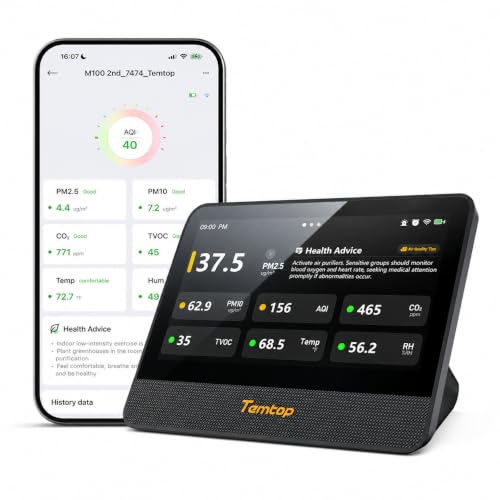
- Tracks PM2.5, PM10, CO2, TVOC, temp, humidity, and AQI
- 2.4 GHz WiFi app alerts plus remote management
- 7-inch touchscreen and optional LoRa expansion
Best For: Large homes, offices, schools, and labs
Smart Home Pick
SONOFF AirGuard CO2 Smart Indoor Monitor
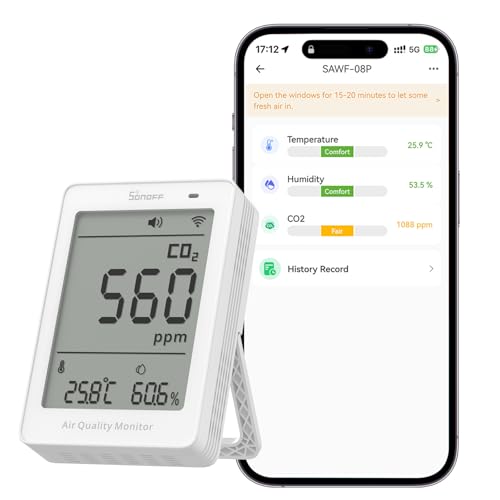
- Matter compatible with major smart home platforms
- NDIR sensor updates every 5 seconds on continuous power
- App alerts plus 12 months of data history
Best For: Smart home users needing a simple CO2-focused monitor
Budget Multi-Sensor Choice
Sacnahe Dual Chip Air Quality Monitor

- Tracks AQI, CO2, PM2.5/PM1.0/PM10, TVOC, and HCHO
- Smart Life and Tuya Smart support with 2.4 GHz WiFi
- Dual-chip design and color LCD with portable battery
Best For: Buyers wanting broad readings and app-based indoor monitoring
Editor Pick
AprilAire 5-in-1 Smart IAQ Monitor
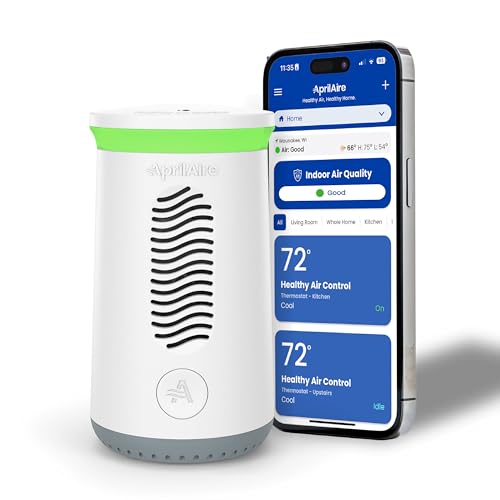
- Tracks CO2, VOCs/TVOCs, PM2.5, humidity, and temperature.
- Simple color status plus app alerts and explanations.
- Can integrate with AprilAire air filtration and ventilation.
Best For: Homeowners wanting broad IAQ monitoring with app guidance
Smart Display

- Tracks CO2, PM2.5, PM10, temperature, and humidity.
- Works with Apple HomeKit and Qingping+ app.
- OLED display and touch bar make on-device checks easy.
Best For: Apple HomeKit users needing a compact air monitor
Large Display
Virtue Sensor WiFi Air Quality Monitor

- NDIR sensor measures CO2 with high anti-interference.
- Large 10-inch screen with auto-brightness adjustment.
- App remote monitoring plus desktop or wall mounting.
Best For: People who want a large-screen CO2 monitor for indoor spaces
Alexa-Connected Home Monitoring – Amazon Smart Air Quality Monitor
If you want a simple entry point into wifi air quality monitors, this Amazon Smart Air Quality Monitor focuses on the essentials. It tracks PM2.5, VOCs, carbon monoxide, humidity, and temperature, then turns those readings into an easy air quality score in the Alexa app.
Best For: Alexa users who want straightforward indoor air monitoring plus automation.
Pros:
- Measures five key indoor air factors: PM2.5, VOCs, CO, humidity, and temperature
- Provides color-coded LED status plus app-based air quality scores
- Sends phone notifications and Echo announcements when air quality drops
- Can trigger Alexa Routines for compatible purifiers, fans, and dehumidifiers
Cons:
- Built around Alexa, so it is less flexible outside that ecosystem
- Does not focus on CO2 or formaldehyde readings
Overall, this is a practical pick if you want a plug-in monitor that is easy to set up and can also help automate compatible smart-home devices when conditions change.
Portable Multi-Sensor Tracking – BREATHE Airmonitor Plus Gen 2
For buyers comparing wifi air quality monitors with broader sensing, the BREATHE Airmonitor Plus Gen 2 stands out for its detailed coverage. It measures CO2, PM1, PM2.5, PM10, TVOC, formaldehyde, temperature, and humidity, while the app adds remote readings, alerts, history, and export tools.
Best For: Users who want deeper air-quality data and trend tracking for home, office, or classroom use.
Pros:
- 8-in-1 monitoring covers CO2, particle sizes, TVOC, formaldehyde, temperature, and humidity
- 2.4 GHz Wi-Fi app support with configurable CO2 and PM2.5 alerts
- 90-day app history and data export for longer-term analysis
- Rechargeable design with up to 6 hours of portable use
Cons:
- Portable battery runtime is limited to up to 6 hours
- Requires app use and Wi-Fi for the full remote-monitoring experience
If you want a more complete picture of indoor pollution sources, this model is a strong fit thanks to its broader sensor set and stronger historical data tools.
Fast-Refresh Basics – GoveeLife Smart Air Quality Monitor
This GoveeLife monitor is a focused option for buyers who want a compact wifi air quality monitor for the basics. It measures PM2.5, temperature, and humidity, updates quickly, and adds app-based remote viewing plus automation with compatible GoveeLife devices.
Best For: People who want fast, simple monitoring with smart-home control for compatible GoveeLife gear.
Pros:
- Measures PM2.5, temperature, and humidity with a 2-second refresh
- Wi-Fi and Bluetooth support for remote monitoring and app graphs
- Can automate compatible GoveeLife purifiers, humidifiers, heaters, and fans
- Offers 2-year data storage and export
Cons:
- No built-in battery; must stay powered by Type-C cable
- Only monitors three indoor air metrics
It is a good choice if you mainly care about particulate, temperature, and humidity readings and want a quick-response display that works with other GoveeLife products.
Alert-Driven IAQ Tracking – AcuRite Wi-Fi Indoor Air Quality Monitor
If you want a wifi air quality monitor with broad pollutant coverage and direct alerts, the AcuRite 17012M is built for that job. It measures CO2, PM1.0, PM2.5, PM10, formaldehyde, TVOCs, temperature, and humidity, then adds a simple green, orange, or red status view for quick checks.
Best For: Users who want a straightforward multi-pollutant monitor with loud alerts and remote awareness.
Pros:
- Tracks CO2, particle matter across three sizes, formaldehyde, and TVOCs
- Includes audible unhealthy-air alerts that can be disabled in the app
- Quick-glance green, orange, or red IAQ meter for easy status checks
- Also measures indoor temperature and humidity
Cons:
- Supplied notes emphasize alerting and monitoring more than app-based analytics
- Included accessories are minimal
This is a sensible option if you value broad sensing and visible, audible warnings over extra ecosystem features or advanced trend tools.
Premium Whole-Home Monitor – Temtop M100 2nd Gen WiFi Air Quality Monitor
If you want one of the more feature-rich wifi air quality monitors for serious indoor tracking, the Temtop M100 2nd Gen stands out with a broad sensor set and a large touch display. It monitors PM2.5, PM10, CO2, TVOC, temperature, humidity, and AQI, then presents the data on a 7-inch screen with graphs, max/min values, and even a localized 7-day weather forecast.
Best For: Homes, offices, schools, or labs that need a detailed, multi-room-ready air quality monitor with app access and expansion options.
Pros:
- Tracks 7 key parameters, including PM2.5, PM10, CO2, TVOC, temperature, humidity, and AQI.
- 2.4 GHz WiFi plus Temtop app support for live data, notifications, and remote device management.
- LoRa expansion support can extend coverage across multiple rooms or buildings up to 1000 meters.
- 7-inch touchscreen shows trends, max/min values, and a weather forecast in an easy-to-read layout.
Cons:
- LoRa sub-units are sold separately.
- App connectivity is limited to 2.4 GHz WiFi.
- Battery life is over 8 hours, but it may still need regular charging for mobile use.
Overall, the M100 2nd Gen is built for users who want more than a basic CO2 meter and prefer a fuller indoor air monitoring setup. Its combination of sensors, visualization, and expandability makes it a strong pick for larger or more demanding spaces.
Smart Home Pick – SONOFF AirGuard CO2 Smart Indoor Monitor
The SONOFF AirGuard is a practical choice if you want wifi air quality monitors that fit neatly into a smart home setup. It focuses on CO2, temperature, and humidity, while adding Matter compatibility, 2.4 GHz WiFi, real-time display, and app notifications for easier day-to-day monitoring in bedrooms, offices, or nurseries.
Best For: Smart home users who want a compact CO2 monitor with Matter support and long-term app tracking.
Pros:
- Supports Matter and integrates with Apple Home, Alexa, Google Home, SmartThings, and Home Assistant.
- NDIR sensor provides ±(50ppm + 5%) accuracy and updates every 5 seconds with continuous power.
- Displays CO2, temperature, and humidity on one screen with a multi-color LED indicator.
- eWeLink app offers customizable notifications and 12 months of historical data with export.
Cons:
- Only measures CO2, temperature, and humidity, not particulate or VOC readings.
- Requires continuous power for the 5-second update cycle.
- Designed around 2.4 GHz WiFi, not higher-band wireless setups.
For buyers who prioritize smart home compatibility over advanced multi-pollutant sensing, the AirGuard is well positioned. It keeps the experience simple while still giving you useful alerts, graphs, and long-term records.
Budget Multi-Sensor Choice – Sacnahe Dual Chip Air Quality Monitor
This Sacnahe model is a versatile option among wifi air quality monitors if you want broader indoor coverage without moving to a more specialized system. It tracks AQI, CO2, PM2.5, PM1.0, PM10, TVOC, HCHO, temperature, and humidity, and it connects to Smart Life or Tuya Smart for remote checking and data storage.
Best For: Users who want a broad-feature indoor monitor with app control and a straightforward setup.
Pros:
- Monitors a wide set of readings, including AQI, CO2, PM2.5, PM1.0, PM10, TVOC, HCHO, temperature, and humidity.
- Works with Smart Life and Tuya Smart on 2.4 GHz WiFi for remote monitoring and historical data.
- Dual-chip design separates sensing and display tasks for faster response and stable output.
- HD LCD screen shows color-coded status bars, and the 3000mAh battery supports portable use.
Cons:
- WiFi 6+ routers may require compatibility mode.
- For long-term data recording, it is recommended to keep the device plugged in.
- Battery life is listed at about 7-15 hours, so it is not ideal for all-day unplugged use.
It’s a strong fit for buyers who want a broad readout and app support in one device. The dual-chip approach and detailed sensor list make it appealing for home, office, travel, or temporary indoor monitoring.
Editor Pick – AprilAire 5-in-1 Smart IAQ Monitor
If you want one of the more feature-rich wifi air quality monitors for whole-home awareness, this AprilAire unit tracks CO2, VOCs/TVOCs, PM2.5, humidity, and temperature in real time. It is built for people who want simple at-a-glance status plus app-based detail, alerts, and guidance for what to do next.
Best For: Homeowners who want a connected, app-guided indoor air monitor with broader pollutant coverage.
Pros:
- Measures CO2, VOCs/TVOCs, PM2.5, humidity, and temperature.
- Uses a simple color status system for quick checks.
- Healthy Air App provides alerts, explanations, trends, and tips.
- Can integrate with AprilAire Healthy Air solutions when paired with compatible equipment.
Cons:
- Requires the AprilAire Healthy Air App to function.
- Some integration features need a compatible AprilAire Wi-Fi thermostat sold separately.
- Designed to work within the AprilAire ecosystem for full functionality.
This is a strong pick if you want a monitor that goes beyond basic readings and gives you actionable indoor-air guidance. Its biggest advantage is the mix of multi-sensor coverage, app alerts, and clear status feedback.
Smart Display – Qingping Air Monitor Lite
The Qingping Air Monitor Lite is a compact option among wifi air quality monitors if you want real-time indoor readings with Apple HomeKit support. It monitors CO2, PM2.5, PM10, temperature, and humidity, and the OLED screen makes it easy to check conditions quickly without opening the app.
Best For: Apple HomeKit users who want a small indoor air monitor with a clear local display.
Pros:
- Measures CO2, PM2.5, PM10, temperature, and humidity.
- Compatible with Apple HomeKit and the Qingping+ app.
- Clear OLED display with touch bar controls.
- Readings refresh every second for fast feedback.
Cons:
- Works on 2.4GHz Wi-Fi only.
- Battery life is limited to about 7 hours, so it is best plugged in.
- Not waterproof or dustproof, and long-term use in high humidity is discouraged.
This model makes sense if you value HomeKit integration and a readable on-device display. It is especially practical for users who want quick checks, app history, and automation options in a compact design.
Large Display – Virtue Sensor WiFi Air Quality Monitor
This Virtue Sensor model is a practical choice if you want wifi air quality monitors with a big display and straightforward CO2 tracking. It measures CO2, temperature, and humidity, then sends the data to an app for remote monitoring, alerts, and historical checks.
Best For: Rooms where a large screen and remote CO2 alerts matter more than extra pollutant sensors.
Pros:
- Uses an NDIR infrared sensor for CO2 measurement with strong anti-interference.
- 10-inch HD screen with auto-brightness adjustment.
- Supports app remote monitoring and historical records.
- Can be used on a desktop or mounted on a wall.
Cons:
- Only monitors CO2, temperature, and humidity.
- Needs constant power and has no internal battery.
- Best suited to indoor spaces where a larger unit is acceptable.
If you mainly want a clear, always-visible monitor for CO2 awareness, this one is easy to place and easy to read. The large screen and adjustable alarm features make it a solid fit for busy rooms like offices, bedrooms, or meeting spaces.
How We Picked the Best Wifi Air Quality Monitors
We focused on monitors that offer the most useful indoor readings for everyday buyers, including CO2, PM2.5, VOCs, temperature, and humidity. We also prioritized Wi-Fi connectivity, app support, clear displays, and smart-home compatibility where it adds real value. For this category, reliability and readability matter more than flashy extras.
Quick Comparison: What Matters Most
Some Wifi Air Quality Monitors are built for simple remote alerts, while others function as full-featured dashboards. If you want basic peace of mind, a compact monitor with app notifications may be enough. If you need deeper insight for a bedroom, nursery, office, or workshop, choose a model with multiple sensors and a display that is easy to read at a glance.
Key Buying Factors for Wi-Fi Air Quality Monitors
Sensor Coverage
Match the monitor to your concerns. CO2 is useful for ventilation and occupancy, PM2.5 helps with smoke and fine particles, and VOC tracking is helpful for cleaning products, new furniture, or paint fumes. Temperature and humidity are not the main air-quality metrics, but they help explain comfort and mold risk.
Connectivity and App Features
Look for stable Wi-Fi, straightforward setup, and app alerts that are actually customizable. A good app should make it easy to check trends, not just current readings. If you use a smart home platform, confirm compatibility before buying.
Display and Placement
Some buyers prefer a large screen for constant visibility, while others want a discreet wall-mounted or compact unit. Placement also affects accuracy, so avoid corners, direct sunlight, vents, and kitchens unless the monitor is designed for those environments.
Calibration and Maintenance
Air quality readings are only useful if they stay consistent over time. Check whether the monitor needs calibration, sensor warm-up, or periodic maintenance. This is especially important for CO2 and particulate tracking.
Who Should Buy Which Wifi Air Quality Monitors?
If you want a simple household monitor for alerts and general awareness, choose a user-friendly model with core readings and app notifications. If you are managing a bedroom, nursery, or home office, prioritize quiet operation, clear trends, and strong CO2 tracking. Smart-home users should look for Matter, HomeKit, or other platform support. For buyers who want a more complete environmental picture, premium Wifi Air Quality Monitors with larger displays and broader sensor suites are worth the extra cost.
In short, the best choice depends on whether you value simplicity, smart integration, or deeper air-quality data. Focus on the sensors that match your space, and you will get far more value from your monitor.